You may encounter many defeats, but you must not be defeated.
Maya Angelou
How much longer???
First, I saw the photo… then her face. No, actually, it was her eyes peering out of that face that I noticed first of all. They had a haunted quality.
They were gentle. Soft. Wounded. There was a sadness to her face I immediately recognized and ached for. Then I saw the headline and felt not only the ache but also the outrage on her behalf.
It was a BBC article from 27 March 2024: “Long wait for therapy after step-grandfather’s abuse.”
Starting at age five, her step-grandfather sexually, emotionally, and physically abused her. As she got older, it really ramped up, and she noted that along with the constant sexual abuse, there was a lot of physical abuse.
I immediately identified with those elements of her story, even as some aspects of our paths differed. Where I didn’t get out of my house until 28, she left home at 16. However, that didn’t make it better. Just different.
On the plus side, she was able to start telling others what happened and even reported her abuser to the police in 2016. The following year, he was sentenced to 25 years in prison.
However, her own recovery was hampered by the very limited availability of therapy services. As she noted in the article, help availability depended on where you lived. And even when she could get any kind of help, it was short-lived and inadequate.
In that regard, my experience was different. Even though I started late on my journey to healing, I had been able to find and access therapists as I needed and wanted.
To bring awareness to the lack of needed therapy resources in her area in the UK, that girl, Charlotte Robinson, 26 at the time of that article, waived her right to anonymity. She told the world about her struggles with nightmares, flushing, and constant flashbacks, and the need for medication to sleep.
She shared that in seeking help, she’d been on waiting lists for 18-months in the past, and at the time of the article, she had been waiting 3 years for the specialized trauma therapy she needs.
It is stories like hers that infuriate me and bring out the warrior in me. I’ve always been the sort of person who, even when I wouldn’t fight for myself, was ready to fight for or defend another.
These days, though, I no longer have the kind of energy to wage big battles. But given her story, and no doubt ones very, very similar, THAT is a driving force for my writing.
If I can get a strong enough message out there through my story, maybe it can help anyone who is still waiting?
I keep Charlotte Robinson’s picture above my work area, so I don’t forget her eyes. I only hope she is no longer on a waiting list…
The “people”
I cringe a bit using the word “Tools” when speaking of the lives of others. I don’t mean people as “objects.” It is the power of their stories, I guess, the wisdom I get from them…because those stories motivate and teach me.
When I am weary of writing my story, I read about others who have been abused or treated badly in life, and then I go on. I see so many people who’ve overcome such odds or waged such battles to try that I can’t help but be inspired. So, I guess it is the “stories” that are the tools.
When I started this post, I made a mind map, as I always do. At the center, I put the word “People.” Then, I asked myself: “What people?” and “Why did they draw my attention?”
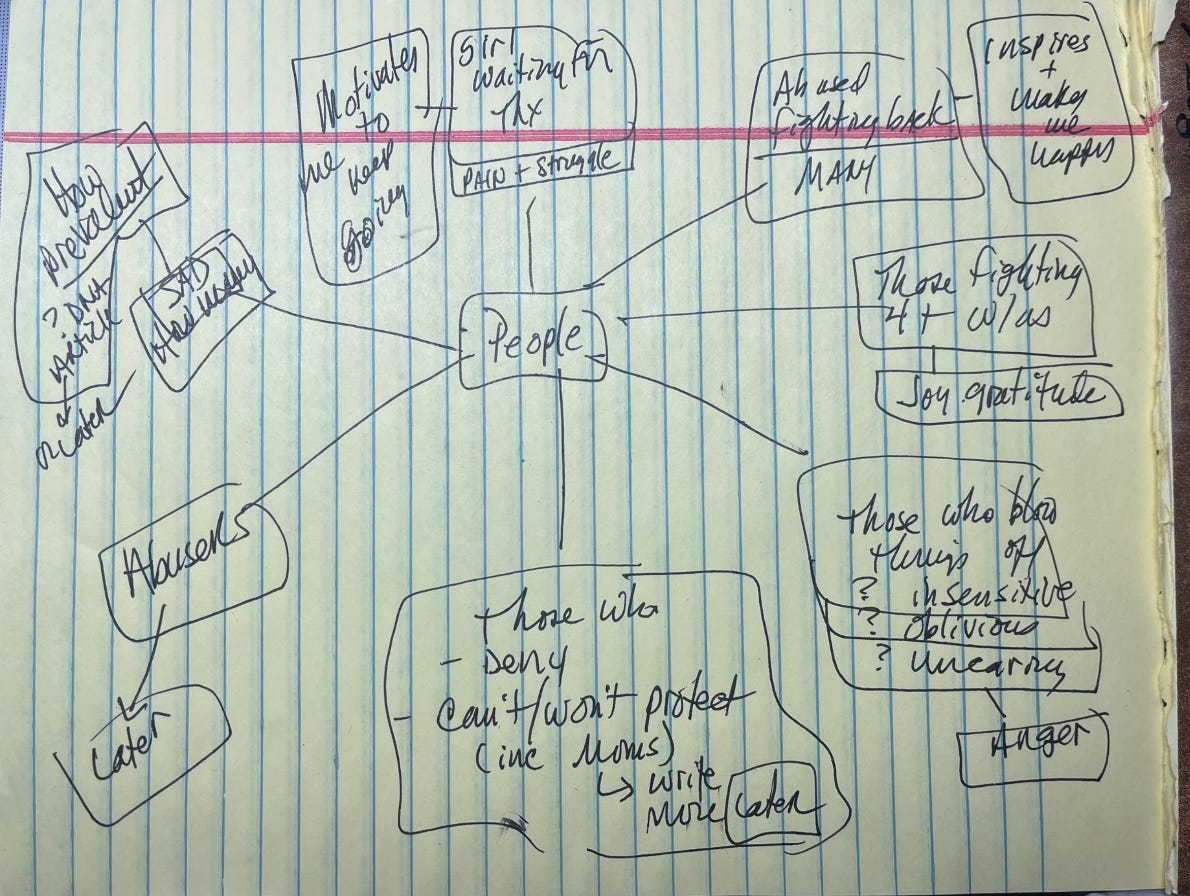
Of course, there was the story above of Charlotte Robinson and the effect her story had on me. I so hurt for her…and wanted to make it all better for her. And I admired her because in spite of all the pain she was in, and all the years of waiting for help she so deserved…she still had FIGHT. She didn’t just give up. But instead, through her actions and stating her name, she was basically telling the world, “Look at this! This is wrong! This needs to be fixed!”
The abused
Then, there were the MANY articles I’d collected over the years on those who’d been abused. Some had suffered deeply, lost their way, and didn’t make it.
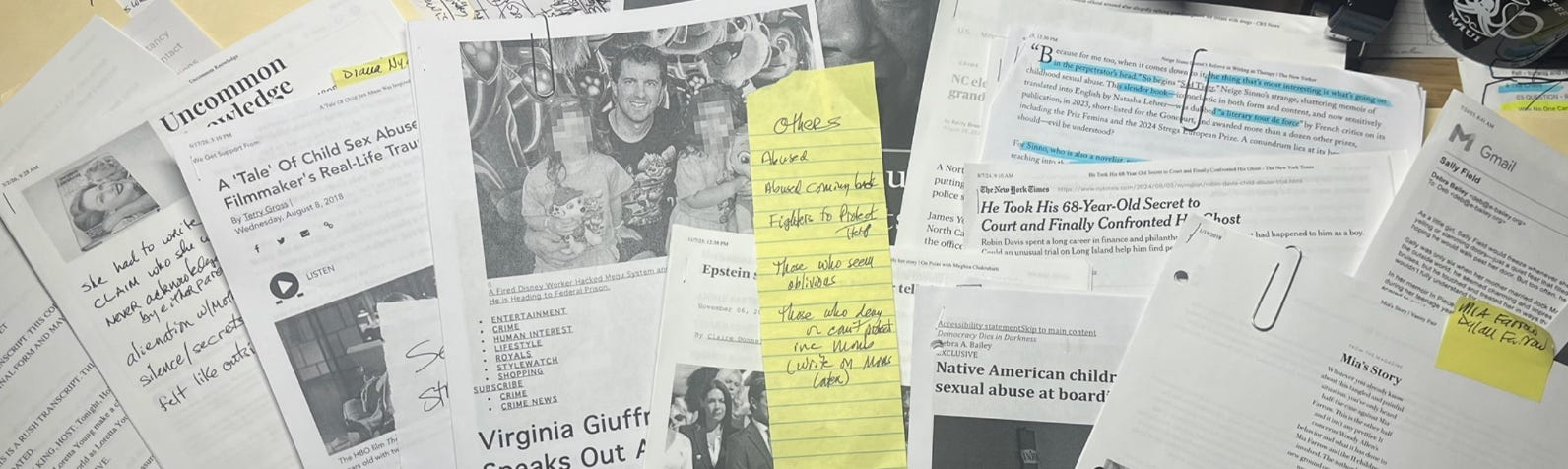
Others became warriors who fought back to bring abusers to justice, or tried to. Anita Hill fought hard against the approval of Clarence Thomas for the Supreme Court, as did Dr. Christine Blasey Ford against Brett Kavanaugh’s nomination to the Supreme Court. Power won out in both cases.
Here is a sampling of the people’s stories in my file folder. They run the gamut from the unknown to the famous:
- Hundreds of Native American children were sexually and emotionally abused for decades in religious boarding schools.
- Author Kate Price was sexually trafficked to truckers near her Pennsylvania home by her father.
- Long-distance swimmer and author Diana Nyad was abused by her high school coach back in the 1960s. She and another girl managed to confront him in front of their school principal and got him fired.
- Olympic gymnast Aly Raisman and dozens of fellow gymnasts confronted Dr Larry Nassar, who was accused of abusing over 200 girls in his care. They later sued USA Gymnastics and the US Olympic Committee for not protecting them.
- Dylan Farrow, daughter of Mia Farrow and Woody Allen, stands unbowed in her accusations of molestation against Allen. She, her mother, Mia Farrow, and her brother, investigative journalist Ronan Farrow, have fought that battle for years.
- Sally Field, molested and terrorized by her stepfather, Jock Mahoney
And it wasn’t just women and girls. Many men were victimized as boys and young men and spent their lives consumed with shame. Or didn’t make it.
Altar boys. Young athletes. At-risk youth….Taken advantage of by priests, church leaders, mentors, coaches, school officials, or teachers, fathers, brothers, grandfathers. People they knew. Trusted. People who held power over them in some fashion.
Even college athletes at Ohio State were vulnerable. Several were molested by a team doctor — a man who held the power of destroying their futures and all they had built for themselves. He had the power to prevent them from competing in their sport or even losing their scholarships.
In one article on that particular situation, the article’s author noted that an assistant wrestling coach there, who later became U.S. Representative Jim Jordan, probably knew about this and did nothing. Like Joe Paterno at Penn State over the Jerry Sandusky abuses.
Why do those who have been abused stay silent? There are many reasons, and I’ll cover them in upcoming posts.
But one I’ll share here is the emotional devastation and destruction that even one sexual assault inflicts on you. That moment the line is crossed, forever changing you.
Once your abuser got you the first time, you were now an outsider…it left you feeling isolated and different from everyone. Defiled. Cut off from the life you lived before.
Something died in you in that moment, and you blamed yourself. Drowning in self-disgust, horror, and shame, you just gave up and let them do whatever because they had already destroyed you. You had no power. You were no longer “clean,” but used goods, dirty. And you had no out…they were always there in your school, environment, club, and escaping them was impossible. Even when you thought you were safe, they found a way.
And even when you spoke up, you PAID for it. French author Neige Sinno, who had been abused by her stepfather throughout childhood, made his crimes public in an effort to protect others, including her younger siblings. Instead, she became a pariah in her hometown.
Some of these stories ended with the suicides of the victims. Or lifelong dysfunction in jobs and marriages. Lifelong outbursts of rage, and addictions.
However, many have fought back to confront abusers in court, including many high-level lawsuits against the Catholic Church for clergy abuse. And there are those who fought back as individuals.
Jennifer Elmore was abused in the 1980s throughout her childhood and teens by her military father. Starting in 2015, she waged a 5-year court battle – first in the military, and then in the Virginia courts, to have her father, Retired Army Major General James Grazioplene, charged with sexual abuse. When the military system claimed a 5-year statute of limitations, Elmore fought to have the case tried in Virginia. In 2020, her father was convicted and reduced in rank to a Lieutenant, among other conditions.
Some have reclaimed their self-worth through advocacy work to help other abuse victims or by personal challenges like running marathons or, in Nyad’s case, swimming from Cuba to Florida. And many, discovering they were not “the only one,” found power through solidarity with other victims, such as with the recent allegations against 1970s activist Cesar Chavez.
That is also the case with women like Virginia Giuffre, Annie Farmer, and many other young women, who spoke out to fight back and demand justice in the Epstein case. It’s a fight that continues, though, unfortunately, despite her intense courage, Giuffre did not survive.
Lastly, many keep fighting, some through their art. Writer Dorothy Allison wrote the novel, Bastard Out of Carolina, about being an abused child in the South. The book was based on her life story. Another novel based on the author’s life surviving domestic violence is Resilience, Breaking the Chains, by Eugene Z. Bertrand, who said, “I wrote it because I am a survivor of domestic violence…Writing became one of my lifelines.”
Documentary filmmaker Jennifer Fox wrote The Tale, a movie starring Laura Dern, about her life experiences being abused in middle school by a teacher and his partner.
And even though it is not the best depiction of confronting incest in families, there was the 1980s TV movie, Something About Amelia. It shattered me the moment I saw it. It blasted away any illusions I had about my family situation being a loving one. Instead, I finally learned that what I lived through had a name – incest and that I wasn’t the only one it happened to. It set off an emotional unraveling in me that got me into therapy.
Even if the sexual abuse is missing, the hurt of being kept “secret” and an outsider is equally destructive. Judy Lewis was the secret daughter of movie stars Clark Gable and Loretta Young. In her memoir, she wrote of the harm done by the fact that her mother never truly embraced her openly, keeping a distance between them to protect her career. Lewis’s parentage was never openly acknowledged by either star, with Young passing Lewis off as her adopted daughter. It is an abandonment that can kill a soul. Yet in Lewis’ case, she managed to stand up for herself, claim her truth, and lead a meaningful life.
The protectors
Another group I cherished reading about was the people who had not been abused themselves, but were fighting to bring abusers to justice and protect future children from them.
I will speak more of them later, but two I’ll mention here were nuns. And I honor them. Sister Sally Butler waged a years-long battle against priests who were abusing boys at the rectory of her parish, and even went so far as to go to the Press at great risk to herself. Another was Sister Maureen Paul Turlish, who risked retaliation from the Church because she was a relentless advocate for victims of sexual abuse.
These are people who had no reason to “stick their necks out” but did, for the love of another. It was the right thing to do, and they wouldn’t back down.
The ones that need a HARD look
But not all of the stories that motivate me are positive.
First – there are, plainly – the abusers. And I will write more of them later.
Another group of people I took a hard look at were those who abdicated any role in protecting or standing up for abused people, or fighting for justice for them.
That includes everyone from former New York Times Op-Ed writer, Bari Weiss, to mothers of the abused, like the Nobel-prize-winning author, Alice Munro…and my own mother. This is a whole different group of women, and I will write about “strong women versus weak women” in a later post.
I would be remiss to leave men out of this group. Again, I’ll write more later. For right here, I will just note the 2018 NPR story about Don Palmerine, who not only witnessed a rape in 1969 as a teenager, but also participated in a sexual assault. Now, decades later, he wants to speak out. As he noted, “I believe it’s time for men to tell the truth about the ways they’ve abused women and what our role has been in creating a culture that tolerates this.”
The unexpected secrets in the “Family Tree”
I appreciate the courage of magazines like The Atlantic and Vanity Fair to confront abuse issues, including incest. And that includes stories on high-profile abuse cases like that of Dylan Farrow versus her father Woody Allen.
In 2013, The Atlantic published an article, “America Has An Incest Problem.” They made it more obvious and less easy to deny in their 2024 article, “DNA Tests are Uncovering the True Prevalence of Incest.” As the subtitle stated: “People are discovering the truth about their biological parents with DNA — and learning that incest is far more common than many think.”
The richness of solidarity
The bottom line in many of these cases is the power of people standing together to confront what has been hidden and ignored for too long. Each person, whether to protect kids, confront or make abusers accountable, share their own story so others can feel embraced, or to find some way to reclaim their personal self-worth, is a hero. Their stories are the true “Hero’s Journey.”
And as for the stories of those who abused, or who failed to be there for an abused child, I will speak more of my thoughts on those as I continue with my writing journey. I have my opinions right now, but I am also evolving as I write. So I will wait until later to see what I feel before sharing.
Note:
I am seeking financial support to complete my memoir, work with an editor, and make a visit to my home state for fact-checking. Your help would mean the world to me as I take this step toward healing and giving voice to my journey.
Please like, comment, and share this post to help spread the word. The link for my fundraiser is on GoFundMe. Thank you for your support.


Leave a Reply