Finally, it is time to get to the point: Writing and the why, how, what, truth, and courage choices of it all.
I’ll start from the “outer edges” of the subject and move to the “heart of the matter.”
The necessary evil that can be a superpower
In my next post, I am going to talk about the ultimate power in writing – that choice of a single, lonely word a writer makes in a given moment to carry the weight of a life.
The choice of a word can mean the difference between sending a flaming spear of meaning directly into your reader’s heart or missing by a mile and watching the spear land in a puddle and dissolve into soggy smoke.
But before I get down to that core decision, I am going to talk about one “auxiliary” power to keep in mind after you choose your words. Grammar.
Please don’t roll your eyes. And before I get started, I am not a grammar expert. Nor do I want to be. For sure, I am not trying to sound literary or impressive. In fact, call this post my “Grammatical disclaimer.”
But I need to say a few things about grammar because it’s a necessary evil. There are few other tools that can take those carefully selected words and supercharge them like they are on steroids. I understand this on a gut level. Just don’t ask me to explain it in highly literal language.
I am “The End User”
We have a joke in our house. My husband is the computer professional, and as such, he is a “power user.” That has been his life’s work.
I, however, have a very “tentative” relationship with technology. As he puts it, “You and technology have issues.” That is because I am an “End user.”
I don’t fully understand all the rules and underpinnings of technology… and I don’t care. I don’t need to know what the computer is doing; I only know I need that technological tool, and I just want it to work when I press the keys.
Suffice it to say, I have the same relationship with grammar.
For the grammarians out there, if I had to describe myself, I’m probably closer to the “descriptive” type than the “prescriptive” one. My understanding is that the latter is about the creation of, and adherence to, strict rules and what is considered proper usage. The descriptive one is about studying and recording how the language is being used, without any judgment on whether that usage is good or bad.
Frankly, I probably need my own category – one much looser than the descriptive type. When I am writing, I sort of “shoot from the hip” to empty my thoughts and emotional intensity on paper before those things slip through my typing fingers. I want not only the right word, but I want them to show up on the page to visually convey what I am feeling in that moment, whether my usage follows any rules or not. I try, but no guarantees.
I see it even if I don’t know what to call it
So I operate intuitively as to what feels “right” for what is bottled up in me. Then, later, I will worry about whether it matches anyone’s convention or not.
This is especially true when it comes to how I am using the words to decode a complex or confusing issue. Not only do I want to come across simply and clearly for my reader, but I need to do it for myself. If I’m confused, my reader doesn’t stand a chance.
So much of this writing for this book has been about taking a boxful of broken, misunderstood pieces and finally assembling them into a clear, unified, understandable whole. When trying to accurately describe a complex set of emotions, I’ll use any tool I think will do the job to best make the point. For complicated things, I like to use a lot of comparisons to more commonly understood things so we can all know what I mean.
In writing, the tools I most use have the lofty name — “Literary Devices.” In particular, I often use things like similes, metaphors, symbols, themes, and symbolism. I don’t intentionally select the specific type; I just write and assemble the words by gut feel in such a way that their meaning feels right and easily understood.
I don’t sit there thinking Now I need to employ a symbol here, and then a metaphor there, followed by a simile. I write, then I look, and realize I have a literary device, even if I’m not sure which one it is.
I do have a general working knowledge of these terms. But I give it 50/50 as to whether, in any given moment, I am correctly calling something a symbol when it should be symbolism, or a metaphor instead of a symbol, or …. Yeah. I recognized it’s a device; bear with me on the rest.
Simple definitions
Just for the record, here’s my very simple working definitions for these devices. Then I’ll share what things I’ve noticed in my writing:
- Simile – Use for simple descriptions to help a reader understand an “unfamiliar” item by comparing it to a known item and using the words “like” or “as if.” “He ate like a horse” tells the reader he ate large quantities.
- Metaphor – This is also a comparison between two seemingly unrelated things, but you leave out as if, or like, and instead describe that the one item IS the other. “Her anger was white-hot fire.”
- Symbol – A concrete object, person, or place is used to represent an abstract concept. “My childhood frogman mask represented all my childhood dreams for my future, and my belief I could reach them.”
- Theme – This represents a key underlying concept or meaning in the story.
- Symbolism – A physical object that carries a deeper meaning and recurs throughout the story.
Examples of my “devices” in this book
In my essays, I have noticed certain descriptions, comparisons, or references that come up again and again. When I see that happening, I pay attention and look closer because, if they keep coming up, they are important. Here are some of them, along with my thoughts about what they mean… and my best guesses as to what “device” they are:
Similes:
- My emotional pain is as if someone speared my hand with a splintered tree shard and left it there.
- The permanence of my PTSD wounds is like someone with a shattered ankle that a surgeon repaired but will never be pristine again.
- With each of my EMDR sessions that I tackled rage, it couldn’t be one giant fix, but just a bit at a time, like chipping off just one small rock from a mountain.
Metaphors:
- The “Old Country” – My grandmother’s description of her home ethnic country that she left behind, a place I mistakenly assumed had no value. I use it here to describe the first part of this book – my life story, which I realize DOES have value. I had to go back there to find out what happened before I could understand how to heal.
- The “Undiscovered Country” – This is my description for the second half of this book. That is about the last several years of therapy as I dove deep for understanding, meaning, and the insights I hadn’t yet discovered.
- Alchemy – In Medieval times, it was a four-stage process to turn lead into gold. I use it as a way to describe the journey in the second half of this book. It is my process to free all my trapped pain and emotions and truly learn what happened and why.
- Underworld/Dark Night of the Soul – In Greek Mythology, it is the journey to the Underworld – the place of the dead; and in the writings of the Medieval mystic, St. John of the Cross, it is the part of a journey filled with darkness, confusion, and despair where a person feels the pain but has no answers yet. I use these to describe the first stage of that alchemical journey I am on right now, where I face all the darkness, confusion, and pain of my life fully, before I start to see clear insights and answers.
- Odyssey – While taken from Greek Mythology’s story of Odysseus’ journey home from the Trojan War, I use it to describe the painful, lifelong path I have been on to recover and find wisdom.
- Crone/sage – In the metaphors of mythology, a crone/sage character is one who has lived through a lot, been through the crucible of many fiery struggles, and has reached a place in life where they begin to recognize their own power and embrace their inner wisdom. I am now in the stage where I am the crone.
- Opening Pandora’s box – In mythology, opening Pandora’s box unleashed all the forces of the world, good and bad. Opening the walled-off world of my trauma was opening me to every possible fury stored in my psyche…as well as my strengths.
- Impasse – This is a situation that cannot be resolved, despite the wishes of both parties, because the differences are too big. This is the place I am in with some of my loved ones. I love them, but I would have to sell myself out to gain their love and acceptance. We are at an impasse because the differences are wide, and the ability to bridge them is inadequate.
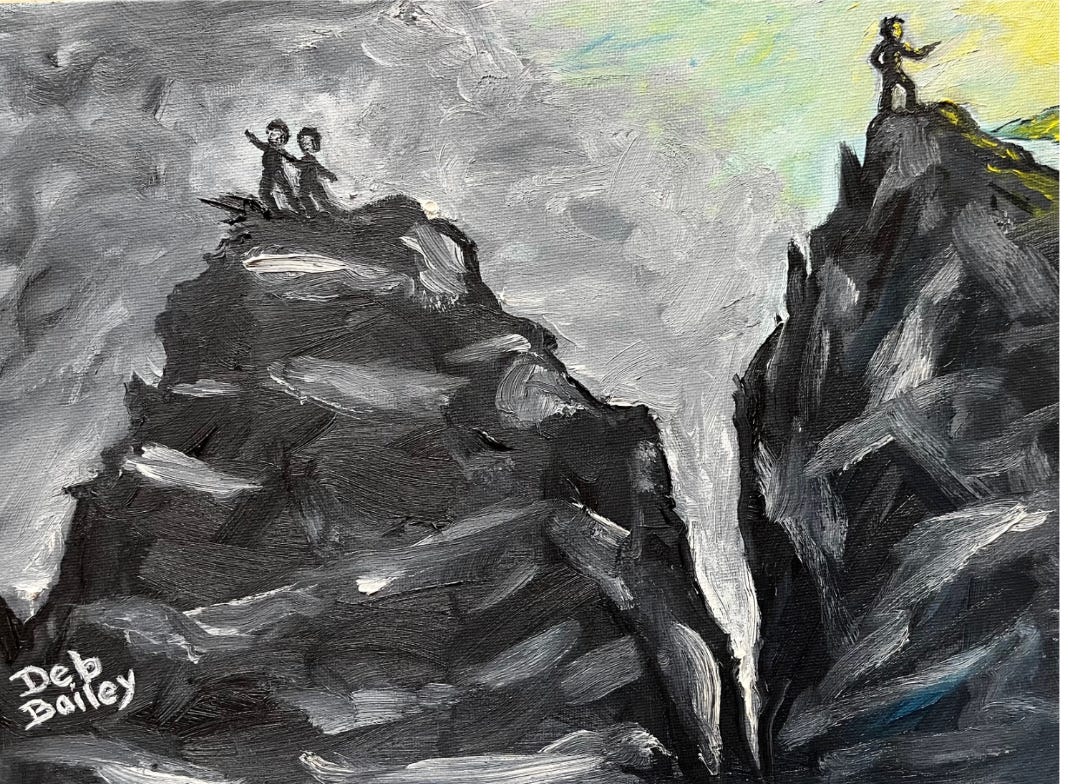
- Painting by author
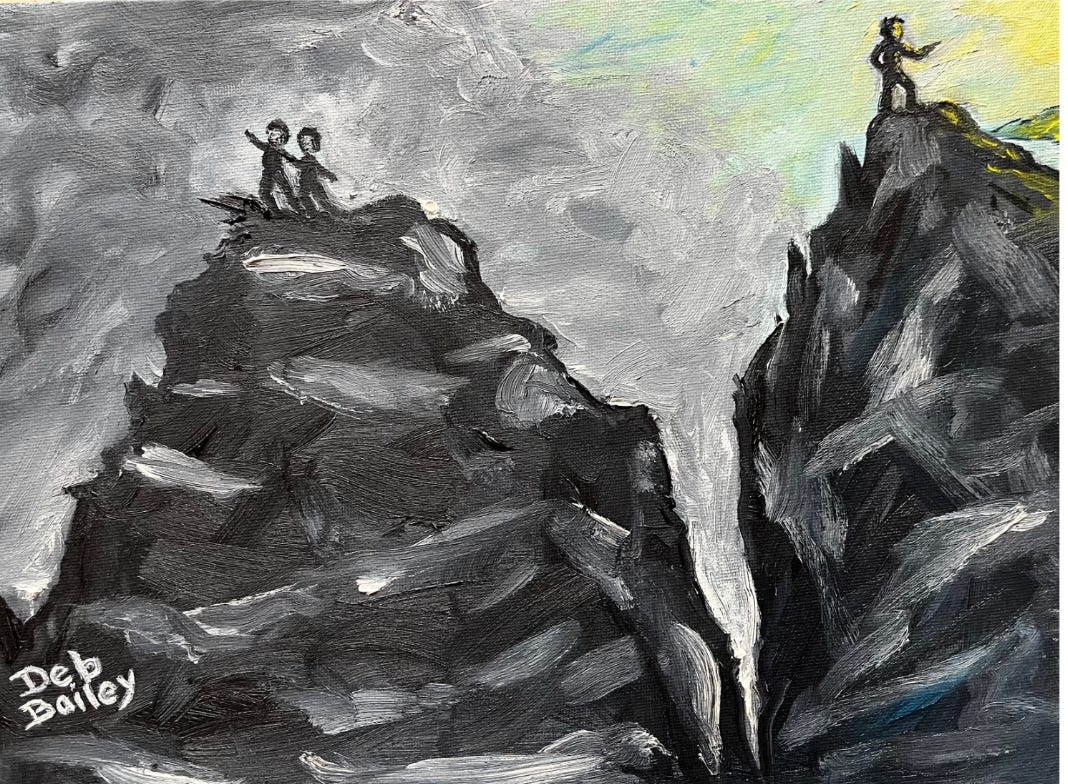
Is this a metaphor or symbol…or both?
- Wrinkled paper – In a previous essay, I described an activity of taking a pristine sheet of paper, crumpling it, then trying to smooth it out completely. The paper will never again be pristine, even when smoothed out. That described the wounds suffered from abuse or racism. You can heal. But those scars will always be there. I feel the paper is a symbol, but it also feels like a metaphor.
- Moments of Respite – These were those moments in between Dad’s abuse, where I would focus on some object, something in nature, a book, anything that could serve as a brief reprieve from stress. I could lose myself in whatever I focused on to remind me there were good things in the world. What category this fits into, I am not sure. But it is such an important element of my survival and comes up often, so I know it’s important.
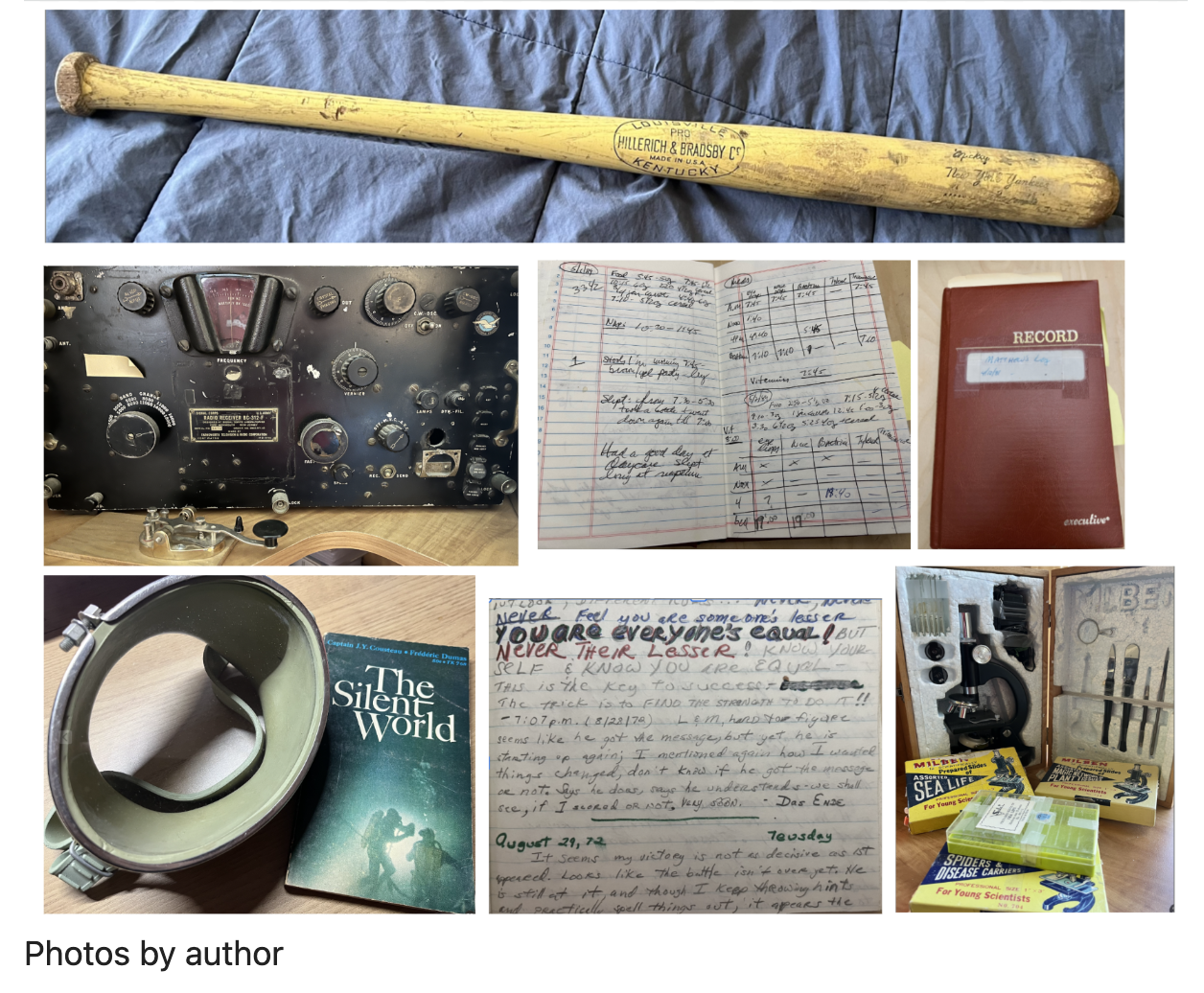
My Talismans – These are probably symbols
- Books have been my friends, protectors, momentary escapes, inspirations, and my means to acquire the tools to escape my house. With a book, I even learned to downhill ski. Give me a book, and I can do “almost” anything.
- My Mickey Mantle baseball bat from 1965 – It held all the energy and fierce tenacity of that young child, and I feel that energy even today when I grip the handle.
- My frogman mask – It stood for my early life dreams and the conviction that I could get them. I still feel that joy today.
- Dad’s ham radio receiver – It represented my awe at all the possible adventures in the world, adventures I wanted for myself. To twist the dials on it today brings that sensation right back.
- Science kits – These spoke to my soul and fed a love of the wonders of science and nature. They represented my future path out of that house.
- Lab manuals and journals – With a lab manual, I solved my infant son’s feeding problems; With my other journals, I cracked open emotional wounds. They gave me power.
Themes
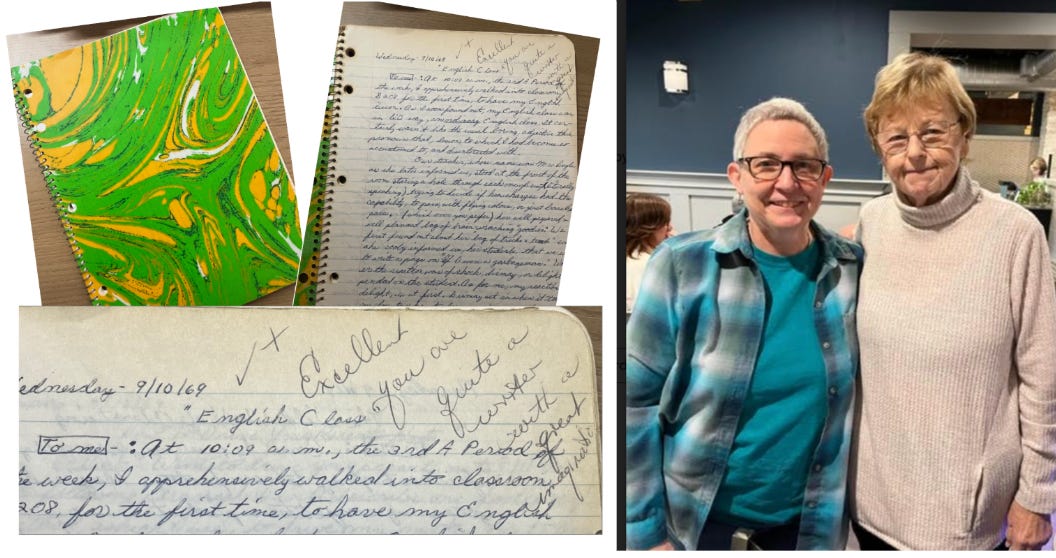
- The power of one person to save a life, AND the power of the feminine. My “Mother wound” was huge and affected me my whole life. I so needed affirming and a good female role model. My freshman high school English teacher, Terry Doyle, saved my life. She was the first person to show me true caring and compassion, as well as encourage my skills. The effects of her praise in my English class journal have stayed with me for a lifetime. And her amazing example and role-modeling of a strong, powerful woman became my model for rebuilding me. We are still friends.
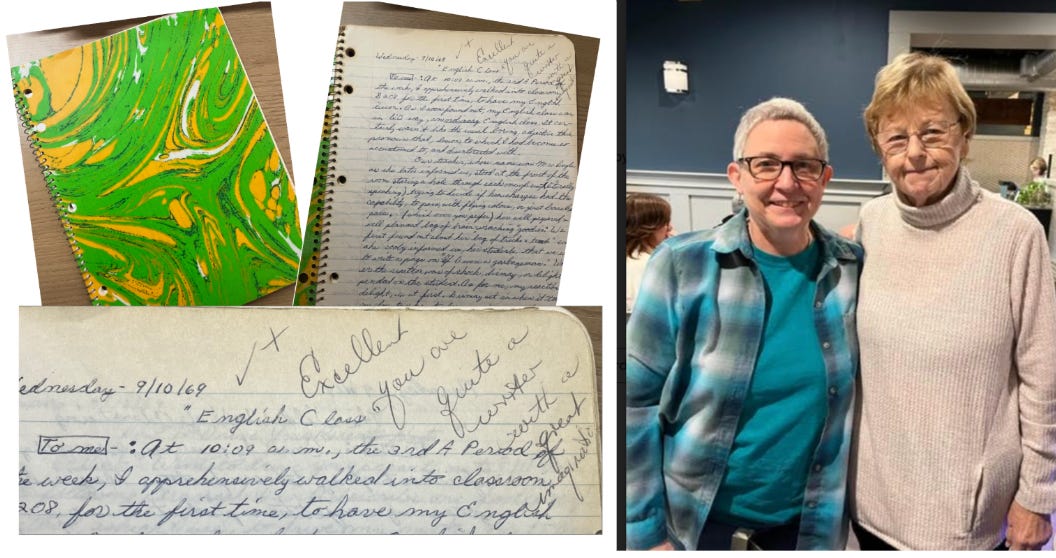 Photos by author
 - “You are Precious” – This represents transformation as I heal. My husband would tell me this, and for years I couldn’t hear it. It revulsed me. It is only with my healing transformation that I could start to accept his words and feel my own self-love.
- The line from the movie, The Natural, about how we live two lives — one that we learn with and one that we live. For me, that is the theme of my life — not giving up but falling down, learning, and continuing. As we gain wisdom, we can start truly living the life we were destined for.
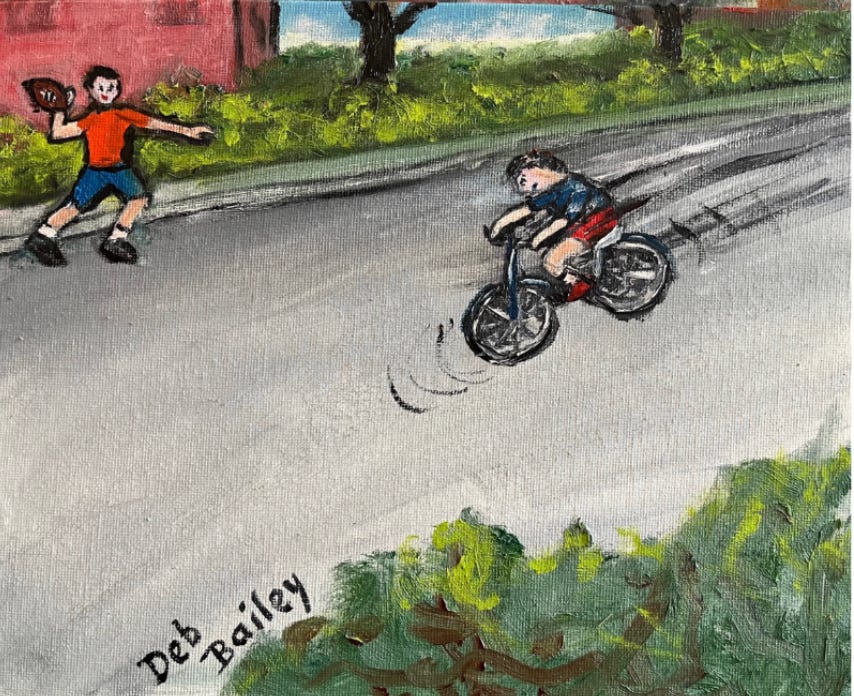
- This was evident in several incidents, but especially the childhood event where I dared my friend to throw a football at my bike tire, confident I could outrace him. This represented my confidence and tenacious belief in my ability to succeed if I worked hard enough.
Symbolism
- There are things that may be metaphors or similes, but because they appear repeatedly throughout the book, they become a deeper element of the story and thus are also “symbolism.”
Art
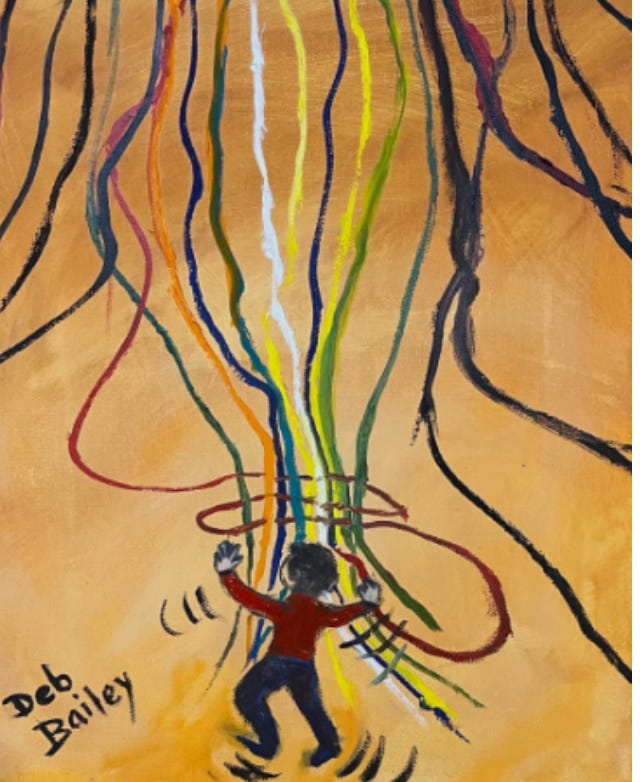
- One last note about metaphors and symbols. They can apply directly to the paintings I do as well. For example, in some upcoming posts, I will have images of knotted yarn, unraveling yarn, and attempts to restring the yarn. Those represent phases of my journey, from the Dark Night to the phases of new insights and power.
The “bottom line”
Now, who knows if I got all my examples listed above correct. But it doesn’t matter. It matters that I know those things are important to the story I am trying to write.
If I distill all of this down to one bit of “grammatical” advice for myself, here it is:
Pay attention to your story and notice when something keeps coming up. Because that’s what matters. Even if you can’t say it’s a symbol or metaphor, or whatever, just know it’s important and treat it right because THAT is the place of power and meaning in your story.
After that, it’s just academics.
Note:
I am seeking financial support to complete my memoir, work with an editor, and make a visit to my home state for fact-checking. Your help would mean the world to me as I take this step toward healing and giving voice to my journey.
Please like, comment, and share this post to help spread the word. The link for my fundraiser is on GoFundMe. Thank you for your support.


Leave a Reply