“Becoming the author of your story is about claiming the power to define what something means and to take charge of the ways your life events impact you and influence how you move forward…the power is in you to shape how you will live…The power is in the stories you tell to encourage you to take the next risk, to make the next move, to keep saying yes to life.”
Sandra Marinella, MA, MEd, The Story You Need To Tell: Writing to Heal From Trauma, Illness, or Loss
Why write?
The world asks, “Why write?”
And the writers answer:
“Avoiding a secret subject can be its own kind of bondage.”
Melissa Febos, in Body Work: The Radical Power of Personal Narrative
There is no greater agony than bearing an untold story inside you.”
Maya Angelou, I Know Why the Caged Bird Sings
“A story untold could be the one that kills you.”
Pat Conroy
But then the world asks, again, “Why write?” as if you never answered.
Which makes me ask, “Didn’t you hear the writers’ answers?”
However, after seeing this go on for years, my mind finally understands: They did. They just didn’t like the answer. So they keep asking. And, besides, “Why write?” was not really a question anyway.
Why write?
I am writing to heal.
Because…my heart is in agony. It throbs from the thousands of wounds sliced into it by the knife edge of secrets I had to carry. And it is crushed by the weight of a silence that proclaims, “You are not worth it.”
When people ask, “Why write…When are you going to get over it?… Why can’t you just live for today?” I have learned that those really aren’t questions. They are unspoken statements that say “Your truth is uncomfortable.” And they are demands, framed as questions, to stay silent, uphold the secrets, and pretend all that happened wasn’t “that bad.”
Who demands silence?
I’ll start with me.
I stayed silent, first, out of love and loyalty. He had drilled into me to NEVER tell. That it would break the family. That my first and total responsibility was to protect the integrity of the family. And when that responsibility is put on you as a toddler, and drilled in all through your formative years and on, you internalize it in the very core of your soul. So I stayed loyal to all except me.
I stayed silent also, because I was terrified. He made it clear that if I did speak, there would be “retribution.” I’d tasted that retribution at the end of his fists for years. And I feared it.
I stayed silent too, because I didn’t think I had the right to speak. It made others uncomfortable to be around me. To hear me. I felt the power of eyes averted. Or outright demands to move on. And I felt badly, because it was obvious I was causing discomfort and that was not what I wanted. Not why I tried to speak. I knew pain all my life. I did not want to give it to another. So I didn’t.
I stayed silent because I didn’t want to be judged as weak. I was taught that to focus on what I felt was being self-centered and unfair. I was being a baby. Weak. Broken. And a failure. After all, everyone in life had difficulties. Other people had it bad…worse, even. So why should I think mine deserved “special treatment?” If everyone else could move on and “be happy,” what was wrong with me? Because if I just sucked it up and stopped thinking about what happened to me, that’s all I needed to be happy. So I sucked it up.
I stayed silent because I was taught, and I believed, that healing myself, repairing me, was my business. I was so ashamed of me – of what I “had allowed,” and I loathed me. So I didn’t want to burden anyone else with it. And I feared criticism or rejection. If I stayed quiet, I was allowed in, and possibly even respected for my “strength.” So I accepted those terms.
Ultimately, I stayed silent, for all of these things. For the sake of others. For supposedly, my own sake. Because I believed all of these things. Because I thought they were right and I was wrong. Because I saw me as failing them and myself if I couldn’t just “get along.” Because I didn’t want to be an “outcast.” I wanted to be loved, and the best way to do that was to “get along.”
Secrets – denying the elephant in the room
Christina Baldwin, in her book, Storycatcher: Making Sense of Our Lives Through the Power and Practice of Story, describes what secrets in our lives look like:
“Story is both the great revealer and concealer. There is the story of what gets said, and the story of what remains unsaid. There is the story that covers up story. There is the blanket of silence thrown over secrets, like people putting sheets on the furniture when leaving home. It’s all still there, the shape of the lamp, the length of the sofa, the arrangement of things on the coffee table, just cloaked, and in many ways revealed more definitively by the attempt to hide, the desire to protect.”
Pretending the secrets aren’t there is just like covering up the furniture, but the shapes still scream out their evidence of what’s underneath.
Later in the book, Baldwin puts it even more directly with a description I’ve used myself:
“When something exists in a family that is not discussed, it goes into what Carl Jung termed ‘the shadow,’ the unacknowledged aspects…the shadow is called ‘the elephant in the living room.’ Everyone accommodates the presence of what is unspoken and verbally talks around that territory, avoiding it as though there really is an elephant in the living room. Everyone knows better than to cut directly from point A to B because he or she would bump into a huge obstacle. That obstacle is silence; that obstacle is fear; that obstacle is facing the unknown.”
The silencing by others
In our house, it was very clear by his rules that life was meant to be hidden. But the truth is, it wasn’t just in my house. Society and the larger world often prefer secrets and silence, too.
Jen Cross described these issues very well in her book, Writing Ourselves Whole.
“As a whole, mainstream American culture doesn’t deal well with the real stories of death — nor of sickness or violence or abuse or mental illness or war…We don’t want the details; we don’t want the day-to-day reality. We want the happy ending.”
She goes on to explain:
“Our trauma stories are often our most disembodied stories…the stories that we most often can’t find welcome for in everyday society…These are the stories that our communities tell us — directly and indirectly — to shut up about, the stories that make other people uncomfortable, these stories of the complicated realities of our living in the aftermath of trauma in a body that remembers and won’t let us forget.”
She quotes another incest survivor’s very apt description that, “Incest is not a taboo. Talking about incest is the taboo.”
And Cross affirms my thought that people’s questions of when will we get over it, when will we forgive, and move on, are not questions “meant to soothe us or witness our pain…They’re meant to shut us down…bring the conversation to a close.”
What silence and secrets do to you
“Major secrets can be stressful…can affect our health, including our immune function, the action of our heart and vascular systems, and even the biochemical workings of our brain and nervous systems.”
Jennifer Leigh Selig, PhD, Deep Memoir: An Archetypal Approach to Deepen Your Story and Broaden Its Appeal
I call this “poisonous” effect the “toxic triad” of secrets, stigma, and shame. It builds and builds and will either explode or kill you.
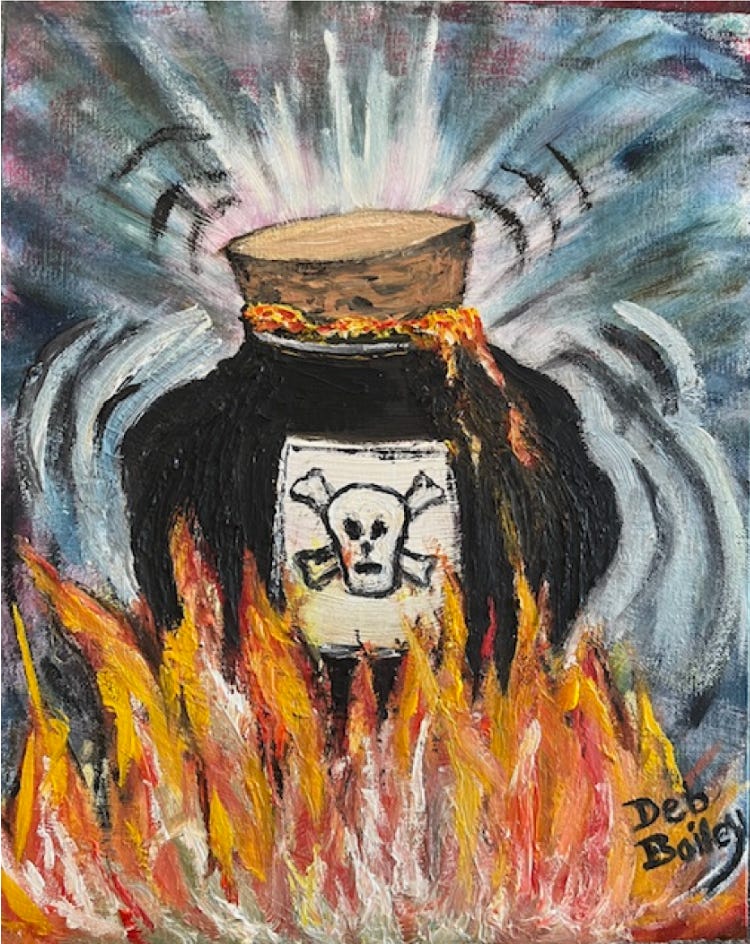
Jen Cross wrote in her book, Writing Ourselves Whole, that “when our body stories are without language, we feel trapped inside our skin with no way out. We feel unfinished, nonsensical. Monstrous.”
And these things don’t just affect us “in our skins,” they explode out and splatter all through our world:
“When things happen that are unexpected, unwelcome, challenging, disorienting, or traumatic, we survive, but the storyline we were following is shattered. Untold stories don’t go away; they morph into volatile emotions, into flashbacks and anxiety, into behaviors we don’t understand…things we wish we didn’t do — lash out, hide, avoid, get depressed…Untold stories cause ruptures in relationships, ill health, and spiritual or religious crisis, and contribute to a growing sense that our lives are disintegrating into chaos.”
Sandra Marinella, MA, MEd, – The Story You Need to Tell: Writing to Heal From Trauma, Illness, or Loss
In the book, Your Brain on Art: How the Arts Transform Us, it explains that two big inhibitors to recovery from trauma, especially shame-filled traumas like sexual assault or abuse, are the shame we feel in ourselves and the stigma society puts on us. We stay quiet because we don’t believe we have the right to speak, we haven’t been believed, or we are beaten down by fear.
And society adds the stigma. It wants us to be quiet because we are viewed as a danger to the normal order of things. We are seen as different, weak, broken, and so we need to be pushed away and set apart. Our brains view “different” or “unknown” as dangerous, and so society either needs to make us conform or drive us away.
For myself, I didn’t go looking for trauma wounds. It wasn’t like I sat around calling up all these feelings. They CAME CALLING to me. Nightmares. Anxiety attacks. Self-loathing. Depression. Memories and flashbacks that showed up unexpectedly, unbidden. Triggered by something in the present moment…or by something I didn’t even recognize. Things could be fine one moment, then in the next, I would be swamped with sorrow, grief, pain, fear, or despair. And so I carry those shame-filled reactions from trauma, AND the strong social message of “play nice or stay away.”
What we need instead
Selig, in her book, Deep Memoir, states that one of the big reasons to write is to “unburden ourselves of our secrets.” She goes on to quote author Carolyn Myss, who gives her own healing prescription using the archetype of the Witness role – one of the most powerful archetypes in the Cosmos:
“We require the role of the witness in order to heal. We need our injuries and wounds to be witnessed by others. We need others to witness that we have been violated. Without the Witness, we cannot truly, fully heal.”
Jen Cross in Writing Ourselves Whole, adds: “We need space for the stories no one told us how to tell, for the stories someone told us NOT to tell, for the stories that made our partners or siblings or parents or friends uncomfortable.”
As much as it might seem strange, it is that public acknowledgement that is essential. From Melissa Febos’ book, Body Work :
“Part of what ultimately and most conclusively resolves trauma is the recognizable public acknowledgment of it. Think of war monuments…Our society has been much quicker to acknowledge the traumas typically suffered by men. Rape victims do not get monuments in public spaces. They rarely even get legal justice….A memoir is also a kind of monument.”
And Christina Baldwin in her book, Storycatcher, puts it very directly – Name it:
“…in order to be able to change something, we need to be able to name it, to speak about it…Story is the liberator from shadow to transformation.”
Why write, revisited, and some conclusions
I have quoted many authors on their opinions regarding silence, secrets, and the need to publicly “name it.” It’s not that I enjoy putting in quotes all the time.
Maybe that is the best way to show just how much I was silenced, and just how very hard it is even now, to embrace my power and feel I am right in speaking. It is HARD.
By quoting so many authors on these things, maybe it’s my way of feeling like I am not alone — both in the fears of speaking that I’ve carried, and in my decisions to damn my fears and just write.
In fact, my answer to the question of “Why write?” is to instead ask, “Why not? Why keep secrets and silence?”
Here is an essay I wrote about not staying silent any longer. It is my reminder, especially to myself, not to worry about speaking publicly:
To anyone (including myself)
who is worried about me because I am writing this hard story….
I’m doing fine.
And I’m not harming me by speaking and writing.
In fact, to stay silent any longer is slowly killing me.
Do I deserve that?
Because I didn’t cause this.
I didn’t choose it.
I didn’t do it.
So tell me, why would I deserve that?
To pay the price for another’s choice?
If you think it is hard to read it, hear it, imagine it, or write it,
trust me, try living it.
And I don’t just mean the abuse.
In fact, that was the “easier part.”
It’s over.
The HARD part, now, is the silence I’ve had to carry.
For 70 years I have had to carry the weight of the pain,
the body memories, the stories, the shame inflicted —
because I was trained to stay quiet to follow someone else’s rules for their comfort.
But that weight is crushing me now.
And I finally realize…I don’t have to be crushed anymore.
I can speak.
People often want silence because this is a messy, uncomfortable thing to hear.
So they say, “Just get over it…move on…it’s better for you that way.”
If you can’t hear it, if it traumatizes you, then you must choose what is right for you.
But don’t ask me not to speak.
As to “uncomfortable,”
I didn’t have a choice about whether to “deal with it.”
I got handed that reality. Period.
And I’m not someone special.
I am not some superhuman hero ordained by God with special powers to be able to handle it.
To silence me leaves me asking myself,
How did I get so lucky as to be chosen for this, both the abuse, and then the silencing that is for everyone else’s comfort?
I am the living, breathing reminder of what everyone else wants to forget…even as I can’t.
Why does everyone else get a choice and I don’t?
I just want to finally put the load down.
Uncomfortable…
How uncomfortable do you think it is to have your body commandeered, and your orifices invaded against your will,
while you have to lie there and not be able to refuse it, just endure it…or worse, pretend to be happy,
and have to go away somewhere mentally to get through it?
And worse, how uncomfortable and destructive do you think it is to have your perceptions twisted and obliterated,
replaced with the brainwashing of another?
To have your own self’s DNA removed and his mindset inserted instead, like some parasitic virus replacing my DNA with its own?
Why is it that I didn’t do anything wrong, but I must carry it and be in pain for the comfort of another?
Why is it the taboo to speak?
It’s the same as if I had a medical issue and it made someone uncomfortable to see me in the hospital bed, so they say “I see you’re sick and working to get better, but until then, could you go over there in a different room by yourself where we can’t see you, so we don’t have to watch it….because it’s hard? But when you’re better, come on back out, and you can be here again?”
I cannot do that anymore.
I will not.
I can feel that silence sucking the life out of me…
Slowly. Insidiously.
That is just like how he hunted, enmeshed, and trapped me — insidiously.
Even if I wanted to live in denial,
the scars I carry won’t allow it.
There is a saying in Latin about God’s presence:
Vocatis atque non vocatis Deus aderit —
Bidden or unbidden, God is present.
The same is true for scars.
They remain, following you,
calling out,
never resting until you face them.
You can always choose to ignore them,
But they will follow, stalk,
call into your ear without stop.
So, no more.
If I had to live it, I am going to speak it.
I have a right to my truth and my story.
I didn’t do anything wrong.
So I will not bear the punishment in his stead.
I did not live through all the things I had to for 28 years, then spend the rest of my life fighting to come back, and rebuild, and heal, to do nothing with it.
It demands to be used, not only for my sake, but for the sake of anyone else in pain who might be helped by my story.
It deserves meaning. And so do I.
It deserves to be free. And FINALLY,
so do I…
So I write, and speak.
Note:
I am seeking financial support to complete my memoir, work with an editor, and make a visit to my home state for fact-checking. Your help would mean the world to me as I take this step toward healing and giving voice to my journey.
Please like, comment, and share this post to help spread the word. The link for my fundraiser is on GoFundMe. Thank you for your support.


Leave a Reply