Before I start writing about my house, the specific tools my father used, or what kind of a person would do those things and why, I wanted to learn more about how domestic abuse operates for anyone. Seeing so many things I experienced listed as “Universal” patterns and techniques felt…affirming. Helpful as a way to stop judging and self-blaming.
For so long I blamed myself for not being smart enough to realize it even was abuse, much less for taking so long to get free. So to see what powerful mind-controlling tools I was up against gave me comfort. The fact I got out was no small achievement and one to be honored, not demeaned.
So, some background that helped me; then I will go on to my experiences.
1950s Terror – A new secret weapon?
In July of 1953, an armistice was finally signed to end hostilities in the Korean War. That also allowed officials on both sides to begin prisoner exchanges.
One particular exchange in September of that year was extremely disturbing to the US authorities there. During that event, twenty-three American POWs, looking well cared for, came forward, shook hands with their captors, shouted expressions of solidarity with them, then, instead of coming to the US side, turned and defected to Communist China. And this was just the beginning of US officials discovering evidence of how many American POWS cooperated with their enemy.
Panic set in at high levels of the military. They were worried that a new “brainwashing” weapon had been employed – one that could somehow render the POWs as “blank mental slates,” and then insert new thoughts and beliefs in them. So, frantic to understand how so many US servicemen could betray their country so willingly, they tasked a US Air Force social scientist, Albert Biderman, to determine what had happened.
Biderman was not convinced that a diabolical new weapon was at play, but suspected a rather a well-established approach known as coercive control. While not a new method, no one had seen it used like this before during a war.
The military’s most recent information on POW experiences came from World War II. There, Japanese or German captors were more likely to brutalize or work their prisoners to death. While there were many similar experiences of brutality toward American POWs in North Korea, some situations were different. There, captors found mind control to be an even more effective way to gain cooperation, complicity, and submission.
Through his work with the POWs, Biderman learned that the captors broke down their prisoners and gained their compliance using a set of eight to ten core mental coercion techniques. Interestingly, he observed that physical violence was a secondary tool to the psychological ones. And he identified three key elements needed for successful coercive control: dependence, debility, and dread.
He went on to compile and define a list of eight standard methods that brought about those three goals:
- Isolation – The captor cuts off the prisoner from others, rendering them alone and at the mercy of the captors
- Monopolization of Perception – The captor controls the messaging and distorts reality until the prisoner doubts their own memory
- Induced Debility or Exhaustion – By constantly keeping the prisoners off-guard and harassed, they drained the energy and will of the prisoners to fight back
- Cultivation of Anxiety and Despair – The captors create dread and fear by using threats and unpredictable actions or schedules
- Alternation of Punishment and Reward – By alternating between severe treatment and rewards/compassionate actions, the captors could foster both dependence and psychological bonds in the prisoners
- Demonstration of Omnipotence – By demonstrating their total power over everything related to the prisoners’ lives, they could make resistance seem futile and hopeless
- Degradation – With systematic insults, humiliation, and criticism, the captors destroyed the prisoners’ sense of self-worth.
- Enforcement of Trivial Demands – Captors enforced arbitrary rules over seemingly insignificant routines to again demonstrate their total control over the prisoners.
This list, which became known as Biderman’s Chart of Coercion, helped researchers understand what was happening to the prisoners. The items were not isolated acts chosen at random but instead used as interconnected steps for a bigger process.
Messages and the acts were inflicted repeatedly and alternated in varying ways. It was as if the captors were drilling into your brain like a parasitic worm. Then add in that the captors created an atmosphere of fear, total control, and exhaustion, and eventually, the prisoners came to identify and bond with their captors.
The social progress in the 1970s
Flash forward to the 1970s, and there were two intersecting trends.
One was the 1973 Amnesty International report on torture, which formally included Biderman’s Chart of Coercion in its pages. It highlighted the significance of these eight tools of torture in trapping, controlling, or enslaving another human being.
At the same time, with a growing spotlight on women’s issues, more and more shelters were being opened for women seeking to escape abusive homes and relationships. And the odd thing that people started to notice and hear about those women’s stories was that they were very similar to the ones the 1950s American POWs told.
As Jess Hill shared in her book, See What You Made Me Do: Power, Control and Domestic Abuse, battered women described techniques that “…match those used by practically anyone who trades in captivity: kidnappers, hostage-takers, pimps, cult leaders.”
She went on to note that “…there is nothing uniquely weak, helpless or masochistic about victims of domestic abuse. Faced with the universal methods of coercive control, their responses are not different from those of trained soldiers.”
It was researcher Dr Diana E. H. Russell, a pioneering feminist, sociologist, and activist, who connected the dots in her groundbreaking book: Rape in Marriage. She made a chart with the tools in abusive relationships, put those next to Biderman’s list, and found that they were virtually identical. Women in abusive households were being subjected to those same calculated, structured, and interdependent list of coercion tools, just as the POWs had been.
Russell dedicated her career to researching and exposing gender-based violence, sexual exploitation, and misogyny, and wrote a number of books on these subjects. She brought awareness to things like femicide and marital rape – especially at a time when it was still viewed that a spouse could not legally rape his wife. She also investigated the harm of pornography and of workplace sexual harassment. Also, she was instrumental in showing, with rigorous scientific data, the epidemic scale of child sexual abuse.
Realizations appear
There were a few key observations that also came from her work. Russell noted, as Biderman had, that physical violence was not the sole source of control, nor often the main one in abusive control. In fact, sometimes there was no physical violence in the abusive relationship, just the threat of it. Those eight psychological factors were the main methods of dominance by the abusive partner.
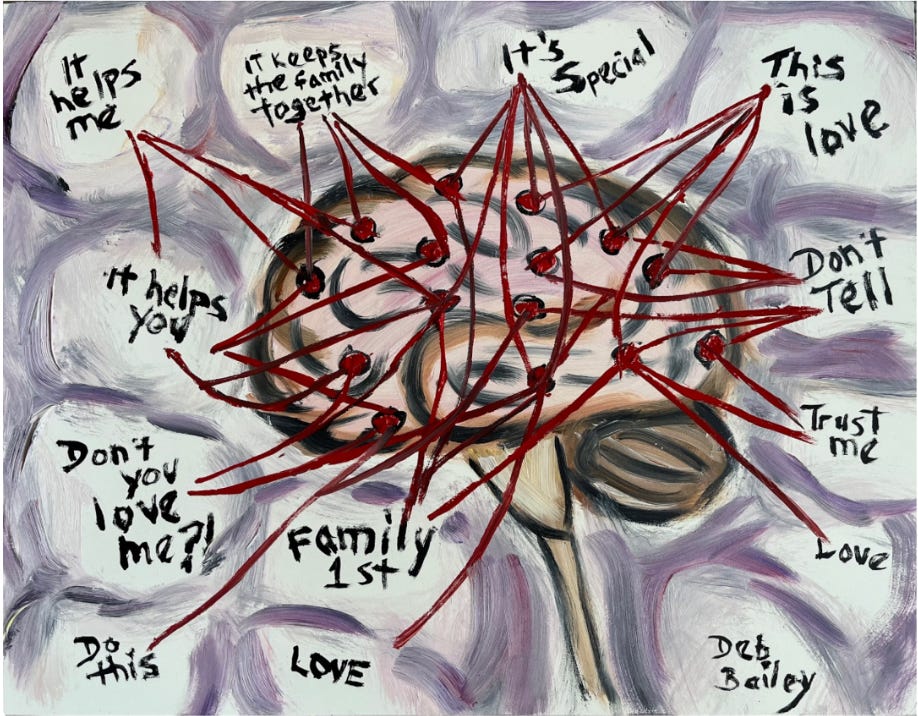
And another highlight was the realization that domestic abuse, like the POW’s mind control, was a calculated SYSTEMIC pattern, not isolated incidents. Later researchers would go on to note that unlike an isolated violent event that was situation-based, domestic violence in the home was powerful because it was ongoing and constant. That pattern rendered the victim exhausted, fearful, unable to fight back after a while, and dependent on the abuser for how to behave to avoid further victimization.
For clarity’s sake, just a note about terminology. I refer to this as coercive control and not brainwashing, even though many times the two are used interchangeably.
Many researchers use the term coercive control instead of brainwashing, because while the two are similar, there can be some subtle differences:
- Brainwashing seeks to completely replace a person’s beliefs. Coercive control is about making them completely dependent on the abuser
- Brainwashing may involve extreme techniques like total physical isolation, sleep deprivation, etc. While abusers may use these, they are often associated with political indoctrination, prisoners of war, or cults.
- Coercive control is a broader and constant system to dominate and intimidate someone, and is often associated with interpersonal relationships. It is more about daily control over a partner’s actions versus ideologies and is focused on stripping that person of their autonomy, self-esteem, and independence.
About physical violence
As I mentioned above, while physical violence can and often is used in domestic abuse, it may not always be, or it may only be threatened. If the abuser can achieve and maintain control with the above psychological techniques, violence may remain a shadow lurking in the background.
However, one of the things about domestic abuse in a household is how “normalized” it can become. Especially when all the techniques are used and alternated over a long period of time, the victims recognize the patterns. And they can become numb to what is going on. Hence, their “fear response” may not satisfy the abuser’s need for dominance. When that happens, the abuser may escalate to violence, and there, too, it has different levels:
- Isolation – Preventing someone from leaving a car or taking them to an isolated location
- Intimidation – Verbal or emotional intimidation by getting in one’s face or physical space to frighten the person into submission with the fear that violence will follow
- Physical restraint – Holding a person back, blocking a door, locking doors and hiding keys, etc.
- Aggression – Using physical force including shoving, punching, biting, choking, strangulation, etc.
- Endangerment – Threats of killing the person, family members, or themselves, using weapons, etc.
The “set-up”
But is it like this right from the beginning? I can’t speak for all relationships, but I don’t think so. I think that long before a relationship gets to the point of meeting those three conditions for coercive control or the eight tools, or those additional levels of violence, it had a beginning. Possibly a very slow, subtle one that may not have even raised an eyebrow.
Most abusers don’t dive into using the “big guns” right away. It is a slow, methodical, steady buildup that the person doesn’t even see coming. My father was a master manipulator who could be charming and engaging. Fun even. If he could get what he wanted with charm, that was fine. But he would use any tool he needed, and he was smart enough to know when to use it and how to “weave it in.”
And there is the person’s “expectation” for what a given situation will bring. A domestic relationship is different than a soldier going to fight a war. The soldier is there to fight an enemy, and if they become a POW, they know they are now entrapped, and who the enemy is. And sometimes, even though they know these things, mind control is possible.
In a relationship, the expectation is love. Caring. A wife, a partner, someone who loves and is vulnerable and open to another in a love relationship, is NOT in a war zone and not expecting to be. And they are not expecting an enemy.
So the first thing is that in a domestic relationship, unlike a soldier in a war zone, you don’t see it coming because you don’t expect that to be a risk. You expect love. Instead, though, sometimes what you get is a trap that slowly closes around you.
Another researcher described the approach as fly fishing – the lure, the enticement, and then finally, the capture. The abuser takes the time to identify the needs, vulnerabilities, and personalities of their victim. Set them up before reeling them in.
The early “set-up” stages of an abusive relationship can include these items, as noted by Andrew Cicchetti in his presentation: “Understanding Coercive Control:”
- Facilitating attachment
- Identifying, creating, and exploiting the victim’s vulnerabilities
- Wearing down the target’s resistance
- Creating the expectancy of negative consequences
So, it is not strange that a person may miss early signs, or think something is their fault when a partner blames them. And an abuser often uses things like guilt trips or blaming the victim for “making the abuser behave that way.” If those signals are missed or minimized, by the time a person realizes something is really wrong…if they do….many of the control tools are already in motion.
Up Next
Armed now with a general awareness of these tools and both how universal and how powerful they are, I will examine what methods were used in our house.
To set the stage for those, I need to address “the people” in these situations:
- What kind of person abuses?
- Who was my father?
- And what of us…his targets?
- What made us vulnerable?
Note:
I am seeking financial support to complete my memoir, work with an editor, and make a visit to my home state for fact-checking. Your help would mean the world to me as I take this step toward healing and giving voice to my journey.
Please like, comment, and share this post to help spread the word. The link for my fundraiser is on GoFundMe. Thank you for your support.


Leave a Reply