Before I get into the specifics of my father’s tools of control, I want to share some general patterns and behaviors common in many abusive households. And many, if not all of these, applied to my home.
At the time, of course, I wouldn’t have known to call these things abusive. I would have shrugged them off as just one of those bad days we had to survive until Dad was in a better mood. Because after all, no one’s house is perfect, right?
I share them now for all of us to see, and especially to help any others out there right now who are living in the same hell.
Things done by abusers to intimate partners and/or older children
Earlier I spoke about five things often done to wives by abusers. The information came from an article by psychologist and life coach Fahim Chughtai. And while he was speaking of narcissists specifically, I can vouch for the fact that my father did these things to my mother CONSTANTLY:
- He decides what counts as an overreaction
- He rewrites arguments after they happen
- He keeps a running tally of what you owe him
- He makes your independence feel like betrayal
- He apologizes to keep you, not because he means it
The article’s subtitle says it all: “The five patterns that turn a marriage into a slow, quiet takeover, and why none of them are your fault.”
For sure, that marriage was a takeover by my father. And by the time I was old enough to notice these patterns, they were a normal course of life in our house. I will also note that these tactics weren’t reserved for my mother alone.
He made the rules, told us how things were, dictated what we should believe. As he would tell us, yeah, he lost his temper, but it wasn’t that bad. And we shouldn’t be so sensitive. After all, nobody’s life is perfect. And we should know it wasn’t that bad because, after all, he would always tell us after his blow-up that he still loved us. So he decided what most things meant, and that his description was the right one.
Also, we never dared forget that we owed him our loyalty. Because despite his anger, there was so much he did for us. After all, most of the time life was good, right?
It’s the same mentality as saying: “Well, yeah, he beats his wife or sexually abuses his daughter, but he doesn’t drink, he works hard, gives us a good life, and is nice to the dog. So it’s not that bad.” And by the way, loyalty PROVED love, and loyalty also meant SECRECY. What went on in the house stayed in the house, or else you might never be loved again by him because that would be a horrible betrayal of a loving father.
Guilt trips. Oh, he was a master of crushing guilt trips. What do you mean you want to spend time with a friend and not at home with him? To want a life that wasn’t totally about him and his needs was like you told him you hated him. He would turn to ice and dole out the silent treatment, sometimes for days. When he finally decided to be nice again and show love and attention, I know I was so grateful just to be back in his good graces that the relief was beyond describing. By that time, I would give anything just to be seen, spoken to, and loved again.
The apologies. There was usually a fight EVERY Saturday morning, or Sunday after church. After he hit my mother or us, he’d tear out of the house in the car. An hour or so later, he’d return, so upset, almost anxious and terrified that my mother would reject him. He would be so beside himself with regret and apologize so intensely it was hard not to accept it. And in those moments, it was hard to believe that he was the same man who had nearly choked my mother or me. It was just like Dr. Jekyll and Mr. Hyde – one man left the house; a different one seemed to come back.
We grew to know the pattern. If we survived his attack and then he left, it was fairly certain the worst was over. For years it would be that way, too. He’d come back so earnest and desperate, you just melted. He’d sorrowfully explain that he was just so stressed from work. And that if we’d just not done “whatever,” he wouldn’t have lost his temper. But he really didn’t mean it. And he would change. And of course he loved us.
Even so, even as a young kid, I sensed a dark, unspoken side to those apologies. I knew…we all knew, without anyone ever having to say it, that we absolutely had to accept his apology. Or else. It was an IMPERATIVE. After all, he WAS saying he was sorry. And I knew that there was no explaining to him how badly he had scared us or hurt us. To express our upset or blame him for something would only set him off again. And we didn’t want that. We would do anything to have peace and quiet, and for Dad to be in a good mood again, for however long it lasted. So it was a rule – just take the apology and be satisfied.
Looking back now, I realize that those frantic pleadings were all about him calming his insecurity over losing my mother. They weren’t about feeling bad for what he did. But by allowing that pattern to continue, over the years, those fights grew worse, more rounds of them went on the whole day, and I suspect he realized she would never leave him. So he could do what he wanted.
Cycle of Violence…aka, “Intimate Terrorism”
When I described the above pattern of those Saturday or Sunday fights, I didn’t realize that it was an actual documented cycle of violence in abusive households. It was only more recently that I learned that fact, as well as another interesting one: that the violence that happened behind closed doors has often been referred to as “Intimate Terrorism”…and believe me, it is. The four phases are:
- The Build-Up: Increasing tension that tells you the abuser may be getting ready to strike. The amount of time is variable in this “build-up phase”
- The violent attack: This may not last long, but it is intensely traumatic. The victim is focused exclusively on survival at this moment.
- Apologies: Regret, remorse, pleading apologies, sometimes mixed with blaming the victim or promises to change
- The honeymoon phase: With the release of rage by the abuser, life resets. For a time, all is well, loving even, and that violence seems so remote, like a bad dream that will never happen again
There is one other aspect to violence as a tool of control. Sometimes, actual violence isn’t necessary to keep the family controlled by terror. Just the THREAT of violence is enough, and believe it or not, the threat of it is WORSE. Because while violence itself “will happen and then be over with,” the THREAT of it may be CONSTANT, and the agony, never-ending.
With the threat, you never know if the explosion will occur or not. You rack your brains trying to figure out when it might happen, what might trigger it, if you can avoid it, or how bad it will be. So you live in constant vigilance, walking on eggshells, hoping things will get better. After a while, the victim may do something to trigger the violence just to get it over with and bring resolution and peace for a while.
And all of this leads to a level of physical, psychological, and emotional exhaustion that is so total that there is no more energy to fight back or even make sense of what is going on. All we knew was that we just wanted to keep “Good Dad” around and avoid the violence as much as we could. We had some misguided idea that we could actually control that. That there was some magical formula for keeping him in control, and if we could just figure it out, all would be well.
So what goes on in the minds of abusers?
After reading books and dozens of articles, here is a list of abuser traits that showed up consistently in all the sources:
- Needs power and control
- Insecure and emotionally needy with unrealistic expectations of a relationship
- Distrustful
- Often jealous
- Verbally abusive
- Needs to be right and MUST be in control
- Possessive; may try to isolate partner from friends and family
- Has a history of aggression or is actively hostile or aggressive towards others
- Easily angered, frustrated, or irritated
- Uses intimidation or dominance behaviors
- Reckless, Impulsive, and can engage in Risk-taking and Thrill-seeking
- Is cruel to animals or children
- Projection – Blames their behavior on others
- Devalues their victim – Blames others for the situation
- Devious or deceptive
- Ruthless in pursuit of their goals
- Superficial charm and powers of persuasion
- Broken moral compass/limited conscience
- Few close bonds or relationships
- Manipulates loved ones emotionally
- Feels entitled and above the rules
- Seek their own advantage at expense of others
- Emotionally detached
- Empathy cannot be maintained or is nonexistent
- Demands loyalty and secrecy
- Pressures and coerces someone into gratitude – look at what I did for you
- Manipulates/changes reality and truth, and refuses to acknowledge the actual reality of a situation
- Forces capitulation under the guise of “cooperation and collaboration”
- Undermines and actively erodes independence, identity, resistance
- Demonstrates omnipotence through violence, total control over life situation, finances, or by enforcing trivial demands to let victims know resistance is futile
- Behaviorally trains family members to react and do what he wants
And the victims?
I am going to write in more detail about my mother, her nature, background, and situation, in a later post. For now, here are some general harms the abuser heaps on anyone in their power sphere:
- Become emotional hostages, totally responsible for managing the abuser’s happiness. They become hypervigilant, an expert at proactively reading moods, anticipating explosions, and rehearsing arguments, excuses, justifications, or apologies; you will sacrifice your happiness to keep the peace
- Learn that their feelings don’t matter; only the abuser’s feelings count
- Begin to apologize for taking up space or having needs, and feel guilty if they “impose” on the abuser by needing something
- Grow to believe that they are overreacting and are too sensitive; They can’t trust their perceptions anymore
- Slowly cease to exist as their own person. They are eroded and insidiously taken apart piece by piece, criticism by criticism
- Their reality is dictated by the abuser, and the victims’ perceptions, experiences, and opinions are twisted and erased
- Taught that abuse is love because words don’t have to match the actions.
- When the abuser gives love and kindness, especially at unexpected intervals, victims are so grateful that their emotional bond with the abuser grows deeper
- When that kindness flips without warning into the silent treatment or other punishments, and love is withdrawn so quickly that one questions if it was ever there, they scramble to get back on the abuser’s good side or do anything to placate him
- Exhaustion and fear grow worse over time because the rewards and kindness lessen and the punishment or demands increase
- Endure increasing guilt trips and accusations from the abuser, who tells them they are not showing enough love, gratitude, and loyalty
- If the victims set boundaries, they are accused of not caring or loving the abuser and are subjected to more punishments or violence
- Victims are frequently accused of the exact things the abuser is guilty of and blamed, again, increasing their fear, exhaustion, and hypervigilance
- They are demeaned to believe they are worthless, powerless, and lucky to have the abuser
- Their perceptions are twisted to believe that the abuser is the victim and they caused the hurt
- They are isolated from anyone who might question what the abuser is doing or give the victim any support
Some special notes regarding children in abusive households
In an article, “Emotional Neglect and Complex PTSD,” by Pete Walker, he wrote that:
“Children so need to believe that their parents love and care for them, that they will deny and minimize away evidence of the most egregious neglect and abuse…The child is forced to exist in a crippling state of self-attack…the ability to support or nurture himself or take his own side in any way is decimated…A childhood rife with verbal and emotional abuse often creates an identification with the critic that is so pervasive, that it is as if the critic is the whole identity.”
This description nails my “identity” all those years. I identified with my father because I needed to. He was the all-powerful holder of love, safety, financial security, food, and shelter…my very life. I was loved or frozen out in the cold based on what he decided to “give me.” He was “God.”
And for so many years, even as I questioned his statements of what the “truth” was, I accepted them as the true reality. I had to in order to survive.
It has taken me a lifetime to learn to trust my own perceptions because they were so belittled, degraded, and almost totally erased in childhood.
And what of sexual abusers?
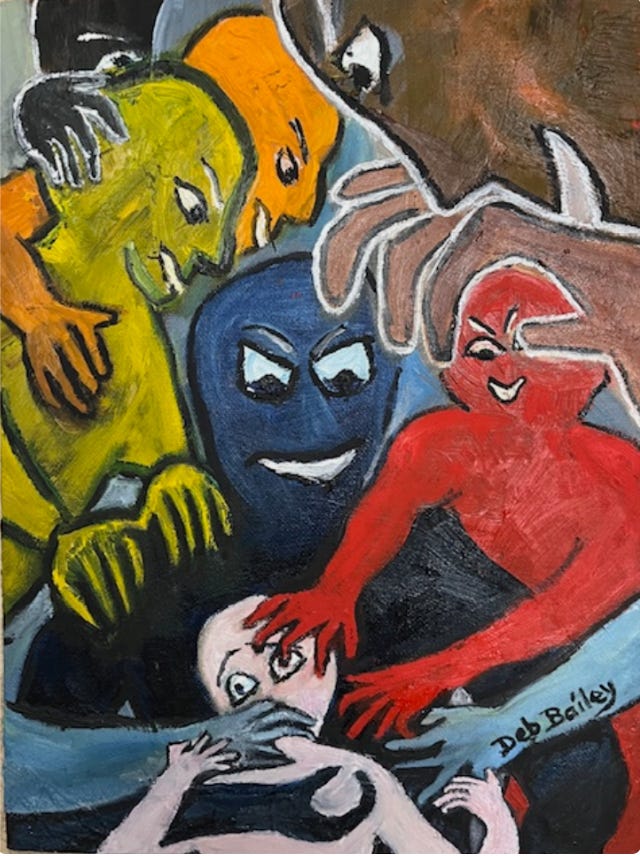
Many abusers may have no boundaries. Often they view their child victim as an extension of themselves. They also may lack or have only intermittent empathy for the child they are abusing. Add to this a sense of “entitlement” – they think, for some reason, that they deserve to have the gratification they desire through the abuse of that child.
Add to these things the fact that sexual abusers are charming, master manipulators who have cultivated a public persona that no one would ever suspect. And they are also masters of how to slowly groom a child to accept physical touch as just play, and to accept anything the abuser tells them as being “okay.”
When the abuser finally makes their move and sexually assaults the child, that child may feel complicit or to blame, wondering if they actually encouraged the abuser because they played along in the games.
By that point, the victim feels it is too late, and they have no control of the situation. They may be so guilty and ashamed that they turn inward and tell no one. The trap was sprung on them; they never saw it coming, and they think it’s their fault.
Up Next
Who Was Dad?
Note:
I am seeking financial support to complete my memoir, work with an editor, and make a visit to my home state for fact-checking. Your help would mean the world to me as I take this step toward healing and giving voice to my journey.
Please like, comment, and share this post to help spread the word. The link for my fundraiser is on GoFundMe. Thank you for your support.
 Soul Mosaic
Leave a comment