Stockholm Syndrome…and Patty Hearst
1973 – Stockholm Syndrome. 1974 – Patty Hearst’s abduction. 1981, 1993, 1997 -Defining Trauma Bonding.
These names have often been batted around almost interchangeably. And while they are related, there are differences that became clearer over the decades.
The term Stockholm Syndrome was coined in 1973 to describe the seeming bond that developed between hostages and their captor following a botched bank robbery in Stockholm, Sweden. The story is much more complicated and beyond the scope of what I want to write here.
But simply, it appeared at the time like the hostages were siding with their captor. In reality, they were traumatized by both their dangerous situation, not knowing if or when their captor might kill them, and the government’s clumsy negotiations that they felt almost got them killed.
Traumatized, enraged by the government putting them at risk, and responding to the kindness their captors started to show them, the hostages had to react in whatever way made sense to them to survive and live, even if it seemed strange to outsiders.
The bond even started to work in reverse. Their captor spoke later that while he initially would have killed them if he needed to, the more they got to know each other during the 6-day hostage situation, the harder it was for him to do that.
It should be noted that Stockholm Syndrome was not, and is not, a recognized psychological condition. From Wikipedia, here is the origin of the term:
“Nils Bejerot, a Swedish criminologist and psychiatrist, invented the term after the Stockholm police asked him for assistance with analyzing the victims’ reactions to the robbery and their status as hostages. Bejerot never met, spoke to, or corresponded with the hostages during or after the incident, yet diagnosed them with a condition he invented. Bejerot, speaking on a news cast after the captives’ release, described the hostages’ reactions as a result of being brainwashed by their captors.3(https://en.wikipedia.org/wiki/Stockholm_syndrome#cite_note-Adorjan_2012-3) He called it Norrmalmstorgssyndromet (after Norrmalmstorg Square, where the attempted robbery took place), meaning “The Norrmalm Square syndrome”; it later became known outside Sweden as Stockholm syndrome.5(https://en.wikipedia.org/wiki/Stockholm_syndrome#cite_note-5)“
The following year, that same term was applied to the 19-year-old heiress, Patty Hearst, who was abducted by a political extremist group and later seemed to side with them. That story, too, has many different complexities that I will not get into here.
Suffice it to say that both situations, which involved captives who seemed to switch allegiances and side with their captors, fueled even more research into the areas of captives, brainwashing, and domestic abuse, which had started in the 1950s with the Korean War POWs.
It was during the 1980s and 1990s that researchers, including Donald Dutton, PhD, Susan Painter, PhD, and Patrick Carnes, PhD, in their study of violence and victims, situations of power imbalances, intermittent reinforcement, and domestic violence, brought more clarity to these situations, along with a new term: Trauma Bonding.
Trauma Bonding 101
Trauma bonding is a powerful, addictive, and destructive emotional bond that develops between the victim and the abuser. It comes about through a variety of manipulative techniques applied carefully and constantly over time by the abuser.
Two of the biggest factors that help in the bond’s development are:
- Power imbalance between the partners
- Intermittent reinforcement of rewards between punishments, by the abuser
Wikipedia, “Traumatic Bonding”
Meredith Miller, in her Inner Integration Podcast, “Cognitive Dissonance & The Trauma Bond,” explained it this way:
“In real life situations, the trauma bond causes the victim to empathize with and defend the abuser. This is why Dr. Patrick Carnes, author of The Betrayal Bond, also calls it ‘insane loyalty.’ The victim is being loyal to someone who is betraying them… this isn’t caused by the rational, conscious parts of the brain. The trauma bond is caused by the primitive and emotional parts of the brain…It’s important to acknowledge that this does NOT mean the victim is stupid. This is not coming from the conscious, cognitive parts of the brain….Abuse goes beyond the cognitive understanding of ‘this is wrong, this is unhealthy, this is not okay for me,’ and it targets the part of the brain that is simply concerned with survival.”
She then listed four criteria for a trauma bond in a domestic relationship:
- There is a perceived threat to the victim’s life (physical or psychological)
- Acts of perceived kindness are offered (love-bombing)
- The person is isolated from outside perspectives physically or psychologically
- There is a perceived inability to escape (learned helplessness; feeling like there’s no way out)
These criteria were essentially the same factors operating in the North Korean POW camps, the Stockholm, Sweden bank robbery, Patty Hearst’s abduction, and countless other captor/captive situations.
How it works
The website “The Mend Project” defined seven stages of how trauma bonding forms:
- Love bombing
- Developing trust and dependence
- Criticism and blaming the victim
- Gaslighting
- Resigning to control
- Loss of self
- Addiction to the cycle
These are all pretty clear, and also, I’ve already described most of them in my previous posts about my father’s tools of abuse. So simply add that he would repeat this cycle over and over and over; it’s no wonder that after a while, my mother…and I …just gave up.
Risk Factors – PTSD
In addition to these tools, there were the factors that put us at additional risk of being his victims. I’ve already talked about the waves of stress chemicals moving through a victim’s body and brain, that drive intense emotional bonding, rewire brain circuits, and cause a person to change their behaviors. And this is especially seen when a victim is living with PTSD, which we were.
Living in a body that is in constant alert, a person has no ability to realize the actual truth of the situation. They can’t think clearly, and their focus is on survival and keeping the threat at bay.
PTSD also clouds perceptions, so if another questions what is happening or tries to help, the victim will actually pull away and defend the abuser. They need the abuser and will protect them because the victim has accepted that the relationship is where the true love is, and the threat is outside. So the victim will avoid and distrust anyone trying to help.
And when the abuser applies those intermittent rewards and moments of love and caring, I can speak from personal experience as to the result: the amount of relief felt is so massive that a victim is just so grateful for his love that they will defend him against anyone.
At that moment, Dad didn’t need to enforce my isolation anymore. Mired in trauma bonding, I did the work for him. I circled the wagons, self-isolated, and defended my home situation.
This even popped up unexpectedly decades later. For example, on a visit to my then, elderly parents who were living in a retirement community, a woman there came up to me and remarked, “I don’t like your father. I like your mother, but I don’t like him.”
I was so caught off-guard, and I admit that my first instinct was to question who this person was and to defend my father, even as in the next moment, after she had walked away, I realized I agreed with her and wished I’d asked her to tell me more. Old programming dies hard.
What Happens in the Victims
Colleen Hoover, in her novel about domestic abuse, It Ends With Us, portrays the dilemma of her main character, Lily, as she tries to explain the bond of love despite the abuse:
“Just because someone hurts you doesn’t mean you can simply stop loving them. It’s not a person’s actions that hurt the most. It’s the love. If there was no love attached to the action, the pain would be a little easier to bear.”
The love is both the glue that keeps her tied to her husband and also the reason his abuse hurts so much. Lily further demonstrates the struggle in her other comment:
“Everyone deserves another chance. Especially the people who mean the most to you.”
While all of this sounds crazy, self-destructive, or melodramatic, it truly becomes the mental struggle of a person that has been wooed, charmed, won, then struck. Then love-bombed, apologized to, explained to, and slowly reprogrammed over and over again.
If ever there was a clear, succinct explanation of what went on in our house as a result of Dad’s manipulation, this list — The 5 Transformations — nails it. It was penned by Fahim Chughtai, in his article, “THIS Is What Trauma Bonding With A Narcissist Does To A Decent Person”:
5 Transformations
- From Self-Trust to Constant Self-Doubt
- From Healthy Boundaries to Profound Vulnerability
- From Emotional Stability to Emotional Dependency
- From Authentic Self to Survival Self
- From Clear Perception to Distorted Reality
All of Dad’s manipulative tools that I listed in the previous posts came down to delivering these transformations in my mother, and in making sure I didn’t develop any of those healthy starting points.
I was raised to doubt myself and only accept Dad’s version of life and love, to have no boundaries, to be emotionally dependent on him and the family system he created, to operate on a minute-by-minute state of hypervigilance to survive, and to embrace the distorted reality of our family life as normal.
For my mother, I can only say that, viewing things from outside of her and my father’s relationship, this list seems to show the story of her life. The early pictures of that smiling, radiant, young woman, who just wanted someone to love and to love her back, who started with some amount of boundaries, beliefs, and sense of self, devolved into pain and bitterness as the years and the photos passed. He did that to her.
And I suspect she didn’t realize it was happening to her until it was too late, because it was done slowly, repeatedly, insidiously, and masterfully over time. When she did start to find her boundaries being pushed more and more, and her perceptions eroded, all she knew was that she was unhappy…and I suspect, blamed herself. She ended up believing his reality that she was failing him and never understood he was abusing her.
For both of us, it was more like our brains had been turned into Swiss cheese, mental holes drilled all through our gray matter and filled with his twisted reality until we actually accepted it.
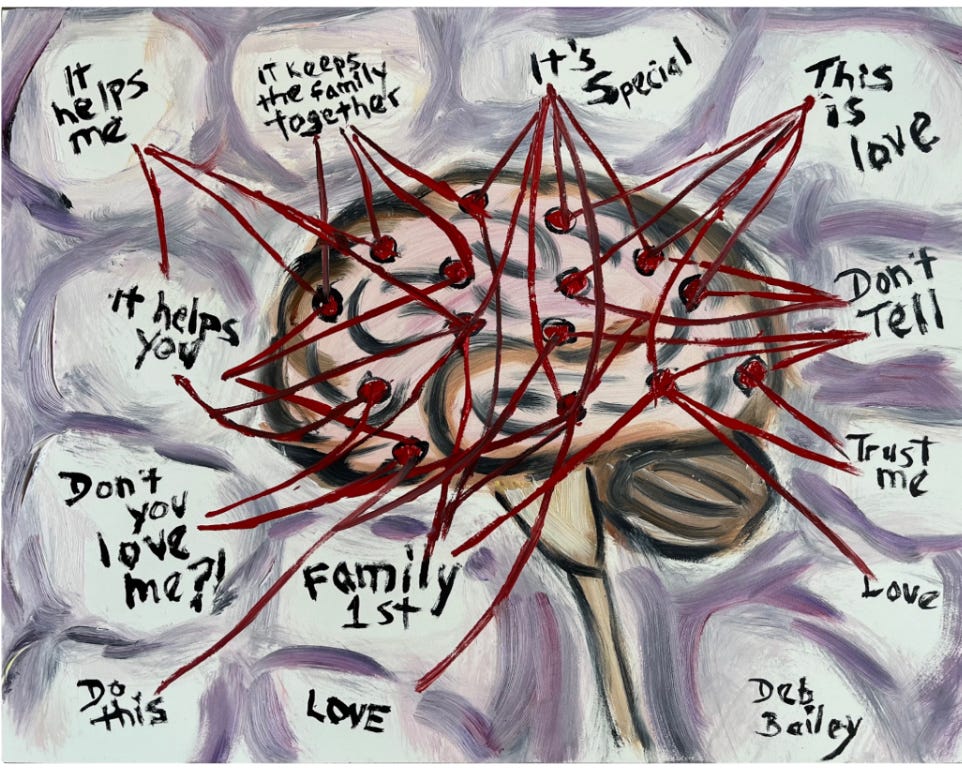
Were there Signs?
Yes. Several. And I know now that these were signs. But none of us knew about this back then. It was just accepted as the normal, if unpleasant, reality of our house:
- Hypervigilance – Walking on eggshells and being intensely aware of the abuser’s moods, actions, and words so as not to set them off
- Trying to please or placate the abuser, even when it goes against your values or perceptions
- Accepting the abuser’s version of reality as your own
- Believing you are failing, worthless, and/or deserve the abuse and criticism
- Hiding and covering up the abuse from anyone else
- Minimizing and making excuses for the abuser’s actions
- Unable to leave because of an intense need for the abuser
- Feeling great relief and gratitude for even small signs of affection or kindness
- Being willing to keep lowering your standards or boundaries more and more to keep the peace
- If you try to leave, feeling intense guilt, and falling for their apologies, begging you to stay, and promises to change
Pathological Denial
Retreat into intense denial could be another sign. One of my therapists mentioned this state to me as a possibility for what my mother may have been living in. Faced with the reality of no escape, no way to support herself, no one to help her, and having his abuse of her and me shoved right in her face, she may have turned inward so as not to “see” the truth of what was happening. So often she felt like a “turned back” to me. Maybe on some level she didn’t even admit to, to turn around might mean seeing him groping me right in the same room as her. So this kind of denial would only have exacerbated her entrapment and mine, and strengthened his control.
Paralysis
With all of the above operating in her and me, the only survival path was paralysis. I just did what I had to do to survive, and to get back in his good graces. I was unable to fight back, unable to know I deserved better, and unable to take any actions that would save me…at least not until my mid-to-late twenties. I was paralyzed, and so was my mother.
5 Reasons You Can’t Leave
- Cognitive dissonance
- Sunk-Cost Fallacy
- Fear of the Unknown
- They pull you back in
- Core Wounds
The cognitive dissonance of being reassured of the abuser’s love with words that don’t match the abusive actions, is crazy-making to the brain. Especially when it happens again and again and again. It causes those five transformations that make you question your own perceptions and instead believe the abuser, even as your gut can’t seem to reconcile it. So instead, you just accept the abuser’s version.
Sunk-cost fallacy is pretty clear. After so much time invested in a relationship and trying to earn the abuser’s love, a person can’t just walk away. Or they feel so much shame that they stayed so long that they are too ashamed to walk away. Either way, they are trapped.
The last three are all emotion-based. Faced with trying to be strong enough to believe yourself, make the break, and then figure out how to survive financially and emotionally on your own, it is terrifying. Even if you sound like you will do it, then the abuser brings on the big guns of the charm offensive to convince you that THIS TIME, it really is different, you are loved, and they will change…all the things that deep down, a victim wants to hear.
And the core wounds – those are the emotional wounds from childhood or previous hurts in life that set up a victim to be vulnerable to the charms of the abuser in the first place. I’ll write more about that next when I talk about my mother.
Bottom line?
The final result of all of this is a family that is dependent, debilitated, and lives in dread of the punishments and violence…i.e., those three qualities the North Koreans discovered when running their POW camps…the three qualities in victims that gave the captor, or the spouse, full “Coercive Control.” Domination is complete.
As to the victims, when they are rendered dependent, debilitated, living in dread of violence, and then intermittently given kindnesses, they become bonded emotionally, physically through brain circuits, and BIOCHEMICALLY through powerful brain hormones, to their abusers.
Up Next
With this, I finally see very clearly…and TOTALLY, just how many weapons he brought to bear on my mother for sure, and me as well. I see now how totally impossible it was for me, as a child brought up in all of this, to have much of a clue that things were so deranged. So the fact I did fight back and get out and finally start on a path back to a saner existence is beyond amazing.
But what of my mother? She was an adult. She was supposed to be his peer in that house. What made her so vulnerable and unable to fight back? And…why don’t I blame her for not protecting me?
Note:
I am seeking financial support to complete my memoir, work with an editor, and make a visit to my home state for fact-checking. Your help would mean the world to me as I take this step toward healing and giving voice to my journey.
Please like, comment, and share this post to help spread the word. The link for my fundraiser is on GoFundMe. Thank you for your support.
Tags: family, love, mental-health, trauma, writing


Leave a comment