Same origins, different paths
I am always picking up interesting rocks and bringing them home…just because I love how they feel in my hand. But while I love all my rocks, I am especially drawn to pegmatite. Powerfully.
I find myself picking it up and just…holding it. Even the obsidian glass arrowheads right next to the pegmatite on my shelf with their ebony sheen just don’t hold a candle to it.
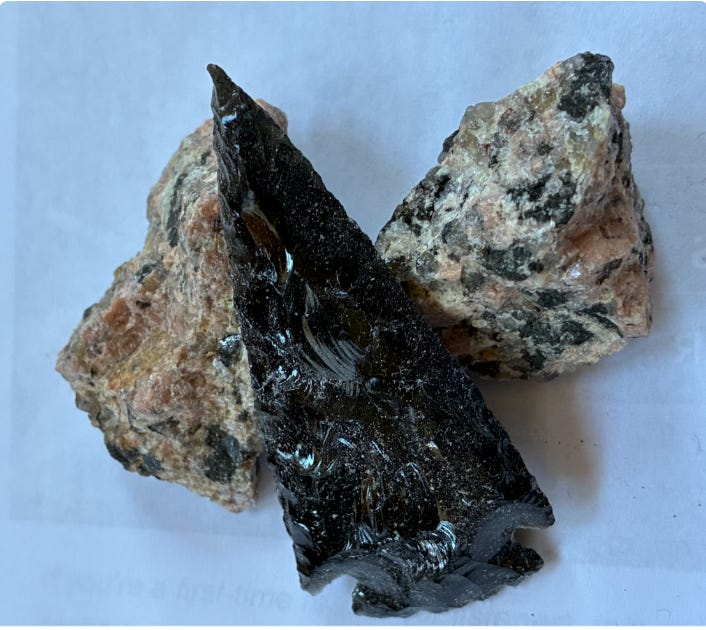
I hold the pegmatite, squeeze it, and feel a sense of “solidity” and “strength.” In my gut, I sense something valuable and complex about it. Why? So, I decided to finally figure out where pegmatite came from and WHY I love it so.
First, it’s an igneous rock, which means it was formed in the fiery heart of a volcanic environment from hot magma. Magma is molten rock held in a chamber deep under a volcano – usually down in the Earth’s lower crust, or even further down in the “mantle” layers that sit above the Earth’s core.
There are different kinds of magma, depending on the minerals dissolved in it. In the case of pegmatite, it is formed from something called “felsic” magma, which means it has a large amount of silica in it. Other things, such as aluminum, oxygen, sodium, and other elements in trace amounts, are present as well. But it has an especially large amount of silica.
It was at this moment that I discovered something really weird. The same magma that produced my beloved pegmatite also produced that glassy black and bluish obsidian! How could two so very different specimens come out of the same magma?
Digging further, I learned that while both are “igneous” rocks, obsidian is called an “extrusive” igneous rock while pegmatite is known as “intrusive.” Okay, I was really intrigued now. It seems that extrusive rocks like obsidian are formed from the top, very viscous layer of magma that gets shot out of the volcano and cools very rapidly. Hence, it has a smooth, glassy, homogeneous consistency.
Pegmatite is formed from the deeper layers when more water and residual minerals are mixed into it. Instead of being forced quickly outside the volcano, that layer of magma is forced deep underground into cracks and crevices where it then cools very slowly. The slow cooling allows all the various atoms of the minerals to rearrange themselves into crystalline structures. So, when you find a chunk of pegmatite, it is often composed of crystals of quartz, feldspar, tourmaline, and mica. It is formed from entirely different processes than obsidian.
While they both started in the same place, with the same ingredients of silica, oxygen, and aluminum, they end up as entirely different “entities” with very different uses.
Obsidian is valued as a gem, as a healing stone, and was also used for arrows and knives in early cultures. In fact, it has an edge sharper than steel and can be made into scalpel blades that cause less inflammation when cutting than regular blades. However, it is not FDA-approved for surgical uses because it is brittle and breaks too easily. It is being used in animal research, though, so maybe they’ll find a human application yet.
Pegmatite has many more uses. Because of the variety of minerals and crystals it contains, it has wide-ranging industrial value. Everything from abrasives, ceramics, pigments, and construction materials to electronics, tin, and even lithium extraction. Some pegmatite even contains uranium.
If you look at pegmatite, it has so much complexity:
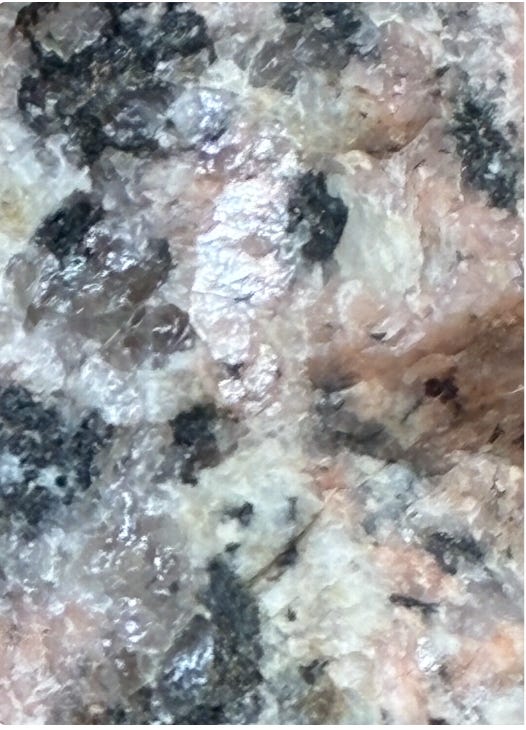
- The white crystal parts are quartz
- The pinkish background rock is feldspar
- The flat shiny sheets that reflect in the light when you move the rock back and forth are mostly mica
- The black background chunks are known as schorl tourmaline – the black color due to the presence of iron
Two rocks. The same origins. The same main chemicals. But very different “births” and then very different outcomes. I think on some level, I always felt that about pegmatite, that it had a deeper story than obsidian.
Wrapping my fingers around a chunk, I can almost feel the reverberations of its origin, its struggle to form, trapped deep underground, held captive for long periods of time, its atoms undergoing severe transformations in the fiery depths, as that magma rearranged itself to be something so very different from obsidian. In the end, both are equally useful. Just different.
Maybe the same can be said about people. Each has their value. But each forms differently and follows their own individual path and timing on their way to their destiny.
Will it go smoothly for everyone else in the family system?
So if a person decides to change their position in that family system, make a break, start therapy, whatever, how will everyone else respond?
First, whether the change is good or bad, it is always hard, both on the person doing it and anyone around them. At the very least, it requires everyone to shift from whatever balance they had and make room for a “new” reality.
Also, there is NEVER a good time or a best time for this. There is only – what do you need to do, and when. And sometimes that “when” may require timing that is critical for you, but terrible for another.
And it will never be executed perfectly, or even well. Changing something in a house full of trauma is a place already off-balance. Everyone is just trying to survive. So it is bound to be messy.
As I’ve written before, everyone in the family system, even if not directly abused, is STILL “abused.” They are still harmed because they are all living in that same system of manipulation and toxic rules, stress, and possibly violence.
Like obsidian and pegmatite, they may all start in the same place, but things may vary widely from there. This means:
- Each person has their own hurts and wounds
- Each experienced the abuse differently
- Each person is trying to just understand what is going on, much less what any change means
- Each has their own needs for a healing process
- Each has different abilities to grasp, process, and integrate the change before they can adapt
- Each has their own way to heal that will work best for them, and they need time to discover that
- Each has their own timing for what they are ready for and need
- This means that no one’s process, timing, abilities, damage, or pain are the same.
- And thus, no one can dictate to another when or how to heal, or what to accept
And none of this even takes into account what is going on in the present moment of each member’s life. What kind of access does each person have to resources and support? What is their current living situation, relationships, and job situation? What are their own immediate crises and responsibilities, such as whether they have kids who have their own needs, etc.
The bottom line is that regardless of the individual experiences, each person is still a survivor who has to find their own way out of it all and figure out how to go on with their life, and when. So each person’s reactions to how another deals with their individual traumas may be wide-ranging, anything from totally supportive to someone who decides to move away and never see the other again. There is no predicting what it will be. And that makes sense.
Monsters and amplifiers
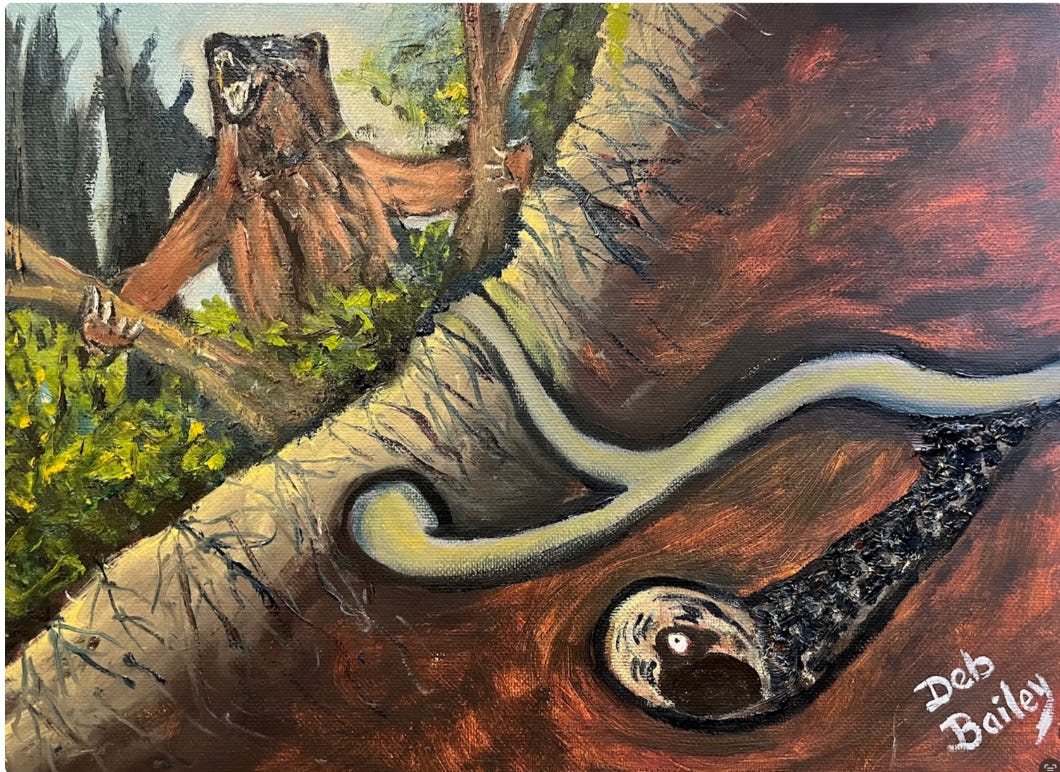
The family system is its own living, breathing monster. The abuser has crafted an environment that serves him or her. It is all about the twisted rules the abuser put in place to be sure his needs are filled. It’s like a wound spring that, when released, can shoot all over the place, at least at first. And while the abuser rages, the rest take cover.
It’s not the people in it. Each has been victimized by this system. It is the toxic atmosphere from those rules that makes the situation more like tearing open an abscess to drain it. It’s necessary to heal, but sometimes it gets messier before it gets better. Thank the abuser. That’s who set it all up.
And even as people try to understand and heal, the abuser will keep interfering with the process. Here is where that tool of cognitive dissonance really drives the wedge between everyone.
In moments where one or more members decide they’ve had enough, he is suddenly sorry. Apologizing, pleading, repentant. He is admitting he was wrong, doing nice things, bombing everyone else with love to play on their sympathies and get them on his side. And this extends to people outside of the immediate household.
In those moments, it is especially destabilizing and disorienting for everyone, even the person or people who want the change. Because in the end, no one wants to have to blow up a household. It’s so hard to reconcile the person who is both abusive AND loving.
Also, when situations are stressful and breaking apart, things may get said that are hurtful or misunderstood. For example, my brother, who was a year older than me, was stillborn. No question, a heartbreaking outcome, especially for my parents. But I have also said I was glad he didn’t make it. That sounds utterly horrible and mean.
The truth is, I didn’t wish for him to die. It was said out of fear and relief. I realized that if he had lived, my father would have destroyed him with expectations and, no doubt, physical abuse. It is entirely possible that I might have ended up being abused by BOTH my father and older brother. Those things happen. And I knew that if both of them abused me, I wouldn’t have survived that. It would have been too much. So my heartless statement was more a statement of fear, relief, and awareness that those forces could have killed me. I was just trying to survive that mess. At that point, it was every man for himself. Toxic family systems can do that.
Mark Manson, the host of the podcast Solved, did a segment entitled: “Bad Relationships: Why Smart People Stay Stuck.” He made one comment that I thought captured things well:
“Relationships are amplifiers. I’ve always thought this. Love doesn’t necessarily make you happy, it amplifies whatever is already there.”
In those “amplifying stress moments,” there can be chaos, hurt, misunderstanding, distrust, and confusion. And most definitely, grief. Grief at the pain inflicted. Grief over the loss of what might have been. And the ache because in a family, along with all the negative feelings, there can also still be love. Yes…love. And support.
While a fractured household, traumatized from years of abuse, may struggle to find a way back, it doesn’t mean there might not also be a desire to fix things… renew bonds… heal wounds. It may take time for each person to work through what they need. In their own way. On their own timetable. And though at times it may seem like there is nothing but an impasse — even in the best of circumstances, families can be messy — there may also be a chance to build bridges across the gaps.
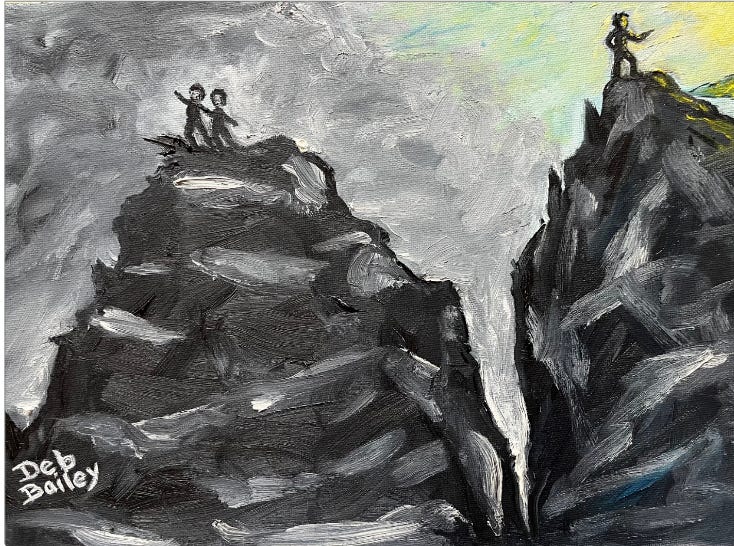
Confronting relationship issues is not admitting failure. It is the beginning of something new. Because if relationships can amplify the bad, they can also magnify the good.
So about “Cycle-breaking”
Is it worth it all? Absolutely. And it’s never too late. Jim Collins, in his book, What to Make of a Life, gives example after example of people who not only did their best work AFTER midlife, but continued to do so well into their 6th, 7th, 8th decades and beyond. The point was to keep feeding the inner fire and remain open to possibilities. To HOPE. I will write about hope soon.
I came across a quote that had no attribution for the author, but I kept it because it is powerful to me:
“Never underestimate a cycle breaker. Not only did they experience years of generational trauma, but they stood in the face of the trauma and fought to say ‘This ends with me.’ This is brave. This is powerful. This comes at a significant cost. Never underestimate a cycle breaker.”
It is possible to do this. We CAN do this. We MUST do this.
“And as hard as this choice is, we break the pattern before the pattern breaks us.”
Colleen Hoover, from her novel It Ends With Us
Up Next
Progress status check: So, after all of this, where was I at?
Note:
I am seeking financial support to complete my memoir, work with an editor, and make a visit to my home state for fact-checking. Your help would mean the world to me as I take this step toward healing and giving voice to my journey.
Please like, comment, and share this post to help spread the word. The link for my fundraiser is on GoFundMe. Thank you for your support.


Leave a Reply