Late afternoons
Maybe it starts the first time you notice just how tightly you clench your teeth every afternoon around 3:00 p.m. Or with the anxiety that floods through you in response to the sun slanting lower in the sky. In those moments, before you even look at the clock, you realize that you already know what time it is. It’s the time that He’ll be home soon. And suddenly, any peace from the day’s respite evaporates.
That time, or the next, or the next, might not be enough to drive a change. But it’s a start. A crack in the wall of your despair. And cracks let drops of the outside world, with its different realities, seep in.
Over time, the crack widens. Because once you have noticed those things in the late afternoons, you can’t unsee them. And your anger and resentment build despite your fear.
The final straw moment might be anything. A poster on the back of the bathroom door at your doctor’s office asking if your partner hits you? Or are you afraid of them? And if so, call this number.
Maybe it’s something more stark, like seeing yet another bruise change from purple to that sick yellow-green as it spreads across your skin. Until you get another. And another.
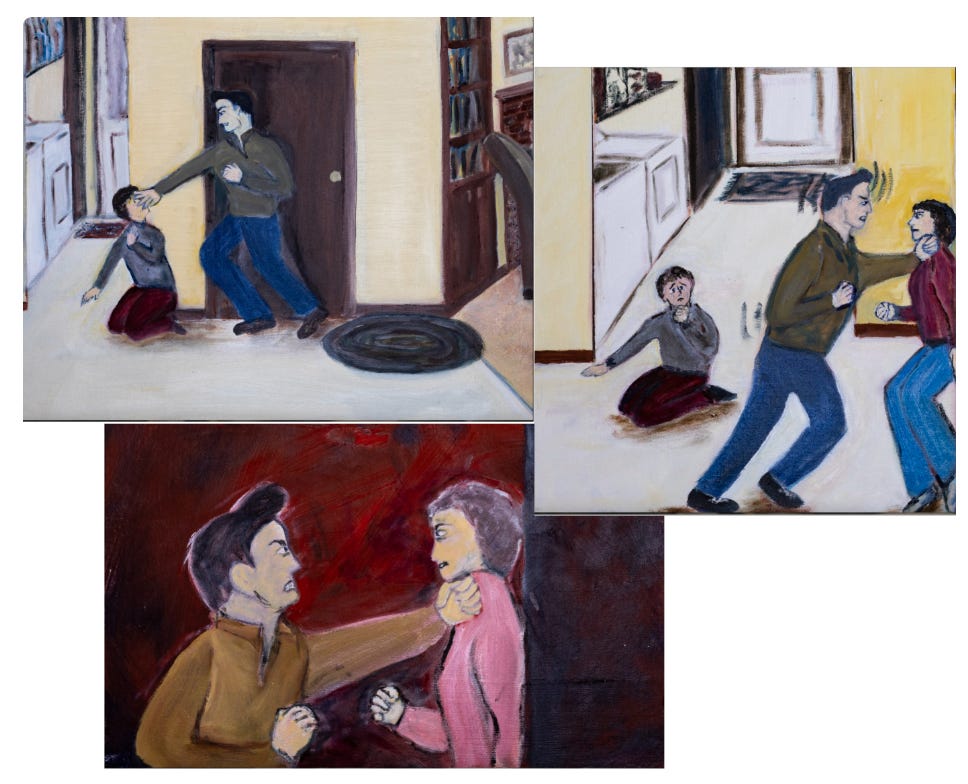
For me, it was that time my father knocked my mother to the floor. Something in me snapped that day. Rage from years of listening to him hit her, and wondering if this was the time he would kill her, just exploded within me.
For the first time ever, I stormed downstairs and actually got between them. I remember the fury I felt as I stared him in the eye and yelled that he needed help. I had never ever risked that before. But this time, it was one time too many. And I wouldn’t let it go anymore. That was my mother on the floor. My MOTHER. And I just wouldn’t stand it anymore.
That’s when he grabbed me by the throat, yet again, like so many times before, and shoved me into the wall. He caught himself before he pushed any harder. But that time became the moment of change. Because in that moment, for the first time ever, I knew if I’d had a weapon in my hands, I would have used it. And that’s when I knew I HAD TO GET OUT. I…was…done.
Forget logic
An outsider watching my life through the years would no doubt have wondered why I was still there or why it took me that long to see how warped it all was. They might have judged me for not knowing better. But I had been in it so long I couldn’t see it. Until that day.
For others, who knows what that moment might look like. And for some, the moment may never come…or it comes too late. It’s not a certainty. I only know it’s hard, and takes a lot.
“Cycles exist because they are excruciating to break. It takes an astronomical amount of pain and courage to disrupt a familiar pattern. Sometimes it seems easier to just keep running in the same familiar circles, rather than facing the fear of jumping and possibly not landing on your feet.”
Colleen Hoover, from her book, It Ends With Us
For years I had tried the usual things people do in relationships – you try to make them see the truth. You try logic. You share heartfelt emotions. You bring mounds of facts and evidence. Surely any logical person, confronted with all of that, should be able to see the truth. But abuse isn’t about logic or facts. It’s about what the abuser wants, needs, and will take one way or another. And every time you present a fact or logical argument that you are sure is effective, they deflect it and change the rules. Even if I confronted him with his own words, it didn’t work.
Whenever he wanted to criticize me for not looking after my siblings correctly, he would say, “You’re the oldest! You should know better!”
Well…he was older than me. Shouldn’t HE have known better than to abuse me? Of course I never said that to him. That would have gotten me pummeled.
For me to get out of that house, it took me coming to that breaking point where, despite all his programming and manipulation, I believed in myself enough to stick with “This ends now.” In the end, for me, it was God and later, therapy, that got me through it all.
Stop asking “Why did he/she wait so long?”
So about breaking patterns, and being that cycle-breaker. Once you decide to leave, is the hard part over? And will you now go forward with no second thoughts? I can’t speak for anyone else. I only know for me it was a long, slow evolution.
“Adult children don’t just wake up one day and say, ‘I’m done with my parent, I don’t ever want to speak to them again.’ Making that decision usually takes years, and many failed attempts to heal the relationship. Cutting off a parent comes with immense grief and lots of shaming.”
Genesis Games, Licensed Mental Health Counselor and relationship therapist
It takes a long time to untangle yourself from the effects of all the mental programming, emotional bonding, and terror, to see clearly what is going on. The progress is glacial. But this is often something outsiders don’t understand.
The New York Times just reported on a comment allegedly made by Cornell University’s president about the gang-rape of one of the students. “Why did she wait so long to report it?” There is a difference of opinion as to his exact meaning. However, that instance brings up the bigger issues regarding rape and abuse.
First, a statement like that seems wrong on so many levels. But the BIGGEST issue right up front is the one of WHERE THE BLAME RESIDES. It ALWAYS resides with the ABUSER. It is the abuser who has the problem, NOT THE VICTIM.
The real question is never “Why did he/she wait so long?” but “Why did he/she think it was okay to abuse?!”
The second issue I have with that kind of question is that it makes it appear that because a victim was unable to report an assault right away, that it lessens the horror of what happened and makes her culpable.
And third, it shows the problem at its core for anyone who has never been abused or raped: They don’t understand that a victim CAN’T always do something right away. That person is reeling from trauma. Whether the trauma is from years of constant abuse or an acute situation, such as a gang-rape, either way, they are cognitively destabilized and unable to harness the power of a frontal cortex to make clear decisions. It’s not just emotions, but biology and chemistry.
A traumatized person is trying to manage destabilizing effects from an abnormal situation. And a comment like that implies victim-blaming and is devoid of empathy or any understanding of the effects of trauma on a victim.
Here’s an example of how hard it was for me to truly SEE the full reality of my father for years.
Even long after I got out of that house and had undergone much therapy, it was STILL hard to see him as an “abuser” versus “a good man with a bad problem. For years, we were still operating on trying to contain him and convince him to get help.
Early on in those years, I had confronted him for not getting help and threatened him with jail if he ever touched our kids. A few years later, I sat across from him at the table trying to make him understand that we loved him and that was why we were challenging him. I tried logic with him. Yes, he was my father. Yes, I appreciated the good things he did. Yes, I even loved him. But, as I reminded him, all through my childhood he brought me up to look after those younger than me. And I was doing that right now because it was the right thing. Couldn’t he see that???
No. He just stared back at me and pretended all was fine. But there was a coldness under it. At the time, I was trying so hard to connect with him. Truly reach him and bring about change. But I know now that he simply heard my words. That was it.
He wasn’t interested in logic, deep connection, or heartfelt pleas to get help for the sake of our family. The truth is…he didn’t care about us. But it took me YEARS…DECADES…to understand that. I was still thinking of him as a man who could be reached…helped…who loved us but just “had this problem. And if I could just find the right words, he would get help, and it would be all better.“ But it wouldn’t. Because he didn’t care and he didn’t WANT TO. And he never would.
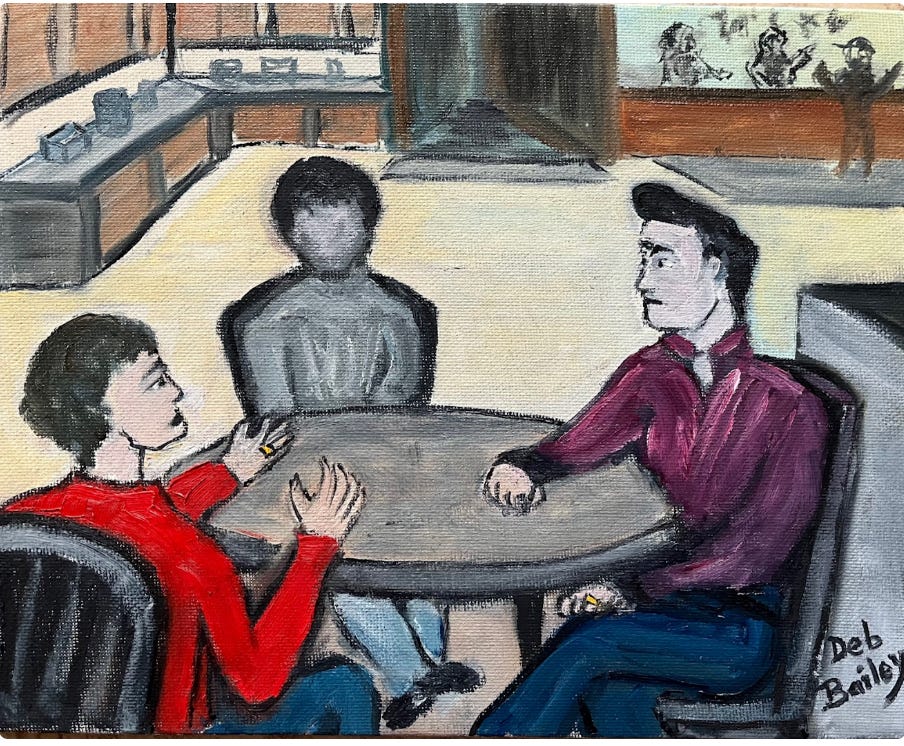
So forget logic, reasoning, facts, or emotions. Dad, “our abuser,” wanted what he wanted, and that was it.
Now what?
In any event, to come back to the example at the top of this post. A person has reached their limit and decides that this is it. They are going to make a break. Is that hard part over?
No. That’s where it begins. Because there are a lot of things to think about. And this is where a crisis hotline or a women’s shelter — those places listed on the poster on the bathroom door in the doctor’s office — is vital. And a therapist or support group.
While I didn’t have any of those resources when I decided to get out, I still had it a bit easier because my decision to get out only affected me. I wasn’t a battered wife with kids to think about. And I had a job, and my own bank accounts with a bit of savings.
But I still had to figure out where I was going to live, what I might need, and take the time to execute it all, all while he was angry at me and giving me the silent treatment. So it was emotionally hard. And I was totally unprepared for life. So I wavered and felt terror.
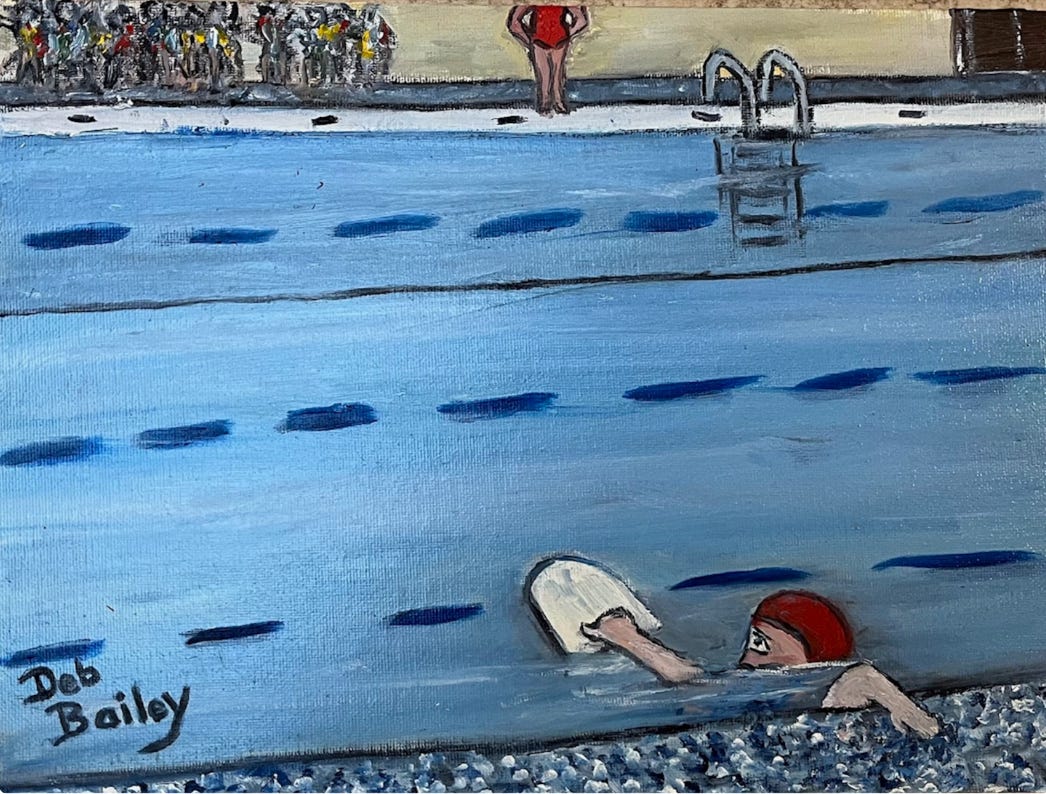
For me, unlike in my childhood swim class, I just finally had to get the courage to “let go of the side of the pool,” and strike out. I could face the rest later.
And even though my father was vindictive and angry about my decision, he wasn’t violent. Quite often there are risks to breaking a cycle, especially if you are the spouse. And that risk can involve threats, physical violence, or deadly attacks. The most dangerous period for a woman leaving an abusive partner is often during the time when she is working to leave. In that case, having a support system, such as a shelter to go to, could be life-saving.
And a good therapist, hotline, or shelter can offer guidance on the many things to plan for, from where to live, legal help, how to get around, and especially any kids involved. What will they need, and how will all of this affect them emotionally, in school, and financially? Someone who has guided others in this can be vital.
Another area where emotional support helps is to deal with the subtler ways abusers may try to fight back. Even if the abuser isn’t physically violent, they may try to use money as a weapon by cutting off bank accounts. Or they might try to discredit or malign the victim through rumors amongst friends or attacks on social media.
The goal is to make the victim appear unstable, dishonest, or the real problem in the relationship. Suddenly, the traumatized spouse has become the “black sheep” for making a change, and the scapegoat for all that is wrong in the home. By shifting the blame onto the victimized spouse, the abuser tries to gain the sympathy of others and to get friends and even other family members on his or her side.
No question this is another way that makes it hard for a cycle-breaker. They feel guilty. Isolated. And question themselves. That is the abuser’s intention because any attempt for change by the victim is seen as a threat to the abuser’s carefully constructed control in the home.
But the reality is, by initiating change in one’s life and leaving the abuse, the survivor is taking healthy action to follow their inner truth. No more abuse. No more secrets. Just truth.
Leaving is not impossible. In fact, it might be life-saving, and the best thing for any children involved. I just can’t recommend enough finding allies and professional help — crisis lines; shelters; therapists; lawyers. They can provide the support, reassurance, and connections to vital resources and protection.
One last thing I learned over a lifetime. I needed the RIGHT therapist for the job. Not all therapists are trained to deal with abuse situations. They may offer advice such as, “Well communicate your needs better…set better boundaries…try forgiving.” This may be fine in a non-abusive relationship where both partners are working in good faith to resolve problems and are equally invested in healing the relationship. And as to FORGIVENESS, I will talk about that later.
For here, I want to emphasize that in abuse situations, the “average advice” isn’t necessarily helpful…or even safe. Here, one partner is being victimized or threatened, and the other may escalate to violence if they feel they are losing control. So it is important to find the right therapist for the job. There is no shame in changing providers.
Again, it is the abuser who is responsible for the trauma, not the survivor. And the next time someone says, “Why doesn’t she just leave?” ….It ain’t that simple.
Up Next
Breaking Free – Part II: The rest of the family system….
Note:
I am seeking financial support to complete my memoir, work with an editor, and make a visit to my home state for fact-checking. Your help would mean the world to me as I take this step toward healing and giving voice to my journey.
Please like, comment, and share this post to help spread the word. The link for my fundraiser is on GoFundMe. Thank you for your support.
Tags: abuse, healing, life, mental-health, writing


Leave a Reply