For several days now, I have been trying to write this post, struggling to find the right entry point and the right words to explain something bigger than me without losing it. Over and over, I’ve written things. Approached from different angles. Journaled on points I want to share. But how to organize it all? And worse, how to connect so many things into a logical sequence. How do you capture things that are of our inner spiritual and emotional realms? That’s like trying to find the words to describe God.
I kept making mind maps, cutting up all my notes and scribbles, and literally taping them together in different ways to find the “flow” of the topic.
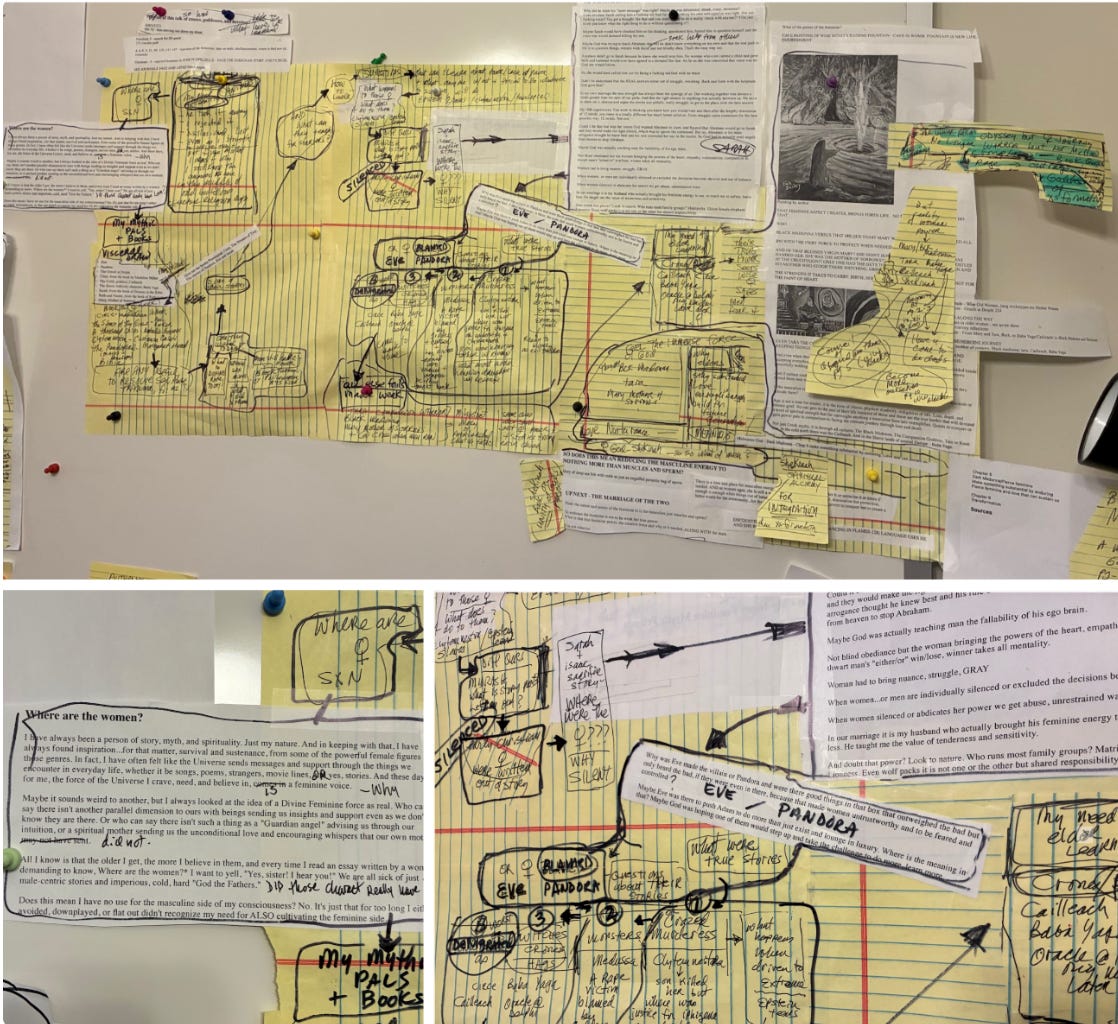
I know that I am at the crux of it all right now – the “core of the onion” that I’ve been peeling apart for years. And my teeth are sunk deep into its layers so it can’t “get away.” But still it fights me as I struggle to get it in focus.
So, finally, it just comes down to: “put words on paper and let the emotions lead where they may.” It’s a “first draft,” and it doesn’t have to be perfect. It just has to be. So here goes…
I’ll know it when I see it
Over the last couple of years, I’ve been on a quest to find that source of primal knowledge — unnamed, but felt — that would reveal to me the secret of how a woman moves well through the stages of her life. It is a body of knowledge I was denied my whole life, and I now hunger for it. It’s like I am searching for the Holy Grail of feminine wisdom.
Words such as mystical, mythical, and divine pull at me, as well as terms like wisdom, identity, and meaning. They compel me to get and read every book I can find about women elders, goddesses, and spiritual leaders.
Most people might be surprised to know that these types of women, or stories, even exist – I know I was. Our male-dominated culture…and my male-dominated life, silenced and hid them.
But now, having discovered these precious gems, I practically scrape their pages clean with my eyes, greedily ingesting each word. I want to understand all of the nuances of that journey that others seemed to already know — from the innocence of the maiden, to the fertility of adulthood; from the descent into midlife’s darkness, to the resurrection and power of the elder years.
There is some “thing” in the pages of those books that I am supposed to find. It’s calling me. And while I can’t tell you exactly what it is I am looking for, I “feel its existence” and will know it when I see it.
It is an overwhelming time for me. Having gotten this far with my writing, I feel close to a breakthrough, on the edge of an even larger metamorphosis than that of a caterpillar to a butterfly. I want to describe it effectively as I experience it, both for me and my reader. So I am going to work through this step-by-step and try to do a good job.
Why my compulsion about identity?
“In my adolescence, a grown man fed identity to me, shoved it down my throat…The man who abused me…did everything he could to take me apart psychically and reassemble me according to his desires and whims…”
Jen Cross, Writing Ourselves Whole: Using the Power of Your Own Creativity to Recover and Heal From Sexual Trauma (53, 96)
That sums up the nature of my wound. No wonder I’ve struggled to know who I was or trust my own assessments. It was bad enough that Dad fed me the identity he wanted me to have and blocked me from forming my own or connecting with my mother to learn from her. But worst of all, he trained me to very effectively do one other thing: Deny myself my feminine identity. And I was not alone in that. What do I mean?
Maureen Murdock, in her book The Heroine’s Journey: Woman’s Quest for Wholeness, tells how the journey starts:
“This beginning stage of the journey often includes a rejection of the feminine as defined as passive, manipulative, or nonproductive. Women in our culture have often been…perceived as weak, inferior, and dependent…by many women as well. Women who seek success in the male-oriented work world often choose this path…Our heroine puts on her armor, picks up her sword, chooses her swiftest steed, and goes into battle…The men smile, shake her hand, and welcome her to the club.”
This same sentiment was mirrored by many other women, including Rabbi Tirzah Firestone. In her book, The Receiving: Reclaiming Jewish Women’s Wisdom, she admits falling into the same trap: “Like many other women in our imbalanced culture, I myself had grown up identifying with masculine values, secretly considering feminine ways less worthy and less effective.”
This is intensified if a woman’s relationship with her mother was missing or negative. For myself, seeing my mother victimized, denigrated, passive, and rendered powerless, drove me so far to the other side of things – the masculine side – because that was where the power, control, and possible safety resided. So…I denied my own feminine identity.
Yet this only works for so long. Both Murdock and Firestone described reaching a place where aligning with the masculine no longer works. They felt out of sync with themselves, and longed for something else. Murdock explains:
“In her desire to dispel the negative associations with the feminine, our heroine has created an imbalance within herself which has left her scarred and broken. She has learned how to get things done logically and efficiently but has sacrificed her health, dreams, and intuition…lost is a deep relationship to her own feminine nature….many women who have embraced the masculine hero’s journey have forgotten how to foster — themselves.”
That’s when a woman finally starts to understand the real issue: How does one act or feel as a woman?
And at that point, the only way back is to descend into the darkness of her soul. She enters a sacred journey to reclaim herself that needs to go slowly, and that demands wandering through grief, shame, and rage, confusion, emptiness, and loss.
That path has been the crux of my struggle as I wrote this book. Walk that road. Sit in the dark with the unknown. Wrestle to find the insights.
In enduring this journey, a woman starts to find all the missing pieces of herself that she abandoned all those years ago. When she emerges, she is a different person, embracing values such as feminine insight, wisdom, and nurturance. Instead of seeking the heights of male power-climbing and glorious victories, she learns of the power of the “ordinary” to ground herself and heal.
Many books refer to this new place of existence as the “Crone stage.” And that is where I am. But I have to say I dislike that name — crone. Or hag. Or witch. Or old woman. Why such demeaning terms? Are men so terrified of an older woman that they need especially nasty names to mock her and render her powerless? And if so, why? What exactly is it about an older woman that men fear?
And that’s when it really confirmed for me that I am on the right track to my answers. If I have walked through my darkness, endured such pain, and emerged different, there is a power I now possess that I didn’t have earlier in life. What is it exactly, and what is its nature? Just how powerful AM I because of this “force” I am feeling but have been unable to define?
That’s when I realized where the rest of my quest in this book needs to go to keep healing — the stories of the Crones and Hags and Witches. It is time to learn the exact nature of my “crone” powers and what I am to do with them.
I have found my identity – an old crone – which means I possess a hard-earned wisdom that needs to be tapped. Now it is time for me to explore why I am feared, and just how I can wield my powers for good in the world, and for meaning in the rest of my days.
And it is that word, meaning, that brings me back to those other words – mystical, mythical, and the divine. Those are the keys to finding my answers.
Where are the women?
I have always been a person of story, myth, and spirituality. Just my nature. And in keeping with that, I have always found inspiration…for that matter, survival and sustenance, with some of the powerful female figures in those genres. In fact, I have often felt like the Universe sends messages and support through the things we encounter in everyday life, whether it be songs, poems, strangers, movie lines, and yes, story characters. And these days, for me, the force from the Universe that I crave, need, and believe in comes in a feminine voice.
Maybe it sounds weird to others, but I always looked at the idea of a Divine Feminine force as real. Who can say there isn’t another parallel dimension to ours with beings sending us insights and support even as we don’t know they are there? Or who can say there isn’t such a thing as a “Guardian angel” advising us through our intuition, or a spiritual mother sending us strength and unconditional love through encouraging whispers…whispers our own mothers may not have sent.
All I know is that the older I get, the more I believe in them, and every time I read an essay written by a woman demanding to know, Where are the women? I want to yell, “Yes, sister! I hear you!”
We are all just so sick of only male-centric stories. Somewhere are the tales of that soft, empathetic force that balances out the imperious, cold hardness of “God the Father.”
Does this mean I have no use for the masculine side of my consciousness? No. And in an upcoming post, I will talk about the power of bringing BOTH sides together. But for right now, I first need to explore just what that feminine is all about.
WHO are the women?
So who are some of my mystical friends, those divine beings and mythological characters that I especially relate to? And what do I draw from each one of them?
I have several, and they come from a variety of stories, cultures, and spiritual paths:
- Eve
- Pandora
- The Oracle at Delphi
- Circe, from the book by Madeline Miller
- The Celtic goddess, Cailleach
- The Slavic folkloric character, Baba Yaga
- Sarah, from the book of Genesis in the Bible
- Ruth and Naomi, from the book of Ruth in the Bible
- Mary, Mother of Sorrows
- The Black Madonna, as opposed to the milquetoast version created by the patriarchal Catholic Church fathers.
- Tara, The Buddhist Compassion Goddess
And regarding books, aside from ones I’ve already quoted and will list in the appendix, ones that draw me so viscerally as if they almost have me by the throat include the following. I list them in no particular order:
Circe by Madeline Miller
The Silence of the Girls by Pat Barker
A Thousand Ships by Natalie Haynes
Clytemnestra by Costanza Casati
The Penelopiad by Margaret Atwood
The Bible’s Book of Genesis and the story of Sarah, Abraham, and Isaac
The Bible’s Book of Ruth and the story of Ruth and Naomi
Each of these stories — the struggles, pain, themes — hit me intensely on a gut level. I’ll speak of all of that next.
Up Next
How can stories from Greek Mythology or the Bible help me heal from decades of sexual abuse?
And why are they actually relevant today?
Note:
I am seeking financial support to complete my memoir, work with an editor, and make a visit to my home state for fact-checking. Your help would mean the world to me as I take this step toward healing and giving voice to my journey.
Please like, comment, and share this post to help spread the word. The link for my fundraiser is on GoFundMe. Thank you for your support.
Tags: healing, life, love, spirituality, writing


Leave a Reply