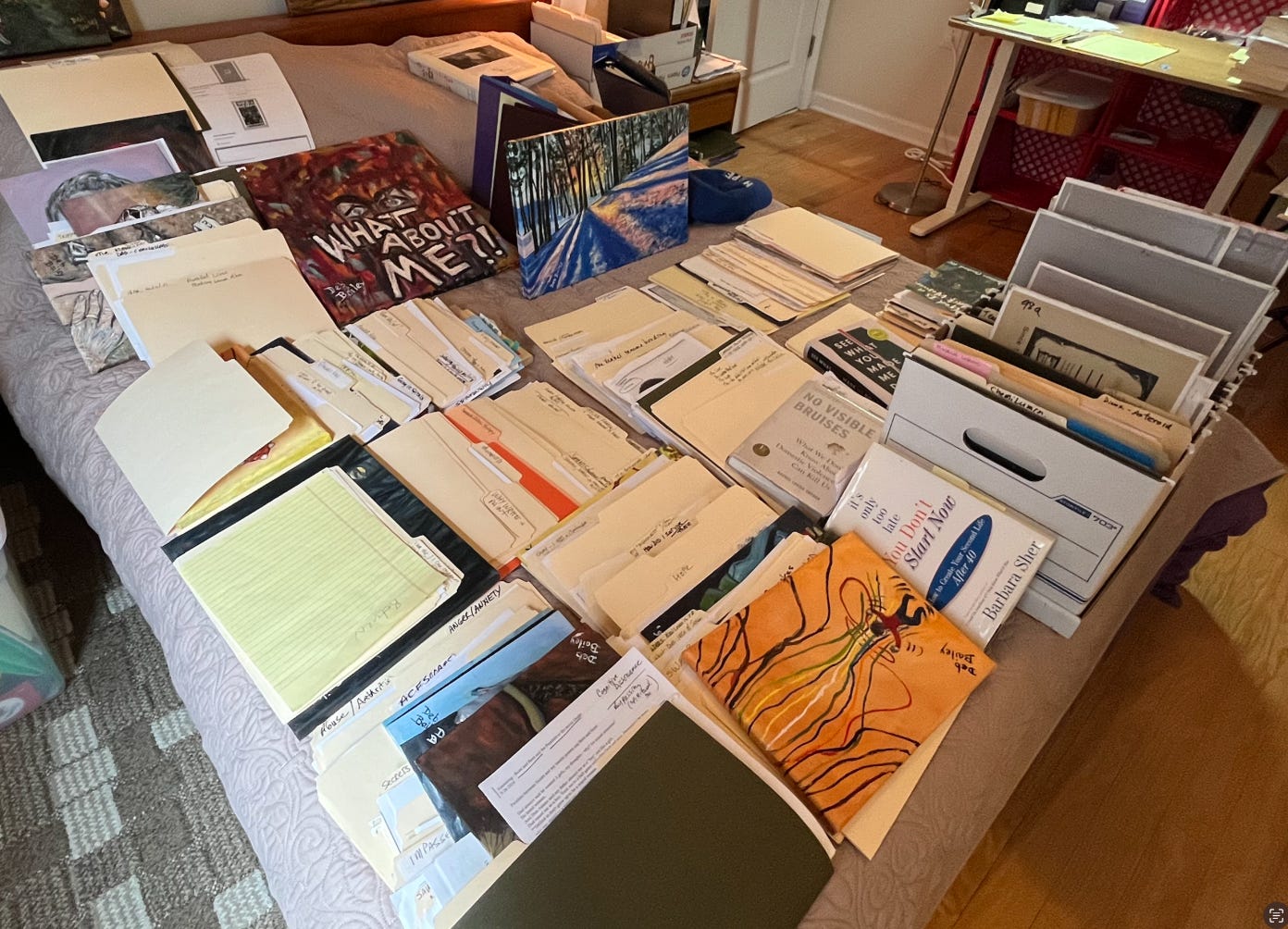
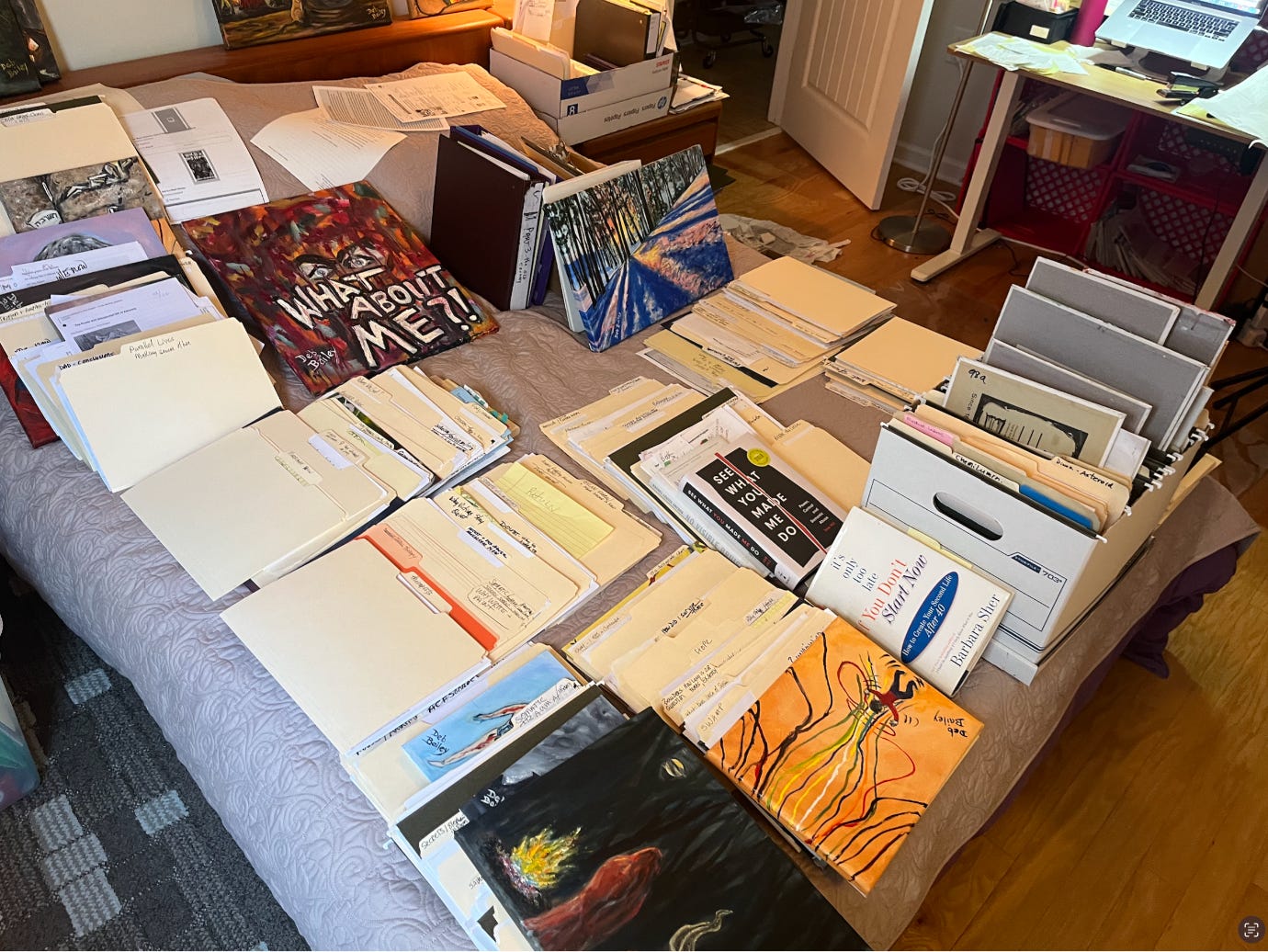
The first time I walked into a therapist’s office, I was actually shaking. Terrified, consumed with shame, and coming apart at the seams, I could barely speak. In fact, when I told the therapist why I was there, I could only WHISPER the words because I was so afraid. For 28 years, I’d been brainwashed, guilted, and bullied into loyal silence by my father. And I understood that just by walking into that office, I was breaking EVERY ONE of those rules drilled into me for a lifetime. I expected unimaginable horrors to descend on me, though I couldn’t tell you what they would be. I was just convinced that this was going to result in something terrible. AND I would be inflicting hurt on my family, because of my “transgression in speaking.”
But I was hanging on by a thread, and was actually scared about how unglued I felt. I was caught between two “no-win” situations. I was damned and betraying my family if I spoke. And I was going down the tubes if I remained silent. I’d never felt this low or hopeless before. And God was of no use to me anymore.
For all those years, I’d believed in and prayed to God for help. Yet in the end, it seemed that I’d asked but not received. I’d had to get myself out of that house, alone. And that was the story of my life, past, present, and future – I was alone. So it was on me to save myself. God was out of the picture. And if my only choice left was to mentally “jump out of the plane,” so be it. Life would either provide a parachute or it would finish me.
Aside from school and my quiet morning Masses, my religion had other ways that it was a very strong influence over who I was and how I dealt with what was happening. I can’t speak for how things operate in the Catholic Church today. I have long since left. So what I share here about Catholicism is from what I grew up with and how it affected me, personally, for better or worse. Thus, I speak only about my own experiences, and no disrespect to anyone else’s.
What is Normal?
To a child, whatever they are living in is “normal.” A child has no other experience or way to assess that what they are living in is beyond the pale, or “abusive.” They only know what is reflected back at them from those around them.
For me, that was from the rules of my culture, my religion, my household, the ethics and examples of the adults around me….all the things I have been sharing. And that would have been IN ADDITION TO the constant repetition of brainwashing messages I got at home from Dad. So if all of those influences reflect back to me that this is just normal life, that is what I accepted.
The only other reference point a child has is their own sense, intuitively, of what feels right or wrong, good or bad to them. Their own compass that just comes from within. My own nature was gentle, even as it was competitive. I loved deeply. I was loyal and had a strong code of honor. And I was very sensitive to not hurting anyone’s feelings, especially the people close to me.
I also seemed to have an ingrained sense of morality, and an intense awareness of church teachings and of what was sinful…which meant what was hurting God.
So it was a source of conflict to me to hear Dad’s messages that what we were doing was okay, versus feeling in my gut that it wasn’t right. Then add in what I learned in religion class and in church. And to me, it seemed like what we were doing was a sin, and so I must be hurting God. These were no small conflicts for a child to feel, much less resolve. And it would only get worse with time.
What were those church teachings and influences? I split them into two categories, the first of which I’ll talk about in this essay – the stories that taught a way to live. The second, the rules and rituals the Church laid out, I’ll speak of in the next essay.
As strange as it sounds, I LOVED the weekday Masses we had to attend before school. It was just me, and God, and a safe space…
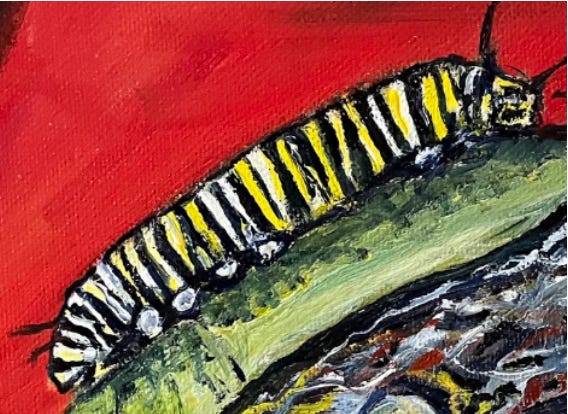
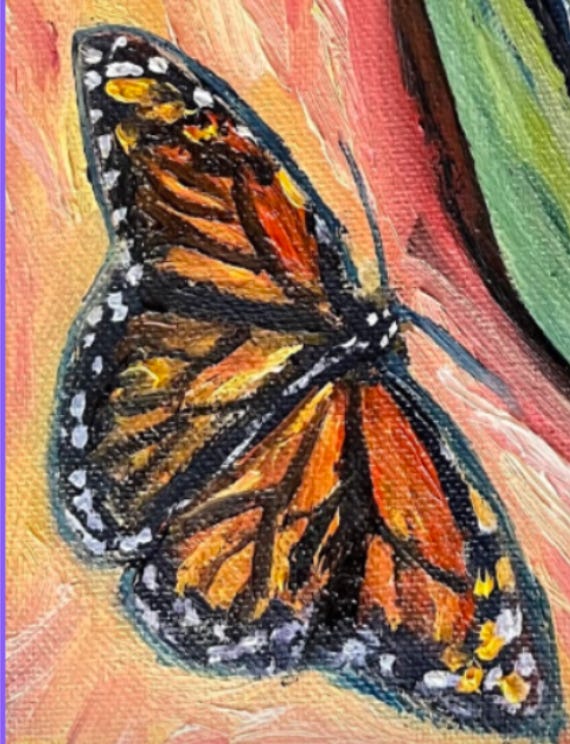
Photo and painting by author
School days started early. When I was first able to receive Communion with Mass at the end of second grade, the rule required that we fast for 3 hours prior to Communion. So I would just dress, grab my red-checkered metal lunch box, and go to church. My mother had packed not just lunch, but some buttered toast with cinnamon and sugar – my favorite. After Mass, the Sisters would give us time to eat breakfast. That rule changed soon after to a 1-hour fast, so I would eat breakfast before leaving in the morning.
Dad would’ve already gone to work, or he would be asleep, so that part of the process was peaceful enough. I’d munch on cereal while the local AM radio station played in the background.
At that time, one of the popular songs was Peggy Lee’s, “Is That All There Is?” I’d listen to her lament over and over, “Is that all there is?” about everything from a circus, to love, to her house burning down. No matter what happened in the song, all she would say was, “Is that all there is?” And then suggest breaking out the booze and keep dancing. I wasn’t sure what the point of the song was or why anyone bothered to write it. Mornings were hard enough without that energy.
Instead, I’d focus on the back of the Ritz cracker box, reading the recipe for “Mock Apple pie” as I ate. Apparently, using their crackers and some spices instead of apples, you could make a pie that tasted like the real thing. While I thought it was neat that you could do that, I wondered why anyone would want to make or eat a fake apple pie. Years later, I learned that during the Depression, apples were expensive and scarce. So this was a way to substitute crackers and still have a dessert. Anyway, done with cereal and Mock Apple pie, and not thinking about if that was all there was, I got dressed and headed to school, and morning Mass.
Photo by author
At church, I’d run to the top of the concrete stairs, yank open the heavy wooden door, and slip quietly inside the vestibule area. The moment the door shut, it felt like I’d entered another world — still, dark, and quiet. It seemed like the air itself didn’t move. Sometimes I would stand there for a couple of minutes before entering the church, just to “soak up” the holy feeling. It was so peaceful, and I loved it.
To everything there is a season….and for one of my nuns, making a whole class write out a chapter from the religion book because we were misbehaving, was the season for punishment. These days, whenever I hear the Byrds sing ‘Turn Turn Turn” on the radio, I remember that day. The chapter we had to write out included the verses from Ecclesiastes 3, about the seasons of life.
In terms of punishment and discipline, both were in abundant supply. And it could range from a simple comment to a physical assault.
My second-grade nun, when she thought we were getting too full of ourselves, would say something like, “Who do you think you are, Lady Jane?!” I always wondered who “Lady Jane” was, or what she did. I expect it wasn’t good, but I knew better than to ask.
Art class
One of my least favorite punishments was for them to take away our Friday-afternoon art time. It was always such a sad, frustrating, and depressing Friday when, yet again, you heard, “Okay, since you can’t behave, no art class today.”
It was as if art was seen as a reward or play, a tool to control behavior, instead of a vital component for balance, and mental and emotional well-being. It got treated like a bastard stepchild in the hierarchical strata of learning priorities. It lowered the subject of art to a status below things like math or geography, when for the student with an art gift, it could be EVERYTHING. It took away their one afternoon a week to get instruction in the one area of life that maybe was their genius and a moment to shine. And the Sisters didn’t seem to get that, for some of us, art was survival, like breathing.
Even for students who weren’t as interested in art, it deprived them of the chance to have a well-rounded creative learning experience. Even those who love science need to learn how to use art to relax, and more importantly, to think outside the box to find creative solutions to science problems.
When I taught science at the museum, I tried to get across to all that Liberal Arts classes are as important as calculus. Maybe even more, because Liberal Arts classes teach you to think, reason, ask questions, and broaden your creativity. That one class could have more effectively helped all of us to positively express our emotions. Instead, we had to bottle them up or act out our frustrations. By using art to punish a few, they deprived all of us of an experience to learn a valuable subject, do something positive, and touch our souls.
However, at that time, there was no awareness of things like ADHD or neurodivergence. It was not known then that art was something that could be harnessed to calm overactive kids struggling to sit still all day, or as a way to express emotions and be creative. And I had no awareness of any of this. I only knew I was upset.
The thing about school and its rules, just like the Slovak culture, was that you had a sense of belonging. There was a place that embraced you and protected you.
And I will note that there were Sisters who were absolute joys, and who were doing just what they were meant to do. My aunt was one. And my eighth-grade nun was one of the kindest people I ever met, and fun. She decided that year we would hatch duck eggs, and the funniest thing was that when they hatched, they imprinted on her as their mother. Those ducklings followed her everywhere, and loved her, and frankly, so did I.
There were also rough ones. I had one of those I will speak of later, whom I refer to as Sister Rampage. And I had one who was a mix of the two. She wasn’t always the nicest to me, but she also saw “a problem,” and for the time, did what she could to help me.
That said, even as its sense of order felt safe, school also taught us right from the start, you weren’t going to be coddled….
There were RULES
So, as I learned quickly in first grade, rule #1 -Don’t cross the lunch ladies. If you do, you’re on your own.
I think if anything captures the soul of that first grader, these drawings do. Innocence revealed in the art…though I don’t think I’d ever want to meet that rabbit!
But this was the year my world expanded to include the domains of Sacred Heart Catholic School and the Sacred Heart Church. It was the beginning of a whole new adventure — school. And even though I would struggle, school was a relief and a reprieve from home.
Photo by author
The walk to school
It felt glorious! As I set out that first morning, I later learned that my grandfather was watching me from his second-floor front porch, crying. But I was unaware of that because I was off on a new adventure — all “six-year-old grown-up” me, leaving my little world and walking to school all by myself.
Map by author of the neighborhood on the way to school
That bridge…
The first test of my spirit was the metal replacement bridge over the nearby Naugatuck River. It had been installed 5 years earlier, after the “1955 Flood” washed the other one away. Hurricane Diane had come through that August and set the Naugatuck River on a destructive rampage through towns up and down its entire valley across the state. With lives lost, and buildings, bridges, and roads ripped apart, that story was a powerful piece of local lore that everyone still spoke about.
The bridge was scary in several ways. For one, the rats lived somewhere along the riverbank under it. Also, the Naugatuck was a mess. People often threw trash in it, and we’d been told never to go near the river. Anytime I was on that bridge, I could see shopping carts, boxes, and pieces of broken things. And sometimes it was different colors because the woolen mill upstream would dump out its leftover dyes into the water. So, some days the Naugatuck was green, and on other days, it was purple, yellow, red, or orange.
Photo by author of bolt from that bridge before it was torn down
As to the bridge itself, I was fascinated by it in a terrified way. The walkway was made of wooden slats with spaces between them. Since the bridge was meant to be a temporary structure until a better one could be built, it was not fancy.
As I walked across, I would stop and lean forward to peer between those slats. Far, far below me — at least it felt that way — the water rushed by. I was always afraid I would fall in. Yet, frozen between fascination and terror, I would remain there, hunched over for several minutes, until I couldn’t stand it any longer. Then I would bolt the rest of the way across the bridge to the corner crosswalk.
Many of the things I know about my grandfather, I learned indirectly, from his sister, my great-aunt, who lived in the third-floor apartment of our house. She was “Auntie Kitty.” I have no idea of the origin of her nickname, but that is what we always called her.
When I was a bit older, I would bring her the Sunday newspaper, and she would make breakfast. Over tea, I could get her to talk about the early days of her and my grandfather’s lives, and she would share what they had been through. While she talked freely and answered my questions, Grandpa NEVER spoke of his early years or any of the struggles he had.
They were born in Connecticut. But their father was always off somewhere, and finally their mother got fed up and took the kids back to Slovakia with her. Ironically, they lived in a place called “Toporec,” which was only about three miles away from where my grandmother grew up. Auntie’s mother had family in Toporec, so it made sense that they went back there, I guess.
However, they weren’t there for too long when their mother died. I don’t know how the decision was made to ship her and my grandfather back to the U.S., but they were put on “the boat” and sent back. When they arrived at Ellis Island, they sent my aunt on to other family members, but sent my grandfather back to Slovakia, alone. Some question about a health issue. They should not have done that because both my grandfather and Auntie Kitty were U.S. citizens. Also, they were children traveling alone.
Before proceeding to the next phase of life, I need to record a momentary aside, an “experimental observation” of sorts.
In the first section of this book, I described this writing journey as a sort of “scientific experiment approach.” First, I would review the past, make observations, and note any insights that came up along the way. Then, in the last two sections of the book, I would explore for meaning, draw some conclusions, and add my thoughts for the future.
As part of that first section, “starting point,” I made a couple of “Baseline” data point observations, one of them about a nightmare.
I am going to discuss the topic of nightmares in more detail in the analysis section of the book, Journey to the Underworld. There, as I share my path through some intense therapy after my mother’s death, I will also share the insights it provided. For now, suffice it to say that during that therapy, I had a lot of nightmares. Frequent and intense. They started with reliving the abuse, but over time…and healing, evolved from despair, to trapped rage, to self-empowerment.
It goes without saying that if all the intense digging into my emotions stirred up those nightmares, then the process of reliving my past as I write this book might certainly do the same. And it has.
Maria. Mary. Mary Gaura Tomala. “Grandma.” A loving, tolerant woman who welcomed us into her home without us even having to knock on the door. It was ALWAYS, “Just come in.” She was a simple woman, born here but mostly raised with relatives in Slovakia, until she returned when she was in her early 20s. I don’t know why she came back, but she did. To spend time with Grandma was to be enveloped in love, joy, and peace.
She had a hard life. Apparently, she had a difficult time with depression, possibly a breakdown, in the late 1930s. By then, she had delivered 4 children in 5 years, including during the Great Depression. My mother was her youngest. My aunt, the nun — Sister Luke — was her oldest daughter. Two sons were in between. The older son had the TV business, and the younger son was my uncle, the missionary priest in Puerto Rico, who came home for a month every summer.
But those early years had to be stressful for her. Then add in my grandfather’s work hours being cut, little money, and years of Sunday afternoon fights when my grandfather would come home drunk from the club, and I am amazed she was as happy as she was when I knew her in my childhood.
Her early life was equally turbulent and traumatic. When she was a child, her mother abandoned the family to run off with another man. Left with a daughter and son to care for, Grandma’s father took them back to Slovakia to live with relatives. It was a place called Nizne Ruzbachy – and my apologies to the people there that I cannot add the accents above the Z’s and the E. It’s interesting to look at pictures of that area on Google Maps. It is a hilly, rural area with farms, very similar in climate and geography to where we lived in Connecticut.
Years later, her mother tried to reconnect, but my grandmother absolutely refused. Grandma never forgave her. I wonder sometimes if Grandma’s deep hurt over that didn’t affect her overall sense of who she was and her own value. That whole sense of, “if my own mother left, who else would be there for me?” It would certainly make sese that Grandma might have felt much pain and shame over that abandonment. Then, add in having a husband who was an alcoholic and it would make her pull into herself.
In thinking about my grandmother as a person, not just as “Grandma,” I can’t recall her ever having any close friends, with one exception.
I am one of those people who, when I get in the shower, relax and let everything slip from my mind. Which is precisely what my subconscious is waiting for!
The minute the mind goes blank and focuses on the snuggly warmth of hot water cascading over my skin, the subconscious starts talking. Some mornings just a word or two, and other mornings…a mile a minute. Everything from items for the grocery list, to what I need to write, connections for things I have been trying to figure out, or flashes of insight out of nowhere about a long forgotten question.
Aware that I can’t trust my memory to remember any of these things in my head until after my shower, I needed a way to capture them. Then I remembered that the nature researchers at the museum I taught at use waterproof field notebooks and pens to capture observations. So, I bought myself a package of “write in the rain” memo pads and a waterproof pen. And voila! I no longer have to worry about remembering.
Now, when a flash of insight pops in my head, I grab the notepad and pen which I keep on the shelf in the shower stall, jot it down, and fling it out of the shower and onto the floor. Afterward, I just collect them all and take action! And should the “thought flood” continue after I am out of the shower, I have another stack of recycled papers that I use to scribble more notes.
Today’s message – change the viewpoint
So the same thing happened this morning, related to my blog post yesterday, about why I write, draw, and paint my memories of abuse. In that post, I talked about looking back at the past in an intense “post-mortem” examination, like an autopsy…dig deep and see what it REALLY looks like, not just what I remembered it looking like.
Photo by author
In the middle of today’s shower, these ideas flowed out about why I needed to get those images out onto paper, in paint, and words. The note about “anger and grief,” I will come back to another time. But the others were key thoughts for today:
I had to change the viewpoint. I needed to, instead, see my young self the way others would have seen me if they were standing there at that moment. The insight said, “Put yourself outside of you,” as if you were an observer seeing an adult doing to another child, the things done to you. In that moment, how would you react to that scene?
When I remember something done to me in the past, I may know it was done in my childhood or my teens, or my young adulthood. But my current-day, “adult” brain isn’t seeing me for the true age I was at the time…isn’t seeing what I was capable of knowing, understanding, or doing.
Instead, I’ve been inserting the “adult me” into that memory. So I am thinking of the me in those moments, as I currently am, and judging the me in that abuse scene, as if I were my current age.
Looking at the memory from within, I am seeing me with the eyes of judgment, shame, and intense self-blame. Statements like, “How could I have been so stupid? Why didn’t I fight back in that moment? Why didn’t I know better???!!!!” I judge the me of “then,” with the knowledge base of “present-day” me.
It has taken me a lifetime to understand how awful I am treating me, and how grossly unfair those judgments and questions are.
The shocking discovery
Four years ago, I realized I needed to write this book. But I couldn’t find words. They, and tons of mixed emotions, were choking me and rendering me unable to say a word. So, I started drawing and painting. And I made a shocking discovery.
When I painted myself as that young child, pinned to the wall after supper, held there by my father’s fist….When I painted that small, scared child sitting by the stove and saying “I don’t want Daddy to come home,” …or, when I painted the Saturday afternoon image of my father pushing my young child’s head into his lap, I was shocked…horrified…then enraged.
The female elder in me now, the old adult, the woman who has been a mother for over 30 years, didn’t see an adult me in those paintings. I saw a helpless child. A child trying desperately to endure and sustain through absolutely abysmal situations. Situations she NEVER should have been put in.
Instead of judging me and hating me for not fighting back, I saw the total impossibility of that. How in God’s name could my little person have been able to stop him when my mother could barely pull him off of me? How could that young child have even understood what he was doing to me on that couch, much less that she was not to blame?
When I paint the scene I have carried in my head, I no longer hate myself. I am, instead, filled with horror FOR me, and compassion. Anger at him. And intense respect and admiration that my young self was able to keep going DESPITE being confronted with those things.
For years, I especially hated my teen and young adult self. But in doing these paintings, I then did the math for how many thousands of times over the years, from infancy to 28, that I was assaulted — physically, mentally, verbally, and sexually, I am now more upset that I judged me so terribly. That child, and teen, and young adult were doing the absolute best they could in that moment.
How could I have expected that young adult to have had the maturity she should’ve had for her age, after years of thousands of assaults? Those assaults and stress affected my cognitive and neurological development. My nervous system development. And assaults that robbed me of having any semblance of a decent childhood development process?
Now, looking at those pictures and writing those scenes, I am, instead, flat-out blown away that I fought back or held onto myself as much and as well as I did. And I NEVER could have made those realizations without doing those drawings and paintings, and writing out in black-and-white words on paper – just what was done.
My husband told me one day that he always heard and believed what I told him about my abuse. But he said that the paintings were so powerful that they made things so intensely real for him in a way that just saying it couldn’t. Powerful, yes.
Changing the picture
So, yes, I am revisiting the memories for a “second look” to see what I missed. But I am also revisiting them WITH DIFFERENT EYES. I have shifted my “viewpoint camera” from within me, to “OUTSIDE of me” and that has made all the difference.
Viewed in that way, THIS is how the picture changes:
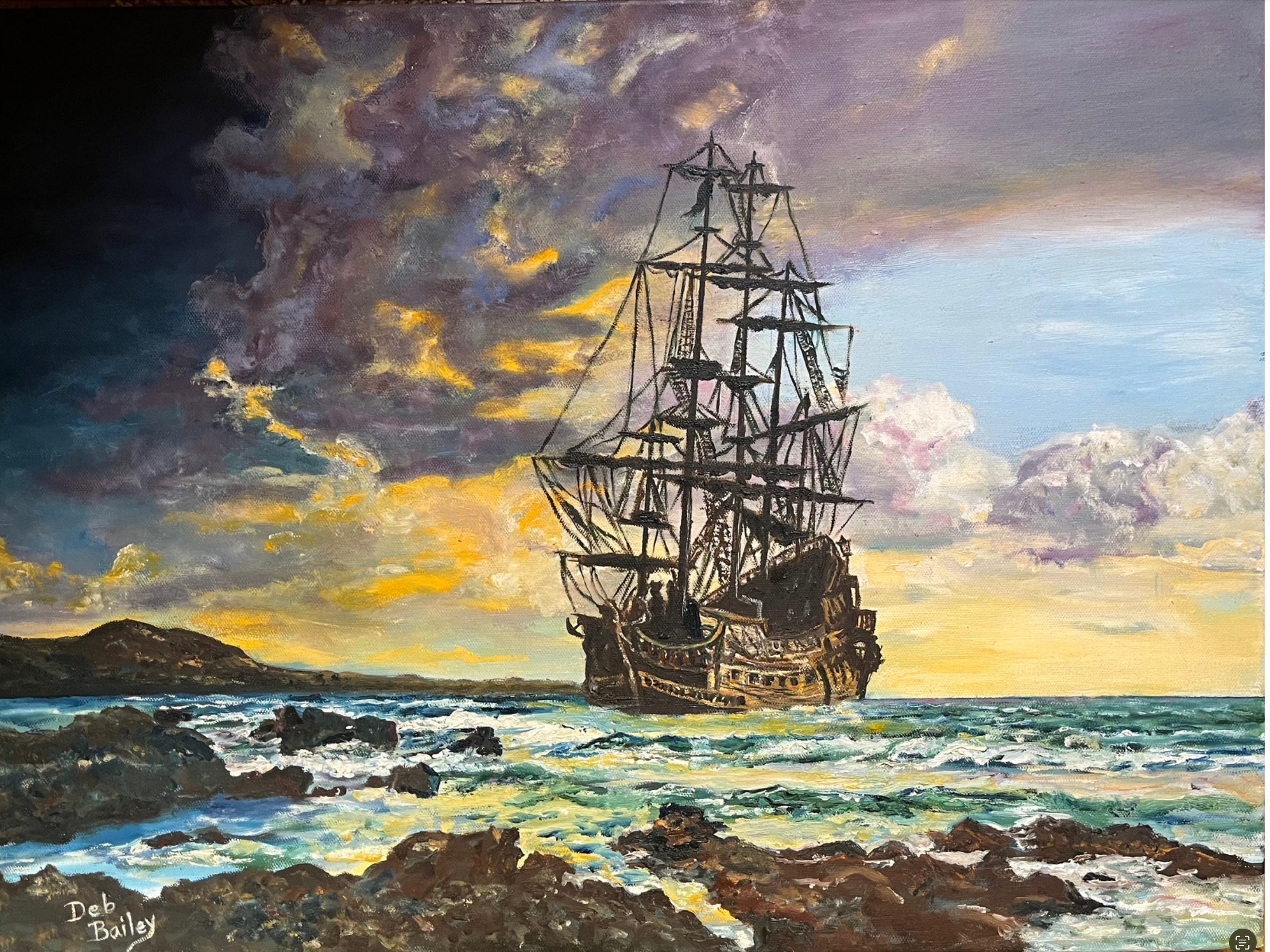
Painting by author
I now feel so much compassion and love for my younger self. I feel remorse over judging her so harshly, and, instead, have such total respect for her….
Now, back to the next pieces on my “Wider Circle” – grandparents, school, and God.