Posts Tagged ‘anger’

Trauma, Anxiety, PTSD….

November 22, 2024

Now there’s a word salad I tried to ignore.

A graphical image of a normal person’s insides vs the throbbing broken insides of someone with PTSD and anxiety. That side the body looks disjointed, bright colors that almost scream at you, brain on fire, overactive bladder, upset intestines
Painting by the author

I live with PTSD and anxiety. I have my whole life, even for those decades when I didn’t know it, or denied it. I just shrugged it off as irritable bowel, being “high-strong,” or having a small bladder. Other than that I was fine, no different than anyone else, right? Because if you ignore what you feel, mobilize some anger at your “weakness” and push harder, of course you will get over it, right? 

Be KIND to anxiety???

There are so many things wrong with that paragraph I won’t even waste time to list them. 

Now, I am not a psychologist so I am not going to give anyone advice. I will just relate my own experience. As to the above, that is how I lived my life for years, and I will simply say that unless you are looking to cause yourself more harm, I wouldn’t recommend it. 

I now work with a wonderful trauma specialist. And anytime I said anything like the above to her, if I didn’t get an eye roll, I would see her take a deep breath, smile with compassion, maybe say something like “Yes, well…” and then proceed to help me understand why treating myself that way was me abusing myself the way I’d been abused for years. 

For starters, she said: “ You come by your anxiety honestly,” by which she meant it would have been abnormal not to have PTSD and anxiety after what I lived through. That was a major revelation to me. I actually had to take a bit of time to wrap my head around the fact I wasn’t being weak. And imagine that, there was actually a valid reason for what I was experiencing. 

Second, when we first started working together I was shocked to see the amount of compassion she showed me. That was certainly nothing I’d experienced much of in my earlier years, never mind allowed for myself. So Clue #2 — perhaps I was not approaching this whole “healing thing” correctly?

“Weak” vs “tough”

Regarding “weak,” I should note that I grew up in a situation where weakness was reviled and it was all about being tough. And I had to be  anyway because  it was survival. The mantra I learned was “hurry up and get over it.”

I remember having a stomach flu one time and right after being ill my father insisted I needed to eat because I needed to get over this fast. So I came by “tough” honestly, too. 

My therapist gradually helped me understand there was nothing wrong with being kind to myself, and that believe it or not, healing is a life-long endeavor. I learned that PTSD and the various things that came along for the ride in me — depression, anxiety, and anger — made total sense given the stress-hormone-fueled cocktail that flooded my system for decades. I joked with a friend, that I had no idea what “calm” felt like, except for maybe the time I was coming out of anesthesia after a colonoscopy. It finally started sinking in that I had a fair bit of “relearning” to do.

The nature of trauma and PTSD

Given I spent my adult life in medical research, I did what I did best — hunted for information that would teach me what I’d not learned my whole life. I consumed research journals and Psychology Today articles on anxiety, stress, and PTSD. I read books, such as one my therapist recommended: Bessel van der Kolk’s The Body Keeps the Score: Brain, Mind, and Body in the Healing of Trauma. I read anything and everything to help me understand why my body felt like the painting above. Once I realized how totally unaware I’d been of how poorly I was treating myself, I was hungry for all the knowledge I could get. After all, I might be decades late, but I can be taught.

So then, of course, I did the opposite. I figured that if I read everything I could find, worked as hard as possible with my therapist as fast as possible, and pushed myself to relax and meditate and… Yeah. It might not have been the stomach virus anymore, but it was still that “hurry up and get well” mentality. So much for self-compassion and letting healing become a way of life. 

Compassion?

I will say with total gratitude, that my therapist is a blessing and the most patient, compassionate person I have ever dealt with besides my husband and a few good friends. Like coming back to the breath when you get distracted in meditation, she kindly brings me back, again and again, to self-compassion…and at least the “suggestion” of patience with myself.

Her knowledge of Yoga and meditative techniques also rekindled the practices I had first started learning in the 1990s when I came across a wonderful book by the former Buddhist monk Jack Kornfield, A Path With Heart. It was all about the reminder that life is filled with suffering, but that we can still show ourselves and others compassion. It was such a help, as were books by Pema Chodron and other meditation practitioners. 

This is not to say that this fixed my PTSD. No, nor the anxiety. In spite of all my work in life, that “word salad” still walks with me. Yet, progress does come and I recently had another “aha” moment. 

The moment of insight

I was sitting on the couch, aware of those pesky tendrils of anxiety starting to spread through my body, as they often do, uninvited. My initial thought was one of “God, when will this ever go away?” and an answer immediately flashed across my brain: “Never.” But instead of being upset, I actually felt a calmness at that. A sense finally, of acceptance and the awareness I wouldn’t be failing if I just stopped fighting it.

In that moment, I was aware of a level of compassion coming in along with the anxiety. It occurred to me that the frantic, anxious part of me…WAS me. A piece of me. She was my lifelong companion, maybe even a friend of sorts — she sure could be as we’d traversed enough of my life together. 

Finally, the awareness dawned on me that I could either spend the rest of my life hating her or…I could simply accept her…welcome her in. I could offer that part of me love and acceptance, and invite her to just “come on over, and sit with me and we will weather the storm together until it eases.” 

“Holding the baby”

This is not to downplay the discomfort or the need for my anxiety meds or continued therapy. But something shifted in that moment just a bit…something softened. To just stop the battle against myself was actually a relief.

After all, if I had a friend who was struggling and upset, what would I do with them? I knew without question — I’d hug them. I’d walk beside them and tell them I love them no matter what. It wouldn’t cure their anxiety, but it would give them relief to know they were loved, accepted, and not alone. So why wasn’t I doing this for myself?

I flashed on this image of “calm me” just holding that quivering stressed-out me and saying gentle words of love. And I remembered a quote I’d read years ago by the Buddhist monk, Thich Nhat Hanh, about holding ourselves like a mother holding and calming an upset infant. Sure, he was talking about managing anger but the same thing applies to anxiety:

Anger is like a howling baby, suffering and crying.
Your anger is your baby. The baby needs his mother
to embrace him. You are the mother.
Embrace your baby.

Embracing the Tiger Within: Meditations on Transforming Difficult Emotions
Thich Nhat Hanh

I figured, if it works for anger, then it might work for anxiety. And God knows, I struggle with anger and impatience too, so what could I lose to try? 

Two sides of the same coin

And then, the other day I found the Psychology Today article by Leon F Selzer, PhD: “Why Anger is Nothing More Than Repressed Anxiety,” and if that didn’t set off waves of self-recognition, nothing would. 

Dr. Selzer explaied how “anxiety and anger are two sides of the same emotional coin, kindred states of ‘agitated unease.’” That hit me. He went on to explain that “most people would prefer to ‘mutate’ their anxiety into anger…” He noted that anger gives a person the “illusion” of regaining control and it was a “pseudo-solution” to the self-shaming that went along with having anxiety. 

Well, hello again. In one short article, he connected the dots between my anxiety, the shame I always felt at “failing to get rid of it,” and my anger and impatience. I resorted to that last one because at least getting angry and taking some action seemed better than being “weak, anxious and stuck.”

The “antidote”

I suddently understood what Thich Nhat Hanh was getting at, and why his antidote to anger had deep relevance as an antidote to anxiety. Imagine that — self-compassion as a better way of life than kicking yourself? Who would have thought. 

Now no, it doesn’t mean I will not feel that familiar creeping sensation of anxiety at unexpected moments, or that I can stop working with a therapist, or doing all the self-caring things she recommends. I just finally understood for the first time in almost 7 decades, how nice it is to be nice to me. So, now, when things get upsetting, I can hold my own “baby” with care, and at least I don’t have to add “self-hate” to the word salad of things I live with. 

If anyone else has felt that familiar sinking sensation of fear spreading through your nervous system, I would of course encourage them to seek their own therapist, mentor, or spiritual guide to help them explore and navigate ways to healing. But I can also add that for anyone, giving oneself a few moments of quiet attention, love, and “holding your own baby” is always a soothing and loving experience. May you all find a way to “comfort that inner being.”
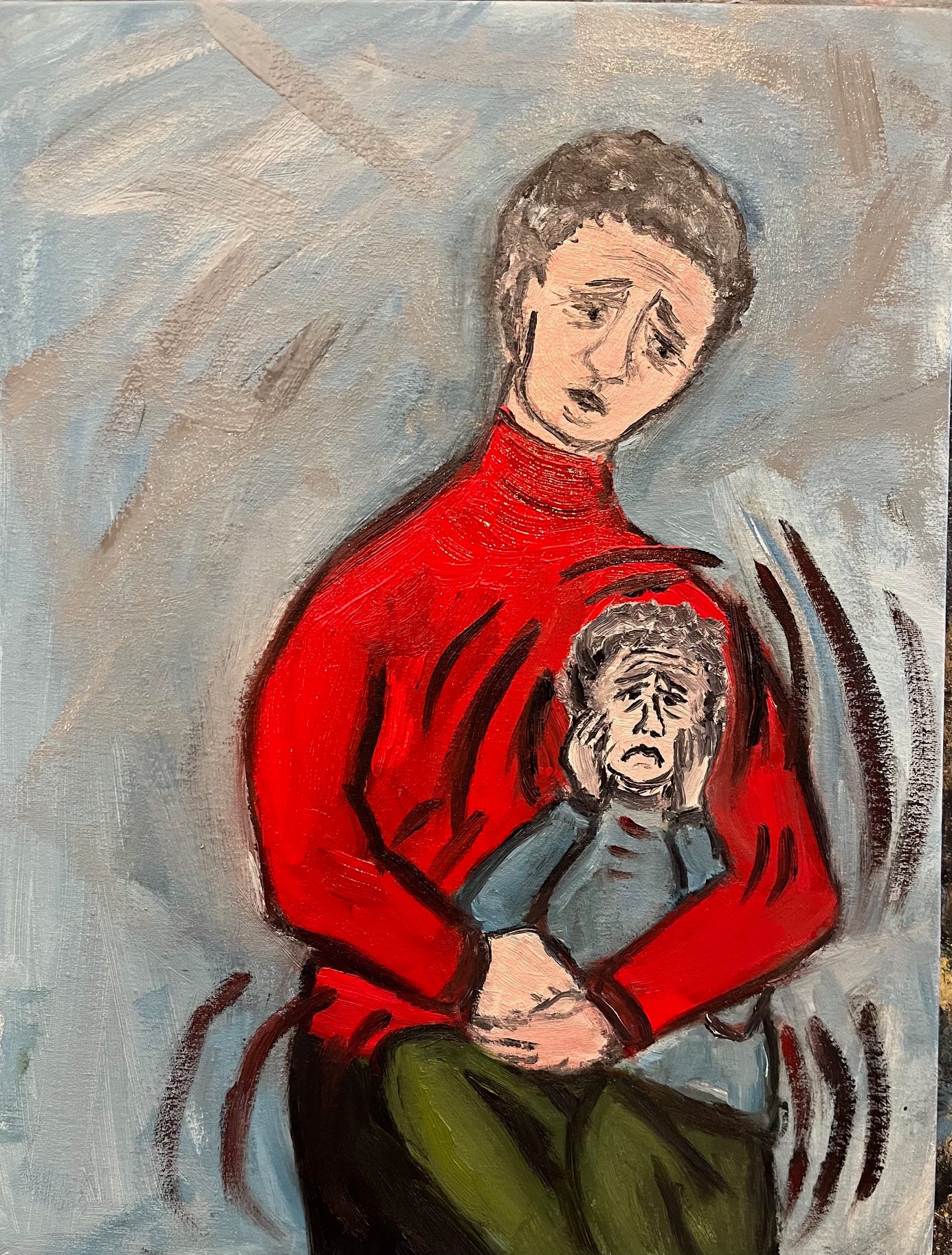
A painting of an older calm, compassionate adult holding their inner anxious self as that inner person struggles with anxiety. A way of calming and showing love to even the parts of ourselves we wish we didn’t have to feel.
Painted by the author

The Gift

April 29, 2008

“If you are patient in one moment of anger, you will avoid one hundred days of sorrow.”

Chinese Proverb

The Post – The Breath, Compassion, and Pacifiers

March 24, 2008

Over the years I’ve read about or studied different kinds of meditation. Some wanted you to focus on a word or sound repeated over and over, others on a lit candle. More recently the focus was on trying to keep a totally blank mind and completely halt all the “noise” and the 10000 things running through your brain every minute. Of course I failed at all of them…as do most people. You’re so focused on a goal, on doing it perfectly, that when you can’t measure up, you give up out of frustration or despair.

On the flip side, I suspect that if you are lucky enough to achieve what these methods want…or at least you think you achieved it, the danger is that then you might walk around feeling so proud of yourself, so much better than others because “you achieved it.” You can try “not to go there,” but it’s hard, and even if you manage not to be proud, there is also the danger of feeling “overly holy and falsely humble” about your accomplishment.

One of the things I like about Buddhism is it’s emphasis on “Middle path.” No extremes of perfection or failure. This extends to its approach to meditation practice – “acceptance” of, in fact, it’s emphasis on the fact that you’ll never be perfect and it’s not about a goal. It’s always about “letting go and coming back to the breath.” Whether the teacher is Thich Nhat Hanh, from the Zen tradition, or Jack Kornfield from the Theravadan tradition, the point is not to “eradicate” what’s going on in you, but on simply to notice it and let it go on. You don’t waste a lot of energy either trying to get rid of all the thoughts, or giving them more importance than they’re worth. You just notice what is happening, acknowledge it, let it go, and come back to the breath.

Even that though, is easier said than done and human beings have a way of making anything a goal or contest. I think the one part of those instructions that I find most useful is: “Come back to the breath.” The reality is, we will be distracted for the rest of our lives. There’s bills, fights with people, retirement planning, kids, whatever. SOMETHING is always creeping in. That’s being human. And as nice as it is to say “notice it, don’t judge it, just let it go” even that is impossible. Something sticks in our throat and it replays in our heads over and over. Our anger, hurt, pride, despair, fear, will get hooked and we have a hard time letting that go. Accept it. We all do it. We always will. Instead of beating yourself up about any of this you simply, come back to the breath.

At first glance that might seem like a useless approach. Someone more “austere” might say “Well what kind of mental discipline is that?” The point is, it’s not about “discipline.” It’s not about self-flagellation, beating yourself up, getting rid of anything, or trying to be perfect. It’s about being human, and it’s about compassion. Being gentle with yourself. It’s about accepting and loving who you are. Even with all the noise in the brain, you can chuckle at your foibles and still say I’m a good person. I’m full of love, even when I’m distracted.

So why bother learning to treat yourself with compassion in your meditation practice? Because it is the way you train yourself to be compassionate with yourself in life. Instead of expecting yourself to be perfect at jobs, parenting, being a spouse, friend, being a human being, you simply note ‘I did my best. Yup, messed that one up, it happens.’ You pick up the pieces. You make amends. You come back to whatever it was you were trying to do and start over. You “come back to it” again and again and again, with no hope of perfection, simply the willingness to “show up and try again.” So if you can accept with compassion, an imperfect meditation practice and come back to the breath, you can learn to do the same for yourself in life.

Is there a benefit to treating yourself with compassion in life?

Yes. Aside from giving yourself some inner peace and acceptance, it is the only way you can exercise that “heart muscle” and learn to give that same gift to others. If you are so hung up on perfection in yourself, will you learn to cut somebody else any slack? Will you even notice anybody is there struggling, too, if you’re so wrapped up in your own struggle to be perfect? And if you can’t accept yourself as less than perfect, will you be able to accept anybody else’s mis-steps? Come back to the breath. Come back to life. Settle yourself, with compassion.

I often noticed how babies settle down when you give them a pacifier. It’s like they need that to stop whatever is winding up in them, settle down, and come back to calm. I’ve joked that maybe adults need them, too. Something that makes you shut your mouth, take a break from the world, focus on something small, and return to calm.

Given that they don’t have adult pacifiers, perhaps coming back to the breath is the next best thing?

PS People often say animals are intuitive and sometimes animals have more compassion than people. If you think the benefits of coming back to the breath and being peaceful, are limited to humans, check out the CNN article:

Zen (dog) Master: A New Take on Prayer Position

This article has two other lessons about life:

1) Sense of humor – Even in religion, a smile is the most important thing for compassion and inner peace.

2) Beginner’s Mind – Keep an open mind to new possibilities. You might write off the dog’s practice, but how do you know that on some level, he isn’t “feeling” the warmth of the compassion in the practice?

The Post – A Murderous Time

March 18, 2008

I am tired. I am tired of struggling and believing and hanging in there. I want to sell everything, and just take off and not have to be responsible anymore. I am tired of struggling and struggling and struggling in life, of reaching for dreams or challenges, trying to live my beliefs, stay open to others, all while life just keeps pounding you. Life, can be murderous. Someone said it’s not the big things that get you, but the accumulation of all those small aggravations, like being nibbled to death by ducks.

Now often those are the words of the tired 2-year-old, and we all have one. Usually when the 2-year-old speaks it, the 52-year-old understands, knows it’s just a rant, and keeps going. It’s those moments in life though, when the 2-year-old utters it, and the 52-year-old agrees, that I know I have to stop and attend to my heart. Those are the times I reach for wisdom others have culled from their lives and put into words.

So for today, I simply leave everyone with the wisdom from others who have been there and lived through it to see the other side:

___________________________
In a murderous time
the heart breaks and breaks
and lives by breaking. It is necessary to go
through dark and deeper dark
and not to turn.
From “The Testing-Tree” by Stanley Kunitz
________________________________
“The only way out is through.”
Unknown
________________________________

“As a species, we should never underestimate our low tolerance for discomfort. …Never underestimate our inclination to bolt when we hurt. …Being compassionate enough to accommodate our own fears takes courage… We need to be told that fear and trembling accompany growing up and that letting go takes courage. Finding the courage to go to the places that scare us cannot happen without compassionate inquiry into the workings of ego. So we ask ourselves, “What do I do when I feel I can’t handle what’s going on? Where do I look for strength and in what do I place my trust?”

The Buddha taught that flexibility and openness bring strength and that running from groundlessness weakens us and brings pain. But do we understand that becoming familiar with the running away is the key? Openness doesn’t come from resisting our fears but from getting to know them well. Rather than going after those walls and barriers with a sledgehammer, we pay attention to them. With gentleness and honesty we move closer to those walls…get to know them well. We begin a process of acknowledging our aversions and our cravings. We become familiar with the strategies and beliefs we use to build the walls…Without calling what we see right or wrong, we simply look as objectively as we can.

….We can begin to pay attention to our methods of escape. …We can misuse any substance or activity to run away from insecurity. When we become addicted to the lord of form, we are creating the causes and conditions for suffering to escalate. We can’t get any lasting satisfaction no matter how hard we try. Instead the very feelings we’re trying to escape from get stronger….Transformation occurs only when we remember, breath by breath, year after year, to move toward our emotional distress without condemning, or justifying our experience.”

Pema Chodron from the book, The Places That Scare You

_____________________________

“Abandon any hope of fruition.”

Mind training slogan #28, of the 59 mind-training slogans or Lojong teachings of Atisha Dipankara, an eleventh century Buddhist teacher who brought these teachings from India to Tibet. These teachings show us how to transform difficult moments…what we most dislike about ourselves….the greatest obstacles in our lives – anger, resentment etc., into the means to awaken our open heart.

For a full teaching by Pema Chodron on this particular slogan, see her book: Start Where You Are : A Guide to Compassionate Living by Pema Chodron, Copyright 1994, Shambhala Publications.

You can also click on the link at the bottom left of the “Tonglen and Mind Training” web page or click here

Two excerpts from her teaching:

“Our next slogan is “Abandon any hope of fruition.” You could also say, “Give up all hope” or “Give up” or just “Give.” The shorter the better.

One of the most powerful teachings of the Buddhist tradition is that as long as you are wishing for things to change, they never will. As long as you’re wanting yourself to get better, you won’t. As long as you have an orientation toward the future, you can never just relax into what you already have or already are.”

” In Boston there’s a stress-reduction clinic run on Buddhist principles. It was started by Dr. Jon Kabat-Zinn, a Buddhist practitioner and author of Full Catastrophe Living. He says that the basic premise of his clinic-to which many people come with a lot of pain-is to give up any hope of fruition. Otherwise the treatment won’t work. If there’s some sense of wanting to change yourself, then it comes from a place of feeling that you’re not good enough. It comes from aggression toward yourself, dislike of your present mind, speech, or body; there’s something about yourself that you feel is not good enough. People come to the clinic with addictions, abuse issues, or stress from work-with all kinds of issues. Yet this simple ingredient of giving up hope is the most important ingredient for developing sanity and healing.”

For a complete list of the mind training slogans: click here

________________________

“You gain strength, courage and confidence by every experience in which you really stop to look fear in the face. You are able to say to yourself, ‘I have lived through this horror. I can take the next thing that comes along.’ You must do the thing you think you cannot do.”

“People grow through experience if they meet life honestly and courageously. This is how character is built.”

Both, by Eleanor Roosevelt, who also instructed us to:

“Do One Thing Every Day That Scares You.”

So now, I will try to see if the 2-year-old, and 52-year old, can reach agreement in their hearts, to struggle on and “do the thing you think you cannot do.”

The Post – When You’re Mad, Give a Gift?

February 8, 2008

Yesterday morning’s reading for my online spirituality course with Thich Nhat Hanh was counter-intuitive to say the least. Some might read it and say “in your dreams.” Others might look at it and say, “That’s manipulative.” But I read it, and in spite of myself, I really did understand it. In fact, I’ve felt it happen now and then.

His words:

“There may be times when you are angry with someone, and you try everything you can to transform your anger, but nothing seems to work. In this case, the Buddha proposes that you give the other person a present. It sounds childish, but it is very effective. When we’re angry with someone, we want to hurt them. Giving them a present changes that into wanting to make them happy. So, when you are angry with someone, send him a present. After you have sent it, you will stop being angry with him. It’s very simple, and it always works.

Don’t wait until you get angry to go and buy the present. When you feel very grateful, when you feel you love him or her so much, then go and buy the present right away. But don’t send it; don’t give it to the other person yet. Keep it. You may have the luxury of having two or three presents stored secretly in your drawer. Later, when you feel angry, take one out and deliver it. It is very effective. The Buddha was very smart.”

Thich Nhat Hanh in Anger: Wisdom for Cooling the Flames

Now at first thought, the idea of giving someone a gift when you want to throttle them, seems impossible, even laughable. Maybe something that blows up? But a real, honest-to-goodness gift? I don’t think so.

And the other person might think: “What’s this? You trying to make me feel guilty and manipulate me into liking you again? You’ve got hopes. Now I’m even angrier at you for pulling this!”

Yet, all skepticism aside, I know what he means and hard as it can be at that moment, it’s true. And it’s not childish. Child-like maybe. A big difference which I’ll mention below.

There have been times when I was angry with my husband and all sense of love and remembering “why I married him” evaporated into fantasies of how best to wring his neck. I’m sure he felt the same way. Revenge plots, not gift ideas, were the order of the day. Yet even in that moment there was that small voice that said “Do you love him?” And of course, the answer deep down was , “Yessss. I love him.” And the voice would answer, “Then if you love him, you cannot act that way.”

I’d remember that if something were to suddenly threaten him, I’d be right there by his side to protect or help him. I’d also remember the many good things shared, times his love saved me, the times things he did just melted my heart. The moment of capitulation would soon follow.

The moment of capitulation when trying to “hold your grudge” is the moment when you want to hate, but instead you remember and feel even a tiny inkling of your love. You feel frustrated with the Universe, for sure. My thoughts would run something like: “I really wanted my pound of flesh and instead, here’s the Universe deflating a good rage.” You feel the struggle of “But I’m mad at him,” versus “He’s my friend and I hate this. Can we just get back to being friends?”

The times that I’ve tried the counter-intuitive approach and gave in to the part that loves, it was like a crack in the dam of anger. By offering even just some tidbit of a compliment, or telling him something like “I’m really upset because I love you and I hate being at odds with you,” it was the thing that started to bring us both back to center. By refraining from revenge and instead remembering the love, by trusting to kindness instead of attacking, it made “space” for things to change. It became safe for both of us to leave our entrenched, polarized fortresses, hold up a flag of truce, meet in the middle, and discuss terms of surrender. And by the way, surrender is not “losing.” It’s “yielding” to a greater good. It’s the meeting of two to make something bigger and better than either one of us . . . or our egos.

I liked Thich Nhat Hanh’s idea to have a few gifts around, and to buy them when you are feeling those warm loving emotions for that person. The feelings will be stored in those gifts. When you take them out during anger, those objects release the good feelings back to you. What you stored in them – goodwill, love, the reminder that there are still good things between you – is like money in the bank you can withdraw at that moment. They are the tangible evidence that love existed, and they are the catalysts that start the process of softening the anger.

So perhaps it’s not so strange an idea after all, if you can just swallow the ego. I can see where it can bring things back from the brink. The gifts can be small – even a funny or loving card, just something that captures what is shared in the good moments. And it’s the lesson we can learn from kids.

If you watch kids play, one minute they’re fighting, two minutes later they’re friends again. Somebody picks up their marbles and runs home. A few minutes later they’re calling to ask if you can come over to play. Kids have the ability to live in the moment, not store up hostilities. They clear the air and move on. That’s probably what Thich Nhat Hanh meant by childish. I prefer the term “child-like” though. Childish can imply selfish, insensitive, immature. Child-like implies the best of being young – the ability to flow with things, to have an open mind, to be in the moment, to find awe in even the simplest things. Jesus said that we had to become like the little child to enter the Kingdom of Heaven. I believe He meant the same thing as Thich Nhat Hanh.

In any event, one thing I do concur with for sure: The gifts should be bought when happy. I’d hate to see what I’d come home with during rage. 🙂