The new place
7/16/82
“As you can see, I’ve been remiss in my journal writing – 21 months. That last retreat (Nov 80) really did me in, and I just wanted to tune it all out for a long time. But since then I finally got up the guts to go to another retreat…a FEW of them actually. One-day retreats at a new place — The Cenacle in Middletown…”
Looking back, what a difference a place makes…though, maybe it was a difference in the person going to the new place that mattered, too? At the very least, the fact that I sought out a new retreat center in spite of how the previous one triggered me, implies that I was willing to trying again…fertile soil just waiting for the right seeds to be planted?
Either way…this became the turning point of my life. More on this, shortly…
Expanding my skill set
Continuing with the steps I began over the last two years to “spread more seeds in the garden of my life,” I started the new year with an investments course at the local community college. I had managed to save a little bit of money and was looking for the best way to invest and grow it. If I could do that, I might have some options for moving on with my life. I also purchased a 35mm camera and took a photography course. If I wanted to expand my chances for my articles to get published, it helped to provide my own photos for the them.
In general, I was discovering that I loved adding to my knowledge of life and the world. Whether it was for writing, music, art or business, all of them fed my self-confidence and sense of wellbeing. I had grown bored with some of the social things – the bowling league, parties, and trying to figure out who I might date. Taking classes put me in contact with a wider group of people. And even if I didn’t meet anyone there, the classes gave me the sense I was building more and more life skills. Even if I didn’t know yet where my future was leading me, I would be ready when I got there.
The person between
Home was still the same — more and more angry fights between my parents, and Dad was still pursuing me. Even as I was still terrified of his rage, I was equally exhausted with putting up with it all. And so guilty about what this had to be doing to my mother. I found it hard to believe she didn’t notice how he fawned all over me and treated her so poorly. I had reached the point where no matter how he spun it, it just felt more and more wrong. I was the person always between them and I hated it.
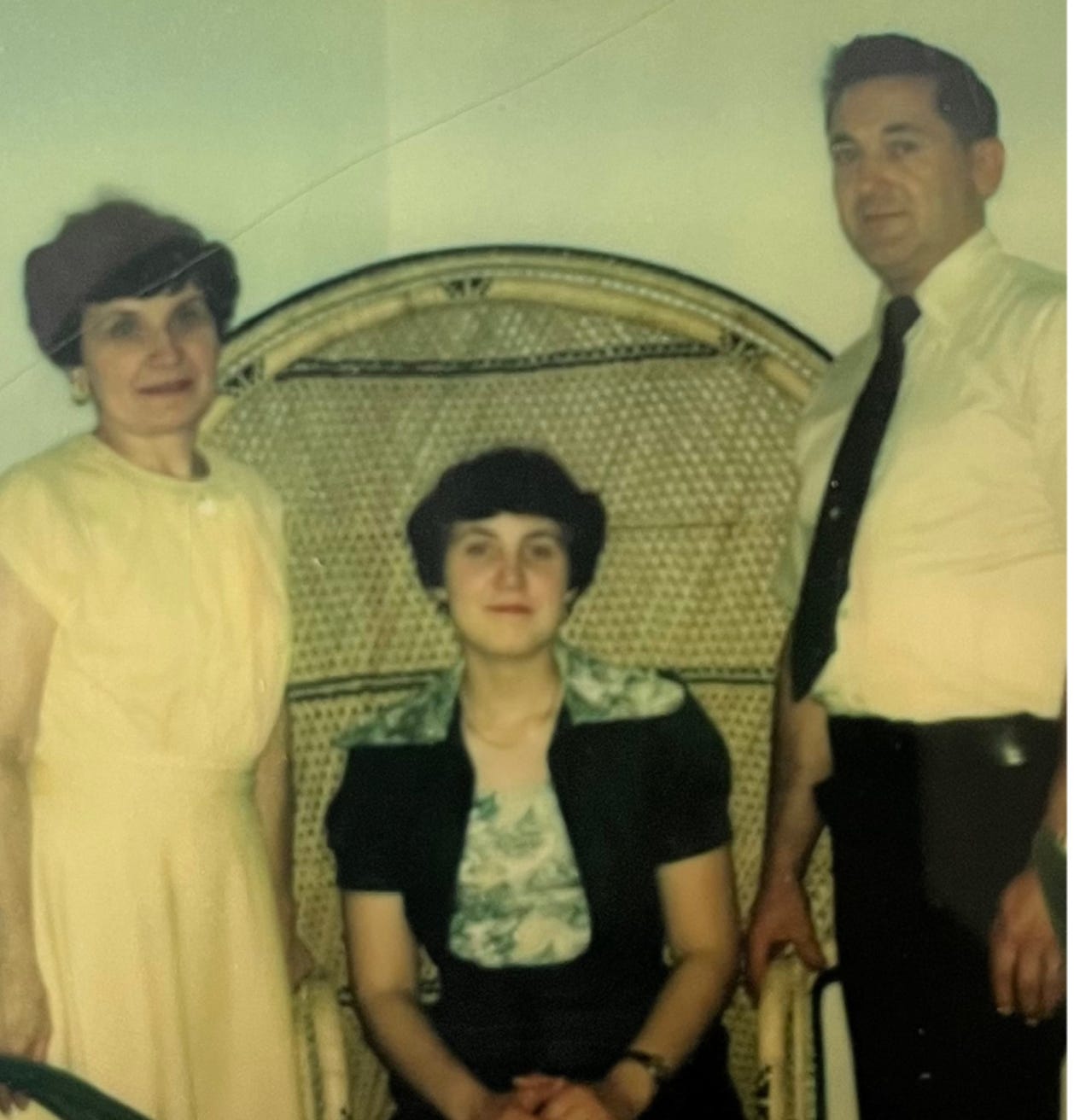
So I made it a point to be busy with my own pursuits, whether classes or personal retreats.
Spending more time away
I also spent more time with friends, though I had to navigate that carefully because if I was out too much, Dad would get angry. But more and more, I tried to get out with friends, whether with people who had similar interests in gardening, homesteading, and raising animals, or another friend whose family had some country property where they spent weekends. In fact, as the weather warmed, I joined them for weekend trips camping at their property.
It was a simple pleasure and so relaxing. Time in nature, campfire cooking, sketching landscapes, and just being away. It was like another world.
And one friend was also a mentor of sorts. Being well-versed in classic clothing styles and makeup, she helped me up my game in those areas.
Of course, Dad hated it when I went out a lot, and especially if I took those trips away. For one, he didn’t like it when anyone “pulled me out of the family circle” and didn’t hesitate to make his feelings known. And, yes, as always, for those trips, he would again put a sexual implication to why I must be going away.
While I had shrugged off that pattern a few times already, it’s only now that I see just how constantly his mind was focused on just one area of life. It was his addiction; he saw the world only through those glasses.
Nova Scotia…and his words
But the two key things about this year were the retreats to the Cenacle that I was taking — even Dad didn’t interfere with things relating to Catholic practice — and a fall trip I took with my parents to Nova Scotia.
First, the trip to Nova Scotia, which was a beautiful place with lots of raw, pure nature and seaside towns. We took a 6-hour ferry from Maine, which was a bit rough. Making that trip in the fall risks more choppy waters, so I was seasick and spent the entire time out on the deck. At least the crisp, fresh air helped me feel a bit better.
On the island itself, we visited a number of museums and toured seaport towns that, in the nice weather, were filled with visiting artists. I could understand why – the landscapes and sea villages provided an infinite number of subjects to paint.
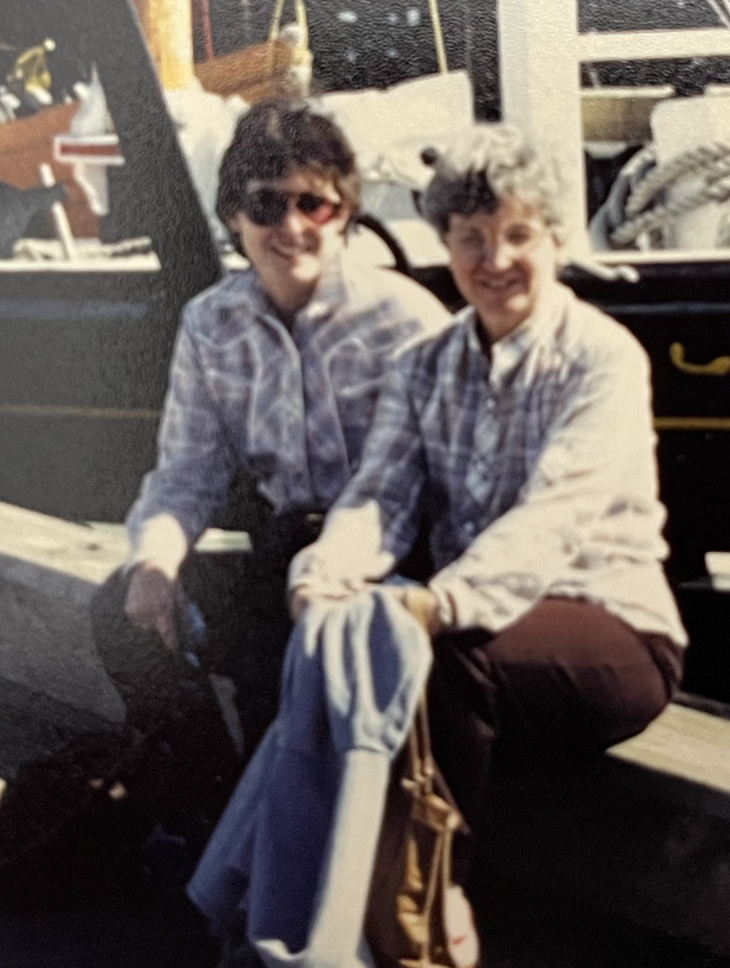
Photo by author
If the trip had involved sticking to those areas, I would have loved it more. The long drives through gray, lonely back country felt more bleak.
9/24/82
“From our trip to Nova Scotia, I learned several things. The first is that I cannot live in an area that is very isolated. I thought I could make myself fit that mold, but I can’t. A small town, maybe…close enough to a large city so that I can still be in touch with the things I enjoy, but isolated enough to give me peace and quiet.”
Just like that experience during my 1980 retreat when I was kept off by myself and couldn’t interact with anyone, it was clear I was not “hermit” material. While I kept looking at property to buy in New Hampshire or Vermont, more and more I had my doubts that “isolation” was my direction.
As we drove through the miles of countryside, my parents kept stopping to eat at small places with the “all-you-can-eat” buffets that, while cheap, were not the best experiences. When we reached Halifax, I finally put my foot down. It’s a lovely city with many opportunities for fine dining, something I had developed a love for over the last couple of years.
So I made us reservations at an upscale seafood restaurant, and it was the whole deal. Located in a historic warehouse, it had beautiful old stone walls, nautical decor, old wood beams in the ceiling, exquisite food, and an ambiance to match. If the fresh seafood wasn’t treat enough, the dessert was the finishing touch: Parfaits of vanilla ice cream swirled with creme de menthe and fresh whipped cream. Even my parents had to agree it was worth every cent.
But no matter how beautiful or peaceful the place, it’s only as nice as the company you are with. Heaven can be hell with the wrong people. And, again, that old saying, no matter where you go, there you are. Just because we were on vacation doesn’t mean Dad wasn’t still a bear to be with. And then there was how he treated Mom:
9/24/82
“I feel that this is the last vacation I will take with my parents. I need and want to go places on my own to see and do what I want, when I want, without waiting for ‘Mommy or Daddy’ to say okay. I am tired of their bickering — they need time now to be alone with each other and become closer and happier with each other…I feel deep down that I sometimes come between them. Dad pays more attention to me than Mom, and I know she feels it, though she never says it. Dad has always done this…and it makes me feel guilty and angers the hell out of me. I resent it greatly. The time has come for this to cease…I represent a threat to my mother’s self-esteem. He puts her down so much, but shows me attention and respect. I can’t stand it, and I feel smothered.”
He KNEW
But the most telling moment of the trip was the evening we got to Halifax and stopped in a motel there. Mom was taking a shower, and I was writing some notes, oblivious to the news he was watching. At least that is, until he demanded my attention to a particular report.
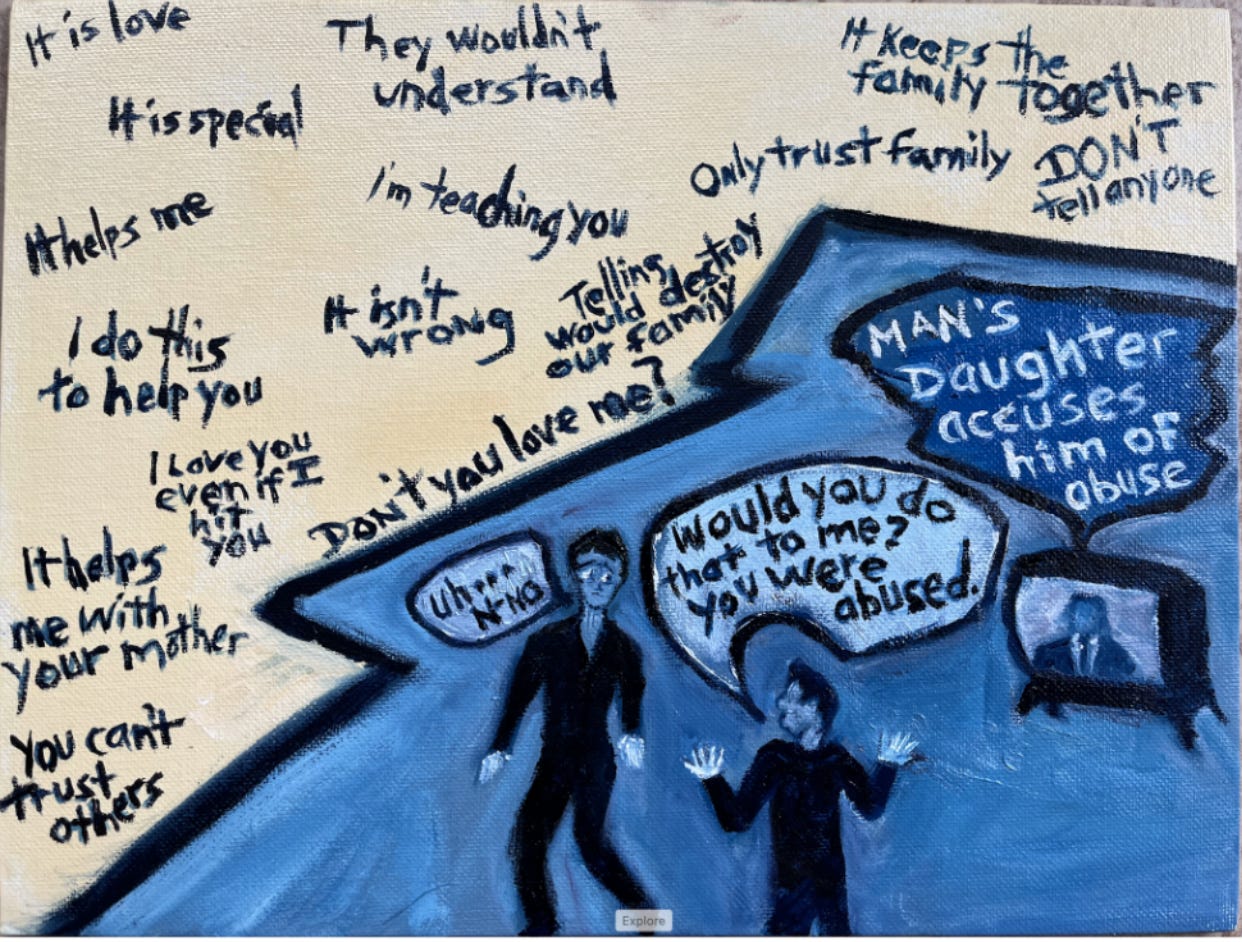
The newscaster spoke about a man who had been arrested and imprisoned because of “something” he was doing to his daughter. I hadn’t heard the whole thing. What struck me was Dad’s reaction – he was upset, almost…I couldn’t tell if he was scared, or outraged, or both. He immediately turned to me and said:
“Would you do that to me?!”
Having only heard half the story and irritated at him interrupting my quiet time, I just shrugged it off and said no. For one thing, I never thought of the things he did to me in terms of abuse. I viewed our family system as generally okay and loving, mixed in with times where he couldn’t control his temper, and “those things he did that I never talked about and tried to stop.”
The other thing was that in those years those kinds of stories were almost never in the news. No one talked about it. Maybe that’s the reason he was so upset. Someone called it what it was and a man was actually put in jail.
So he wouldn’t let up and asked me again:
“Well, YOU were abused! Would you do that?!”
The odd thing, which shows just how much I had compartmentalized, normalized, and minimized the things he had done to me, was that his comment didn’t really register. I was still in that place of, “Well yeah he does a lot of mean things, but also good things. So you just move on.”
But it was his level of upset over the report that got my attention more than anything. For me at that point in time, arresting him for something I still hadn’t called “abuse,” was not in my mind at all. All I knew was that he was upset, so I tried to reassure him. “No. I wouldn’t do that.”
Whether it was my words or my flat emotional response to the whole thing, he seemed satisfied and went back to the TV.
It is only now, years later, re-reading that in my journals, that his words scream at me off the page:
“Well, YOU were abused! Would you do that?!”
There it was…You were abused.
He knew it was abuse.
He knew it was wrong.
He did it anyway.
He was a conscious, insidious, cold, calculating abuser.
It would have been bad enough if he actually thought he loved me during all of that time, actually believed the lines he was feeding me. But he never did. They were manipulation, pure and simple
Despite all his messages to brainwash and program me, in the end, he knew exactly what it was…abuse.
The Cenacle
But if there was one experience that totally rocked my life that year, it was discovering the retreat center called “The Cenacle.” It was not quite an hour from where I lived and thus was an easy place to get to, even for just the day. And unlike the first retreat I had done two years ago, this one did not trigger me at all.
Maybe it was the nature of the Sister I worked with. She was relaxed, friendly, and not pushy at all. It could have been me, and where I was emotionally two years earlier, but I just felt like that previous Sister at the other center had more of an agenda, such as pushing me toward being a nun. That might have been my own fears speaking. But no matter what, this Sister felt totally…safe. Collaborative. In my corner. It was like she was my ally, ready to help me peel the layers back to reveal the real “me” and find my true destiny. She wasn’t determined to force me into a preconceived format for a retreat, but instead helped me to define my own needs and experience.
If that wasn’t remarkable enough, her mention of their July weekend retreat WAS. The topic was “Effective Living.” If EVER there was a topic I WANTED, and NEEDED, and was READY FOR, that was it. I went. And it would change my life from then on.
A “revolution in thinking”
Over the course of that effective living retreat, several rich and deeply empowering statements were shared with us. So many of them spoke to my soul like water on a parched plant:
- “Unconditional love is the key. It is love without conditions.”
- “You take responsibility for your own choice. No one has power over you unless you give it to them.”
- “Inner direction is the key to happiness. Happiness does not come from outside of you, ie, seeking it from others, money, jobs, or things.”
- “Self-image is vital to the use of our potential to love and live.”
- “Fear is the big key in negative habits.”
- “Life can be changed in three steps: Determine what you do REALLY want and need; Get information so you can act; Repeat until this becomes your habit to live.”
- “If you’re faced with a decision and can’t decide because both seem right, wait, gather more data, then listen to your gut for the answer.”
- “If someone makes you feel guilty, they have control over you. They have power, and you are giving it to them. GUILT IS NOT FROM GOD.”
- “God is not about punishment. He is the means to achieve the positive.”
- “Never use self-devaluation. We may do stupid things. But we are NOT dumb.”
And probably **the most revolutionary** thing for me, especially coming from a nun:
- “God wants us to spend life doing things WE ENJOY, that give us peace. HE DOES NOT WANT US TO HAVE A LIFE OF DRUDGERY!”
THAT had been the terror of the retreat in 1980 – that God would demand that I do something I hated.
Listening to Sister teach about how the different levels of the mind worked and how to change our attitudes and outcomes, I jotted down some things for myself:
- “I am completely self-determined. I decide what is best for myself, and I allow others to do the same.”
- “There is no knight on a white horse coming to rescue me. I need to rescue myself.”
- “I am completely responsible for all of my responses to all persons and all events.”
- “I used to think in terms of someday when I get married, or when I finally do this or that. But now I am thinking in terms of what exactly I am going to do NOW. I can’t wait until everyone else in my life has their life in order before I consider mine.”
- “I have to NOW formulate a plan of action for myself for the next year, or nothing will change.”
The seminar was not just revolutionary for me, but I think for all the people there. The particular Sister presenting the course spent a lot of time talking about the psychology of the mind. How our thoughts and programming determine our feelings and then, by extension, our choices and actions.
She spoke about “habits,” and the kinds of thoughts about ourselves that we reinforce in our minds. Those mattered, she shared, because they determined what we feel and do.
Concrete actions for change
Other things she spoke of that I’d never heard of: Meditation techniques as a way to center and calm ourselves so we can think clearly. How to identify what goals we feel are right for us and how to bring them about. And something called “affirmations” – positive statements we can use to change how we think about ourselves and our lives. Lastly, Sister gave us concrete instructions for how to do all of these things.
During the course of the weekend, I also met a woman who worked in the field of gerontology – working with the elderly. I’d never heard of it, but it intrigued me, so I jotted down a note to see if there were any study programs available should I want to change career paths. And, I made a list of what specific choices were available to me right now, and my thoughts about them:
- Decide if moving to New Hampshire and buying land was really the right thing for me. Given my reaction to the bleak solitude of Nova Scotia, probably not.
- Take a leave of absence from my job and join Vista or a church organization geared to helping in underprivileged areas. This one could be possible.
- Join the military and travel. This one had lost its appeal for me.
- Become a nun and help people as a counselor? This one was a contender.
- Write to my old boyfriend and see if we had any connection left or not. This didn’t feel right, and I tabled it.
- Talk to a job counselor about gerontology and other career paths. Good idea.
While I didn’t walk out at the end of the weekend with my life all magically fixed, I did walk out with a totally altered way of thinking about myself, my life, and what was possible. This was mind-blowing in itself and a totally unexpected outcome from that weekend.
It was SO mind-blowing in fact, that I immediately knew I needed to do the course again. They were offering another round of it in November, and I immediately signed up.
There was so much “meat” to this course that it almost overwhelmed me, not in a bad way, but in the excitement of its possibilities. Like sitting at a feast with so much food you know you’ll have to come back later for more because it’s too much in the moment. I saw the immense power of all that wisdom and knew in my gut that this could help me change my life. So I didn’t want to miss a single detail.
And it wasn’t so much that it was a religious thing. In fact, the connection with God was secondary to the immense revelation that I had power I could and should claim. Maybe for another person, they would have discovered this in some course in college, time with a therapist, or a self-help group. But this was the option that presented itself to me, and I wasn’t going to pass it up.
A sudden jump forward
In fact, even before the November seminar came around, I had taken some actions that were not even on my above list of choices. One item I hadn’t considered at the time was the simple choice of finding my own place to live. There still weren’t any apartments, but there were houses and condos. And this time, I had saved some money, which meant maybe I could buy something? An investment? That class I took had taught me a lot more about money management. Perhaps having a place of my own was not an impossible dream?
Looking back from now, I was surprised to see just how quickly I mobilized on that idea. On the back of one of the handouts from that first seminar, I had jotted down a bunch of notes regarding a mortgage. I had called a few banks and spoken to one woman in particular who was very helpful. She explained about mortgage points, indexes, and how a variable rate mortgage worked. After calculating costs, that one actually seemed possible.
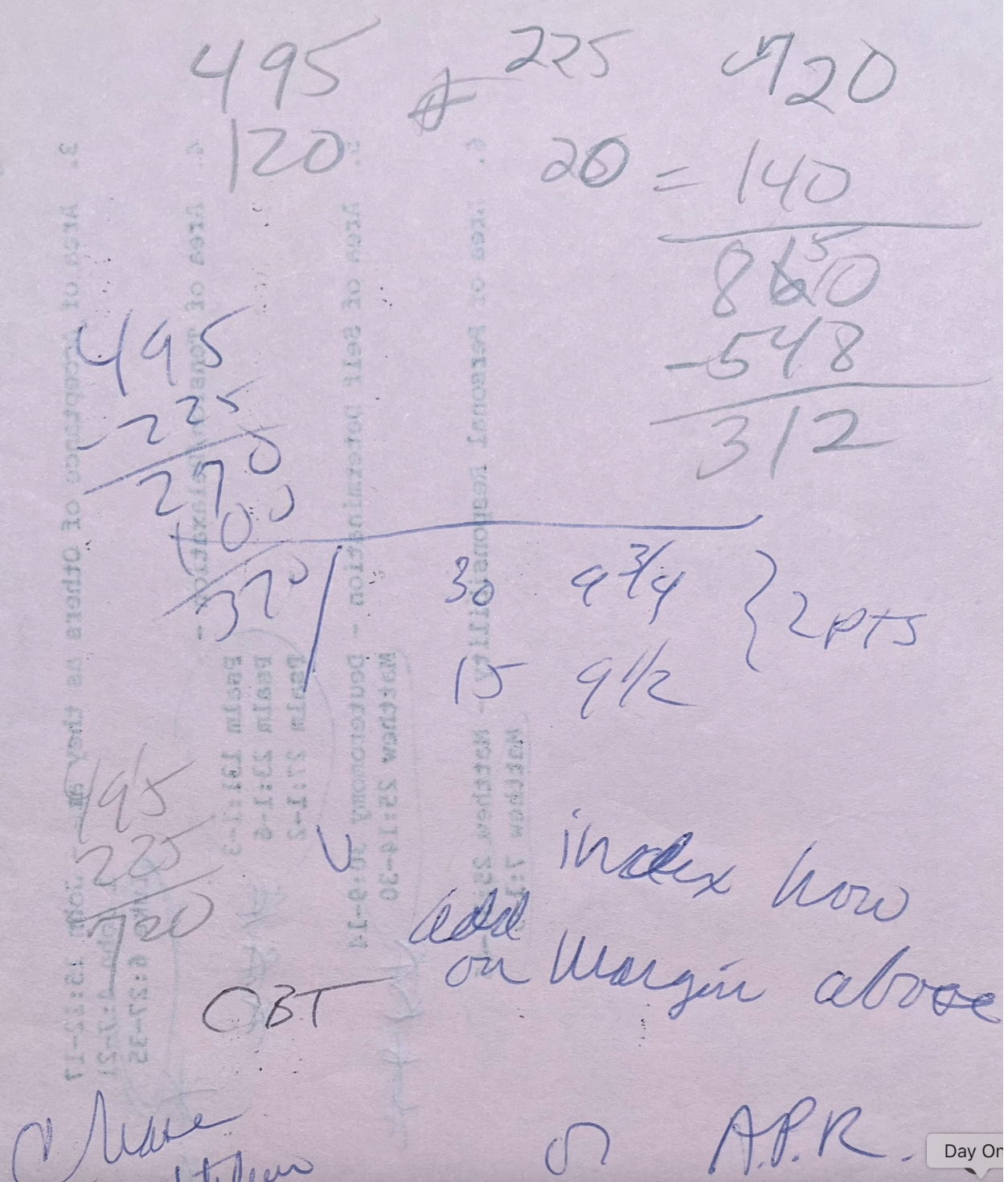
Just having this information set me on fire. There might actually be a way to a better life, and it might not even need some huge, drastic move to achieve it. I just had to set goals, gather information, and tap my own power. And it was a tremendous relief to consider that God might actually want me to be happy, not suffer.
The snowball transformed into an avalanche
Suddenly, where before there had been no path, now, there just might be a way forward.
As a final thing the end of that year, I made a note to talk to a relative who was a realtor to see what I might be able to afford. And then I set up more retreat dates for the coming year.
There was no stopping me now. It was like that snowball from a year or two ago was now an avalanche racing down the mountain.
 Soul Mosaic