And she deserves to finally be seen and heard
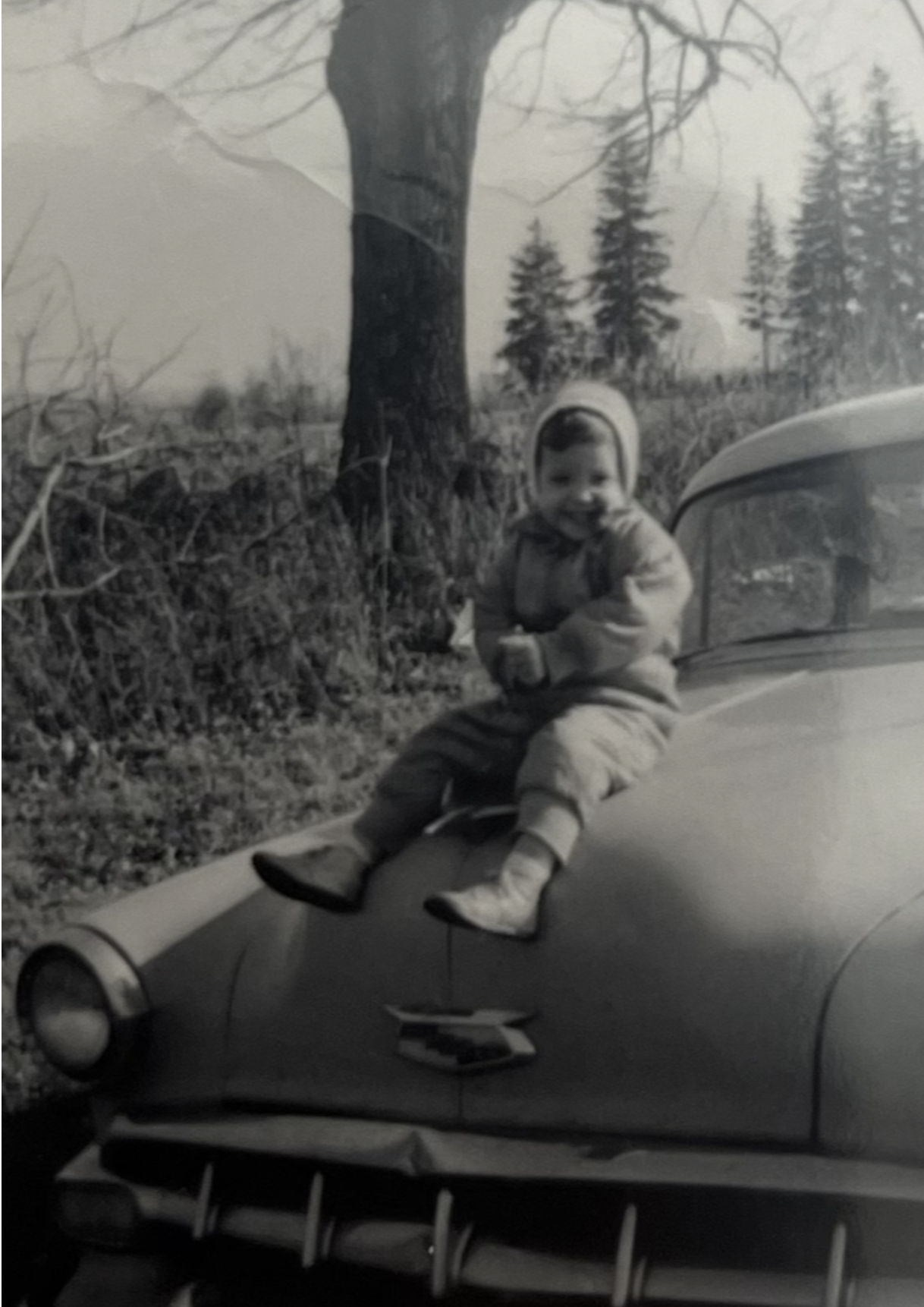
The “ancient history look” of 1950s black-and-white photos
It’s one of those typical 1950s black-and-white photos found in family albums — those of the era of the late Baby Boomers but before the 1960s when you could more easily obtain color film. It has that dated look and these days, it could simply be viewed as “back then, ancient history.” Only the car gives a clue as to the time period. The bottom line is that this picture comes across more as something found in a history book than a real moment out of a real life. So, while I’ll use some photos in this book, for a large part I am going to use paintings.
The details of a photo…
Why? First, check out the difference when viewing that same moment in full color:
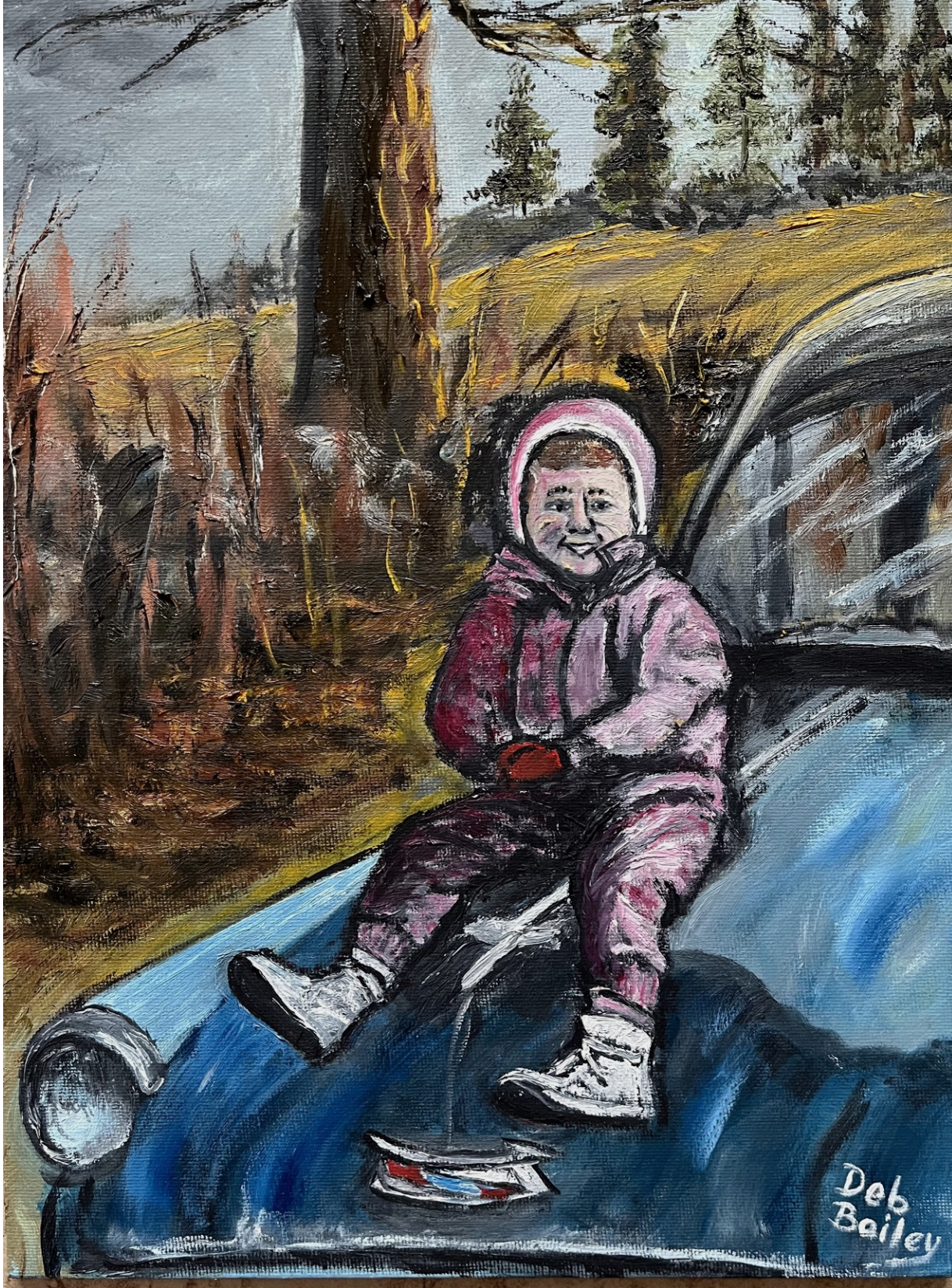
When I painted it, I didn’t fabricate anything about it. Yet the painted scene has a very different quality. Certainly, there is no question that the black-and-white photo yields a lot of information if you look closely at the details. It is a sunny day – either early morning or late afternoon based on the sharp angle of sunlight and shadows. Given my knowledge of that location and which side of my snowsuit the sun is hitting, I suspect it is late afternoon. Also, aside from the fact I am wearing a snowsuit, the lack of tree foliage shows a winter day.
The car is a Chevy sedan. Between the photo details, my research, and my car-geek husband’s knowledge of 1950s Chevy sedans, I know it is a light blue, 1954, 2-door Chevy Belair sedan. And I can even see the dented front bumper– the evidence of the frequent car accidents my father had back then that my mother used to complain about.
Lastly, based on my size, type of shoes, and clothing, as well as personal knowledge such as when I was born and details from a few other pictures of that day, I can estimate my age to be about 2 years old. And I am smiling.
So it is very possible to extract a lot of information from that black-and-white photo.
But then, with color, it feels “alive”…
But there is something about casting it in full color that enhances that moment and infuses it with life, energy, and emotion. It’s one thing to deduce from the details that it was a sunny, winter, late afternoon. It’s another thing to see and feel that late afternoon sun casting shadows across a car hood and a bleak leafless landscape. Color brings an immediacy to the moment that gray tones just don’t. This is a moment that could be happening right now, old car notwithstanding. It is a way to bring the “me of that moment” back to life instead of being buried in the shadowy cobwebs of ancient history.
The eyes of the adult
About bringing that moment back to life, this is the chance to look at that moment again, except through the eyes of an adult. Often the things we remember from childhood can have seriously mistaken interpretations. We missed important things in the moment We had no context for understanding. We knew so little of life. For example, in those moments, we may have thought of ourselves as fully formed, capable, and hence…responsible for whatever was being done to us at that moment.
Yet now, when I look at myself from that time so long ago…fully look at that moment with the eyes of an elder, I don’t see a kid who was responsible for the abuse done to her. I don’t see “damaged goods” or someone who failed to stand up to her father. I see this young, beautiful, vulnerable, pure, innocent who had no idea what she was in for. I see myself as an “innocent,” not as stupid, or responsible for what happened.
Seeing “her,” not the gray tones
And maybe that is the number one reason I have used paintings here – for her…me. I want to get as close as possible to seeing her in each of those moments, really see the reality of her at that moment in time–get to know that small part of myself as a real living breathing person who was taken advantage of, not just some gray tones on paper. I commented one time to my husband that I felt that back then that I was damned no matter what I chose to do with him. He responded that “you were damned the minute he chose you.” And I suddenly realized, years later — I wasn’t damned by my choices but by his. So, I want to see that damned child fully and witness her truth.
The moments never captured on film
Another reason for painting is to see the moments that were never captured on film. Nobody was around with a camera when he was abusing me or hitting my mother. Those didn’t end up in the album. So, I want to see what it looked like for a grown man to hold a 6-year-old against a wall by her throat and fully appreciate that discrepancy of power between us. It is the way to begin to answer–why did I stay so long?
Stopping the “video loop”
By painting those moments, I also get to release them from their prison in my brain. Those moments, while not on film, do end up preserved as anxiety in the “album” of my nervous system. They are remembered in vivid, detailed, flashes of specific moments or places of terror that were seared into my brain. The unprocessed traumas have sat there filed away in my memory banks, alive, spinning over and over as if someone forgot to turn off the projector and the video loop keeps playing. The emotions of those moments are alive within, churning beneath the surface. And until they are reconnected to my adult me and released, they continue to do just that.
That is the reason a person may sit there on a sunny and calm day, but be overwhelmed with anxiety, inexplicably tense, vigilant for some threat, and not even know why. But in fact, we do know. It’s just that those memories are buried like some old file folder in a dusty cabinet, forgotten, and waiting to finally be pulled out and seen for what they are.
For her…and all the kids who have a story to tell
Lastly, when I question why I am telling this story, I can take just one look at that painting and know I am writing this for her…for my young innocent self. I am telling this story so she can finally be heard. And beyond myself, I write also to give witness to all the small children out there who have a story, who lived through hell, and who also deserve to be finally seen and heard.
Tags: 1954 2-door Chevy Belair, 1954 Chevrolet Belair sedan, 1954 Chevy Belair sedan, abuse, abused children, anxiety, art, black and white film, black and white photographs, color film, damaged goods, damned, details, family photo albums, finding voice, giving witness, gray tones, immediacy, innocent, late afternoon, memoir, memories, mental health, mental-health, moments never captured on film, paintings, paintings vs photographs, reading, sexual abuse, snowsuit, telling the story that needs to be told, the eyes of the adult vs the child, toddler, video loop, vulnerable, winter afternoon, writing, writing memoir
 Soul Mosaic
Leave a comment