Why show abuse and trauma in art? Why show it to another? Why SEE it?
The very direct version? For the world…and for me and anyone else who was abused.
Let me start with “for the world.”
For the world – the moments NOT in the family photo album
There is a raw reality that exists behind words like abused or molested. Those words are relatively “clean.” Cerebral. They tell another that “this” happened, but they do not convey the real horror of what “this” was.
They do not describe what I had to live through in each of those moments, for thousands of moments. They do not show the true images of what happened behind closed doors. Images that weren’t memorialized in the family photo albums. Those words don’t tell the “other side” of the story.
So, seeing those moments of horror in living color on a canvas gives that story a level of reality that words just can’t match.
My husband, who has watched me paint for every one of these pieces and saw the episodes of abuse emerge in paint, said as much. “I always knew about these things from what you told me, and I believed you. But seeing those moments makes them real in a whole different way. If he were standing here before me right now, I don’t know that I could actually restrain myself from going at him.”
The paintings show things that maybe society has never thought about in relation to “abuse,” things it doesn’t understand, or things it doesn’t want to look at.
And I want society to understand, because that is the only way this can change, and those harmed can be fully loved.
I want society to see what “childhood sexual abuse” really means. For me. For that young child that I was. For anyone out there who has been through it and isn’t understood by anyone around them. And to answer all of those who demand to know, “When are you going to get over this and leave it behind? Why can’t you just forget it already and move on?”
Intention
People may question the motives of artists and writers who are candid and open in sharing these experiences.
I will state totally emphatically that the intention for the art in this book is NOT to shock, traumatize, or titillate.
It is actually a heartfelt attempt to reach for that deepest human need – connection – by communicating what that reality was.
After being abused, you are “separated” from the rest of your peers. You become an outsider. Different. Either because you can’t tell or are not allowed to tell. You become a split person – the one you show to the world and that the world allows you to be, and the one slowly being eaten alive from the inside by a living, breathing, alien creature – the trauma that shames and humiliates you. You are the person who lives on the other side of the mirror…the person no one wants to see.
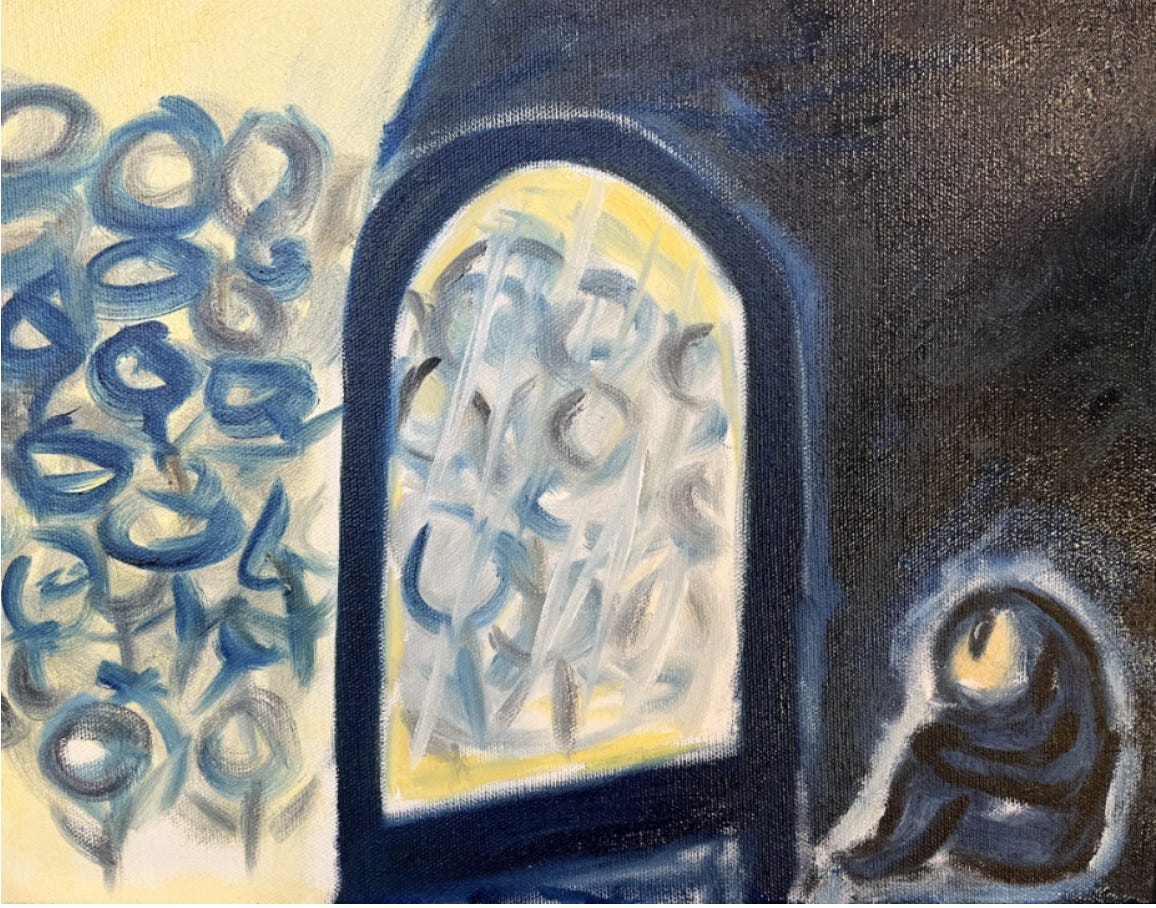
Isolated and alone, I wanted desperately to have SOMEONE be there for me. SEE the REAL me, love and accept me. HEAR me.
By forcing us to be silent, society forces us to stand outside as an outcast observer. We get to watch the world go by but can’t be part of it. And that’s what slowly kills us.
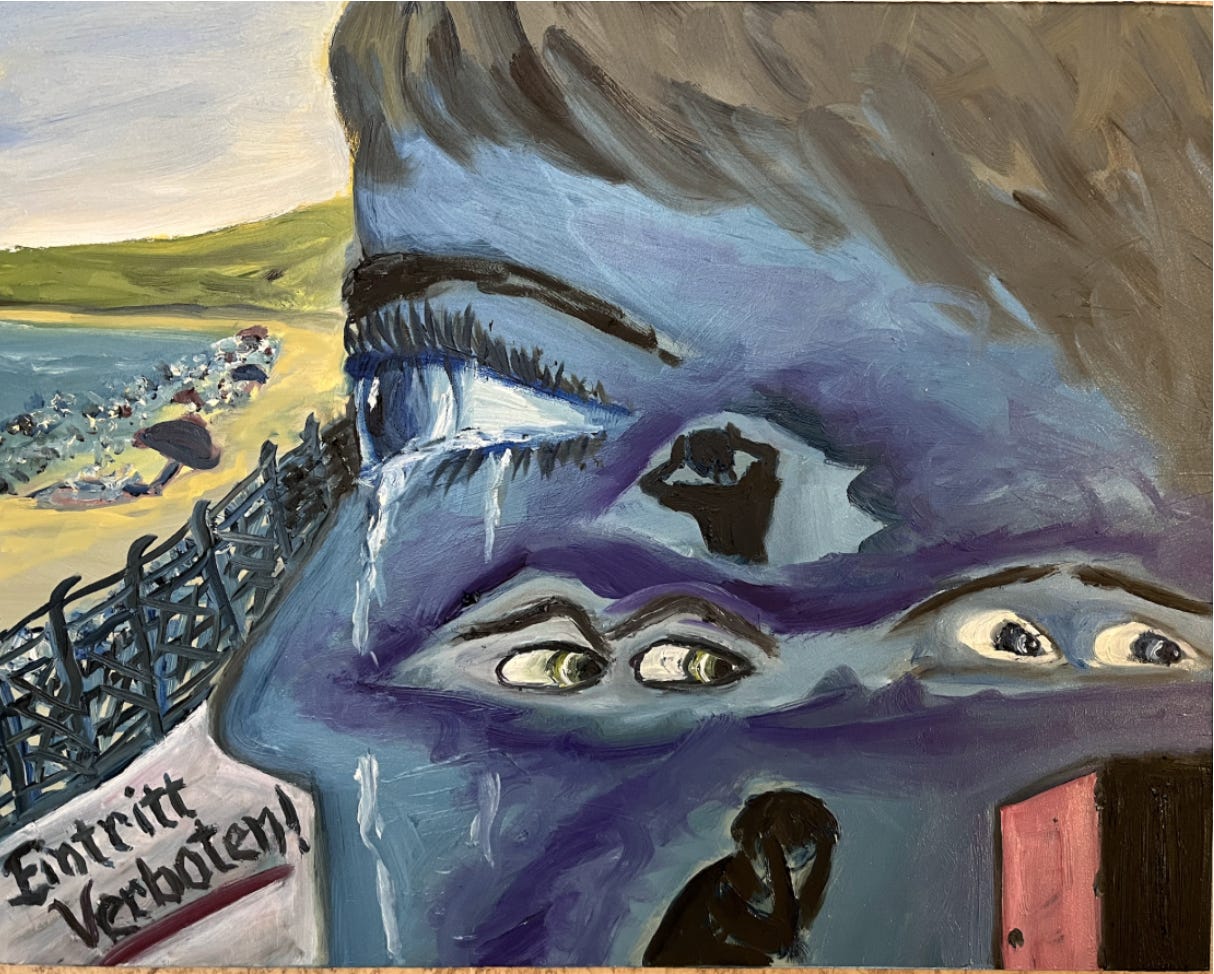
So, the artist or writer tries desperately to show the world as clearly as they can, without going too far, what it is that’s inside you and eating you alive. What that looks like. And WHY it is so hard to reintegrate back into life.
The voice for the millions who can’t speak
The artist and writer are the voices for the hurting millions who have been harmed and can’t speak. And we do what we do in the hopes that another can understand, will WANT to even try to understand. And will let us back into the fold that the sexual assault severed us from.
It is about trying to help another understand a reality many of us had forced on us, a reality we wouldn’t wish on our worst. enemy. And it is about hoping that if you “show it accurately enough,” people will want to do something about it and stop asking questions like “Why can’t you get over it?”
When people ask me that question, I want to ask them: “What part of me would you have me cut out to make it better?”
I was sexually assaulted and mentally, emotionally, and physically terrorized from infancy until I left that house at 28. I endured thousands of sexual assaults. What do you think that does to a person?
So I ask, again, “What part of me should I cut out to make it better? And if I did, would there be anything left to me?”
A colleague gave a seminar on how racism harms a person permanently, and he used a very simple but powerful visual example that applies to abuse as well. He handed each person a pristine sheet of paper, then told each of us to crumple it up. After that, he told us to apply as much pressure as we could to smooth out the paper. While we could certainly stretch the paper back out to its full size, it was covered with hundreds of lines – the evidence of what we had done to it. The reality was, no matter how much pressure we exerted to smooth that paper, it was never going to be pristine again.
For my own life, there are scars that I carry that trigger me in certain situations, set off fear, shame, sadness, even as I know why it is happening. And those scars will always be with me.
I described it to a friend one time in this way. Imagine your ankle was injured and was shattered into many pieces. Now the skilled surgeons were able to operate and piece it back together, and eventually that ankle healed well enough to walk on. But because of the damage done, they couldn’t repair it perfectly. And so, for the rest of your life, you were going to have to limp. That’s just as good as it gets. It wasn’t for lack of trying by the surgeons, physical therapists, or your own efforts. That’s just the best that could be done. It doesn’t mean you wouldn’t be able to get around, live a rich life, travel, and experience wonderful things. But that ankle was never going to be well enough after that to run a marathon or put too much pressure on it. In that injury, something was taken from you, permanently.
So, to be clear, it is not about saying we don’t want to move forward, heal, and embrace our current lives. But creating the art and the story is about showing that someone took something from us that we will NEVER get back, that they changed our life trajectory PERMANENTLY, and that what was done to us wasn’t our fault and will never be gone from our psyches. We can heal it, transform it, reintegrate all our broken parts, but we cannot and will not ever fully erase, fix, or smooth it over.
And we are tired of having the world brush it off, ignore it, or minimize the permanent damage inflicted on us by another against our will. And what that cost us for our futures. I’ll write about costs in another post.
Bari Weiss, a former New York Times Op-Ed writer, spoke, in an interview several years ago, about the allegations of attempted rape against Brett Kavanaugh by Dr. Christine Blasey Ford. She noted that she believed Dr Ford, but in a supremely incredibly tone-deaf comment, she also questioned if Kavanaugh should be deprived of sitting on the Supreme Court because of something done as a drunken teenager.
I can’t even begin to express the outrage I feel at that statement. So, HE shouldn’t have his life’s opportunities removed or curtailed because of a “teenage mistake?” What about Dr. Ford? What about the permanent harm inflicted on her against her will? What about the life opportunities removed or curtailed because of what happened? Sexual assault changes us, PERMANENTLY. What about that?
So, to come back to the question of an artist depicting disturbing realities, it is our only voice, for all of us. Yet it is controversial.
Is it good or bad?
Artist Eric Fischl created a body of paintings that he described as his way to find catharsis and wholeness, a way to exorcise sexual and emotional angst. His background included an alcoholic mother who killed herself, family dysfunction, lack of boundaries, and many mixed messages about sex. His artwork is disturbing and has generated everything from praise to condemnations. Some questioned if his work was sincere.
Fischl argued that “what is clearly ‘bad’ in his work — the awkward and embarrassing sexual situations and the somewhat inept technique — are ‘good’ because they are authentic: he and his work deal in rough truths not glossy fantasies.”
When asked her thoughts about the varied reactions to Fischl’s paintings, his wife, painter April Gornick, stated she didn’t feel his paintings and sculptures were meant to simply provoke the viewer. “My reaction to that question is that every artist feels that the truth, beauty & strength in their work will overcome negative reactions.”
I can’t speak to the inner intentions of Fischl or if he could have done it differently or better. But I share his wife’s sentiment about feeling that the truth, beauty and strength of the work will overcome.
I tried very hard with my paintings to show clear truth without being too blatant. Simply an approach of “Here is enough of the reality I lived so you can get the picture.”
I stand by the truth of my work…and my life. And that brings me to the second big reason to see these scenes.
Now…for me
Each painting I did is a “conversation with myself,” held through the tactile communication between my fingers on the paintbrush and the pain and memories in my psyche. I stepped out of the way to let the horrors in my mind come out onto canvas along with the buried emotions. I let the psyche and the brush tell the story.
The other aspect to my “getting out of the way of the process” was that when I painted these, for the first time in my life, I had a chance to see the FULL REALITY of what happened. This time, I was the viewer of a movie, the observer like a fly on the wall, to the reality of what those moments in time actually looked like.
When I painted these, I was seeing those moments from my past through the eyes of my ADULT. I was seeing the fullness of what that poor kid suffered through even as she excused him, normalized and minimized what was happening, loved him, and then blamed herself.
What does it REALLY look like when you’re in that room?
My adult eyes could finally see the truth of not only what was done, but what it looked like when not excused or normalized. Just how does it look to see a grown, 30-something-year-old man pin a 6-year-old little girl to the wall by her throat without her feet touching the floor? Or to choke her way through being forced to try to give him a blow job?
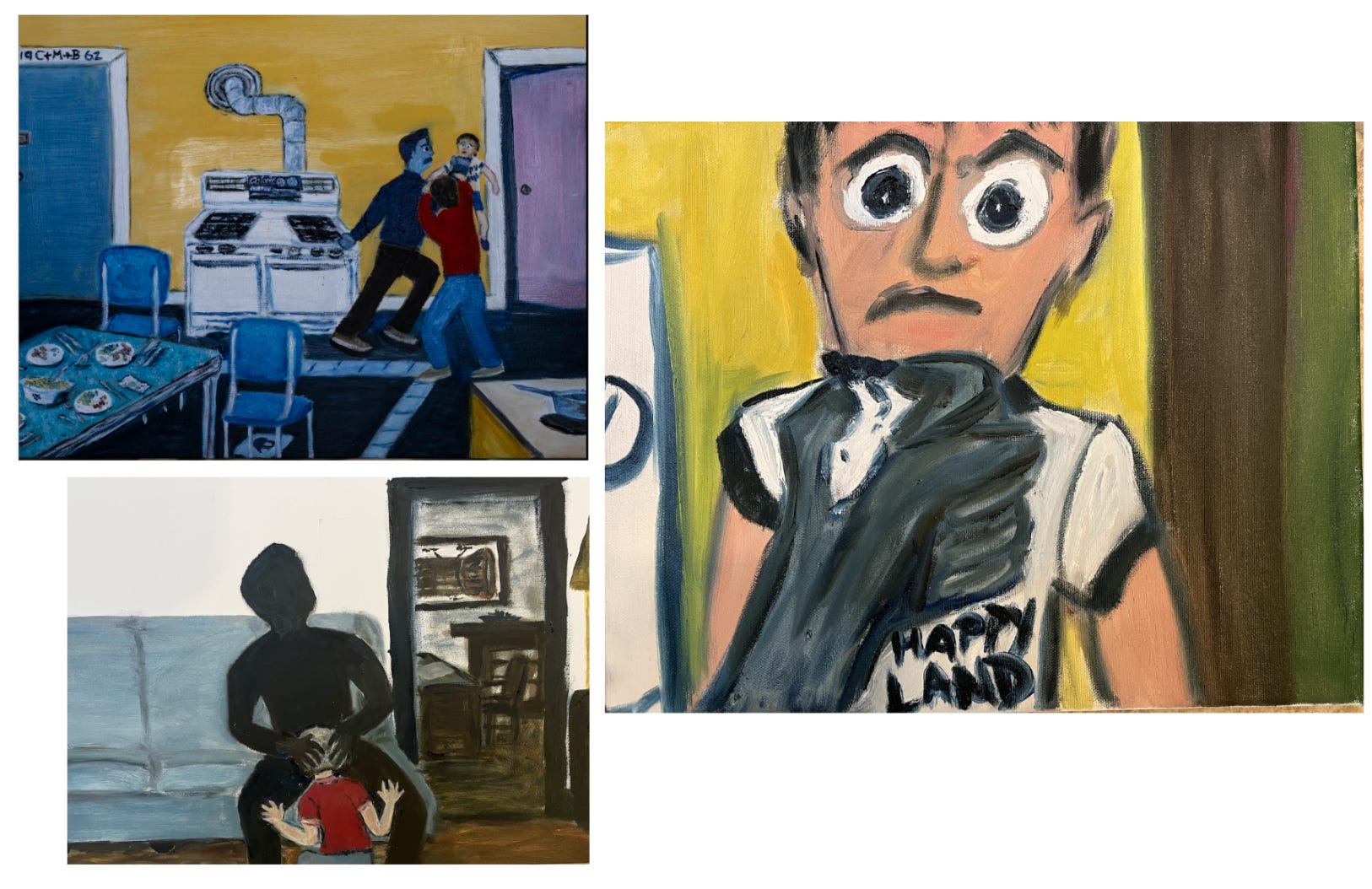
My adult eyes could finally see:
- How strong, heroic, and brave my child, teen, and young adult selves really were
- How truly SMALL and vulnerable I was
- The immense power imbalance between him and me
- The truth of him as a predator, and a PERPETRATOR of evil, selfishness, and harm
- What emotions I was experiencing then, that I had to shove down inside me and not express
By seeing and experiencing all of this, I could finally walk alongside my younger selves, reclaim power for them now, honor them and affirm their worth, and show them the love needed to dispel all self-hate.
Up next
In the next post, I’ll write about HOW I approached the art and the choices I made to express these things.
Note:
I am seeking financial support to complete my memoir, work with an editor, and make a visit to my home state for fact-checking. Your help would mean the world to me as I take this step toward healing and giving voice to my journey.
Please like, comment, and share this post to help spread the word. The link for my fundraiser is on GoFundMe. Thank you for your support.
Tags: art, life, mental-health, painting, writing


Leave a Reply