My Behaviors now –
I have written in past posts about my struggles with friendships, especially with women. I was clingy, insecure, deferred to others’ opinions versus having confidence in my own, and needed constant reassurance that people cared. And I didn’t always select the healthiest of relationships. Over time, I came to realize I’d been looking for my mother my whole life. Not the best foundation for a healthy adult relationship.
I don’t deny any of that. And I fully acknowledge that, try as I might to do better, the pattern repeated even as I didn’t want it to. I was mystified by my neediness and ashamed because my adult self viewed me as acting like a child. While I managed my professional life like the forty or fifty-year-old adult I was, why was I acting like an insecure teenager in my friendships?
As I worked with various therapists to overcome these insecurities, I kept failing. No matter how much we talked it through, I just could NOT get past it. Until one day, during some recent work with my current therapist, we struck on the problem.
We were doing a yoga exercise that involved my being on my back in a vulnerable position. Even as I relaxed into the pose, I found myself getting more and more anxious, afraid, and downright terrified. She called a halt to that work, and instead we discussed what had happened. She was quiet for a moment, then mentioned something about “somatic memories” and “object constancy.”
I’ll get into those in the next post. But for now, she basically explained that the reaction I’d had, as well as the insecurities and some other reactions we’d worked on, were all from a very early “pre-verbal” stage of life.
Trying to understand exactly what that meant, I asked my therapist if that was related to the sexual assault my father inflicted on me during a car ride when I was three. It was an assault I still remember clearly, but given my age, would that have been “pre-verbal?”
She shook her head and quietly said, “No. It would have been much earlier than that.”
I took that in for a moment. “How much earlier than being three?”
“Infancy.”
That stopped me in my tracks. Not because I hadn’t been told by multiple therapists that “I was never safe with him in life.” But I think it was different this time because I finally…believed it. I finally took in the full impact of what that meant. Not intellectually this time. But EMOTIONALLY.
When I first started working on all of this in 2019, I had not really internalized that truth, that I had been “harmed” as an infant. I heard the words, but it was only now that I started to really process what that meant.
Yet… the funny part was that as I turned those words over in my mind right then, I knew she was right. On a gut level, my body already knew it was true. And some part of me inside was nodding her head and saying, “Yes. I’ve been trying to tell you that all your life.”
It was only now, at this point in my work, that I could truly face it and let me FEEL what it meant to KNOW…he sexually assaulted me…his INFANT daughter.
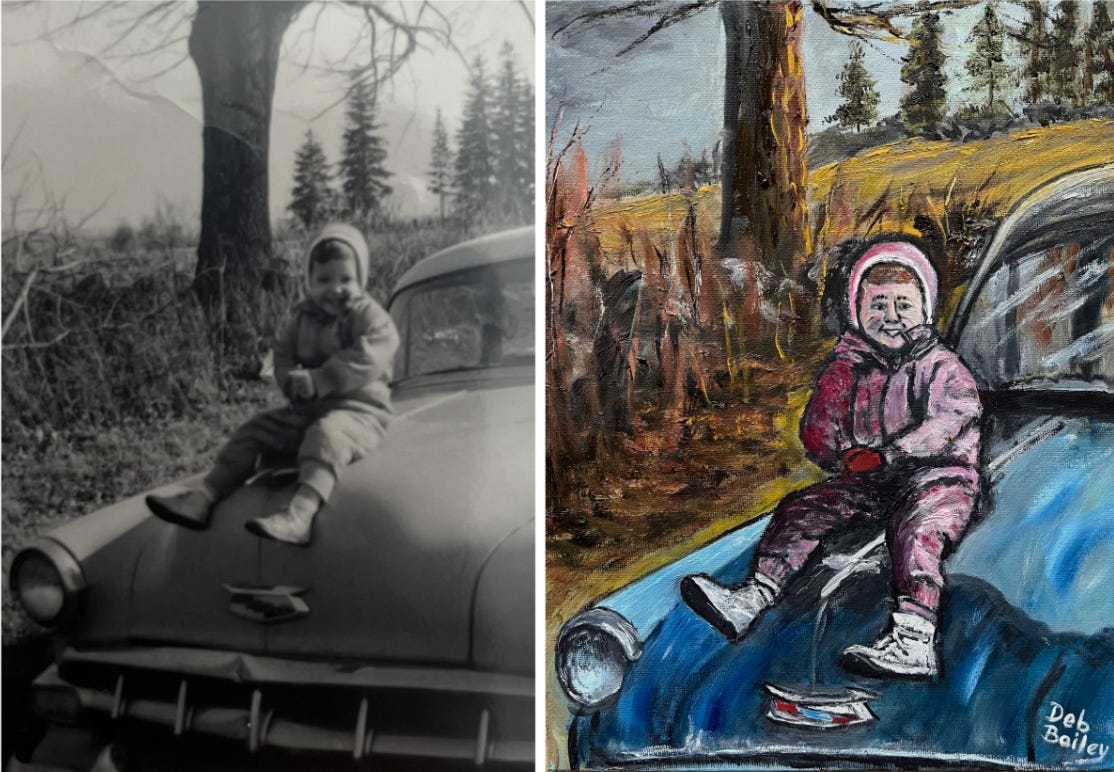
So…what does “pre-verbal” abuse actually mean to my psyche and my body?
What is preverbal
Just for clarity’s sake, a definition of “pre-verbal trauma.”
“Pre-verbal trauma occurs before age 2-3, when the brain cannot form language-based memories, storing traumatic experiences instead as implicit memories in the nervous system and body. This trauma manifests through unexplained physical pain, chronic anxiety, and somatic sensations, as the body holds the ‘felt sense’ of danger, neglect, or distress. Because the brain’s hippocampus (responsible for explicit memory) is not fully developed, these traumas are stored as somatic (body) experiences.”
Google search
Additional facts included things such as the trauma leaves the body stuck in chronic fight, flight, or freeze modes, with sensations of numbing or high-alert states being common. The article went on to explain that triggers include sensory items, such as sounds, smells, or sights that resemble the original trauma.
AND — something which was key for me and my current-day emotional struggles — all of this results in body pains, intense fear of abandonment, trust issues, and unexplainable mood swings, anxiety, or feelings of “badness.
So I seemed to be on the track of a cause for my struggles. My question then became, “How do I use these “memories” to help me heal?”
Can an infant possibly recall abuse?
“The key word in this question is ‘recall.’ Most people think of memory as limited to the storage and recall of cognitive, narrative memory. With this understanding, a pre-verbal infant would not be capable of ‘remembering’ and ‘recalling any event.’ …And…we are all familiar with the developmental amnesia that occurs at approximately age three…such that narrative memory for events prior to age three or four are difficult to access later in life. These two points have led to the pervasive, inaccurate, and destructive view that infants do not recall traumatic experiences, including sexual abuse. Nothing could be further from the truth.”
Bruce Perry, “How we remember,” in CYC-Online (The International Child and Youth Care Network) 122 April 2009. On the Brain
How DOES the infant memory work?
Perry goes on to say that the brain has a number of ways that it stores and recalls memories, including “…motor, vestibular, emotional, social, and cognitive memories.”
Through these pathways, significant memories are stored, AND will affect the person for life:
“All incoming sensory information creates neuronal patterns of activity that are compared against previously experienced and stored patterns….the majority of these memory templates are based upon experiences that took place in early childhood…the majority of our ‘memories’ are non-cognitive and pre-verbal. It is the experiences of early childhood that create the foundational organization of neural systems that will be used for a lifetime. This is why…infants and young children are more vulnerable to traumatic stress – including sexual abuse. If the original experiences of the infant with primary caregiving adults involve fear, unpredictability, pain, and abnormal genital sensations, neural organization in many key areas will be altered….Depending on the specific nature of the abuse, the duration, the frequency, and the time during development, a host of problems can result…the long-term effects of sexual abuse in infancy are the result of memories – physiological state memories, motor-vestibular memories, and emotional memories- which in later years can be triggered by a host of cues that are pervasive. Incestuous sexual abuse is most destructive in this regard…If these original ‘templates’ for all future relationships are corrupted by sexual exploitation and abuse, the child will have a lifetime of difficulties with intimacy, trust, touch, and bonding — …the core elements of healthy development and functioning throughout the lifecycle will be altered.“
So the bottom line is that YES, those abuse memories ARE stored and kept, not as cognitive narrative, but as body responses, emotions, and memories of touch and being handled inappropriately. AND it affects us permanently.
So, what does it all mean now?
Perry goes on to detail the damage done to the developing child, including altered brain development. This results in emotional, behavioral, and cognitive development that is harmed by that early abuse. He notes that the brains of children suffering such abuse are changed in multiple ways, and the earlier the abuse takes place, the more wide-ranging and severe the impacts on that child. As he concludes:
“…trauma during infancy has a profound impact on the developing child; and sadly, most traumatized infants end up ‘remembering’ the trauma in one way or another for the rest of their lives.”
So for me – Insecurity. Abandonment terror. Lack of self-worth. Needing validation from others. Along with tension, hyperreactivity, anxiety, hypervigilance, body pains, and sensory reactions. What did they all point to? Yes, they were recorded in infancy. SOMETHING happened back there. Was there some way I could access them? Understand how to help them?
“The most fundamental idea at the heart of modern psychotherapy is that in order to heal ourselves from our neuroses in the present we’ve got to understand what went on in our childhoods. Though this thesis makes impeccable theoretical sense, there’s one enormous problem with it – amnesia. Simply put, almost no adult remembers a single thing that happened to them before they were three….We might sense that something was peculiar around our caregivers, but to really get a proper understanding of what these people were up to tends to be far beyond our ordinary powers…but there is one extremely useful way to make progress. We should look at ourselves in the present and start asking ourselves questions. Everything we need to know about the past is actually contained in what’s going on for us right now. We don’t need to try to remember all sorts of things that have in reality escaped our memories totally, we just need to check in on who we are today. The legacy of the past will be active, rich and vibrant for better and for worse at every moment of our actual adult lives. So one of the first questions we need to ask ourselves as archaeologists of our past is what day to day in the adult world we are afraid of.”
The School of Life video: “One Key Question to Liberate Yourself From Childhood.”
Well, what do I fear?
Given all my reactions above, my therapist and I could identify two main infancy wounds:
Somatic trauma in my body tissues: From the sexual, physical, and emotional abuse from my father, there was “somatic” damage. My body tissues and nervous system absorbed the powerful emotional terror of angry faces and loud voices. It felt rage at being grabbed and sexually assaulted. And fear. Confusion. These would all be thanks to Dad. And these days they show up as nightmares, body pain, emotional responses to certain situations, and health issues.
And given that I have been writing about these in the past few posts, enough said about that part.
The other wound had to do with “attachment issues. And this one is tied to ineffective bonding with caregivers at a critical time in my early development. VERY early development….Infancy.
Some therapists refer to this as a Mother wound. And while there are definite Mom issues in this one, I had TWO caregivers, so I won’t put this one all at my mother’s doorstep.
It is this latter wound – attachment – that explains so much now that I understand it. And I will write about this next.
Up next
Part II – The word salad of “object constancy,” “object permanence,” “emotional permanence,” and attachment.
Note:
I am seeking financial support to complete my memoir, work with an editor, and make a visit to my home state for fact-checking. Your help would mean the world to me as I take this step toward healing and giving voice to my journey.
Please like, comment, and share this post to help spread the word. The link for my fundraiser is on GoFundMe. Thank you for your support.
Tags: healing, mental-health, PTSD, trauma, writing


Leave a Reply