A glimpse at “the me of today”
So who am I now? That is the focus of this Rubedo section. What have I learned? Have I changed? Have I healed? How?
I have a bunch of folders with scribbled notes I am organizing as we speak. Those are my “source material” to consider. The thoughts on those notes came up all throughout my writing process. But since they were more for the end of the draft, I would scribble them down and toss them in the folders. It will now be interesting to see how the “me of then” who wrote those notes compares to the “me of now” who has finally reached the point to consider them.
I know there will be a difference, because I feel so different after all the writing of this past year and a half. Hence, this will be a journey of discovery. Pleasant discovery, I think.
Before I dig into serious topics, I will start with joy. The me of the present moment is not just serious and introspective, but also joyful, curious, and in awe of so many things.
So I will start with one of my “Moments of Respite.” In the past, these were any kind of distraction to help me survive Dad’s raging abuse episodes. They were always about hyperfocusing on some small overlooked aspect of my surroundings that I could escape into. Now, though, they are more about embracing my wonder and joy at the world around me.
Given that it is fall here in North Carolina — a time of year I absolutely love — and the squirrels in my yard have been so busy readying things for the winter, I will share a piece I wrote earlier this year.
A Moment of Respite: The squirrel drey
As I ran to the mailbox, I hunched over against the wind gusts. It was one of those times when, even in normally warm North Carolina, we hit single-digit temps with an ice storm due. That’s when I noticed the three trees at our end of the street, each with one of those crazy-looking leaf balls high up in the limbs.
I thought about the squirrels who might be in them and wondered how they could stand it, or would they be frozen? The questions started piling up. The first one obviously was: “Were they even in there?” I thought they nested in dead tree cavities. “And how warm are those things when it’s this cold and windy?”
If that wasn’t enough, I wondered if the same squirrel made these three dreys, or was each one a different squirrel? And how close was “too close” if they were different squirrels?
So, that became my next quest over the next few weeks whenever I had free time.
Dreys vs tree cavities
First, those “leaf balls” are called squirrel dreys. While flying squirrels and red squirrels will sometimes make nests in trees, the ones here were from grey squirrels. And while they looked crazy and haphazardly built, it turns out they are pretty amazing structures.
While it’s true that in the cold weather, squirrels usually prefer tree cavities for better warmth and protection, they can and sometimes WILL winter in the dreys, especially if there aren’t any available cavities. The tree cavities are usually great for staying warm, and they offer protection against predators. Also, it’s not uncommon for several squirrels to gather in the cavity, using their collective body heat to stay warm.
Squirrels may also find other “cavity inhabitants” in a tree. Owls, various birds, bats, raccoons, and other animals also make use of such shelters. Even insects burrow under the bark.
If they can’t find a tree cavity, then gray squirrels will build tree nests – dreys. There are some squirrels, especially red squirrels, that will seek out empty birdhouses. In fact, the red squirrels will chew up the opening to make it larger so they can get inside. On the topic of using birdhouses, red squirrels can, apparently, be vicious little critters. If there are eggs already in the nest box, they may toss them out or destroy them. Also, red squirrels have been known to partially eat any baby birds, or kill the adult, and sometimes will weave those bodies into the nesting material!
But about those leaf dreys…
Well, squirrels have good reason to always be “on the run,” as they keep a lot of things happening at once. For starters, a single squirrel usually builds between 2 and 10 nests per year, usually about 4 on average. They place them high in the tree, about 20-50 feet up in the tree, using trees with food, such as acorns, available. The nest is usually nestled in a fork of limbs near the trunk of the tree. The multiple dreys are sometimes in the same tree or in ones close to each other. But all in the animal’s home range. So the odds are, those three at the end of our street probably belonged to the same squirrel.
There are multiple reasons they build them. While one or two may be the strongest and thus able to be used for nesting or during the winter, other ones are for more “temporary” reprieves. Those may be much lighter in construction with less lining. Since squirrels are often foraging, some of these may be used for resting or to store caches of food. Also, they serve as quick hideouts when predators may be around. And yet others are backups in case the main nest becomes infested with fleas, or the squirrel needs to relocate when a storm knocks one from a tree. Except for mating times or in the very cold days of winter, squirrels usually don’t share the nest.
Squirrels generally build the dreys during the summer and early fall. The nests built in June and July are usually for their second, end-of-summer, breeding season. Fall construction, which will be for winter and early March breeding nests, usually peaks right before trees shed their leaves.
Construction is actually fairly quick – usually about 2-5 days, though under ideal circumstances, some have been built in as little as 12 hours. As to size and shape, they are usually 1-2 feet in diameter, and some are football-shaped. The entrance is small and designed for security. By facing the tree trunk side of the nest, the small hole blocks predators and wind.
What is inside of that pile of leaves?
Again, talking about gray squirrels, it’s actually a multi-layered, rather meticulously engineered structure. (Red squirrels, if they build a nest in a tree outside of a cavity, usually build smaller, more compact structures between the branches of conifer trees.
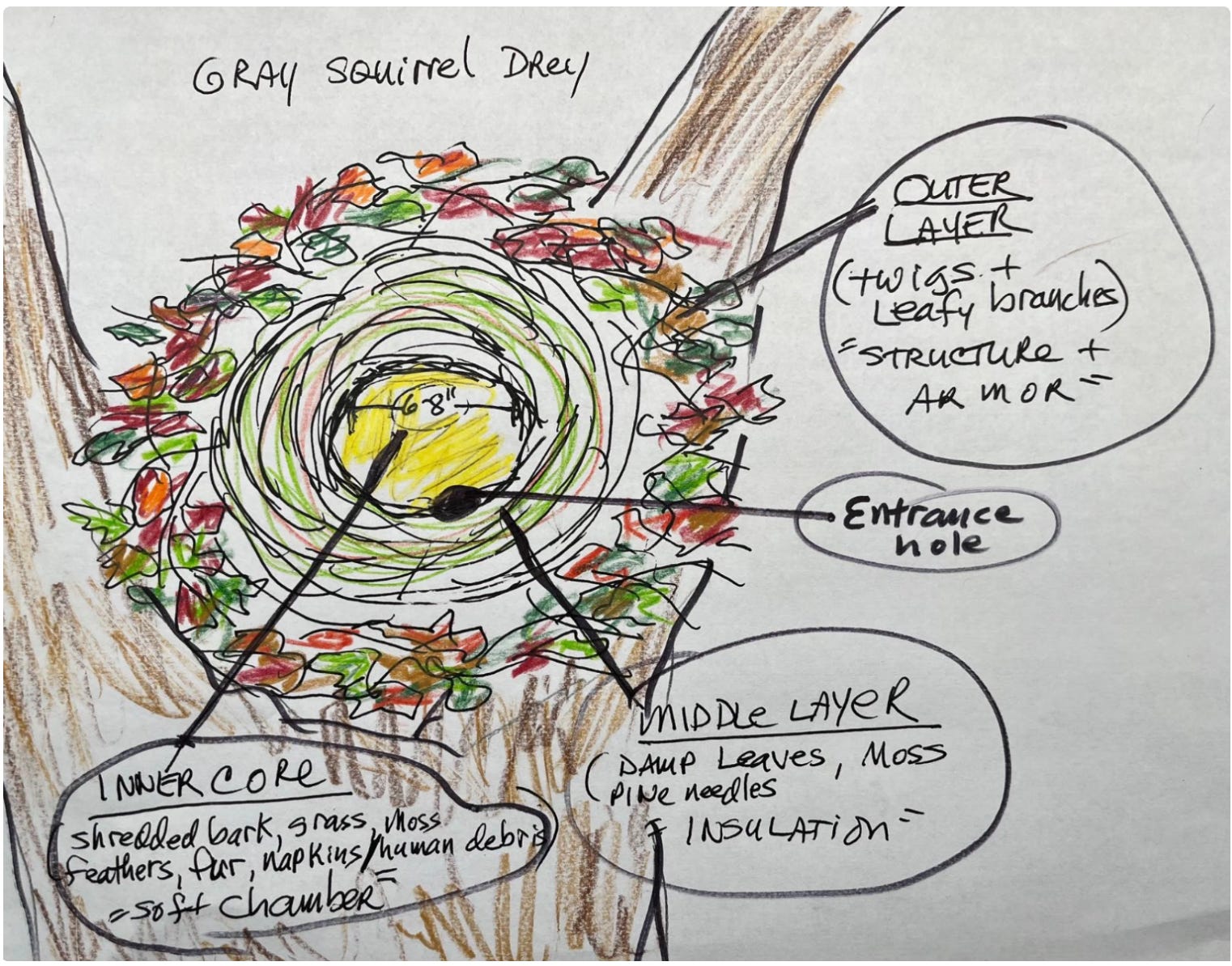
The structure is 3-layered:
- Outer Layer – This is the structural shell of the nest, made up of intertwined twigs and branches with leaves. Squirrels often use living, leafy branches and weave this layer into a tight ball that is actually waterproof
- Middle Layer – This thick layer is the magic in terms of temperature control. It is made up of damp leaves, moss, and sometimes pine needles. In addition to providing insulation, it also reinforces the structure of the shell. One researcher found a nest with 26 layers piled on top of each other. The leaves are packed so tightly they are like interlocking shingles, which are watertight.
- Inner Core – This is the central cavity where the squirrel curls up. It is about 6-8 inches in diameter and is lined with any soft materials the squirrel can find. These usually include shredded birch or cedar bark, grass, moss, lichens, feathers, fur, or any soft human debris. Some nests have had napkins in them. As a bit of trivia, the Northwest Indians used shredded cedar bark to diaper their babies.
- Entrance Hole – This is located at the bottom where the nest is nestled against the tree trunk.
So, finally, just how warm DO those nests get?
Well, generally dreys can effectively maintain an internal temperature of 36-54 degrees Fahrenheit (2.2-12.2 degrees Celsius), warmer than the outside temperatures. That means that even in sub-zero conditions, the nests remain above freezing. If you add a squirrel into the nest, the temperature can rise to 68-86 degrees Fahrenheit (20-30 degrees Celsius), warmer than the outside temperatures. The drey can become even warmer if there is more than one squirrel in the nest, such as a mother and her babies.
Gray squirrels don’t hibernate, but are instead in and out of the nest regularly. This is to look for food stored elsewhere, or during its Jan-Feb mating season. When the squirrel exits the nest, the insulation will prevent rapid cooling. And when it returns later, its body can re-warm the drey in as little as 10-30 minutes.
So to come back to my original questions at the beginning of this piece, on that frigid, windy afternoon, were the squirrels in that drey and would they be warm enough to survive? Not only was the answer “Yes” to both, but in that moment, the odds were good that they were a whole lot warmer in their drey than I was while running outside to get the mail.
Up Next
I THRIVE! Even in my seventies, I still have a whole lot of feistiness and passion for life!
Note:
I am seeking financial support to complete my memoir, work with an editor, and make a visit to my home state for fact-checking. Your help would mean the world to me as I take this step toward healing and giving voice to my journey.
Please like, comment, and share this post to help spread the word. The link for my fundraiser is on GoFundMe. Thank you for your support.


Leave a Reply