Archive for the ‘Broken Bits’ Category
February 21, 2008
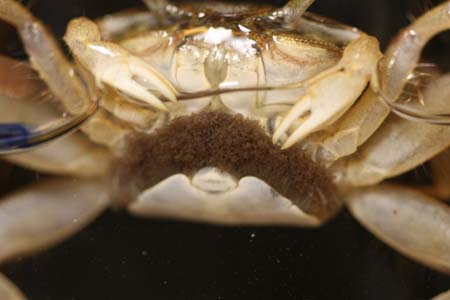
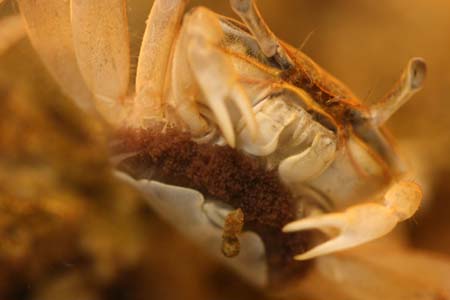
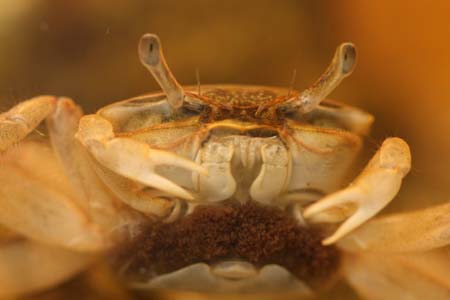
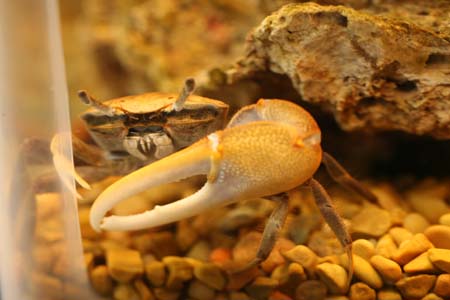
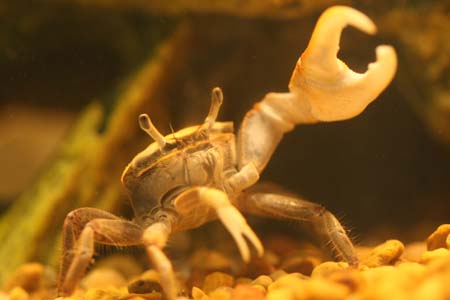
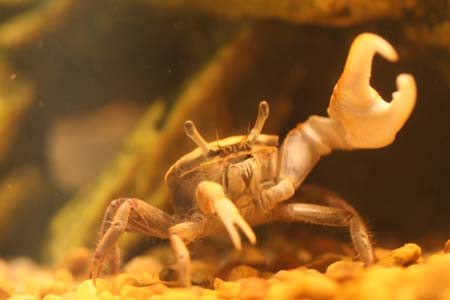
I am going to be out of the office today, so a brief, fun posting with pictures of pregnant Scarlett O’Hara carrying her larval fiddler crab babies. Also a shot or two of the proud father, Admiral Byrd, who is STILL waving his claw. I am determined to get a really good shot of him doing that claw wave, but these aren’t too bad.
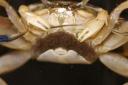
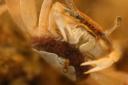
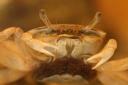
Here are some shots of “the babies.” They are the brown mass of egg-looking things tucked in that shelf on her abdomen. They’re not the sharpest shots, but then, Scarlett O’Hara is not the most cooperative super-model. She won’t stand still. Also, it’s hard to get a shot where she’s not moving her claws. She is CONSTANTLY shoving food in her mouth – she is a two-fisted, non-stop eater. I guess though, she is eating for a few thousand? 🙂
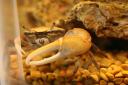
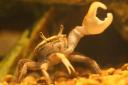
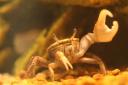
Admiral Byrd spots me and tries to hide in the corner of the tank against the live rock. The grayish streak is the silicone sealant in corner of the tank. I think he likes to hide behind that strip and also the thermometer strip (not seen) because it blocks his vision of me – that whole “if he can’t see me, then I don’t exist and he’s safe,” mentality? What do you want from a creature with a brain the size of a pinpoint?
The other two pictures are classic Admiral Byrd poses. He sometimes spends all day with his large claw in the air, sometime both claws in the air. While I know he’s either trying to scare me off or encourage the ladies, sometimes when he has both claws up, he looks like he’s paying homage to the god of the tank, the aquarium light above. He is also very pragmatic when trying to show off for the ladies. He’ll have his large claw up to get their attention, while using his smaller claw to shove food in his mouth. A guy has to eat, right?
See you tomorrow!
Tags:abdomen, Admiral Byrd, aquarium, babies, brain, claw, crab, egg, fiddler, God, larval, mentality, mouth, pinpoint, pregnant, Scarlett O'Hara, sealant, silicone, super model, tank, two-fisted
Posted in Broken Bits | 3 Comments »
February 20, 2008
I absolutely LOVE diners. They were part of the world I grew up in. To me they were places of love, connection, friendship, community and sustenance. I still feel that way. They also factor very strongly in both my current novel-in-progress, Under the Pier, and a chapter book/novel-in-progress, Diner Kids.
I also feel very strongly about our kids. All of them. It matters to me that they all have a shot at happy, productive lives no matter where they live.
I came across an interesting program when I found the web site for the American Diner Museum in Providence, Rhode Island. I had a chance to interview Daniel Zilka, the museum director, and learned about two important projects they sponsor. Through those programs both at-risk youth and historic diners stand to benefit. As my gift back to diners and those kids, I pass on this info:
Important News About Diners at the American Diner Museum:
The American Diner Museum in Providence, RI not only records and preserves the history of diners in America, but it is actively involved in preserving and restoring both the diners and our youth in today’s world. They have two ongoing programs:
The Diner Rescue Fund: a fund from donations to restore and preserve historic diners in America
The New Hope Project/Diner Restoration Fund: A project with The American Diner Museum and the Rhode Island Training School to restore old diners and save at-risk youth. From the New Hope Project web page:
“The Rhode Island Training School saw a need for enhanced vocational training for the student population and the American Diner Museum visualized new hope for diners that it was trying to save from demolition”
The project teaches youth skills from carpentry and cooking to business management. The diners are restored by the youth and are either displayed or will be used as functioning diners, possibly staffed and run by these youth.
This whole thing is summed up best in a quote from the RITS Community Liaison, John Scott, in an October 31, 2007 article by Joe Kernan in the Warwick Beacon Online :
“The poetry in all of this is that the students of the RITS, a population that society turns away from, is going to save historic structures that society has turned away from.”
The Rhode Island Training School (RITS) is part of The Juvenile Corrections Division of the Rhode Island Department of Children, Youth & Families.
The links above contain information about the programs and places to send any donations.
Tags:American Diner Museum, at-risk, chapter book, community, connection, Daniel Zilka, diner, Diner Kids, Diner Rescue Fund, donate, fund, historic, Joe Kernan, John Scott, Juvenile Corrections Division, love, novel, Providence Rhode Island, rescue, restoration, Rhode Island Department of Children, Rhode Island Training School, RITS, The New Hope Project, under the pier, Warwick Beacon, Warwick Beacon Online, youth, Youth & Families
Posted in Broken Bits | Leave a Comment »
February 19, 2008
Initially, I was going to call this entry “Evolution of the Novel” thinking I would dig right in to the logistics of writing Under the Pier. But I realized before I could do that, I had to finish the process Uri Shulevitz outlined for the “Evolution of the WRITER.” From that it was clear that this entry’s title needed to be “Evolution TO a novel,” the final leg of coming into my own.
I have always struggled with the fact that others seem to do rings around me. My husband works in a job where not just every day, but every hour, the priorities change, the deadlines change, who he has working for him changes. It’s constant jumping. He has a quick, fast mind. My sisters and friends manage full-time jobs, more than one job, kids, house, pets, and other responsibilities. I thought maybe it’s a writer thing – writers just move at a slower pace. Yet I observe other writers producing novels, while writing articles, while chatting on the writers’ email lists, updating their web sites, promoting their books and doing school visits. It’s like trying to walk with someone who is always faster than you. The best you can do is maybe match them for a little while, but eventually, you always fall behind. For years it bothered me, and the competitive person inside kept trying to keep up or catch up. And I absolutely ABHORRED admitting to anyone, that I couldn’t keep up with them.
The title of last Thursday’s entry for Thich Nhat Hanh’s online course read: “Let Go.” The entry said: “Letting go gives us freedom, and freedom is the only condition for happiness. If, in our heart, we still cling to anything . . . we cannot be free.” That was the answer I’d finally come to in the last year or so. Just, let it go. Even playing racquetball – I always fought to win when I was younger. Now I never win, but I have grown to love the process of just playing my best. Coming into your own is the moment you finally choose to be free. You let go of the competition and comparisons and just accept who you are.
I am a plodder. Plodders do not have fast brains. While others are rushing around, plodders just stare at them from the sidelines with their mouths open. Instead of snap conclusions, plodders pull things apart, stare at the parts, put them back together differently, then stare some more. Confronted with a pile of seemingly useless, unrelated bits of information, plodders push them around for hours or days or years, until finally a whole picture emerges. The one thing about plodders is that they never quit. They just keep plodding until they find the big picture and make sense of things. They feel the questions and keep going until they have an answer to the question, “What is it?”
It’s like when I did bacteriology. You start out with a confusing mass of all different kinds of bacterial colonies on an agar plate. You look it over until you spot the one that’s probably the culprit of the infection. You stare at the colony on the plate. What color is it? What’s its size, texture, smell? How does it look on different types of agar? What does it look like under the microscope? You run a battery of 20 or more biochemical tests. You end up with this heap of separate, seemingly unrelated bits of data, and the question – what is it? The answer comes from how all those pieces are assembled by a person too stubborn to quit. Assemble the bits like a mosaic and you have Staphylococcus aureus, or Escherichia Coli, or Enterobacter aerogenes, or my favorite, Campylobacter. 🙂
Maybe the thing that plodders and at least this writer have in common is the place inside where we carry both the tools to recognize the patterns, as well as the questions that need to be stared at.
I think stories come from the places within us that hold the unanswered questions. Those places hold the deepest hurts, the places of anger, confusion, sadness, the disappointments, the unsettled business, the tangles we never unknotted, the humiliations we’d like to forget, or the ugly things we don’t want to look at. And the happy moments. There’s the ultimate confusion in life: Why are some times happy and others abysmal? Plodders seek answers by picking through all the tangles, like a bag person picking through the garbage can. If the plodders also happen to be writers, they make their moments of picking through the trash, public. They write a story to document their quest for truth.
The story may not even resemble anything from the writer’s life. Last time I checked, no author has lived in futuristic space or slain any dragons. The story doesn’t have to be autobiography. What it must contain at its core are the questions that that writer carries in their heart. Writers then journey through what they write, to the ultimate whole picture, hopefully, the answer to their question. Some writers can express this journey to find their truth in a 4-line poem or succeed in capturing God in five words or less. Some write picture books. And some, like me, need the panoramic expanse of a longer, more meandering path. That means, novels.
It means plots and subplots, woven like twisted threads. It means primary characters, secondary characters, and maybe a few cardboard characters. It means diverse settings and tweaky, idiosyncratic details. I know this now, because I know me, now. I am exhausted and weary of trying to be what I am not. I am what I am, take it or leave it. Some will relate to my stories, some will hate them. No matter. I write, for me.
I’ve spent many, many years trying all different things on for size. I’ve tried to be what others are. Do what they did. I’m tired of that. I’m ready to be me. So I just, let go.
“Better to write for yourself and have no public, than to write for the public and have no self.”
Cyril Connolly – 20th Century British literary critic.
UP NEXT: Okay, NOW Let’s Talk About Where Under the Pier Came From
Tags:agar, answers, bacteriology, bag person, biochemical, bits, British, Campylobacter, characters, colonies, colony, comparison, competition, confidence, Cyril Connolly, data, details, disappointment, Enterobacter aerogenes, Escherichia coli, evolution, garbage, identity, idiosyncratic, let go, literary critic, microscope, mosaic, novel, pain, panoramic, path, picture book, pieces, pier, plodder, plots, poem, questions, racquetball, setting, Staphylococcus aureus, stories, subplots, tangles, test, Thich Nhat Hanh, trash, truth, Uri Shulevitz, writer, writing
Posted in Broken Bits | Leave a Comment »
February 18, 2008
Well, after everything from ER to fiddler crabs to grocery shopping, it’s back to the regular business of life today. Regroup and back to work. There’s bills, taxes, and yes, back to the last couple of installments in my journey to being a writer. I will resume the last one tomorrow with:
Stage Three: Coming Into My Own – The Evolution of a Novel
I am of course, not forgetting that I need to do the one on Writer’s Rooms vs. my Writer’s House, which is like that motile swarming bacteria, Proteus mirabilis. So for today, bills and taxes. I hate those tasks, but they must be done, so just get it over with. Have a great day.
Tags:bacteria, bills, business, ER, evolution, fiddler crabs, grocery, installments, journey, motile, novel, Proteus mirabilis, shopping, Stage Three, swarming, tasks, taxes, writer, writer's house, writer's room
Posted in Broken Bits | Leave a Comment »
February 17, 2008
Well, that is life for you. One minute you’re choking in the ER, the next maybe we’ll be surrogate grandparents for our fiddler crabs?
Again, it is my husband, the one who made fun of my fiddler crab project, who notices changes in the fiddler crab tank.
We have noticed Scarlett O’Hara on occasion, seeming interested in Admiral Byrd. Admiral Byrd of course, ALWAYS waves his claw even when no one is around. My husband explained this is a guy thing – you always stand around looking cool, just in case. Well, apparently things happen when the lights go out.
For the last 2 days my husband has mentioned, with concern in his voice, that Scarlett O’Hara has been climbing all the way up the water filter, almost to the top of the tank, and has been hanging out up there. We just thought she wanted to be queen of all she surveyed and liked being up high.
Today he looked at her and said: “I think Scarlett is going to have babies! Do fiddler crabs carry their eggs on their abdomen?” I glanced at her and there was this wad of brownish spongy stuff tucked against her abdomen, underneath her mandibles.
Sure enough, a glance at a web site of the Fiddler Crab Life Cycle, shows pictures of pregnant females carrying hundreds of thousands of fertilized eggs on their abdomen. The pictures look just like Scarlett O’Hara. So, she’s pregnant!!!!
Now my understanding from something I read, was that female fiddler crabs burrowed down into the sand 23 inches or so, to lay their eggs. So I felt assured we would not be contending with “babies.” In fact, maybe that’s why Scarlett’s been climbing on top of the water filter. Maybe she’s been looking for someplace deep to lay her eggs.
However this same website on the fiddler crab life cycle indicates that female fiddler crabs RELEASE their fertilized eggs into the water and they float around as plankton. When they molt and get big enough, then there’s JUVENILE CRABS running around the tank.
My husband’s reaction was almost identical to 20 years ago when I invited him to have lunch with me at the hospital one weekend when I was working, so I could tell him the results of a certain pregnancy test I had just run: “Oh my God.” My husband said, “I’m not ready to be a grandfather yet, especially to a few hundred thousand fiddler crabs . . . ” But you and I both know, if there’s babies in the tank, he’ll be watching over them and concerned about them.
Now another site I found, About.com’s Keeping fiddler crabs as pets, (which by the way is a GREAT summary of how to raise fiddler crabs in general AND has instructions on setting up a brackish water tank) indicates it’s near to impossible to raise the babies in captivity. Apparently the babies need to go out into deep ocean water to grow then return to the brackish water estuary when they are older.
Well we shall see. Who knows? We may yet have BABIES in the tank!!!!! 🙂 So, the $4 fiddler crabs, with the >$100 of support gear so I could establish a brackish water tank so they wouldn’t die, have apparently not only not died, but thrived! Now we may need ANOTHER TANK so the thousands of babies have a home. Anybody want to buy some fiddler crabs? I’ll keep you posted on the progress of the pregnancy.
Stay tuned this week for pictures of the pregnant mom!
Tags:Admiral Byrd, babies, choking, claw, cool, crabs, eggs, ER, fertilized, fiddler crabs, filter, grandfather, grandparents, guy, hospital, husband, juvenile, life cycle, pregnant, project, queen, Scarlett O'Hara, surrogate, tank, test, thing, water, waving
Posted in Broken Bits | Leave a Comment »
February 17, 2008
After intense things, while it’s important to reflect and absorb the full depth and impact of the event, it is also good to return to humor. My husband found this web site with cute animal pictures and funny quotations. Though it’s not a fiddler crab, I give you “I Has a Stik.”
Tags:animal, depth, event, fiddler crab, humor, husband, impact, intense, pictures, quotation, stik, web site
Posted in Broken Bits | Leave a Comment »
February 16, 2008
Some good writing blogs I heard about on the children’s writing list today:
The Longstockings. It’s eight writers who discuss areas of interest to writers and readers of children’s and teen literature. They share info about the next two blogs.
The first blog, Pound, is by a 36-year-old children’s book editor in Chicago who also writes about body image, weight issues and the diet culture. She has an entry for beginning children’s writers entitled:
Seven things I would tell you about publishing a children’s book if you bought me a drink and didn’t mind me getting all worked up.
She is irreverent, doesn’t mince her language and very informative.
The second blog is: Editorial Anonymous – A Blog of a Children’s Book Editor. The site description of who Editorial Anonymous is reads as follows:
- Editorial Anonymous’ anecdotes are mostly true. Names of authors, illustrators, editors, agents, publishers, manuscripts, and a few random nouns have been changed to protect her ass.
LOTS of good information on the day-to-day workings in publishing.
Tags:anonymous, blogs, body, book, Chicago, children's, culture, diet, editor, editorial, image, issues, literature, longstockings, Pound, readers, teen, weight, writers
Posted in Broken Bits | Leave a Comment »
February 16, 2008
Before I start talking about the Under the Pier process, I need to address the one side that calls to me in a big way – essays. I’ve sold a couple already and I yearn to do more. While this blog is a collection of all the bits of me, perhaps the one area of my soul most fed, is the ability to “speak in essays.”
I have spent most of my time over the last 12 years calling myself a children’s writer, though I have noticed that a lot of my focus is geared toward adults. Is this a contradiction or betrayal of a certain writing path? I don’t think so. Perhaps Madeleine L’Engle handled it best. She used to hate it when she was referred to as a children’s writer, as if that was all she was or it was a special category considered “not quite a writer.” She insisted on being referred to as a writer and considered her children’s writing just one aspect of her career, though certainly not the easiest or least important. Her observation there was: “If I have something that is too difficult for adults to swallow, then I will write it in a book for children.”
So in the same vein, I am first drawn to writing for children as there is the very alive open child within me who wants to speak. However, like everything else in my life, I do not fit neatly into categories. The label “children’s” writer is not totally accurate because I find, I just write. Who it fits, I leave for the readers to determine.
As to my essays, they run the range – spiritual, humorous, nature-based, flippant. One current essay is a list I keep of irreverent things to put on my tombstone: “But it was HER fault, really!” “But I had the right of way!” or “But the bus NEVER came up this far on the curb before!” – the last one from a moment at Colonial Williamsburg where my husband and son expressed concern at how close to the bus stop curb I was standing. When I reassured them the bus never comes that far up, they offered to put that one on my tombstone. 🙂
I love to write essays because my right brain revels in being able to take a single quote or line of dialogue, a comic, photograph, painting or a life question, and just write. Something that starts in the specific and ends up at a universal truth. A journey where I start with the concrete and wander around always surprised where I end up, usually someplace emotional.
In a lot of respects, though I’ve started this blog in the midst of writing a novel for upper middle-grade/Young adult readers, a lot of it so far has been more essays, journaling, unearthing the soul of the writer, rather than a lot about the Children’s Writing business. That’s okay. I need to have that soul of the writer to do that novel. The reality is, that novel has been a journey to answers in life. Maybe in a way, novels are just one long essay because the characters in those fictions worlds still ask the same life questions we all do.
This blog is also my “raw material” that I can mine at will for whatever projects come along. It’s my toy box of thoughts that I can spin into something for adults or children. Truth, is truth.
My “internship of the essay craft” has involved continuing education classes at nearby Duke University, as well questions. Always, questions. They are the catalyst for life, for growth, for wisdom. At least to me, if I stop asking questions, I stop growing. I lose the path to peace
The internship has also included reading countless books. Fiction, philosophy, spirituality, nature guides, and of course, books on essay writing. One in particular is my favorite, and has been the most useful for seeing how to first collect, then transform life experiences. I recommend it highly:
Leaving a Trace: On Keeping a Journal – The Art of Transforming a Life into Stories, by Alexandra Johnson. She teaches memoir and creative nonfiction writing at Harvard and has been published extensively. The book is divided into three parts. It’s possible to only use one of the three at a particular time in life, or ever. The first is about having a journal – creating one, the various types, what raw material to collect; the second part is about transforming your life – finding the patterns and meaning in what you’ve collected; the third section is called “Crossover: Moving a Journal into a Creative Work.”
Whether you just collect raw material, mine it for meaning, or use it to create fiction and nonfiction works, the process changes you. Like that overly used cliched example of a rock thrown in a pond, change one thing and it touches places unseen. Even keeping a list of favorite phrases over a lifetime does something deep inside to your soul and alters your outlook on life.
So I am a writer for all ages. I love to write essays, whoever reads them. They are my journey to answers. They are the playground of the right brain, and the compost pile that fertilizes the rest of my works.
Tags:adults, Alexandra Johnson, bits, blog, books, bus, business, categories, category, characters, children's, collection, Colonial Williamsburg, compost, creative, curb, emotional, essays, experiences, fertilize, fiction, flippant, humorous, husband, internship, irreverent, journey, label, Leaving a Trace, life, Madeleine L'Engle, middle-grade, mine, nature guide, nature-based, nonfiction, novel, On Keeping a Journal, outlook, philosophy, pier, pond, process, raw material, readers, rock, son, soul, specific, spiritual, tombstone, toy box, toybox, truth, under the pier, universal, works, writer, Young adult
Posted in Broken Bits | 2 Comments »
February 15, 2008
I knew Phase II had arrived. Its symptom was unmistakable. I was tired. The amount of work coming from the dictionary job ran up against the short-term deadlines and heavier workload from the ethics board. Family needs took up more time. The ethics board work increased even more. And then there was the point of it all, my writing projects. I realized that I not only couldn’t keep spinning 20 plates on sticks forever, but I didn’t want to. Where some people revel in that level of activity or that challenge, I did not. That, in itself, was telling.
Going back to Mr. Shulevitz’s advice: “You must listen to yourself from your own depths and become acquainted with your own true self . . . learn which is you and which is NOT you. You are what you truly love.” My husband’s reminder felt viscerally real: I wasn’t getting any younger and I needed to stop trying to be what I was not.
I let go of the dictionary work. While it was a good job, I wasn’t meant to be a lexicographer. I throttled back on the ethics board work. It was time for that directive: “Be alone with yourself . . . Achieve inner silence.” In my case that came partly from renewing my dormant practice of meditation and prayer, as well as just, being alone. You can’t run from yourself. To be a writer, if you’re going to have anything worth saying, you must learn your own truth. And it’s only in the quiet moments that the voice within can be heard.
For the first time, I stepped back from my work and took a look at the big picture. I listened to Mr. Shulevitz and sorted out the voices without and within, I looked to see what themes kept repeating themselves in me and my work. That’s when things started to come clear.
I love nature. I loved being 10 and climbing trees and fences and running free in the neighborhood – that time of childhood where you are most capable, where adventure and innocence are at their crest, before the trials and tribulations of adolescence set in. I love castles, the Revolutionary War, diners and the sixties and the blue collar, ethnic world I grew up in. And mythology.
I noticed that I collected, and still do, every silly, touching or factual story about nature, animals, and zoos. I kept a nature journal of our backyard bird feeder and the pond area and collected 3 years of information. I identified with creatures either too small or too much in the background to get noticed, and I was that nature-geek, driven to learn about every tiny sea creature that lived under the ocean pier.
I also knew I’d probably never draw comic strips, or write romance novels, science fiction, or true crime. Nothing against any of those genres, by the way. In fact I am fascinated by the genres of comics and romance novels – they are unique worlds and they seem cool and fun. They just aren’t my talent. And no, I will not try to write any more picture books. In truth, my husband has that voice.
I started to define the projects that were me:
A mid-grade novel set in Williamsburg Virginia during the Revolution. A mid-grade novel set in a 1960s blue collar ethnic New England town, of course, set in a diner. A historical fiction set in 1200s England on the Welsh Marches borderlands. A chapter-book of Greek mythology stories. A fantasy trilogy involving the world of a groundhog living at a highway rest stop, who faces the battle of ultimate evil, personal despair, loss, and emergence into wisdom. And a present day Tween novel of a girl above the pier, in another diner of course, and a hermit crab below the pier.
There is also a love of tweaky, short non-fiction articles about history and . . . nature. I rediscovered a love of and need for essays, which I will write about separately.
I started collecting reference books for all of these projects. Nature guides. Historical fiction. Topographical and historical maps of England and Wales. I made a plaster of paris model of the castle that my lord built, incorporating the latest high-tech gadgets of the early 1200s.
I pinned my project papers everywhere – the study walls were covered on one side with the pier story – maps of the fictitious town, topographical maps of Narragansett Bay, schematic of the diner of my dreams, the one I’d have if I had the money. The other side of the study has the groundhog world – map of the rest, deep woods, nearby farms. The hallway, spare room and stairwell have 1700s Williamsburg, while the den downstairs houses maps of England, schematics of the castle, and the castle model itself.
I even have two webcams up on my computer that allow me to step into 1700s Williamsburg whenever I want. I can see the view down Duke of Gloucester Street or watch the goings-on at the Raleigh Tavern any time day or night. I even had a lobster-cam until that one broke. So I had to settle for the DVD, Realm of the Lobster, that has footage of the undersea world of the lobster in the Gulf of Maine. I found that in this cool marine store store, Hamilton Marine, up in Searsport, Maine. Great website and catalog! Everything from diesel boat cabin heaters and EPIRBS, to cold-water rescue suits and ship’s bells. My next purchase from them will be a hand-crafted wind bell that sounds like a harbor buoy. They even give you the choice of 13 different bells – each one sounding like a buoy in a different place – Bar Harbor, Portland Head, Camden Reach, Outer Banks, etc. I use anything that puts me in the place of my stories.
I started painting again and even did one for the pier story. I bought a new digital camera and started shooting pictures . . . once I stopped being afraid of the thing. It only sat in a box for 2 years. In both painting and photography, I noticed the themes of nature, broken things and overlooked things.
And the words mosaics and broken bits, kept surfacing.
Finally, exhausted, I left the ethics board job. It had gotten to be so much work I was too drained to write. Besides, it was no longer who I was. Revisiting Stage One, I collected outside information as it applied to the projects I wanted to do, from sources like Writer’s Digest magazine, The Writer, countless writing newsletters, market guides and writing books.
All of this I did silently. Alone. Immersed in my own world. And I came to accept that I will work alone. Others can prepare you, teach you, assist you, but when you finally stand at the edge of that dark forest- your own inner world – you must face that one alone. It’s that line from the movie, The Empire Strikes Back. Luke Skywalker is about to enter an area of the swamp where evil lives. He asks Yoda what is in there. Yoda’s response: “Only what you take with you.”
All that was left now was to pick which project came up on deck first. My groundhog story was fairly well outlined. The 1700s Williamsburg novel had some drafts done, characters fleshed out, rejection slips collected. The Under the Pier story had an equal amount of journaling, drafts, and character work finished. The other projects were much further back in the data collection and journaling stages. One day in confused desperation I asked God to please “pick a nipple for me.” A few days later we stopped at Science Safari, a tweaky science store for kids. Sitting atop the discards pile on the sale table outside, was a stuffed hermit crab. My husband and son spotted it. I knew who sent it, so I bought it. The answer had been sent: Start with Under the Pier.
UP NEXT: A Sidetrip to Essays – But the Bus NEVER Came Up This Far on the Curb Before!
THEN: Phase Three: Coming Into My Own – The Evolution of a Novel.
Tags:1200s, 1200s England, 1700s, 1700s Williamsburg, 1960s, adolescence, adventure, animals, articles, Bar Harbor, battle, big picture, bird feeder, blue collar, borderlands, Broken Bits, broken things, Camden Reach, castle, castle model, catalog, challenge, chapter book, characters, climbing trees, cold-water rescue suit, comic strip, comics, crest, dark forest, data collection, deadlines, deep woods, den, dictionary, diesel boat cabin heater, digital camera, diner, Diners, discards, dormant practice, drafts, Duke of Gloucester Street, DVD, emergence, England, EPIRBS, essays, ethic, ethics board, evil, fantasy trilogy, farms, fleshed out, gadget, geek, Greek mythology, groundhog, Gulf of Maine, Hamilton Marine, hand-crafted, harbor buoy, hermit crab, high-tech, historical fiction, historical map, history, inner world, innocence, job, journaling, level of activity, lexicographer, lobster, lobster-cam, loss, Luke Skywalker, Maine, maps of England, marine supply store, market guides, meditation, mid-grade novel, model, mosaics, mythology, Narragansett Bay, nature, nature guides, nature journal, nature-geek, New England, newsletters, nipple, non-fiction, novel, Only what you take with you, Outer Banks, overlooked things, painting, personal despair, Phase II, Phase Three, photography, pick a nipple, picture book, pier, plaster of paris, Portland Head, prayer, project, quiet moments, Raleigh Tavern, Realm of the Lobster, reference books, rejection slip, Revolutionary War, romance novel, sale table, schematic, science fiction, Science Safari, science store, sea creature, Searsport, short-term, Stage One, story, The Empire Strikes Back, The Writer, themes, topographical map, trials and tribulations, trilogy, true crime, true self, tweaky, tween novel, ultimate evil, under the pier, unique worlds, Uri Shulevitz, Wales, webcam, Welsh marches, Williamsburg Virginia, wind bell, wisdom, workload, Writer's Digest magazine, writing books, Yoda, zoos
Posted in Broken Bits | Leave a Comment »
February 14, 2008
As I mentioned, I had reached that place in my Phase I apprenticeship where I had grasped that it takes a long time to become an overnight success. There is no way around paying your dues and learning your craft. You can’t short-change apprenticeship. I knew I did not want to give up my dream to write, so that meant going back to the drawing board, taking classes, and starting at the bottom, all of which would take time. This also meant I had to find some way to bring in an income while pursuing my goal. The most marketable skill I had was that I was an extremely detail-oriented anal-retentive, par excellance. As it turns out, not such a bad skill to have.
I don’t think I was born with that skill. It became second nature from the 15 years I worked in a hospital lab. In a hospital, there is no acceptable margin of error. You have to be right. No matter what I did in the lab, whether it was a crossmatch for someone’s transfusion, a glucose level for a diabetic, a blood count for a leukemia patient, or a drug level for someone’s medication dosage – I knew that the results I reported would directly affect someone’s life. A doctor would base a decision to treat, or not treat, change a dosage or a medicine, based on what I reported. If I was wrong, their lives would pay the price. That training deepened when I worked in the pharmaceutical company. There I validated hundreds of thousands of pieces of data with an allowable error level something in the neighborhood of 0.01 %. The bottom line – details mattered – and in becoming a writer, that wasn’t such a bad place to start.
I decided with that kind of skill, perhaps I could find some editing jobs. Phase I was supposed to be about going “out there” and experiencing, experimenting, and trying new things. So I searched both locally and nationally. I cold-called countless managing editors in all of the publishing houses to let them know I was available for work. I was so terrified on each call, I had my “script” written in front of me while I talked. I sounded assured and confident, even as I sat there rapidly skimming every book on copy-editing, proofreading, content editing, and freelance editing that I could get my hands on. This was survival. I HAD to make this work or I had to find another 40-hour, 9-5 job. If I had to go back to that, I had to give up my writing dream. That, to me, would have been failure. I had given up good jobs, and good income. I just couldn’t give up the dream, too.
I did a few copy-editing jobs for major publishers. That was an interesting time, including the one publisher who didn’t like my work because the editor in charge of that project was a semi-retired person who liked stickies with notes in brown colored pencil . . . ONLY brown-colored pencil. I used the wrong color. No one told me about the colored pencil thing. They later acknowledged that that particular editor was a little “persnickety.” Whatever. I moved on.
A local vanity publisher hired me as their editor – copy-editor, substantive editor, press release writer, you name it, I did it. The money was terrible – flat rate no matter how long the job – but it was money, and it was training. I learned a LOT. After a while I could quote sections of the Chicago Manual of Style by heart and knew it inside and out. The trouble with that local publisher involved getting paid. When their cash-flow stopped, so did mine. It took an attorney to collect from them, so I vowed, no more small self-publishers.
In keeping with experimenting, I answered an online position announcement on the copyeditors email list, for a “native speaker of US English who had experience with other cultures.” It turns out that Bloomsbury, a publisher in the UK was doing a “Global English dictionary.” They needed someone to review all entries to make sure all definitions were there for each word, that they were culturally correct, and sounded “American.” I didn’t expect much but went ahead and sent a note indicating I grew up in a very multi-ethnic community and had just spent 4 years in a British drug company. They gave me an online-test and I passed, so my next title became “lexicographer.” I am listed as one of the lexicographers in the Encarta World English Dictionary, as well as in a thesaurus. They were GREAT to work with and I recommend the experience highly. It was all done by email and overnight overseas deliveries of work, and they paid well . . . and on time. Their Barclays Bank checks were so beautiful that if I hadn’t needed the income, I would have kept one just to frame.
During this time I also became associated with a medical ethics board that would be the mainstay of my freelance work for 10 years. I reviewed the research study documents, and edited, and often rewrote the consent forms that the research subjects would sign. This job spoke to my heart. It used every bit of my medical and pharmaceutical background and then some, REQUIRED someone picky and anal-retentive, and it tapped something else in me – the strong desire to protect. My job was to protect these people by making sure we gave them consent forms that told them fully, what the research might do to them, good and bad. I was well-suited for the work, well-paid, and the job did not require a large chunk of my time each week. That meant – I still had time to write.
I went ahead and did the other direction for Phase I: get outside knowledge. I took courses through the Duke University continuing education program. Classes in essay-writing, picture books, fiction, and how to run a freelance business. I also took and completed two children’s writing courses through the Institute of Children’s Literature. I joined the SCBWI (Society of Children’s Book Writers and Illustrators) and attended their conferences. I joined writing groups and paid authors to critique some of my work. And of course, collected more rejection letters.
I started to have a few successes in my writing efforts. I sold an essay to two parenting magazines about the heartbreak I felt every morning dropping my son at day care. I sold an essay to The Writer, and articles to Boys’ Life magazine. I even wrote two CliffsNotes – a result of one of the cold calls I’d made a year or two earlier – one for Dickens’ Great Expectations, and one for Michael Shaara’s, The Killer Angel. I still collected more rejection letters, but the quality of the rejections were getting better. 🙂 Busy editors took time to write personal notes on the form letters. Sometimes they even requested another revision or two before they said no. Overall, a good sign.
All in all, Phase I had taken a turn for the better, and I was learning a great deal very fast. My goal of seeing my name on the cover of a picture book, however, kept eluding me. Yes. Like many others, I had the idea that I should write picture books. They’re short, easy, quick to bang out, and besides, isn’t that what children’s writers write? I banged my head against the brick wall of the picture book writer idol for a long time before I finally surrendered to the truth that even my husband pointed out: I do NOT have a voice for picture books. He also noted I wasn’t getting any younger and maybe I should stop trying to be something I’m not, and focus on what my real strengths appeared to be . . . longer stories. When I finally accepted that truth, I also came to accept another set of truths: a good picture book writer, like a good poet, is rare. It takes special talent and voice, and writing a picture book is about the hardest, at least for me, of all children’s writing. Don’t let short deceive. Like the Tao Te Ching, those short entries are the hardest to do well.
UP NEXT: FINALLY, I GRADUATE TO PHASE II – FOCUSING THE LENS
Tags:9-to-5, anal retentive, apprenticeship, Barclays Bank, blood count, Bloomsbury, Boys' Life, Chicago Manual of Style, CliffsNotes, cold call, content editing, copy edit, craft, cultural editor, data, definitions, detail oriented, details, diabetic, Dickens, dosage, dream, drug level, editing, Encarta World English Dictionary, error, ethics board, freelance, getting a grip, give up dream, glucose, goal, Great Expectations, income, inside and out, Institute of Children's Literature, learning your craft, leukemia, lexicographer, medical, medication, Michael Shaara, multi-ethic, native speaker, outside knowledge, overnight success, par excellance, patient, paying your dues, pharmaceutical, Phase I, picture book, poet, press release, proofread, publisher, rejection letters, SCBWI, script, self publisher, skill, Society of Children's Book Writers and Illustrators, survival, Tao Te Ching, The Killer Angel, The Writer, US English, world English, write, writer, writing
Posted in Broken Bits | Leave a Comment »
 Soul Mosaic