I was racing my bike around the block, happily flying down the hill on the last leg, before bombing down the sharp decline into my yard. My friend was on the sidewalk tossing his football up in the air. A mischievous smile crept across his face.
“I bet I can nail this football right in front of your bike tire!” His eyes danced with glee at the prospect of the challenge.
Mine did too, and I could feel the spark of excitement rush through me. It would never occur to me to show fear or back away from a challenge, especially one from a boy. In fact, this was all about showing him up and proving, yet again, that I was as good as any boy.
Taunting him back, I threw down the gauntlet with, “I DARE you!”
Then I shot past him down into my yard and started my next circle of the block. This was too good to pass up.
Rounding the corner of his street, I pedaled to the top of the hill and stopped. I could see him waiting for me, tossing the ball in the air, then taking his position to throw, a big grin on his face.
I grinned back at him, lowered myself flatter against the bike, and pushed off. Pedaling with all my might, I flew down the hill. Out of the corner of my eye, I could see his arm go up. I pedaled faster. He took aim. I leaned flat against the bike. He spiked the ball.
One of the things about writing deep and heavy things is that while I don’t shy from them, I do take time to savor the gift of the present moment. So today’s entry is a “Respite from that writing,” and a gift to my readers…
My neighbor stood at my front door, hands outstretched, holding a bag of treasure! Well, treasure to me, given my love of all things coffee. There is so much that excites me about it that goes beyond just getting a hit of caffeine.
First, it was just the joy of seeing my neighbor standing there. Second, it was the pleasant surprise of that bag of coffee she was gifting me. And third, it was her lovely comment that she wanted to give it “just to celebrate ‘me’.” How can you not love a gift like that?
From the moment I came “galloping into the kitchen” on my stick horse at 5, I was bound to be an adventurer. I grew up with TV shows like Zorro, the Lone Ranger and Tonto, Cochise on Broken Arrow, and Roy Rogers and his horse, Trigger. So I was always swinging a sword, galloping my horse, or sliding across the floor.
Of course, that particular day I fell, slid headfirst into the cast-iron radiator, and learned what it meant to get stitches in my forehead at the local hospital ER. I wasn’t scared at first, more intrigued by all the medical tools and equipment. At least, that is, until the girl across the hall started screaming. Not sure what was coming, I panicked and started screaming, too.
I did survive it and even got homemade chocolate chip cookies from Mom when I got home. So, I was an old hand at stitches when I ended up back in the ER again the next year, when I fell off a bench and cut open my jaw. The bottom line is that in spite of my reticence to ever let go of the side of that YMCA pool, I not only learned to swim, I became the adventurer.
Nothing was more exciting at the beginning of every summer than the Saturday night family shopping trip to a discount store in Unionville called Myrtle Mills. It had everything, but most especially, sneakers! The new summer sneakers’ trip. To this day, I still remember the smell of rubber as we approached the basement area in the back, where all the new sneakers were on sale.
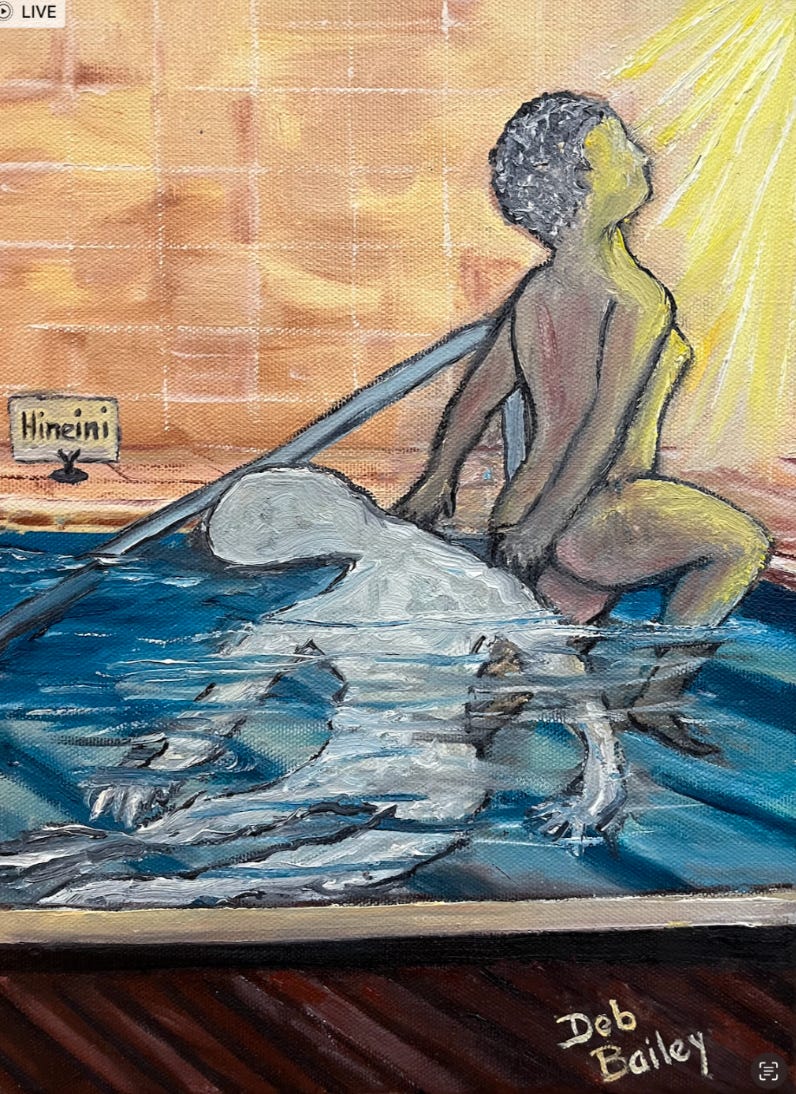
When I was about 6, my parents enrolled me in swimming lessons at the local YMCA, along with a family friend. It was fun enough heading through the large lobby, getting my little membership card that said I was now a member of the “Pollywog” group.
It was an adventure going into the large room with benches and lockers, then heading through the tiled shower rooms where we got rinsed off before going into the pool. I didn’t even care that I was freezing every time we had to walk through those showers.
The pool was a challenge for me because I was short. The water level was literally up to my nose, even as I stood up on my toes. But still, I was game enough.
We had to do things like dunk our heads. Blow bubbles underwater. Hold onto the edge of the pool and learn how to kick. They had a whole string of things we had to pass so we could move up into the next level. In spite of struggling to keep my head above water, I hung in there and passed each test, one by one.
Finally, it came down to the last test. Kick your way across the narrow side of the pool while holding onto a foam board. It seemed logical enough. If you could hold onto the side of the pool and kick strongly, then you just had to do the same thing while using a foam board to hold you up. You didn’t have to swim across the pool unaided. That’s what the board was for.
One by one, each of the many kids in the class took their turn. They’d grab their board, give a little hop to get their feet out behind them, kick furiously, and in no time, each was across the pool.
I don’t recall when exactly they asked me to do it. It seems like I had more than one chance, but I wasn’t ready. So everyone else took their turns, then climbed out on the other side to cheer on the next person.
Finally, there was no one left. Just me. The teacher called me to take my turn. I was tired of stretching up on my toes to keep my nose above water. For me to stretch my feet out behind me meant I would sink a bit, and the water level was now at my eyes. This freaked me out. I refused to go.
Any kid who grew up in the 1960s knows this question, and remembers exactly how they needed to answer it…or else.
“No!” (Said while trying to breathe in between swallowing sobs as your chest heaved)
“You better not be crying!
“I’m not!”
“Okay. Because if you’re crying, I’ll give you something to cry about!”
While you still might be stifling a few more sobs over the next couple of minutes, as long as you showed you were shutting down any emotional display, you would likely escape further threats.
We all knew the rules of the game — this was part of the standard 1960s Parenting 101 technique. It meant: “You’re being too sensitive! You have nothing to be crying about, so stop it! Now! Or else!”
I can’t speak for how often this came up in other households, or how angry the parents really got over the crying, but for sure, it was the iron rule in our house, and a rage trigger for my father. And I was the frequent target of this, because 1) during childhood, I was still emotionally open and cried about everything, and 2) my father had NO tolerance for weakness, emotions, or crying. So, I learned early and fast to look away if I was ready to cry so he wouldn’t see me, or how to inhale and swallow sobs…fast.
In trying to answer the question of how I survived that household, I need to explore who that young girl was — me — in the times when Dad was not around, in the times I could just be “me.” In a lot of respects, so much of who I became, and still am, how I navigated life both then and now, came out of her spirit.
Even in my seventh decade, I am a 9 or 10-year-old at heart. I am still all of the qualities listed below that she had. Those things got pummeled and almost beaten out of me. But somehow, the spark stayed alive within, and slowly, ever so slowly over my lifetime, I’ve fanned those flames back alive. And I would say it is now, in my seventh decade, that I have fully returned to the spirit of that kid. And no, it’s not “second childhood.”
About the only problem, though, is that while I have reclaimed my inner 10-year-old and she continues to drive all of these things in my heart, my body begs to differ with me on some days. So I am learning now to “moderate” that 10-year-old to match the 70-year-old body!
But to come back to that question of how I survived, if I had to give a short answer, aside from key people along the way, and God, it would be: “Her spirit.”
Who was she? Here is a list of those qualities she embodied, and I’ll expand on them over the next few pieces.
In many stories, the place and the time period are considered characters in their own right. Certainly, I would agree given the unique flavor of where I grew up, and when.
Torrington, Connecticut:
Nestled in the valley between the foothills of a section of the Appalachian Mountains known as the Berkshire Hills, Torrington is built around the Naugatuck River, which flows south through that valley, right through the center of town. When the town was originally founded, it was located on the hillsides east and west of the river valley, where the climate was healthier and less swampy and mosquito-infested in the summer.
A lot of the surrounding county area was, and remains, rural, with dairy farms, state forests, and nature trails. It is hilly countryside, and as such, the geography itself gives a sense of “constriction” between those hills, and isolation from nearby areas because of them. There are a lot of hardwood forests, including things like oak and sugar maples, and in spite of steel-gray cold skies in November, Fall, with its amazing color display, is my favorite time of year there.
The town and surrounding areas are steeped in history. Whether it is of ancient Mohawk tribes living in longhouses, or the story of Connecticut as the Charter Oak State, the state is living history.
The latter story is based on the fact that the state was given a royal charter in 1662, allowing for self-governance. During the Revolution, the charter was hidden in an oak tree to prevent it from being confiscated by the British.
Many locations around Torrington and throughout the state have markers noting various sites of importance from the 1700s and during the Revolution. The culture of the area was heavily influenced by the strict ethics of the Puritans, who had moved there from England to have religious freedom. And throughout the area, there is still a strong sense of individual ruggedness. That ruggedness is further fostered by the climate, which can suffer extremely cold winters with blizzards, and summers and falls with hurricanes, tornadoes, and Nor’easters.
Torrington was and is a small former factory town in that Northwest corner of Connecticut. It was an industrial powerhouse in the 19th and part of the 20th century, providing employment, a decent standard of living, and a strong economic base for the towns there. Industry included things like brass production, arms manufacturing, skilled tool and die companies, and small factories providing parts for the automotive and aerospace industries. Most of those places shut down and moved south during the 1960s-1980s, and later those things moved overseas. So the employment and economy of the area have taken a hit. But during my childhood, especially with the ’60s space race, things related to aircraft and aerospace industries were still thriving.
Most people during the early and middle of the 20th century lived in the main town because they worked in the local factories. This allowed them to walk to work, shops, churches, and doctors. My grandparents did not have a car, nor did most of the older Slovaks. In fact, our house was just down the street from the church and school we attended, so easily within walking distance.
The homes in town, including the one we lived in, were multi-family 2- and 3-story homes, in keeping with the blue-collar, industrial flavor of the area. There were some single-family homes scattered around in town, but more of those were on the outskirts, in more residential or agricultural areas.
As a scientist, one of the best ways to capture what happens in a reaction, especially a chemical one, is to set up a formula. On one side of the equation are all the reactants, the items that are mixed together for the reaction to take place, and on the other side is the final product or outcome.
I wasn’t aware of what was happening to me all those years, because when I was living in the “water” of that house, I just considered it the norm and never questioned anything. But now, when I look back, I can see the patterns. If I want to visualize life in that house, I could use the following formula:
My nature + Time (Day/Wk/Yr) + Where Dad Was vs Where I Was + His Mood + His House Rules = My Experience
More generally, the ingredients were people, time, place, and rules. But no matter how you look at it, the equation was heavily weighted toward the power of his ingredients: Time, Where He Was, His Mood, and His House Rules.
Another thing about chemical reactions is that some ingredients have more power over the others, especially if they are present in overwhelming amounts, versus the others. In reactions, the reagent with the least amount present is called the “limiting reagent.” Once that particular ingredient runs out, the reaction is done.
For example, consider my nature. At any given time, my ability to be calm or in control of what was happening to me, was limited. If he he wasn’t around, most of the time I could be me, indulging in play with friends, books, daydreams, school. I say “most of the time” because there were times even when he was gone, that if he was angry with me, I would be a nervous wreck anticipating what was coming when he returned. But generally, I could use those “in-between” times away from him, to recharge, and live a “normal life.”
But when he was around, I needed to be on guard. I learned early on that everything about my day revolved around him and his mood. The absolute constant was to always be focused on him, assess the state of things, then adjust me to match what was happening. So in thinking about it, this required some amount of psychic energy no matter what.
If he was in a good mood, I still needed to stay on guard because I couldn’t be sure how long it might last or what might trigger a change. But if he was in a bad mood, I was consuming vast amounts of my emotional energy rapidly to “prepare or endure.”
The bottom line is that my emotional energy would run out long before his. So I was the limiting reagent. He could control me and have his way with me, even when I tried to resist, because all he had to do was keep battering me with his reagents — his mood, twisting his house rules, picking fights with me and not leaving me alone. Since he had these infinite amounts, sooner or later, I would run out of fight out of sheer nervousness. I would have to cave because I just couldn’t stand it anymore.
The last thing about chemical reactions is that they are either one-way or reversible. One-way reactions are “all-consuming,” that is, they can only go on until the limiting reagent is used up. Then the reaction stops. And there is no going backwards to restore any of that limiting reagent.
Reversible reactions can flow back and forth, sometimes benefiting one side and other times benefiting the other, depending on conditions. The chemical reaction in our house was one-way and all-consuming. His way, and I was being consumed.
Only now do I realize all of this, and the full extent of what I was up against. Yet, I am still here. I sustained, somehow, even if I am left with permanent scars. How did that happen? And what does that mean for my continued healing?
It’s time to look at not just Mom and Dad, but time, place, house rules, and the one “people” I haven’t said much about yet…that kid…me…that person in those “in-between” times. Just who was that kid, and why did she survive?
So that is next. But to start off, I will start with “place” — my world, the house and immediate area that I lived in. Then I’ll visit that young child and see what she was like, especially when he was not around…those “in-between times” when I could be myself.
As usual on any afternoon, my Mother was preparing a full meal for dinner, including a homemade dessert. Dad expected full dinners, including desserts, with his meal. While store-bought” Oreos were allowed for snacks because Dad liked them and he brought home the paycheck, desserts had to be homemade.
On this particular afternoon, Mom had two cake layers cooling on top of the stove, and they gave off the sweetest vanilla aroma that I couldn’t miss as I ran into the kitchen. I stopped near the stove to examine them because they smelled so good, and that’s when I spotted the problem.
Poor Mom! She always worked so hard to make all her desserts from scratch, usually from recipes out of the red binder — her Betty Crocker cookbook. But today, looking at the cake tops, I felt bad at how they were turning out. That’s when the perfect idea popped into my head for how to help her and fix the problem.
Happily, I set to work with a knife. A few minutes later, I was almost done when Mom came into the room. She stopped dead in her tracks, her eyes wide in horror, and she yelled, “What are you doing?!”
“I’m helping you!”
I pointed to the piles of cake chunks I’d cut off the top of each tier – the uneven bumps that, to my mind, marred the smooth surface.
“The cakes were all bumpy, so I figured I’d cut them off and make it all smooth for you!”
My mother stood there, staring from me to the cakes, then back again, as she struggled to process my logic. For several moments, she said nothing. I wasn’t sure what was wrong. This was not the reaction I expected.
Then, she took in a deep breath then let her shoulders drop as she exhaled slowly, and said quietly, “It’s okay. Go play. I’ll fix this.”
Now, many years later, I realize the artful skill it must have taken her to spread frosting onto those two cake layers whose tops were almost totally crumbs….
**
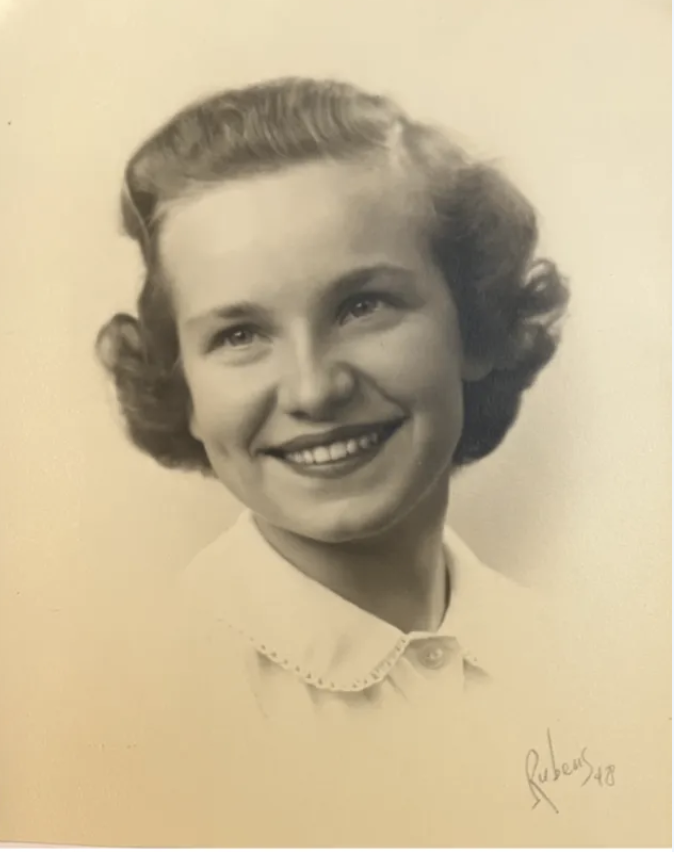
I love looking at pictures of my Mother from her early years. She was beautiful and had a radiant joy that seemed to burst out from within.
We were on a typical Sunday visit to Bridgeport, Stratford, actually, where Dad’s parents lived. It was always an uncomfortable time. We’d have to be dressed up, which meant not really being able to play or do anything fun, not that there was anything fun to do there anyway. The only saving grace was the TV set because Grandma could get all the New York City TV channels we could not. So we could at least watch old movies and programs like “The Thunderbirds. But there were strict rules in her living room, and God help you if you broke them.
For one, we couldn’t touch the TV. If we wanted to change the channel, we’d have to ask an adult to do it. If you were even in the vicinity of the TV set and she walked in, she would start yelling. The living room itself was equally uncomfortable, with plastic runners across the rug and plastic sheets on the couches so we couldn’t mess anything up. Also, forget about bringing a snack in there or touching the candy in the dish on the end table. And don’t touch any of the hundreds of her knick-knacks scattered around the room. One time, one of us accidentally broke one of her statues, and Dad actually hid it so we wouldn’t get in trouble.
But on that morning, all of that fun would come later. For right now, we were marched outside to say hello to Dad’s grandfather — my Grandmother’s father — who was usually referred to as “Little Grandpa,” because he was shorter than Dad’s father, who was “Big Grandpa.” Little Grandpa was very old at that point, and mostly stayed out on the patio in good weather, or upstairs in his room in bad weather, as he and Big Grandpa did not get along much.
On this particular Spring Sunday morning, he was sitting outside. So, we dutifully went up and said hello and stood there lined up like robots in front of him as Dad talked with him. Little Grandpa didn’t say much that we could understand. He had no teeth, didn’t speak much English, and just kind of sat there nodding his head at us. But there was one thing he would always say, every time we saw him. He would shake his head, point a finger at us, and look at us very seriously, as if he were about to deliver a sage bit of wisdom that would save our lives. He would draw himself up, raise his voice, which was very raspy, and say in a Slavic accent, emphasizing each word slowly:
“You…lucky…you…got…Richie!” Richie was my father’s nickname.
He would then shake his head again, fold his hands, and look down at the ground, I guess satisfied that he had told us this.
I was never sure what to make of it. Did I really trust a toothless old man who spent most of his time drunk? And given Dad’s alternating good and bad moods, I wondered why we were so lucky. But being a kid, I remember thinking, Well, he is an old man, and an adult, so he must know something. He must be right. I also wondered, if we were so lucky to have Dad, how bad were his brothers to live with?
So we just smiled and agreed, “We lucky we got Richie.”
But to this day, I’ll be damned if I know why…or if it was true.
Of my two parents, there is no question that Dad was the interesting one. And I mean that in a kind and grateful way. Whatever else I will say about him in this book, like all human beings, even ones who do horrible things, he also did good things. No one is *just* evil. And maybe it’s because of those things that it was so hard to know what to make of him, or to even know I should stand up to him.