I went to see my regular doctor, desperate for any kind of help. Whereas in 1978, I had refused to take the Librium the doctor gave me because I viewed it as a failure to use them, now I had no such illusions. He did give me a prescription for Prozac, but I later learned it was such a low dose it wouldn’t have done anything for me. And he wouldn’t consider increasing the dose or changing the med.
The only other thing he offered was some Ambien or Lunesta for sleep, and some Xanax for anxiety. I didn’t want the Xanax. I had used it once in the past, and I feared its addictive powers. So I tried the sleep meds.
To me, those seemed “odd.” Yes, I “slept.” But it was more like just flipping switches on and off. I took them, they’d hit, and shortly I’d be “out.” Then, when they wore off, it was like flipping the light switch back on, and I was conscious. But not rested. It wasn’t “sleep.” More like “suspended animation.” I am sure they are helpful for others, but they just didn’t work for me.
I was so desperate, I even looked up one of my old gynecologists. She had the same last name as my dead aunt, who had been a nun. Could that be a sign from heaven? However, she didn’t have anything else she could offer me other than possibly some estrogen.
In 1984, I was walking every night, trying not to kill myself. I had to start life all over again. In 2008, I was afraid to get off the couch, and having an emotional breakdown. And again, I was having to start life over.
Both times, I was at the end of my rope, hanging by a thread, not wanting to be dead, but wondering what else there was in life, and if I had any value.
I was consumed by a level of anxiety I’d never experienced before. It was so bad, I was afraid to get out of bed in the morning — dreaded starting another day of pain. But I was too afraid to stay in bed. Yet I couldn’t wait for the day to be over so I could get back in bed, and when I did, I only felt safe on my stomach, propped up on elbows, watching the same video over and over again on a small portable player while Ed watched TV.
Almost every night for months, it was the Pixar movie, “A Bug’s Life.” It was safe, all the ants worked together, and there was nothing scary or provocative. And the best part, the part I wanted to be in, was the big sleeping chamber where all the ants rested, sleeping safely and comfortably in their little hammocks. It was snuggly, all of them there together, safe from any threats. Just the security of being there together with all of their friends. I so wished I could live with them.
In college, I had a lot of chemistry classes. An especially dreadful one was called “Quantitative Analysis.” It was a special form of torture that focused on three things: precision, purity, and creating a brand new compound from original ingredients.
We would execute experiments of extreme precision to create new compounds that had totally different behaviors from the ingredients we started with. All this through the “magic” of chemical reactions.
A chemical reaction happens when you mix different chemicals together, then apply heat or something other “stressor” to cause them to react with each other. In that process, the atoms of each chemical come apart, then reassemble themselves into totally new compounds.
Think baking a cake. The original ingredients you measure out and put in the bowl, and stir. Say flour, sugars, baking soda, and such. But when you put that mixture in a cake pan and subject it to oven heat for a period of time, those ingredients “rearrange” to become something new, a cake.
So far, not so bad. But unlike measuring cake ingredients with spoons and measuring cups, in our lab, we had to use TINY amounts of each chemical. So we had to use a special “analytical” balance to weigh out each ingredient, and after the experiment, weigh the tiny amount of the new compound we made.
The analytical balance was so sensitive that you dare not breathe near it. It lived in its own closet, inside its own case, which sat on a thick stone slab for stability. When weighing each item, we had to weigh it three times, and those three measure HAD to match within a very narrow range, or you started over. You were at the mercy of that balance.
To me, it was torture. Sometimes the class seemed less about the actual chemical reactions we had to execute, and more about becoming proficient in weighing the tiny amounts of chemicals. If your weights were wrong at the start, so was your “cake.” And then you failed.
For example, we would usually start with maybe a gram or less of each ingredient. For perspective, 1 gram = 0.035 ounces. Not a lot. And sometimes even less. The balance could measure amounts to the TEN-THOUSANDTH of a gram, or 0.0000035 ounces. REALLY small. So lots of potential for failure.
To make matters worse, once we had our ingredients weighed, before we could put them into our “cake pan,” which was a small ceramic cup called a crucible, we had to make sure the crucible was “pure.”
A pure crucible meant it had no moisture or stray impurities in its ceramic structure that could interfere with the chemical reaction of the ingredients. To achieve a pure crucible, we had to heat it for two hours over a special lab burner that ran at 3000°F. Only then could we start the experiment. Yes, a degree of precision and purity that could drive you crazy.
But the point is this. The process of firing that crucible to white-hot for two hours meant that all stray chemical impurities or water in that vessel were burned out of it. The only thing remaining at that point was the pure vessel itself.
So, to make our chemical cake, it took precision and purity. Then, if you were lucky, you would create that brand new substance that did different things than the original ingredients…and you could then weigh it to extreme insanity.
That was Quantitative Analysis.
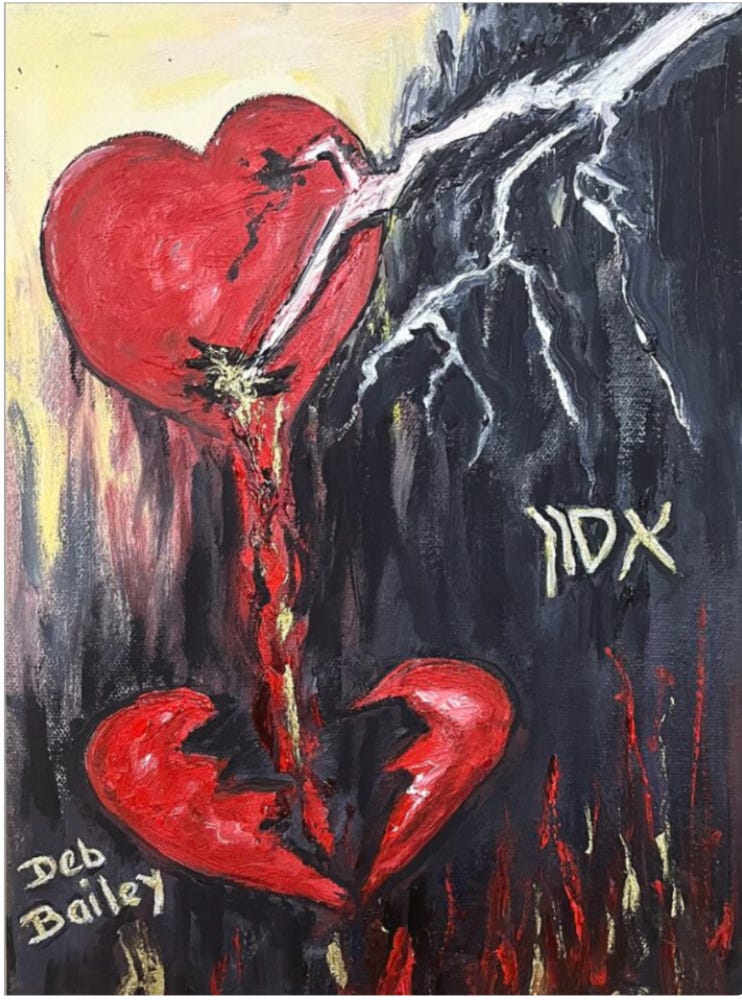
The “trauma crucible”
Painting by author
I never envisioned going through that process ever again. Until December of 2006. Watching my soulmate, Ed, almost die in front of me, I became that white-hot crucible being purified over the burner of terror and pain. Anything less than my pure heart would get burned out of me.
All my life, I was strong. I had to be. And aside from Ed, I walked that road alone. I was like all those old Slovak women: “Str-r-r-o-n-g like bull!” I would do what I had to. Depend on no one. Keep going.
Until life finally broke me. Hard. And then it became – What now? IS there a “now” anymore?
I started the entries for this memoir’s first draft on June 3, 2025.
Since then, I have been writing almost every day. I will soon finish this longest part, “The Old Country,” which has been the story of my life, from the beginning, with all the abuse, then the escape, the recovery, the battles, the good things, the crises, and the aging. All of those pieces contributed to my life and who I am.
It is a relief. For the first time in my life, instead of shattered, stuffed-down shards of a life, I will have a “whole” – an entire picture put back together, for the very first time. The “mosaic of my broken soul.”
Even now, as I labor through it, clarity about many things is emerging. FINALLY, I have the whole wide-angle view of all that happened. Like standing on a hilltop, taking in the vista of the landscape before you.
That “wholeness” is what will make the final part of the book possible – the…insights, the “digested” understanding, the ability to let go of things that have haunted and shamed me for a lifetime.
The first half of 2007 was an absolute joy. While Ed was still somewhat weak, he was making good progress. He was even able to join my son and me on a trip to tour a Virginia university that our son was considering for that fall.
And June was the celebration of so many years of hard work by our son. We reveled in…and cried at…his high school graduation.
Ed and I also decided on a rare “indulgence” for ourselves, by joining a brand new gym that spring. Aside from an amazing variety of weights and machines, they also offered swimming, racquetball courts, a wide range of classes, nutritionists, trainers, and facilities that were almost decadent. After all we had been through, tiled showers, a sauna, hot tubs, and a cafe with health food and smoothies seemed like something to help us celebrate.
It also let us renew our connection as a couple with regular date nights at the gym. Not to mention that it was a healthy way to help us transition to being “empty-nest” parents, especially since our son would be out of state. We had been focused on parenthood since I got pregnant 3 months into our marriage. So this was our celebration of a new phase of life, and of us.
We spent a lot of time on the weight machines – a way to trim the bodies, and regain muscle strength. Given that Ed’s hospitalization had weakened him, the machines were a great help with recovery.
Life was going perfectly. It was like the first day of our honeymoon years ago, when we sat in the sun sipping Pina Coladas, reveling in that peace and wondering how long it would last.
I’d sent my son downstairs to sit in the sunny atrium and call his friends. He needed a break. This was one time when I was glad for teenage friends on cell phones. A tiny touch of normalcy for him from the last couple of days.
All morning, we’d watched Ed’s oxygen numbers bounce up and down on the monitor. It was like watching a race where the lead was uncertain yet, but our “runner” might just bolt forward at any moment. Clearly, his levels were trending up. If they could just break through to normal….
I watched my husband sleeping in the bed. He was still on a lot of morphine to keep him quiet. However, given that his oxygen levels were inching toward normal, they started to bring the morphine dose down. As soon as his oxygen levels stabilized for sure, they wanted to get him off the respirator and bring him out of his coma.
The respirator had been a lifesaver for sure. But leaving him on it longer than needed risked infection. On the other hand, bringing someone out of their coma and removing the respirator is uncomfortable for the patient and excruciating to watch.
We wanted to be there to greet him on his “return from the coma”…and see, Was he still “Ed?” His brain swelling had not gotten any worse and was starting to improve. But the moment of truth would only come when he was awake. Then we would learn what all of this trauma had done to him.
There is something about the ICU waiting room that I wish could be captured and spread throughout the world — unconditional love.
The ICU waiting room is a place out of time. While everyone hangs in limbo for an outcome, for a hoped-for word on a loved one, for relief from the intense pain of not knowing either way, life, as you know it, stops.
In that room, you enter the land of pain, fear, and sorrow – the great equalizers. No matter what walk of life you came from, rich, poor, or famous, no matter what color or race you are, when you enter the ICU waiting room, each one of you is the same — a hurting, terrified human being.
“Your husband’s blood oxygen has dropped. It’s hovering around 47% right now. Below 50% we usually see brain damage.”
The words hit me like a rock against my skull. All of us went so silent that the quiet crushed against my eardrums.
“Is my husband going to live?”
Those were words I never expected to hear coming out of my mouth at this point in life. Especially given Ed was only 47.
The doctor hesitated.
But I was blunt, direct, to-the-point, with words that meant I wanted no fluff answers. I had been in the medical field too long. I knew how doctors and nurses sometimes sugar-coated things or used evasive words so as not “freak the family out.” I didn’t want coddling or patronizing. I couldn’t bear “uncertainty.” Tell me now – Is he dying or is he going to make it?”
It was one of those warm, fall afternoons, not sunny, but still, the array of colors splattered on the trees across the pond dazzled.
On the TV, my son was watching the old movie, “The Trouble With Angels.” It was a 1966 comedy with Rosalind Russell and Haley Mills about life in a Catholic girls’ boarding school, where Mills is the determined troublemaker, and Russell is the equally formidable Mother Superior. It is a funny movie, especially if you had the nuns for teachers as I did, and one that we played now and again for comic relief.
I was sitting at my painting easel in the corner of the living room, near the window that looked out on the pond. By all accounts, it should have been a serene afternoon. At any time in the past, with a similar setup, it was. And today started that way. But then, it suddenly changed.
The longer the movie played, the more afraid I became. Dread, foreboding, and this overwhelming sense of …guilt…being in trouble…bad things about to happen, flooded through me.
I tried to shake it off. This is stupid, I remember thinking. I mean, what the hell was wrong? Yet the longer I sat there trying to paint, the more afraid I got.
Worse. I had never experienced anything like this before. I mean, sure, when I was a kid at home, and my father was raging. But I was a 51-year-old adult woman having a peaceful afternoon with my son in my own home. So what was I suddenly so afraid of?
I tried to summon all that rigid strength I’d always had at my fingertips, to quell the fear. I could always depend on being strong. But that day, for the first time in my life, that strength failed me. Shocked, I realized I had no control over the intensifying terror racing through my body.