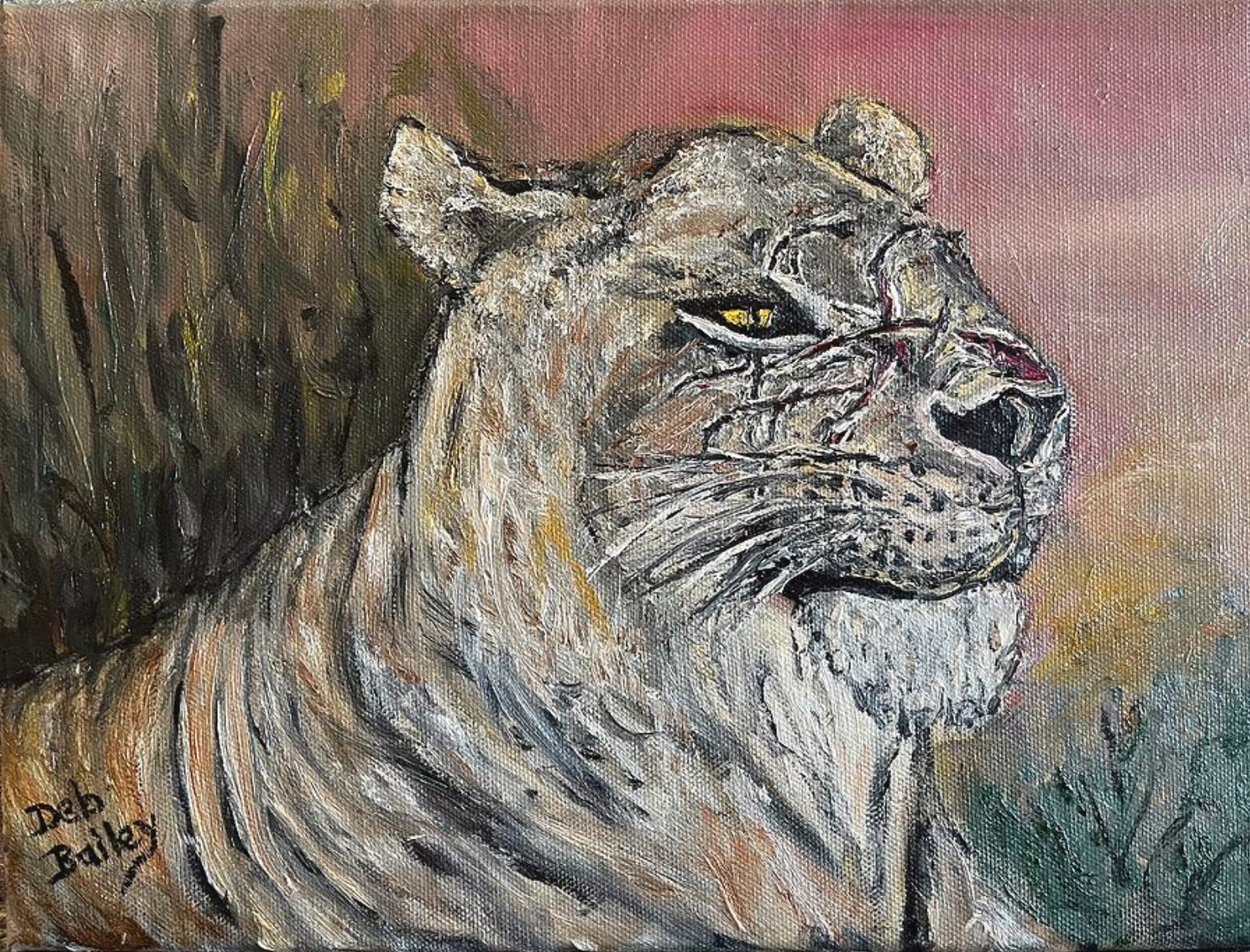
Before I move on to the next post about the upcoming explosion of nightmares that started to peak in this period, I need to revisit the post from a few days ago – “Time Out for a July 2026 Status Check on My Current Level of Rage.”
When meeting with my therapist the other day, she made some very important observations about the role of “rage” in my life and helped me realize I was looking at things the wrong way.
And about the same time, a reader shared her own thoughts about my posts. Her wise insights reinforced the therapist’s ideas. So, I want to take a brief “time out” to add an “Addendum” to that earlier post.
Just like those Sundays…
“What do you think your current rage does for you…what does it give you?”
I pondered my therapist’s question for just a moment, then answered with no hesitation: “Validation. That I have every right to be angry!…And power – that I am strong enough to stand up for me.”
She nodded and firmly agreed that I absolutely had every right to feel rage for the terrible things he did to me.
“How do you see the anger in the future? How do you see it as you move toward the end of writing this book?”
When I first started working with this trauma therapist almost twenty years ago, all I could feel was anxiety and terror. I wasn’t even aware of the rage, just terror. Beyond that, my emotions, as well as any emotional power, were a flat line. I was not a fully open, fully expressive human being
It took ten years of regular work for me to even reach the place where anger might be a possible emotion in me. It took a literal lifetime for me to mine deep enough into my psyche to finally hit that vein of rage.
No question, once opened, there was no turning back. But then…maybe that was the point? Could it be that maybe my very life force…the one I’d been denied since infancy, was also there? The life force that is the “light side” of rage, and that could finally allow me to accept and embrace all of me, all of my life and being, fully…with love?
I only knew that once I started through that swamp of emotions, I had to keep going…because the rage had something to teach me.
THIS TIME, I’ll win…
I talked about proxy battles — re-enacting past moments of abuse or conflict by “fighting back” in some current-day situation — my way to win some kind of perceived battle in the present day. They could be some small angry interaction with someone in the grocery store, or whatever. But if I perceived insult or disrespect, especially by a man, I would “stand up for me!”
Even as I know I don’t want to get hooked by whatever it is, and on some level I know it’s ridiculous, there are times I just feel compelled to do it anyway. And even more weirdly, I experience a tremendous sense of relief if I “win.” And it’s not just relief that I “won”, but…that I FOUGHT BACK.
Then I came across these passages in the book Trauma and Recovery, by Judith Herman, MD:
From my journal, December, 25, 2019 Christmas Eve nightmare
The little girl in my care, I don’t know who she was – that didn’t stand out in the dream…but looking back, she was probably a young “me”; anyway, she was a young girl who needed to be protected from my Dad and needed to be in someone’s care. She was too young to be alone, and I needed to be “away” for some reason.
Dad was the dad in his “prime” from the 1960s – – in his 30s – so strong, and a total bully and threat. And I was an adult, at my current age, aware of all the years of abuse and all the years of struggle to come back from it.
This was in my childhood house…Dad was living in the first-floor apartment that we lived in then and did not yet know that the little girl and I were living on the second floor in my grandparents’ apartment. It was strange, though, because in that apartment for us, it was current day. The 2nd-floor apartment had the appearance and feel of a place lost in time – sort of like it was back then, but gaunt, because it had been left that way and uninhabited for decades, as my grandparents were long dead and gone.
My friend had agreed to come and stay with the little girl, but only as a favor to me, and was tired because she’d had to drive over 200 miles to get to my place to be there, and was doing this only because I asked. She was tired, and she didn’t know about my father and what he was like. I needed my friend to just care for the young child and take good care of her, which I knew she would. But I also needed to make sure that my friend and the young girl were protected from Dad, without knowing just how big of a monster he was…I needed somebody who understood the whole situation and who would watch over my friend and the little girl for me.
I was out of time, as it was almost time for me to leave, and I realized the only one I could hope to handle this was my great aunt who lived in the third-floor apartment. Even though I was terrified to speak, I decided I had no choice. There was too big a risk not to tell her. And time was about up, so I had to do it NOW. I had waited too long before I needed to leave, and it was “now or never,” and I couldn’t let it be “never.” That would be wrong.
In the dream I was overwhelmed with the INTENSE NEED to protect them all and at the same time the TERROR of going up against Dad and crossing him by daring to tell someone. But I had no choice. I COULD NOT RISK THEIR SAFETY!
So I went to her and just blurted out the whole story of my abuse by him, and the length of time, and the things that happened to me, and I STRESSED she HAD to keep quiet. That I was only telling her to protect the others, and she COULDN’T LET HIM KNOW I had told her.
I said to her, “I am finally opening the door to this by telling you.”
And as I spoke these words, I felt the great emotions of fear and stressful energy regarding my inner struggles to do this, as well as its importance, i.e.,just HOW SIGNIFICANT it was that both I was FINALLY telling SOMEONE after all these decades of silence, and that I viewed the current situation as dire enough to do so.And I was terrified of what would happen if he found out that she knew. What if she got angry and said something and he blew up?! Yet I HAD to tell her. So I just told her the entire story.
This was bad because she got REALLY angry – ENRAGED AT HIM and wanted to confront him. I had to make clear to her that she couldn’t let her emotions show; she had to interact with Dad like all was well so as not to tip him off that she knew, because if he figured that out, he would erupt in rage and might hurt everyone.
I didn’t really want to go, and I could also see that in spite of her initial rage, my great aunt was too old and frail to be up to this task. But for whatever reason, I knew I HAD to be somewhere even though I didn’t feel good about leaving this situation as it was with an old woman who I felt was too frail, and who I didn’t think would be able to keep the secret. I was trying to hold out long enough to be sure she could properly compose herself before I left, so as not to reveal she knew. And I was stressing because I knew I had to leave soon….
And then I woke up….
Reflections on the dream
This nightmare portrayed a scene that wasn’t real, but accurately captured the intense struggle in me all those years to speak or stay silent. The loyalty. The fear. The responsibility to protect others. In all those early years, it was impossible for me to speak about what he had done. I thought I was alone. I was ashamed. I had been trained to protect my family with my silence and loyalty.
But what was obvious to me in this dream was the change in me. In all my past nightmares before I had started doing the intense therapy and EMDR, I had just been reliving my abuse. Reliving being the victim. And those nightmares had been filled with terror and shame.
But this one? It was a metaphor for something in me in real life – I had to start opening…speaking. There was danger and risk and harm now to stay silent. And even though it took all I had in me in that nightmare to risk telling my great aunt, for the first time, I wasn’t being just the victim anymore. I was beginning to stand up, even a little. The reality of danger to another child drove me to open up even a little, to protect that child. Whoever that child was in the dream, I wasn’t going to let her be harmed. My walls of silence were starting to crack.
2023 Snakes part II…and why won’t anyone do something?
Journal Entry: NIGHTMARE: A COUPLE WEEKS AGO. 12/29/23:
A combination of my childhood home. I am in the garage, and then inside the house, and I see a copperhead go by. I start to say something about I deal with cobras, but then change it to copperheads. Meaning? unknown.
But I am aware in the dream that the house is “not safe” – that copperhead going through the house means it can pop up anywhere and there may be more. Nowhere is safe and I always have to be watching.
Danger is everywhere, unseen, unpredictable.
I am aware of thinking: Why does no one ever question that copperheads come and go in our house? Nobody seems to care to do anything about them? Why don’t they find where they are getting in and block it, get exterminators….WHY is the attitude: “This is just how it is, and we just live with it!”
There is also the sense of “inevitability” that danger will always be allowed, and I WILL be harmed.
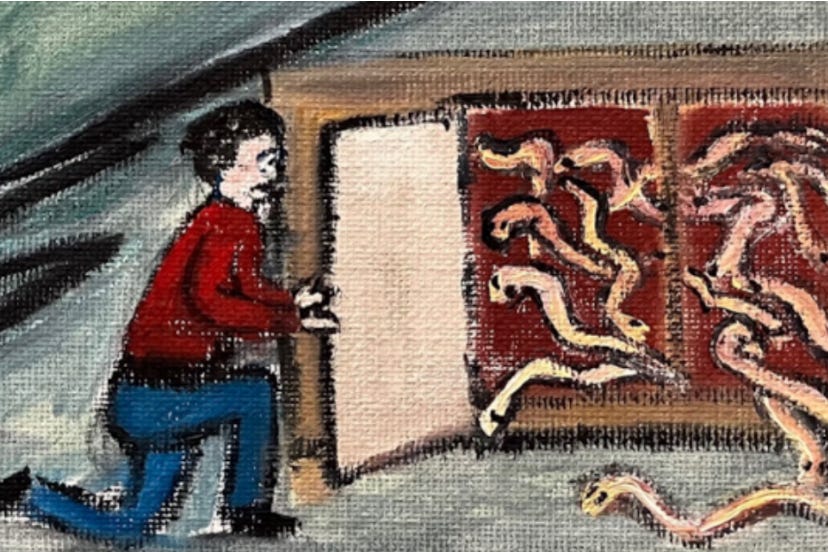
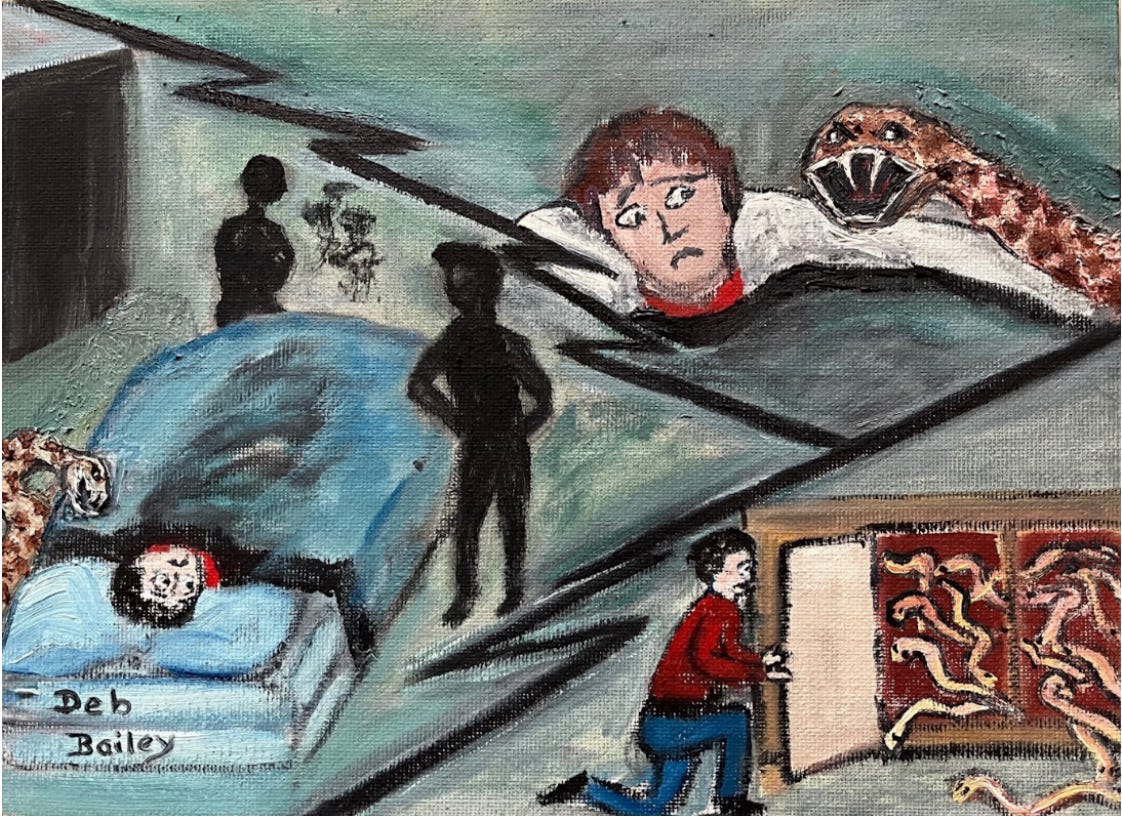
In the dream, next scene: I go into a pantry cabinet to get some cans of vegetables. I reach in, and immediately a copperhead comes out of the cabinet. Then more…and more…and more.
Painting by author
My immediate thought is acceptance – telling myself, “Well, anytime I need to go in that cabinet, I will just have to use caution to avoid the snakes when getting what I need from there.”
But then…I feel this swelling sense of ?frustration…?appalled confusion …anger….WHY are the snakes allowed to roam freely in the house?!! WHY do we just LIVE WITH THIS? Surely there must be a way to stop them from getting in!!!
Then the dream quickly shifts, and in the next image I am lying on a pillow on the bed, and others are in the background of the room …?Dad, not sure, is watching me, and I am in danger because there is an angry copperhead approaching right near my head. I am afraid to move. I ask if I should “bolt quickly” out of the bed, but the look on his face, and my own awareness of how close the snake is to my head, tells me I am stuck, in trouble, no escape, and I am about to be harmed. Maybe if I lie totally motionless, it will choose to move on, but I sense it is only a matter of seconds, and it will strike me. No escape.
Painting by author
I am frozen in terror – screaming inside my head to get away, be safe, get free. I feel totally alone in my problem; no one seems concerned (in background), and he (?Dad) seems to just be watching and not doing anything to help me. I feel helpless, fatalistic – No way out; I WILL be bitten no matter what.
Then the dream shifts one more time before it ends:
I am in bed asleep, and suddenly I am aware of someone against my back pushing something “hard and pointy” against me. I immediately am aware my mother is asleep next to me, but dad has literally rolled on top of and over her to push against me. I immediately react and rage and shove him back to his side of bed and yell at him to get away and stop doing that and who does he think he is?!
At this point, I wake up.
Reflections again
Probably the best assessment of those nightmares comes from the conversation I had with my husband the next day, which I wrote about in my journal. The amount of sheer terror, the awareness that I was trapped with no help, hope, or escape, and the depth of the trauma inflicted on me as a young girl are so clear in these dreams.
From my journal, 12/30/2023:
There is a definite change of energy in these nightmares. Whereas in the past nightmares the snakes always overwhelmed and got me, these show a shift to “questioning why this is allowed?” and a growing sense of anger and frustration.
In talking with my husband the next day, we both agreed about the following points that the nightmares conveyed:
The sense of danger in both dreams starts out small, but is not dealt with, and rapidly grows out of control – just like life in our house.
I am overrun by the danger, and the sense of being attacked from all sides and that there is no safe place, no escape, is overwhelming and all-consuming.
I am frantic, overwhelmed, frozen with the awareness that I cannot get away and I AM going to be harmed. It is inevitable and fatalistic.
The overwhelming rule in that house is that I just have to live that way and live navigating the space, trying to evade the unseen dangers that can strike out at any moment without warning.
That is my life, and I have to survive it as best as I can.
I live hoping I can escape the snakes and always fall prey to them
There is no control, no escape, no intervention by anyone to save me, or to stop the threat.
In the dream, I am always wondering, “Why aren’t we fixing this problem? Stopping the snakes? Why is there no exterminator? Everyone in that house is just accepting that this is how it is. That was the reality in my life, and my anger and confusion now has been “Why wasn’t anyone doing anything about this?!”
The anger I was feeling in the dream is similar in some ways to the fight I never got to fight in real life — a full-out battle with him…or more likely, given all the snakes, with his genitals….
My husband, who has heard my description of these nightmares over the years, added some very good insights, especially with regards to the metaphor of “snakes.”
There were always 3 in the bed…me, the dad I tried to reason with, and that penis, and there was no reasoning with or appealing to that force. It ran everything and was out of control.
The snakes were the uncontrolled penis.
I have over the years stood up to and fought Dad, the man, but NEVER his penis, which inflicted so much trauma.
I have never had a chance to “behead” the snakes in my dreams.
So in my dreams, while I do now stand up to Dad and scream at him, rage, fight, taunt, attempt to goad him into a fight, I don’t even look at or acknowledge that “threatening presence” …the snake/penis.
I recalled for him the time when I was quite young that Dad tried to force me to give him a blow job. I can still remember my horror and confusion – mentally screaming “What is happening?!!!!” – while I gagged. And then his only comment, “Well, you’re too young. Maybe we try this again when you are older.”
While I can’t remember if he did or not, that doesn’t mean it didn’t happen. I just can’t remember.
Ed mentioned how traumatized that I, as that young girl, had to be, how frightened in the face of such intense sexual energy.
While I remember that episode, almost without emotion, I sense it is there underneath. I wonder, HOW MUCH TRAUMA WAS INFLICTED ON THAT YOUNG GIRL BEING FORCED TO DEAL WITH THAT RAW SEXUAL ENERGY/THREAT?!
And who knows what happened at night when I was asleep and he came home from second shift work and ?did he come into my room – which was isolated from the other bedrooms and was right off the kitchen…Did he come to my bed …with that hard penis…and I just don’t remember?
I said that when I was finally out of the house, and in therapy, the idea of sex with a man was terrifying to me to conceive of, so it made sense that I had a sexual relationship with a woman first as the “introduction to sex with another human being” because that represented safety, friendship, a mother figure.
I needed to have sex first with a “non-penis” person….so the experience could be “non-threatening” I was terrified of sex with a man because I knew that no matter how nice he might be normally, when the arousal got going enough, the penis would take over and that “nice man” would go away and I was at ITS mercy. Unsafe, it would strike.
I told Ed that he was different because he always respected my boundaries; had “control of his penis”…ie, never seemed to be overtaken by passion so that he wasn’t “in control”; he CHOSE his response.That both comforted and confused me at times. I wondered if he had too much control and longed for him to be more uninhibited; but I also saw his gentle, pure heart and knew he was always a “safe” person. What I didn’t understand then was the concept that both “boundaries and self-control” were the NORM, not the exception… whereas he did.
Was it the EMDR and therapy?
In looking back at these journal entries, I can see that both my nightmares and my understanding of them were changing. And I have no doubt that was because in my “daytime life,” I was also changing.
In upcoming posts, I’ll share how all that hard work with my therapist to explore newly released emotions as well as the many hours of EMDR sessions to reprocess traumatic memories were making a big difference in my life. And because of that, my nightmares were starting to evolve as well. On some very primal, subconscious level, I was starting to work things out.
Up next
The intensive nature of this time was like a tapestry being unraveled before it could be repaired. The threads of my days were therapy, EMDR, and learning to feel and live with these newly released emotions. The threads of my nights were the very strange and evolving nightmares. And through both days and nights, there were the ongoing threads of my rage. So I will continue to tell the tale of my progress by going back and forth between the threads of rage, nightmares, and therapy
So up next – Rage Part II — WHY?
Note:
I am seeking financial support to complete my memoir, work with an editor, and make a visit to my home state for fact-checking. Your help would mean the world to me as I take this step toward healing and giving voice to my journey.
Please like, comment, and share this post to help spread the word. The link formy fundraiser is on GoFundMe. Thank you for your support.
One of the things I have learned about rage is that it didn’t come from me. It didn’t start with me. It was GIVEN to me…like an alien parasite inserted deep into my tissues.
I became its “vessel of gestation,” holding it, incubating it like some psychotic pregnancy, until things would trigger me and I would lash out seemingly from nowhere.
HE gave it to me — his “Rage Monster” — as it was given to him, from his elders. It was passed on like a sort of intergenerational time bomb. Not only does it make you lash out when you least expect it, but you also have no idea it’s there or where that rage comes from. And with any “luck,” at least for the Rage Monster, you might even pass it on to the next generation, continuing its toxic, parasitic legacy.
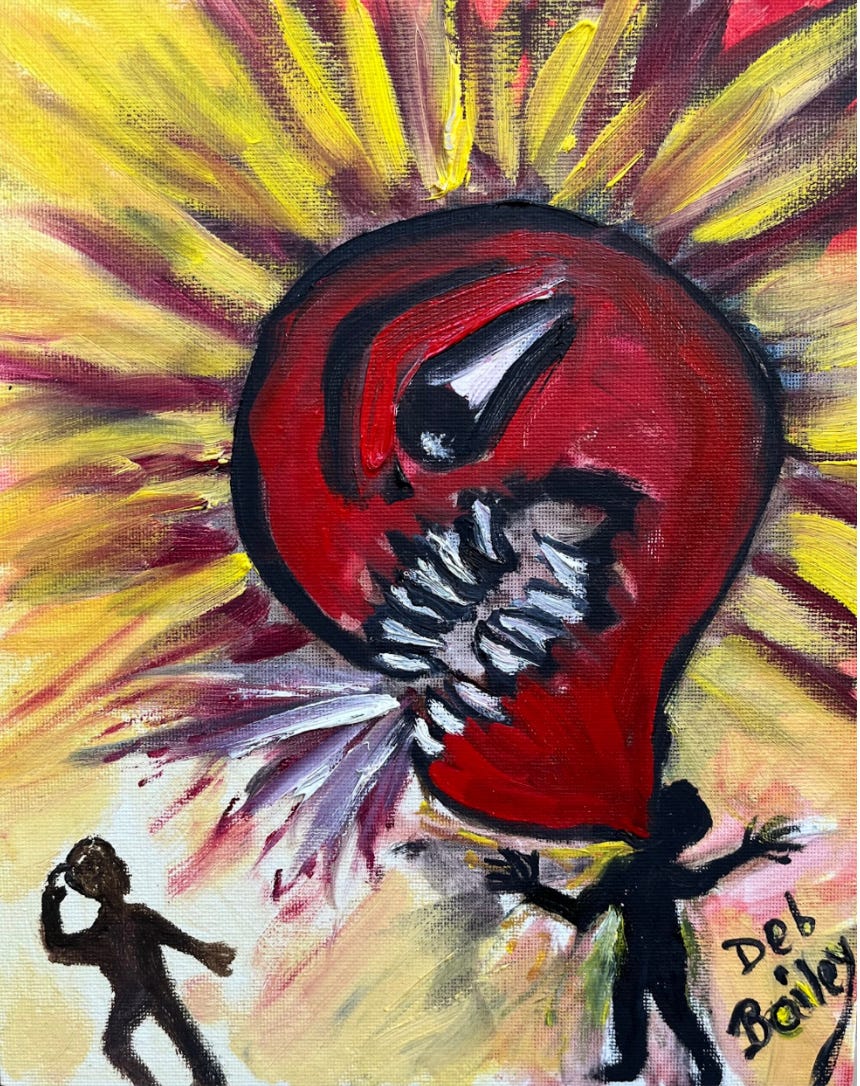
The Rage Monster is a “scorched earth” sort of being. When it bursts out, it attempts to level everything before it.
Painted by author
It was the Rage Monster that would snap its fingers and change my father from a smiling charmer to a violent beast.
In the movie Moonstruck, Olympia Dukakis’s character, Rose, spends the movie seeking an answer to the question of why her elder husband is having an affair. She suspects it’s rooted in her husband’s fear of death, and her suspicion is confirmed late in the movie by another character’s response. Vindicated and relieved, she exclaims, “THANK YOU! Thank you for answering my question!”
I live with a deep question that festers in the pit of my emotions – How to resolve my anger at my father? And while I have no answer now, I believe it will eventually come. Then I too will exclaim, “THANK YOU FOR ANSWERING MY QUESTION!” even if it is just to myself. In the meantime, I keep searching for that wisdom.
So when I spotted the podcast title — “Evil People Don’t Go To Hell. Here’s What Actually Happens to Them,” — it immediately had my attention.
“The nightmares had been quiet for some time, but started back up in December, and increased in frequency and intensity of disturbing emotions and emotional pain….I’d had nightmares for decades. Mostly memories of the abuse itself….But over the last few years two new versions started up, one worse than the other….SNAKES – copperheads and cobras. Always those – venomous, threatening.
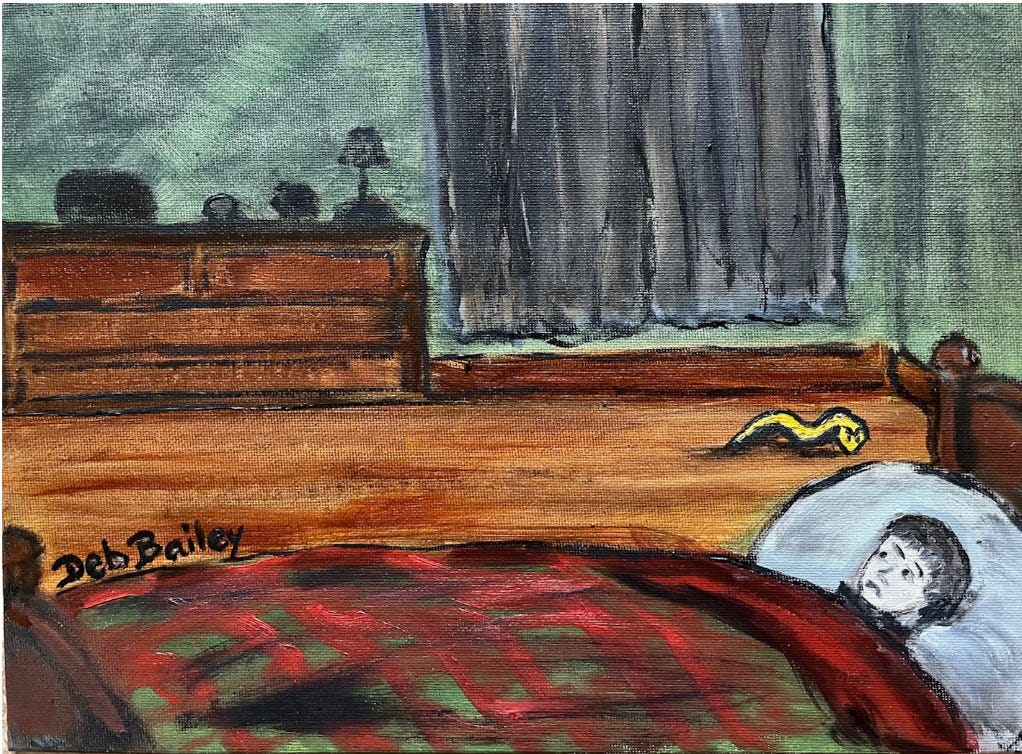
The nightmare always started the same — it was always at night – always just one tiny snake lurking in the background. Sometimes it was a tiny one in a dark corner of my bedroom. Other times it was one tiny snake lurking in the back corner of my bureau drawer, tucked under and behind my sweaters.
And always, whenever I approached that drawer, I would tell myself, ‘Just be careful. Don’t draw its attention – if I’m careful, the snake won’t notice me, and it will leave me alone. I can get what I need and avoid it.’ In my dreams, I accepted this as normal reality. That was how it was there – I just needed to use cautious co-existence, and “maybe” it would all be okay? At least I thought that in the dream. But it really wasn’t so, because the snake was always there and I NEVER really felt safe.
Painting by author
Then the dream would progress the same way every time. Co-existence became impossible because the snake would swell, get very large… and then start multiplying…hundreds, then thousands of them. They were always there, filling that bureau drawer, getting more dangerous by the moment. I didn’t know where they might move to. Or when they might strike.
Finally, they overtook the whole drawer, spilling out of it and onto the floor. Very quickly they would cover the entire floor, then my whole room and finally cover my bed, and me, until they were all over me and I was overwhelmed. Each time, I had no escape, not one bit of space for me. Their mouths would open, fangs about to clamp down on me….and then I would wake up in a cold sweat…
“‘Man or bear’ is a viral social media debate and thought experiment in which women consider whether they would prefer to be alone in the woods with a random man or a random bear. The debate originated from a TikTok video published by Screenshot HQ in April 2024, which interviewed eight women asking the question: ‘Would you rather be stuck in a forest with a man or a bear?’ with seven of them picking the bear. The post went viral and gained over 16 million views in two months.” Wikipedia, “Man or bear”
When I read this, before I even gave it a second thought, I answered – “The bear.” And I meant it. A bear is a known threat. But it comes by it honestly. A man…well, a man can be many things…all of them unpredictable and many, not good. I’ll take my chances with the bear. And I am not being flippant.
There was a social media storm over this outcome, and there were articles written by men expressing outrage that women chose this. There was even one clueless man who went into a long diatribe to prove women wrong, using probability statistics of how many sex offenders there were in America, that it was actually a small percentage versus 17% of fatal bear attacks, and that OF COURSE women should take the odds of picking a man.
Truly, he has no idea what it is to go through life always having to consider whether an approaching man is a risk. To be told never to go anywhere alone. Or to be a woman who was assaulted and then criticized because she either tried to fight, didn’t fight enough, didn’t yell, yelled, wore the wrong clothes, went somewhere alone, and on and on and on.
Yet there were men who understood and chose the bear versus a man, when considering what their daughters should pick. And even social media influencer Amanda Wylie, who’d had an encounter with a bear in the Montana woods, said she would still choose the bear. I agree with her.
1 – Frozen
To understand my choosing the bear, it’s necessary to understand the emotions that drive such a choice. And to talk about the roiling mix of emotions locked up inside of me until after my mother’s death, I would first need to have felt them, and then, known what they were. And none of that was the case in 2018 and 2019.
I hope to be back early next week. I was originally shooting for Saturday the 18th, but I need to update my computer while on break, so fingers crossed all goes well!
Our son’s visit during this break gave us joy and fresh energy. And my next post, Emotions, Part I, is in progress. So I will be back soon.
Thank you for your patience, and for walking with me on this journey.
Saturday, July 18, 2026
“There is always light, if only we’re brave enough to see it. If only we’re brave enough to be it.” — Amanda Gorman