Posts Tagged ‘art’

Notes from the Shower – A Morning Insight About Painting, Drawing, and Writing Those Past Abuses

October 15, 2025
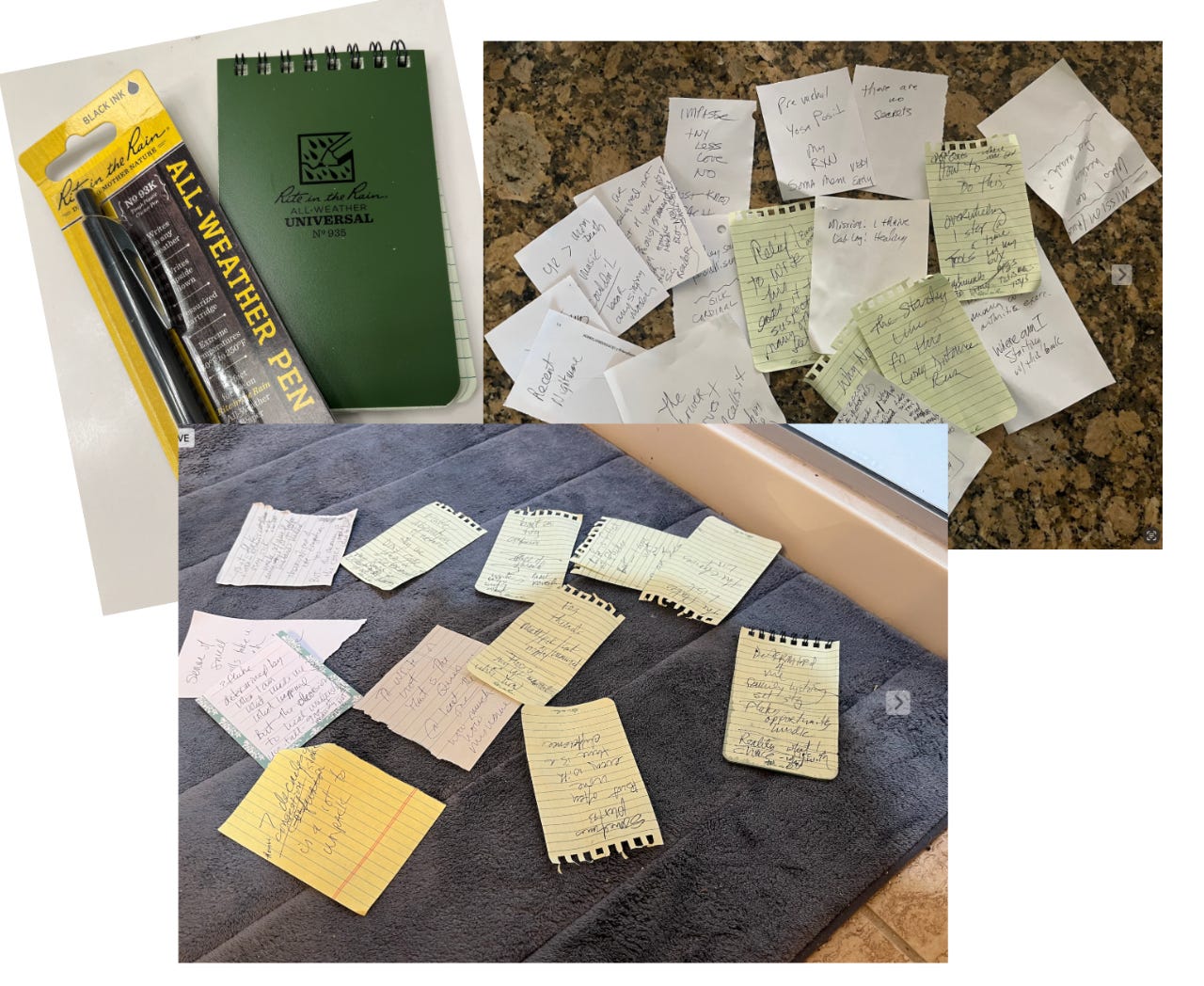
Photo by author

Notes from the shower

I am one of those people who, when I get in the shower, relax and let everything slip from my mind. Which is precisely what my subconscious is waiting for!

The minute the mind goes blank and focuses on the snuggly warmth of hot water cascading over my skin, the subconscious starts talking. Some mornings just a word or two, and other mornings…a mile a minute. Everything from items for the grocery list, to what I need to write, connections for things I have been trying to figure out, or flashes of insight out of nowhere about a long forgotten question.

Aware that I can’t trust my memory to remember any of these things in my head until after my shower, I needed a way to capture them. Then I remembered that the nature researchers at the museum I taught at use waterproof field notebooks and pens to capture observations. So, I bought myself a package of “write in the rain” memo pads and a waterproof pen. And voila! I no longer have to worry about remembering.

Now, when a flash of insight pops in my head, I grab the notepad and pen which I keep on the shelf in the shower stall, jot it down, and fling it out of the shower and onto the floor. Afterward, I just collect them all and take action! And should the “thought flood” continue after I am out of the shower, I have another stack of recycled papers that I use to scribble more notes.

Today’s message – change the viewpoint

So the same thing happened this morning, related to my blog post yesterday, about why I write, draw, and paint my memories of abuse. In that post, I talked about looking back at the past in an intense “post-mortem” examination, like an autopsy…dig deep and see what it REALLY looks like, not just what I remembered it looking like.
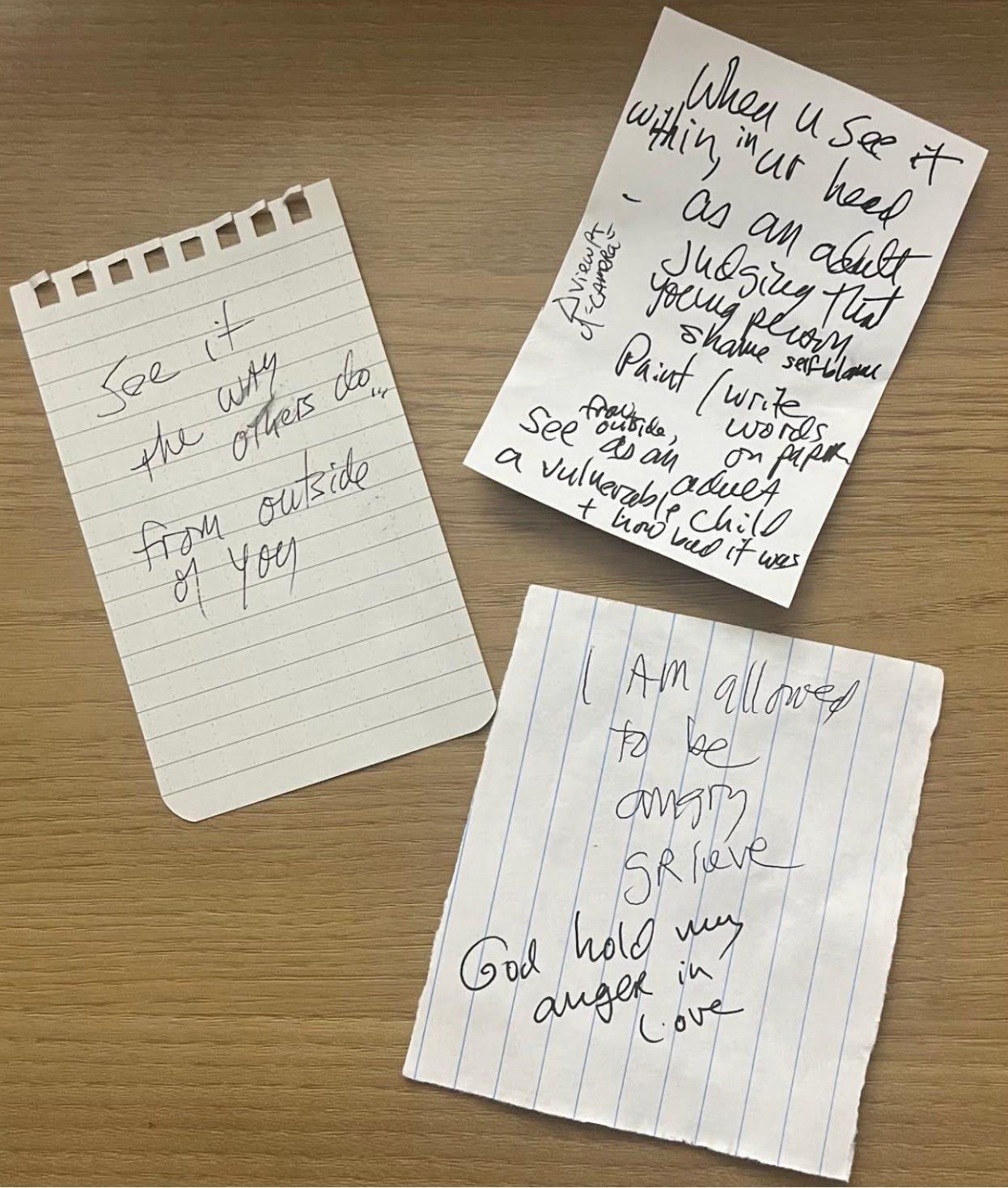
Photo by author

In the middle of today’s shower, these ideas flowed out about why I needed to get those images out onto paper, in paint, and words. The note about “anger and grief,” I will come back to another time. But the others were key thoughts for today:

I had to change the viewpoint. I needed to, instead, see my young self the way others would have seen me if they were standing there at that moment. The insight said, “Put yourself outside of you,” as if you were an observer seeing an adult doing to another child, the things done to you. In that moment, how would you react to that scene?

When I remember something done to me in the past, I may know it was done in my childhood or my teens, or my young adulthood. But my current-day, “adult” brain isn’t seeing me for the true age I was at the time…isn’t seeing what I was capable of knowing, understanding, or doing.

Instead, I’ve been inserting the “adult me” into that memory. So I am thinking of the me in those moments, as I currently am, and judging the me in that abuse scene, as if I were my current age.

Looking at the memory from within, I am seeing me with the eyes of judgment, shame, and intense self-blame. Statements like, “How could I have been so stupid? Why didn’t I fight back in that moment? Why didn’t I know better???!!!!” I judge the me of “then,” with the knowledge base of “present-day” me.

It has taken me a lifetime to understand how awful I am treating me, and how grossly unfair those judgments and questions are.

The shocking discovery

Four years ago, I realized I needed to write this book. But I couldn’t find words. They, and tons of mixed emotions, were choking me and rendering me unable to say a word. So, I started drawing and painting. And I made a shocking discovery.

When I painted myself as that young child, pinned to the wall after supper, held there by my father’s fist….When I painted that small, scared child sitting by the stove and saying “I don’t want Daddy to come home,” …or, when I painted the Saturday afternoon image of my father pushing my young child’s head into his lap, I was shocked…horrified…then enraged.

The female elder in me now, the old adult, the woman who has been a mother for over 30 years, didn’t see an adult me in those paintings. I saw a helpless child. A child trying desperately to endure and sustain through absolutely abysmal situations. Situations she NEVER should have been put in.

Instead of judging me and hating me for not fighting back, I saw the total impossibility of that. How in God’s name could my little person have been able to stop him when my mother could barely pull him off of me? How could that young child have even understood what he was doing to me on that couch, much less that she was not to blame?

When I paint the scene I have carried in my head, I no longer hate myself. I am, instead, filled with horror FOR me, and compassion. Anger at him. And intense respect and admiration that my young self was able to keep going DESPITE being confronted with those things.

For years, I especially hated my teen and young adult self. But in doing these paintings, I then did the math for how many thousands of times over the years, from infancy to 28, that I was assaulted — physically, mentally, verbally, and sexually, I am now more upset that I judged me so terribly. That child, and teen, and young adult were doing the absolute best they could in that moment.

How could I have expected that young adult to have had the maturity she should’ve had for her age, after years of thousands of assaults? Those assaults and stress affected my cognitive and neurological development. My nervous system development. And assaults that robbed me of having any semblance of a decent childhood development process?

Now, looking at those pictures and writing those scenes, I am, instead, flat-out blown away that I fought back or held onto myself as much and as well as I did. And I NEVER could have made those realizations without doing those drawings and paintings, and writing out in black-and-white words on paper – just what was done.

My husband told me one day that he always heard and believed what I told him about my abuse. But he said that the paintings were so powerful that they made things so intensely real for him in a way that just saying it couldn’t. Powerful, yes.

Changing the picture

So, yes, I am revisiting the memories for a “second look” to see what I missed. But I am also revisiting them WITH DIFFERENT EYES. I have shifted my “viewpoint camera” from within me, to “OUTSIDE of me” and that has made all the difference.

Viewed in that way, THIS is how the picture changes:
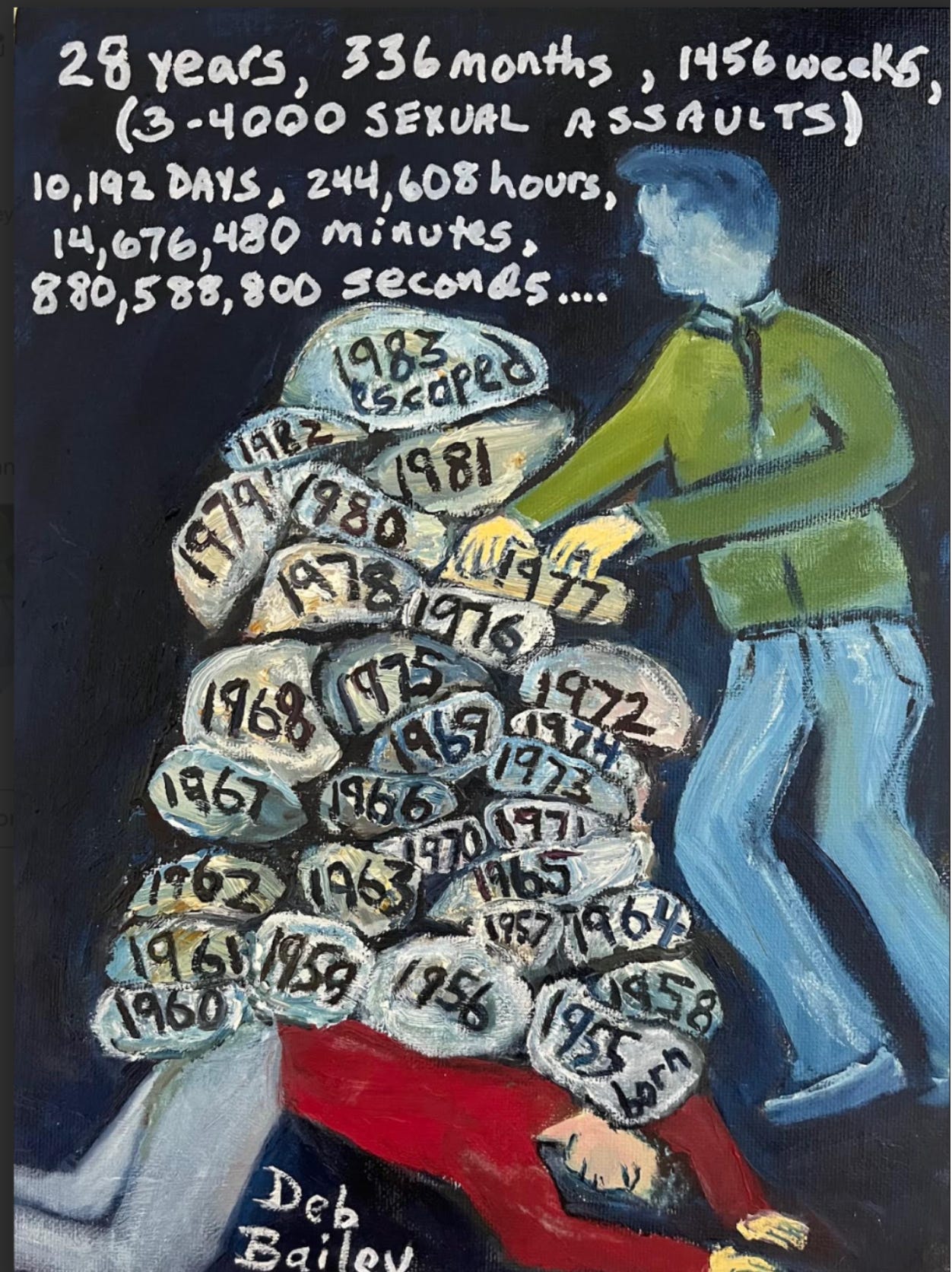
Painting by author

I now feel so much compassion and love for my younger self. I feel remorse over judging her so harshly, and, instead, have such total respect for her….

Now, back to the next pieces on my “Wider Circle” – grandparents, school, and God.
She Had No Idea What She Was In For…

December 9, 2024

And she deserves to finally be seen and heard

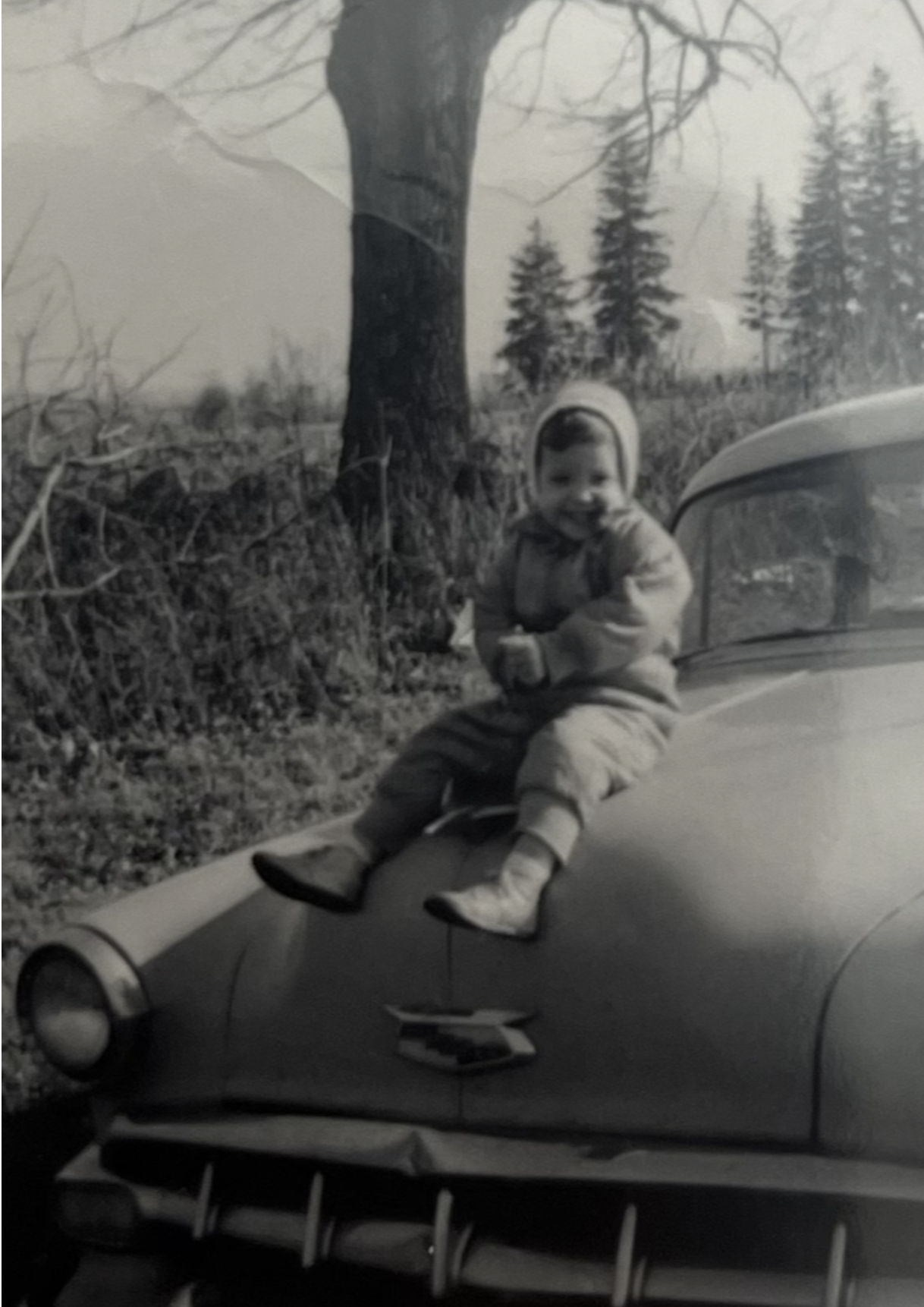
Black-and-white 1957 photo of the author as a 2-year-old toddler in a snowsuit, sitting on the hood of a 1954 Chevy Belair sedan on a sunny late afternoon winter day. Countryside of Torrington CT around Klug Hill Rd.
Photo by author

The “ancient history look” of 1950s black-and-white photos

It’s one of those typical 1950s black-and-white photos found in family albums — those of the era of the late Baby Boomers but before the 1960s when you could more easily obtain color film. It has that dated look and these days, it could simply be viewed as “back then, ancient history.” Only the car gives a clue as to the time period. The bottom line is that this picture comes across more as something found in a history book than a real moment out of a real life. So, while I’ll use some photos in this book, for a large part I am going to use paintings.

The details of a photo…

Why? First, check out the difference when viewing that same moment in full color:

(more…)

A Moment of Humor

December 6, 2024

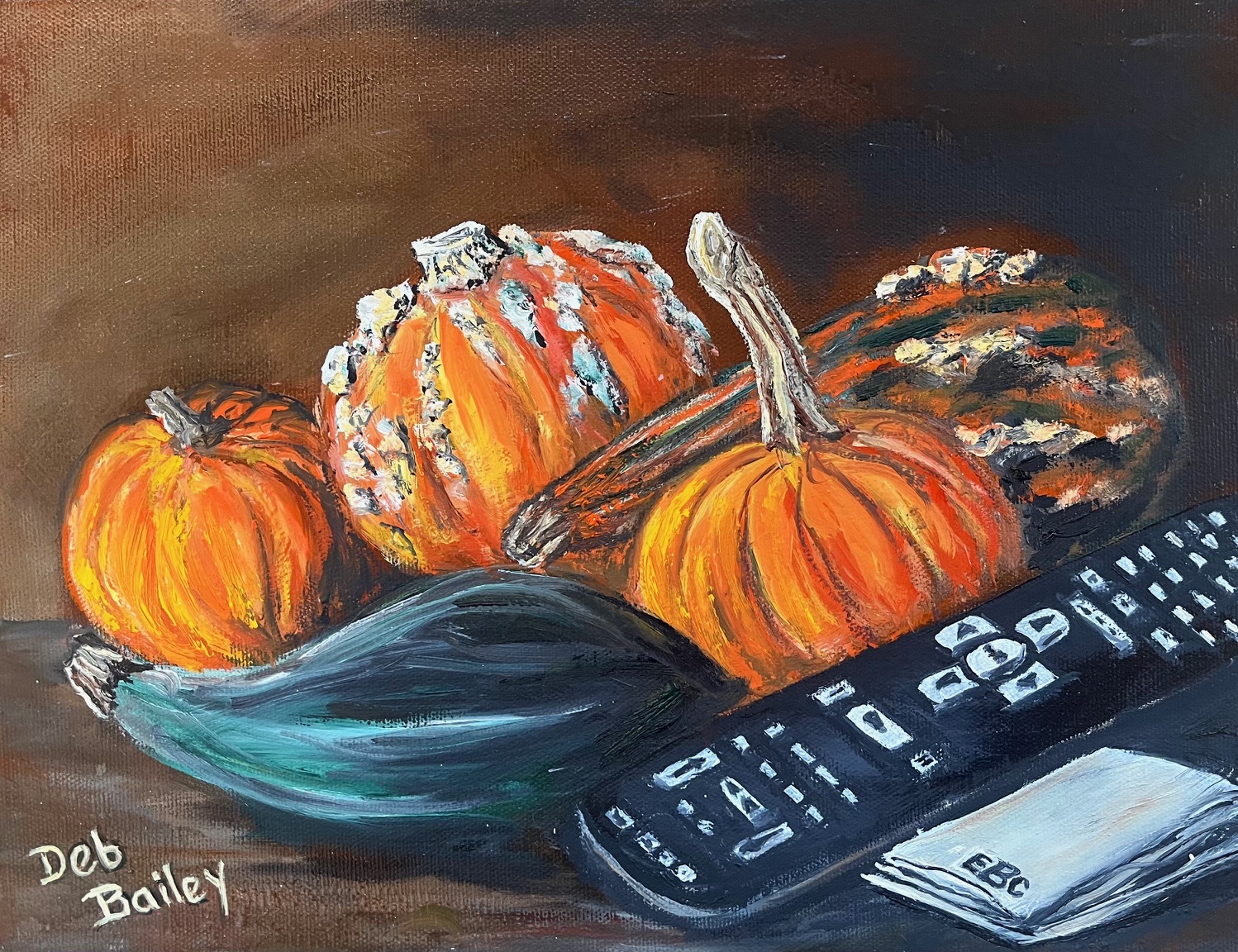
A Humorous Twist on the Old Masters’ painting style

Oil painting done by the author in the style of the Old Masters of the Renaissance - dark browns and oranges; image shows fall harvest gourds and pumpkins, with a TV remote and monogrammed cloth napkin
“The Old Masters with a TV Twist” – Painted by the author

The need for stress reducers during intense writing

There is no question that writing a memoir about abuse …frankly, about anything serious in one’s life if you are emotionally open and honest, can get intense. It takes energy to face it, feel it, process it, and extract the meaning behind the events. So, in order to maintain a healthy outlook it is important to have some activity for a “tension-breaker.” For me, that is art — both looking at good art as well as creating my own oil paintings.

The Old Masters paintings

I happen to love the Old Masters – whether the styles and color tones of the Northern Renaissance, such as Rembrandt, Albrecht Durer, Pieter Bruegel the Elder, or Hieronymous Bosch; or the Italian Renaissance painters and sculptors. I have a lot of books on the various artists or on the time period.

Giving the Old Masters a “modern” twist

Recently I decided to have some fun with the topic and created the above painting – The Old Masters With a TV Twist. I love the idea of throwing in some current-day object(s) to give a modern twist to the classical still-life painting approach! So there will be more of these coming along!

BTW, if you want to know more about the “Old Masters” – here you go:

https://en.wikipedia.org/wiki/Old_Master

Sites to watch my painting progress

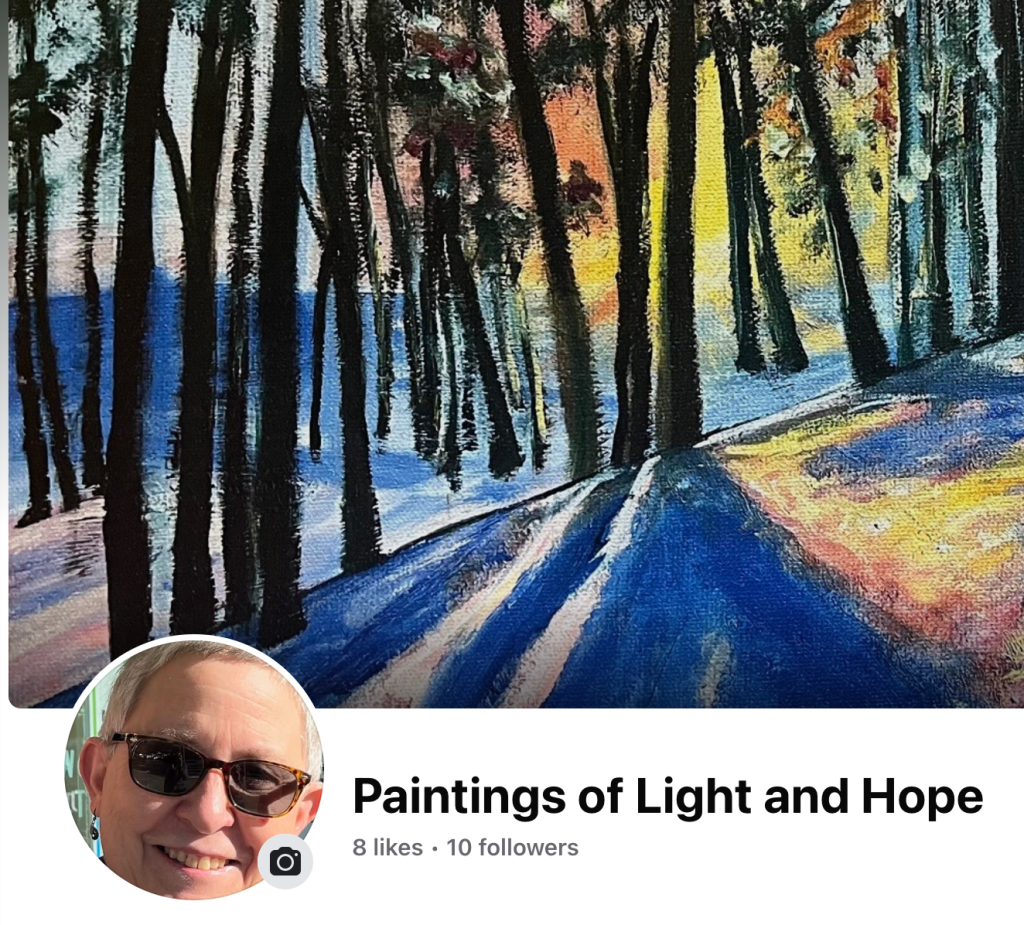
For anyone who might enjoy watching the progress of my paintings from blank canvas to finished “masterpiece” please check out my Facebook page: Paintings of Light and Hope:

Picture showing the author's Facebook Page entitled:
 Paintings of Light and Hope
Photo link by author

You can also view my art progress on Instagram (if you’re not on Facebook)

https://www.instagram.com/debbailey4038/

Sites to purchase paintings, prints, puzzles, etc.

If you are interested in purchasing originals, prints, puzzles, etc. – visit my Fine Arts – Debra-Bailey.pixels.com site:

Image and link of authors artist website at Pixels.com
Photo link by author

Or for originals and digital prints visit my :

Photo of the home page of author's Etsy store : ArtofLightandHope
Photo link by author

The Post – New directions – art

December 19, 2010

Okay. It’s been over a year since I took a “sabbatical” from my blog. In that time I’ve taken a break from writing projects too. The reason? I re-discovered my love for oil painting, and decided to spend some quality time focused full time on that. In the coming year, I’ll have more info available and will be connecting this blog with my website where my art is on display/sale. For now I’m trying to solve the intricacies of how to get all these sites to talk to each other. Stay tuned.

Oh, if you’d like to see what’s up with my art website, just check out:

debra-bailey.artistwebsites.com

The Post – As Promised, What Photography Teaches You About Writing

February 6, 2008

As I mentioned earlier, photographing fiddler crabs helped me to “be one with them.” Armed with the heart of a crab, maybe I can get that across in the book.

In a broader sense, there are some similarities between the arts of photography and writing:

1) Narrow the topic:

The viewfinder of a camera sets the limits on how much you can fit in the picture. A photo is a one-moment slice of an event. You can’t show everything, so you have to choose. What will you focus on?

Good writing, especially essays and short pieces, needs limits too. Start with too broad a topic and the piece runs too long, lacks focus and depth, and leaves the reader wondering it’s about. You can’t say everything, so you have to choose what you will say. Choose a specific slant and give the reader depth for that one topic.

2) Composition – Create the Scene:

Part of the art in a good photograph is its composition. What did you include and why? How did you choose to portray it? What angle was it shot from? Lighting? Shadows? Contrast?

In a good story, “show don’t tell” is done with scenes. You’re the director. How will you set it up? Who will be in it and who will be left out? Why? What will they say and do? What are they holding? Wearing? Where are they? Is it frigid or tropical? Are they scared or serene?

3) Detail is the life of the creation:

The camera’s eye doesn’t miss much and often sees more details than the photographer did when taking the shot. The details that show up in the picture bring it alive, especially in things like still life and macro photography. The details ARE the photo.

In writing, specifics are the spice that creates the picture. Something doesn’t smell good, it has a licorice herbal aroma that wafts through the sunlit cottage and makes you salivate with anticipation. Something doesn’t feel rough and hurt you, it has a gritty surface that grinds against the tender flesh of your palm until it strips the skin raw and bloody. Specifics create the image.

4) Deliver the vision:

You can see the image you want in your mind’s eye, but if you can’t work the camera, all you’ll get is a dark blur. Master the technology.

The most amazing story may run through your mind. Yet if what appears on paper lacks organization, moves too slowly, leaves out needed plot points, has poor sentence structure, bloated dialogue, or no sensory details, no one will get it. Master your craft.

5) Know what you want to say:

A photograph may be wordless, but it will still speak to the viewer if the photographer knows what he’s looking for.

In writing, you may have a 500-page novel but you still need to be able to sum it up in a line or two. If you can’t do that, you don’t know what your story is about.

In the future, 10 or so things an oil painting taught me about the writing process. Stay tuned.