Posts Tagged ‘books’

Is Writing a Memoir Worth It? 2/3 – YES

December 1, 2024

54 Reasons Why Writing a Memoir MATTERS

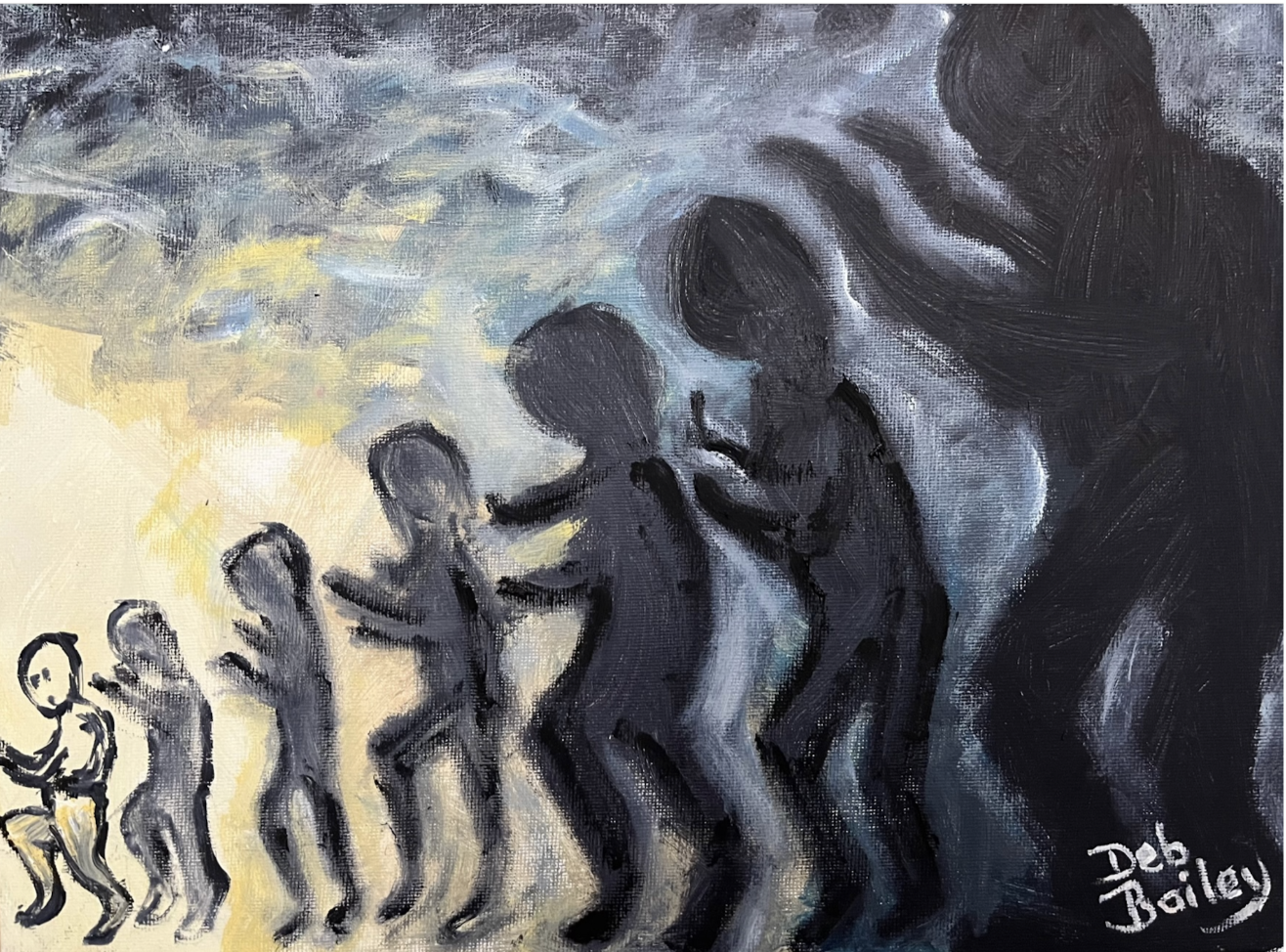
Abstract painting with a person trying to tiptoe away from their shadow selves who carry that person's secrets and past. The person is trying to avoid facing their past but the shadow versions just get bigger, darker, more ominous
Painting by author

Real safety is your willingness to not run away from yourself — Pema Chodron

The audience

A friend of mine asked who I was writing the book for. Almost without hesitation, I said– myself. Now in case that sounds selfish, it really isn’t. There is that old saying that before you can help another, you have to take care of yourself.

In the past, I would have answered that question differently. So many times over the years I tried to write my story in one form or another, but always, I thought I was writing it for others. After all, shouldn’t we want to help another if we can, to escape the pain we were in? A noble thought but it’s not that simple.

Each person must untie their own Gordian Knot

It’s also been said that the more you learn, the more you realize you don’t know. Hence the idea of writing a book to save another seemed arrogant, presumptuous, and flat-out wrong. I’ve spent a lifetime searching for my own answers, so how could I think I had answers for anyone else?

That might have been a bit of the pendulum swinging a little too far in the other direction, though. About the point I had decided never to write, a few key mentors in my life took issue with that. One of them–my high school English teacher who was pivotal in saving me back then, said to me: “You don’t give people answers. You tell your story. From your story, they find their own answers and untie their own Gordian knot.”

In that second, I was convinced. Her comment cemented my decision–this was a reason I could accept and write for.

Are there many good reasons to write a memoir?

Now I recently listed the number of risks in writing this kind of story, which made me wonder what, if anything, might be a good reason for doing my memoir. Maybe a few more than just “I knew my mentors were right.”

(more…)

Is Writing a Memoir Worth it? 1/3 – RISKS

November 26, 2024
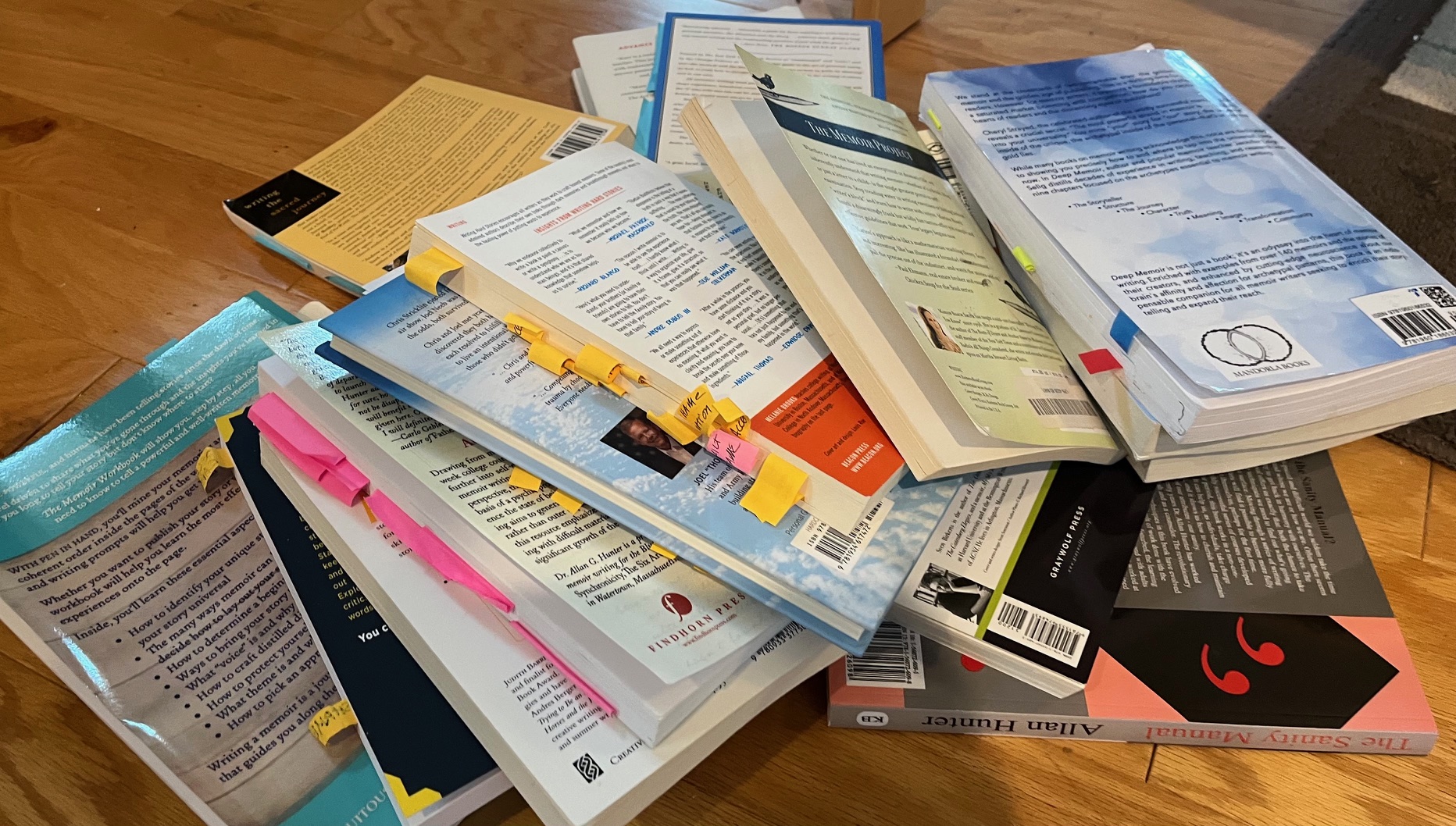
Pile of over 20 books on memoir writing the author has read to learn how to do this. They have many stick tags and notes sticking out of them.
Photo by the author of just “some” of the many memoir-writing books in her home library

What About the Risks?

So you’re considering writing your memoir. You take stock of what stories, events, and insights most impacted your life. You examine your life and make a list of obstacles encountered, successes and failures — and how you dealt with either. Your soul says “there‘s bits here that might be helpful to share,” so you sit down at the computer, get ready to open a vein and…you freeze.

There is no question that many writers experience tremendous fear when writing, no matter the topic. There are many books and articles out there on how to write, what to write, and even how to overcome the fear of writing. I have more than a few of each kind on my bookshelf. 

Fear of writing

On that last item, fear of writing, I have a book — The Courage to Write: How Writers Transcend Fear by Ralph Keyes — that I’ve kept since it was first published in 1995. So, it’s not a new problem. I suspect the first time a cave person scrawled an image on a stone wall it might have given them pause when they stepped back to assess their work.

The idea of putting ourselves out on the page…even if we never show it to anyone, may stop us before we ever start. And I am not even talking about whether the writing is any good or not. First, there is the possibility of triggering powerful emotions never before confronted. That is immediately followed by self-judgment: Am I really like that?

The pages never read aloud

We all have those “pages we never read aloud” to anyone — things we don’t want anyone to know about us, and for that matter, things we may not even want to admit to ourselves. And yet there is no escaping their reality when the words sit there — stark black letters blazing tracks across the white page.

Even if we’re not writing about our own mistakes or faults, there is no question that subjects of a serious nature will impact any writer’s willingness to venture there. It’s one thing to talk about how a car engine works and know you will be judged on how well and accurately you write the piece. But to write about victimization, shame, or messy emotions, and to say on the page what someone drilled into you NEVER to speak about, invites some powerful ghosts to come stomp all over your courage.

While you may have shared those stories with therapists, relatives, or close friends, it is a whole other matter to actually know that thousands of perfect strangers know your secrets. And that doesn’t take into account in a digital age, putting things out in places where people can respond immediately, and with things like: “What’s the big deal? Get over it” or worse. 

So that brings me back to my original question — is writing a memoir worth it?

The power of transformation

I have been reading a book on memoir writing that is great…actually, I’ve read many over the last few years. But the one I speak of right now — Deep Memoir, by Jennifer Leigh Selig, PhD — just nails soooo many important themes.

One theme in particular, in a chapter near the end of the book, really caught my attention. In that section, the author dug into the power of writing a memoir to transform you — change you not just by looking back at the past and making observations about what happened THEN, but to change you RIGHT NOW as you are writing

As soon as I read that sentence, my gut tightened because I knew exactly what she meant. I’d be writing about some issue of anger or shame that I’ve carried for years and even as I was typing the words, I could feel some slight shift in me…a softening, compassion, a lowering of terror. 

All I know is that in those moments, I am like a crucible holding individual chemicals. And as I am held over the fire in that writing process, the chemicals start to melt, mix, react, and become something new. The process taking place in that “writing crucible” changes me and it’s not about the ingredients I started with. It’s the process.

But what about the risks?

But the book also notes some authors who have experienced extreme emotional trauma such that after they published their book they said they would never do it again. Jessmyn Ward, writing about five men in her life who died, said she doesn’t know if she could go through that process again. Carmen Maria Machado, after writing about intimate partner abuse, said she probably would not. And Pat Conroy, writing about his childhood abuse in his novels, experienced suicidal despair, attempted suicide, and had another suicidal breakdown later, after another book. So the risks to one’s mental health are not imaginary or inconsequential, especially when writing about traumatic events.

Physical illness is another way traumatic material can wreak havoc on a writer. Kate Bornstein was already experiencing sleep and eating disturbances, along with having to seek therapy because her writing triggered a borderline personality disorder. But she also suffered gut problems so severe they had to remove part of her intestine, something she attributed to her writing. She said the writing “gets you right in your gut…and I took that as a sign that I was on the right track.”

All of that aside, there are the “normal fears” about writing a book. What if people hate it? Or don’t get it? Or maybe worse, what if they love it and the response overwhelms you? Fear of success is just as strong as fear of failure. Especially if you’ve lived through abuse, you may have lived your life in the shadows and sudden public awareness is too much. Or there are the stories about writers who’ve encountered rejections and relationship breakups; angry responses from others who don’t like what was shared; or for some, even lawsuits.

What risks am I facing?

So, based on all of the above, in terms of writing my memoir I realize it might:

  • Trigger my own pain, health, and emotional reactions to revisiting painful things
  • Expose all my hidden details to the public
  • Deliver reactions from others that I may fear, or be emotionally devastated by
  • Change my life

As to “change my life” — well it already has. And will continue to. Just look at the fact I am writing here and saying truths I’ve not put out publicly before. So change is a given. And the remedy for that is just “one day at a time.”

Regarding the first three risks, I have given those a lot of thought. I have put in place some support systems for me as I do this. Also, I drafted a list of things to share with readers at the beginning of the book — things such as rules and boundaries for how I chose to write the story; trauma-trigger cautions for readers, given the topic; and most importantly, the purpose for writing. 

What is memoir REALLY for?

The last one matters most because in the end, if I am going to write a memoir, it is not about just making a laundry list of all the things I lived through. It is REALLY about: because of what happened, what did I do with it? It is about coming back. It is about hope. It is about connecting on a universal level with a reader who might have a different story but still experienced similar emotions. 

The “decision-maker”

Having thoroughly rattled myself with the risks, I did one last thing before answering the question — I made a comparable list of “why it’s worth it to write a memoir.” I figured it would be blatantly obvious after that, what I should do.

Digging into all of the books in the above picture (and several more) I compiled a list. It was an illuminating…actually an eye-opening experience. And so I came to my decision.

I will share in a separate post, what I put on that list. It will, no doubt, make clear my logic and maybe be helpful to anyone else considering whether to write their memoir or not. It goes without saying — but I will say it anyway — that each person has to make their own list and determine what their own risk/benefit ratio is for writing and then make their own decision. 

The bottom line

But for me? Is writing a memoir worth it despite everything above? And despite the fact it’s taken me seven decades to come to this point?

A very short, simple, but emphatic answer: YES!

My “benefits” list will come soon. 

So…after a long hiatus…the “Prodigal Writer” returns…

November 19, 2024

WHERE have I been?

I have been busy for the last many years – working at the NC Museum of Natural Sciences in Raleigh, NC. It was the BEST job of my life and it used every bit of what I learned through 40 years of medical labs, pharma research, clinical trials and medical ethics. And my creativity, painting, play and prototyping with Play-Doh…it was a return to my childhood of dissecting frogs, chemistry sets, and reading about the adventures of undersea-shipwreck explorers. That job was literally PLAY that drew my long-dormant 10-year-old back to the surface. I could reach and excite kids about all the weird tweaky details of science and its stories, because I returned to BEING that kid.

I did it for 15 years, every day a new exciting topic to create an activity or class or show for all ages. The topics, the ways to spin it, the ways to get people involved, surprised, laughing even, fed my soul to no end I would have done it forever, but finally, arthritis plaguing my joints, a really bad bout with the flu and subsequent infections this past year, and just plain tired no matter how much I loved it all, I knew it was time to stop. I’ll be 70 next year. It was a good run. I “did good!” 🙂 But yes, it was time for new blood, and so I retired.

So now what?

However…that doesn’t mean I sit in a rocking chair. I have a manilla folder full of things I want to do – take all the poetry and literature classes I never had time for when I went to college in the 70s – only enough money and time then to get my requirements, my lab classes, get out and get to work. But now, the adult ed classes at local universities have these classes and I will take them.

I want to learn to play chess well. I know how to play – poorly 😉 – but it would be nice to get better. There are a few small trips I would like to do.

And I now oil paint every day — partly for me — partly to sell — and partly to brighten people’s lives. As I do a painting I post pictures of the progress on my Facebook page as I did it during Covid. People then found comfort and joy in watching the evolution of various paintings. And these days the world has so many “issues” going on, I figured people could use “a Moment of Respite” from it all, if only to follow along with my oil paintings again.

If you too could use a “break from reality” come visit my Paintings of Light and Hope Facebook page: https://www.facebook.com/profile.php?id=61568762302738

And if you like what you see, there are links on that page (and below) to my DebsWritingandArt Etsy store where I sell the originals, or to my FineArtAmerica pixels.com website page where I sell prints and originals, and also blog about the paintings:

https://debra-bailey.pixels.com/

https://www.etsy.com/shop/DebsWritingandArt?ref=seller-platform-mcnav

And yes…finally, I have returned to writing.

First, I restarted by posting essays with the pictures of related paintings, on the platform Medium in a publication there called Pure d’esprit

In addition to the posts I write about my artwork on the Facebook page I also blog on my FineArtAmerica Pixels.com page

https://debra-bailey.pixels.com/myblog.html

But why am I bothering to write here then, if I have all these other places I show up on the internet?

It’s because the “Soul Mosaic” concept has never left me…

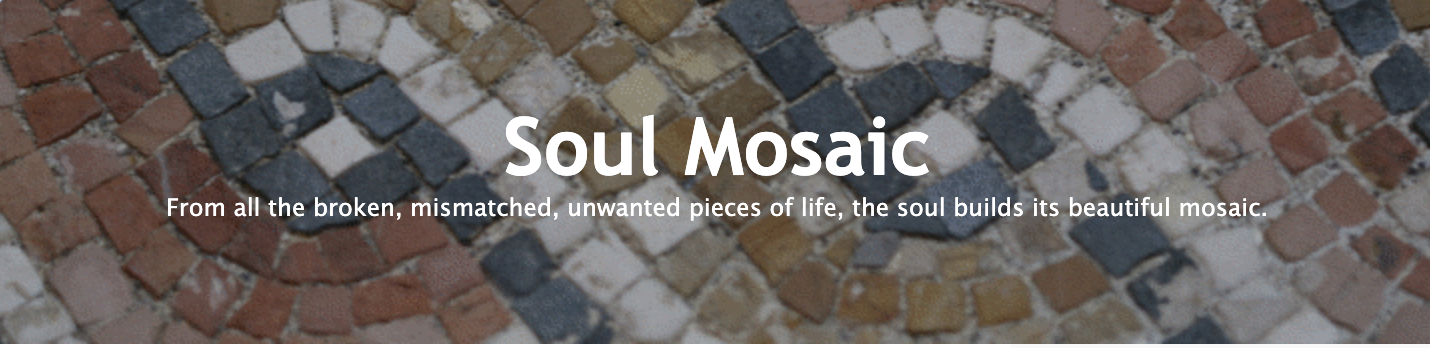
The photo shows a closeup image of a Roman mosaic with the tiles looking like two eyes. This is the background of the logo for this blog's header. The blog is Soul Mosaic, and the subtitle is: From all the broken, mismatched, unwanted pieces of life, the soul builds its beautiful mosaic.
Logo for this blog, incorporating a picture of a mosaic the author took at the NC Museum of Art

The truth is, that mosaic idea is the truest metaphor of my life – broken, mismatched, unwanted — rebuilt into a beautiful mosaic. The truth is, it may have taken me a lifetime to get here, to learn what I needed to, but I am STILL HERE…and in spite of all the havoc that went on in the first half of my life, I THRIVE.

The work of my lifetime?

So that brings me back to the writing work of I am doing and have been working on for the last few years…the writing work that has waited a lifetime for me to come back to it…my memoir.

In short, I was abused – physically, sexually, emotionally, mentally — from infancy through age 27. I should never have gotten out due to all the brainwashing, gaslighting, shame, and frankly ignorance that what happened to me had a name – incest. I thought I was an aberration of nature, and instead I found out it happened to others. Many others. And all of us who lived it walk through life, silent, SILENCED, and broken. The key to healing – understanding, speaking, finding our strength – are denied in silence.

I have fought back for most of my life. I left it behind, rebuilt a life, a good life, and I have done well in spite of the scars I carry. But life has a way of coming back with the well of emotional pain left behind that demands to be heard…in fact, MUST be faced and heard if one is to heal…learn…understand…LOVE.

Why go back? Why write?

Rabbi Jonathan Sacks commented about Holocaust survivors that most spent the bulk of their lives LIVING and BUILDING a life. THEN, only after that, was it time to “look back” – T’shuvah – return to it, and examine what it all meant.

The book – Deep Memoir by Jennifer Selig, PhD – has some pithy answers:

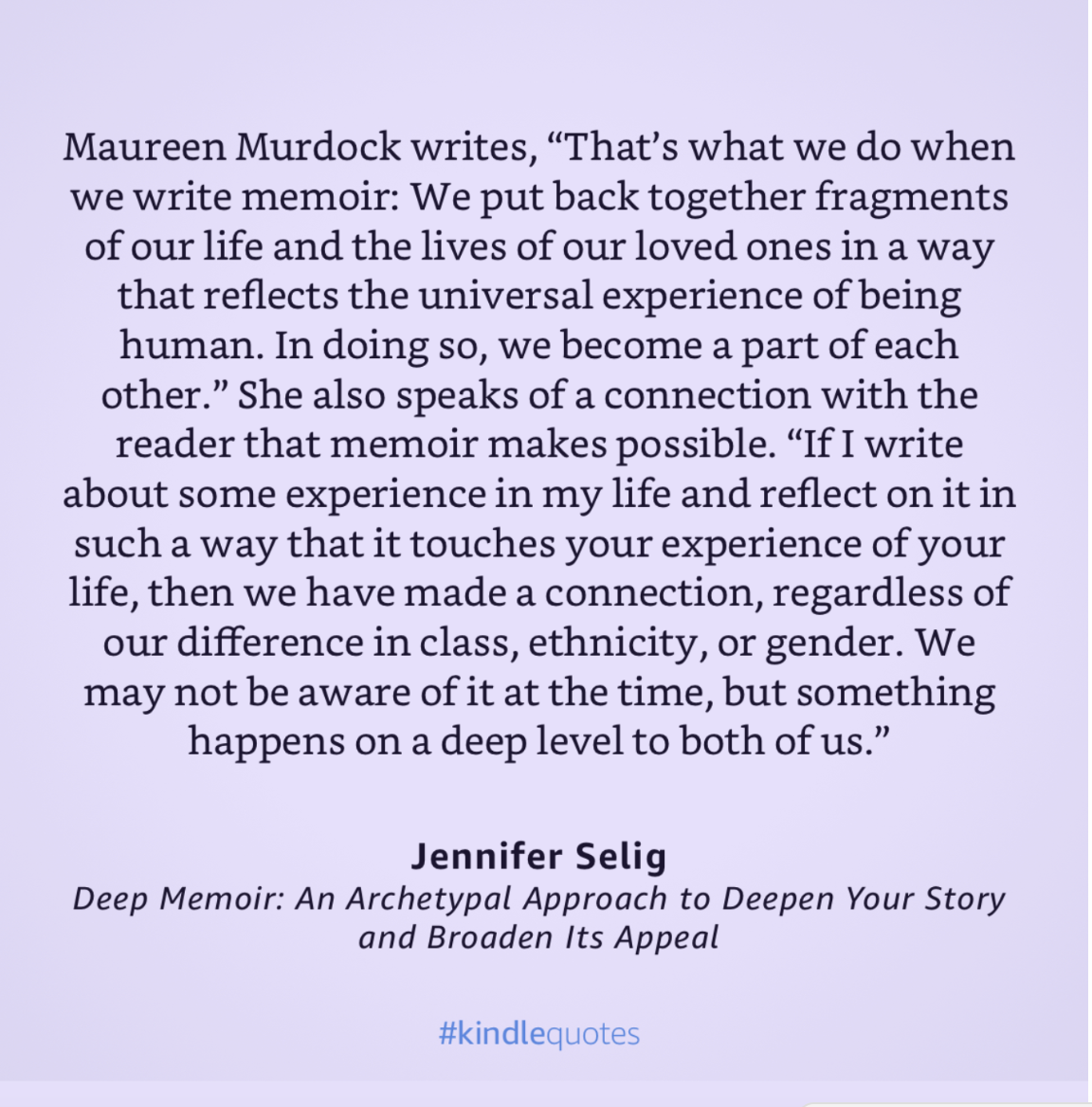
Photo by the author of a book page with a quote explaining that we write memoir to put pack together fragments of our lives and and those of our loves ones in a way that reflects the universal human experience. The focus of the quote from the book Deep Memoir by Jennifer Selig, is that memoir makes connections between writer and reader that connect us both no matter our backgrounds.
Photo quote take by the author from the book, Deep Memoir

Later in the book she also has a quote from another author who sums up the “why”:

”You too are driven by the desire to understand…Beneath your desire for knowledge writhes the hunger to understand and love yourself.”

So – understand…heal…connect with others…and finally PUT BACK TOGETHER FRAGMENTS….LOVE YOURSELF

And to anyone who thinks it is just a litany of just this happened and that, or gee, why me? It is the story of hope…after despair. It is the story of evolving over a lifetime, from a pile of broken-bits rubble, into that mosaic.

It is told through almost 100 paintings and photos that helped me remember, feel the trapped emotions, then find the right words to understand and move forward.

So it is the story that says: “In spite of what you did to me…in spite of how I struggle...I THRIVE.

As to Questions – that tired old “why me?” – that was NEVER the question that plagued me.

MY QUESTION was always:

“Because of what happened…what do I do with it?”

That is the final reason I write – MEANING. All that destruction has to have meaning, and if that comes by writing and helping even one other person in pain with my story, it will MEAN SOMETHING.

Why use the blog?

A way to get my book written, is to have a place I can write posts that discuss one topic at a time that will be covered in the book. This can be my place for “rough-drafting and brainstorming a concept” that I will later more fully develop in the book.

By the way, to write the book I am using a software called Obsidian. I LOVE IT! And it has been a gift to come across, both for gathering thoughts, storing easily accessible info I need to have available, but also to hold the drafts as I build the book.

Anyway, I realized that this Soul Mosaic blog could be my “scratchpad” or “sounding board” place for things I need to explore so I can then expand on them and put them in the book.

Some of the topics I have written about in related essays I published in the Pure d’esprit Medium publication, and I will share those essays here too because the Medium platform is only open to paying members.

But some of the topics I just prefer to write here, in my “old friend” Soul Mosaic because emotionally, it is my place for broken bits being reformed into beauty…and always has been.

So I will be posting here again. For anyone who decides to follow along, welcome.

The Gift – A Writer’s Extra

March 21, 2008

I came across a great blog, done by one of the local SCBWI-Carolinas (Society of Children’s Book Writers and Illustrators) writers. It’s such an informative site with tons of information and instruction in writing. So my Good Friday Writer’s Extra Gift is:

Writermorphosis: The Process of Becoming a Writer

Her own description, along with recent activities:

“Writermorphosis, this is not a book review website. It’s a site by and for Children’s/YA writers, where we can learn tips and techniques from each other, and encourage each other in our writing.

So, during the month of February, and for a week or two in March, we are doing what may look like book reviews. We’re critiquing “from a writer’s perspective,” some of the 10 books that were short-listed for this year’s CYBILS Awards in the category of fantasy/science fiction. We’re looking for techniques that we can use in our own fiction writing.

Last week, we looked at two books from the CYBILS list that are good examples of how to weave two different stories or plot lines together into one book.

This week, for those interested in writing about history and culture, we’re looking at two books that would NOT be considered historical fiction. One is Sci-Fi. One is Fantasy. But both of these books clearly incorporate (and sneakily even teach) history to the kids and adult who read them.”

There are several other writing blogs I’ll be mentioning in the coming weeks, from fellow writers. Stay tuned.

The Post: Under the Pier – Setting as Character, Part I

March 15, 2008

I’ve seen writing books and articles that talk about “setting” as character. For some stories setting may just be the convenient place to locate a tale that could happen anywhere. Though, I have to wonder if that’s really true. I suspect on some level, setting is always a character. I have to think the author chose the particular locations for a reason, if only to give a certain emotional feeling or atmosphere to the story.

In Under the Pier, it’s a main character. I can’t imagine it taking place in California, North Carolina, or even New Jersey. There is a unique combination of influences: history-from witches to rebellion to World War II; independent Yankees who kept farming or going to sea, refusing to quit and finding innovative solutions for their problems, even though the land stinks for farming and so many died at sea; ethnic and immigrant work ethics, religion and beliefs; family ties; blue collar industrial types, and a pragmatic, no-BS attitude that sees through and hates charm and flattery. That butts head-on against Yuppie, new money, old money, universities and the intellectuals. You have the heritage of rebels like Sam Adams, abolitionists like John Brown and Harriet Beecher Stowe, and those strange independent types who would spend a year living alone on Walden’s Pond writing a book, thrust face to face with investment bankers, world politics, and cutting edge research. Where else would a large town mayor be accused of Mafia ties and the people still want to keep him in office because he revitalized the region?

The climate is difficult – as steamy and hot as the south in the summer, yet bitter cold with Artic winds in the winter. The short growing season and poor land make it difficult to earn a living farming. The sea brings nor’easters and claims fishermen as karmic payment for men daring to venture out there. And yet, they keep going.

Crammed right in each other’s faces are the poor and rich, intellectual and backwoods, new and old. The small geographical area makes it a pressure cooker because it shoves these groups right in each other’s faces. Like all places where boundaries meet, the participants cross back and forth between the two sides all the time. You can walk into a diner on a tougher side of town and have a truck driver on one side of you and a neurosurgeon on the other. People are pragmatic. If they want good diner food, they go to where they can get it and it doesn’t matter what walk of life they come from. Tough blue collar dockworkers raise sons and daughters who go to Ivy league colleges and have letters after their names like “PhD.” In fact, it’s almost an unwritten law in those harder places that you make sure your kids work hard, “get an education” and get a job where they don’t have to “do what their parents had to do to get by.” In a culture where immigrants measure progress in generations, the force and focus is always on making sure that next generation moves up a notch and has that “security” the previous generation never had.

So in looking this over, if this isn’t a character in its own right, I don’t know what is.

Under the Pier is set in one of those boundary places that straddles the worlds of commercial fishermen, dockworkers, manual laborers, and factory workers, vs the “new moneyed” rich tourists who fill their restaurants, the higher class well-educated intellectuals, and old money.

Max lives in the world of diners and auto body shops, commercial fishermen and the wharfs downtown. Her grandmother, Connie, is a widow, and has worked in Rosa’s diner all her life. It’s where she met her husband who came back from Vietnam and drove trucks for Grunder’s Moving and Storage until he died. Her grandmother’s total focus was to make sure her kids had the security and respect she didn’t have when she grew up. It’s all about prestige, money, position, getting ahead, but it’s really about security. If you have the others, the thinking is, you have the security. Connie’s youngest son is one of those who have crossed the line. He’s a post-doctoral researcher dating another PhD whose love is all those undersea critters. Her oldest daughter is a business consultant married to a successful doctor and lives in an exclusive area in Farmington CT. The biggest worry of Connie’s life was that middle daughter, Alicia, Max’s mom, who threw caution out the window, followed her artistic heart to Cape Cod, and worried her mother to death because she rejected most of her mother’s values….at least on the surface.

So the “personality” of the place, creates the personalities of the people who live there. From those personalities and the fact they’re all thrown up against each other, you get, story conflict.

Coming up next: Place as Character, Part II: Specifics of the Story’s locations and the research behind them.

The Gift

February 27, 2008

A love story of a different kind – a writer’s love story: 84 Charing Cross Road, with Anne Bancroft and Anthony Hopkins.

If you want the full story behind the movie, I recommend the two books:

84 Charing Cross Road, by Helene Hanff

The Duchess of Bloomsbury Street, by Helene Hanff

The Post – How Do You Take Three Picture Books and Make a Novel?

February 22, 2008

In writing this post I feel the same amount of confusion and struggle as I did when I was trying to get my head around how to set up the novel. Where do I start? There’s too many thoughts and ideas, too much to wade through or convey. My brain feels overwhelmed and I want to give up and go have hot chocolate at Starbucks instead.

Back then, I was surrounded by papers…drowning actually. I had a binder full of hermit crab story versions from all the different submissions I’d sent out, as well as their rejection letters. I even filed each rejection letter neatly alongside the particular story version sent to that publisher, and the binder was organized in chronological order. That way I could see the not only the history of all the submissions, to whom, and the result, but also, the evolution of the story itself as it changed for each new submission. So in reality, for that one picture book, I had about 20 versions of that story as I tweaked, changed, revised, and resubmitted it.

I had another binder with the multitude of revisions (and rejection letters) for the Max and Jamie un-picture book. Then there was that third short story whose revisions and versions filled, first a folder, then a box. Climbing Mount Everest would have been easier. That journey of a thousand miles seemed shorter than whatever it was going to take to wade through all that stuff and find the story that needed telling. And worst of all, here I was, this very goal-oriented person who lived to finish things fast and cross them off the to-do list. The thought of what this job was going to take to start it, never mind finish it, seemed too daunting to face.

You can drive yourself crazy trying to find the exact perfect place to start or the exact perfect way to work. In fact, I don’t think either exists. As far as getting started, you just have to pick a nipple and get going. It’s like Billy Joel said about the songs in his dreams never matching what he created. Nothing will be as perfect as our dreams and visions. So you can either give up right then because you can’t have perfection, or you swallow your ego and create the best you can. Even the imperfect can move souls. But you still have to write it. Tabitha King, wife of novelist Stephen King, and a critically acclaimed author in her own right, noted in an interview in Writer’s Digest magazine that, “…fiction never turns out the way it’s imagined. Your expectations are never gonna jive. …But that doesn’t mean it’s not a success.” So you put your butt in the chair and start somewhere, working through it all, somehow.

This is where going through Stage 2 helped – you have to know yourself. If you do, you have at least 2 things going for you: 1) you have at least some idea of the questions in your heart that might need to be answered in a book; 2) you have a pretty good idea of how you work best.

How you work defines what your processes and tasks will be. Some writers just sit down and start writing. They write several hundred pages until they finally discover their story and characters. Then they throw away those pages and write the story. A few, like Isaac Asimov, can sit down and organically know where they’re going and just get it right the first time out. And then there’s us plodders. We think, percolate, plan, research ….plod.

Tabitha King said that she likes to research “the living crap out it” before entering the story. Jodi Picoult, best-selling author of 14 novels, said that often she spends more time on research than writing. Why? In her June 2007 column, “This Writer’s Life,” for Writer’s Digest magazine, she said, “…fiction’s a tightrope. I’m supposed to whisk the reader away from his everyday life, but to do that, I need to create characters and situations real enough to entice him to follow. To that end, I’ve found myself living the lives of dozens of people, all in the name of research.” She said that research allows you to write with authority so readers can trust you to get the facts straight, and it gives you the “chance to walk a mile in the shoes of a character that might have lived a life very different from your own.”

I knew I wasn’t Asimov. I also know that to meander aimlessly through hundreds of pages before knowing where I was going, would drive me crazy. I need order, organization, planning, research. You should see how I plan a road trip. After all, my natural tendency was to be General Patton. Generals assess what they’ve got, research their enemy, plan their strategy, then execute the battle. That’s me.

So, first I assessed what I had:

1) I knew now what kind of book it should be – novel.

2) I had LOTS of raw material. I knew the setting, the time of the story-current day – and had some ideas about characters and plot points because I had MANY versions of each story to choose from.

3) I finally knew about what age my own child was inside, 11 or 12. That sort of tells you what age the reader of your book might be. Also, knowing about what ages you and your readers are points you toward what kinds of story questions you can tackle.

At least for me, writing is all about questions and choices. As you ask, you learn something. As you learn, you make a choice about something in the story. Another question comes up, another choice. Before you know it, characters appear, setting, time, places, problems. Others are excluded. The story evolves. So at this point, the question for me became: What is my story about?

I came out of childhood with scars and resentments and issues. So has everyone else. If my own life has depth and there’s more to ME than meets the eye, the same is true of everyone else out there. This means there’s lots of potential for conflict and issues and depth of characters, quirks, oddities, and unexpected twists and turns. No need for clichés, stereotypes and superficial stories when you have some real meat to work with under the surface.

The very story you tell comes out of a choice when answering the questions – Do I write what I know? Or what I want to know about? Sometimes you choose a place or character or issue that you know personally. Sometimes you choose something you have no experience with. You could even choose something that repulses you, but you want to explore it so you can stretch yourself and grow. George C. Scott did that when he portrayed General George S. Patton, Jr. in the 1970 movie, Patton. In this quote from a special features documentary included on that movie’s DVD, one of the former executives at 20th Century Fox, David Brown, spoke of all the issues they had to deal with in making that movie. One was casting an actor for the lead role:

“…of all the critical decisions made for the project, perhaps none was more crucial than the casting of George C. Scott as Patton. George C. Scott was not very fond of General Patton. Why he accepted it was because it was a good script and it was a reach for him as an actor.”

Jodi Picoult noted that she’d grown up happy in the suburbs. Everyone in her family liked each other, there were no dark secrets in the family’s closet, and she worried that she was doomed as a writer before she even got started. “Frankly, I didn’t have enough trauma in my life to write about.” She came to the conclusion she had to alter that “write what you know” rule a bit to “write what could be learned.” Tabitha King said most people assume that “write what you know” means “tart up your autobiography.” Her feeling is you should “know what you write.” All of these things come back to…questions.

But which question do you start with to unlock the answer to “What is my story about?” For my money, if I was allowed only one question, it would be ‘why’? That’s the one I used most heavily in getting this novel going.

Why write this book? Why have these characters and not others? Why does someone do what they do? Buried in the answer to why, is the story of that whole character: flaws, strengths, wishes, dreams, disappointments, crimes, family background, personality traits, likes, dislikes. Ask “why” and you’ve opened the can of worms. Everything is folded into “why?”

People act a certain way. Pretty girls, tomboys, shy ones, party girls. They each have their personality and behaviors. Why? Were they born that way? Did something happen to cause them to act that way? Both? What was it that happened?

Why leads to more questions:

– Where do they live? What’s their environment like? Why are they living in that environment? Are they rich? Poor? Brilliant? Anti-social?

– Who do they live with? Why? Do they get along? Why or why not?

– What’s the story behind the people they live with? Work with? Go to school with? Why do THOSE people act like they do? Who is or isn’t in their lives? What happened to them if someone, say a parent or spouse, is missing?

It’s like spinning a web. You start with one thread, one character. Give that person one trait and ask why. The minute you do, other pieces of the puzzle pop up. You choose a few pieces. More questions come up. Add another trait. Exponentially, the character expands before your eyes. Things you didn’t even know about your character show up on the pages. And so far, you just have the one character.

Now. Want some real complications? Add in another character. The minute you add in another character, the possible choices for how they interact, what they are like, what’s going to happen when those two collide, expands. Then add in a third, a fourth. Add in the environment. Add in the weather, the teacher, the dog down the street, whatever. The minute you add ANYTHING to that one solitary person, you get a reaction. It’s like adding a second chemical into a solution with something else – chances are, you get a reaction. That reaction is based on the properties each chemical brings. And why does a particular chemical have those properties? Because of it’s structure, it’s formation process. So, mix two people together and based on their structure, formation, properties in the form of their birth, environment, personality, etc. you get a reaction.

If you haven’t had enough, add in the question “What if?” What if one character jumps off a bridge and the second one tries to save him and the first one lives but the second one dies? What does that do to the person who tried to kill themself in the first place? Questions multiply the possibilities.

With all these questions and answers, your story seems to be beyond your control, right? It’s not. It’s messy, but that’s good. For right now, you want your right brain to just explode with the possibilities and get it all down. This is still part of the “what have I got” stage. You want to have as many options as possible, as rich a palette of colors as possible, to choose from. Save controlling it for later. Right now just throw all the mosaic stones on the table and see what you’ve got.

You will have to reel in the storyline at some point. Your story will need a road map – the plot, and its soul – the premise. Premise is a one line summary of what the real heart and soul of your story is. Premise may take time but it is percolating in the background as you go through assessing, researching, and planning. It may even change after you put your first stage wild ideas through the research and planning process. But all of this can come later. Right now, just keep throwing things on the pile of “what have you got?”

So how do you do all this? I’ve thrown in all kinds of theoretical process information and questions. But you’re me sitting in that room with these folders and binders of pieces of stories all around you. You’re not sure how to put them together, if to put them together, which characters to keep, create, jettison . . .

I don’t know about anybody else, but the way through all of this for me, was to journal. I have a couple of binders of journaling. Maybe those journals were my “couple hundred pages to find the story” that other authors write then throw away.

I picked a version of each of those three stories and used that as my starting point. If there were scene variations, better wording, or different events in other story versions, I cut and pasted those into my journal or made a “list of possible things to add later” to the version I started with. The point is – I had to pick a version to begin with, then journal from there. I might in the end decide a particular version, scene, person didn’t work. In fact, I know I did. But at least, I had a starting point. You can always add, take away, or start over. But you have to pick that one nipple and just start journaling.

Every day I sat down and did a piece of a scene here, a character description there. I wrote up thoughts about what if you mix these two characters in that setting with this problem – how that might play out? I did sample plot lines. Again and again and again. Dialogue samples. Setting descriptions. List of things to check on. I wrote and wrote and wrote, and made to-do lists.

It’s a messy, imprecise process, but what I was doing was slowly working my way to the soul of the story and its characters. I was pruning. Refining ideas, discarding others. For me, it’s a gut, organic kind of process, like baking bread. You mix up this mess of ingredients, knead it, set it aside. It rises. You come back, push it down. It incubates some more, then you come back and roll it, stretch it, bake it. You eventually end up with a concrete product: a loaf of bread, that you can hold in your hands, see with your eyes, smell with your nose and taste. The same happens with your story and characters. By the end of the journaling, you have this concrete mass of information about the story structure, who’s in it, you may have even answered that one line premise question. The reality is, if you can’t describe your story in a sentence or two, you don’t know the story and need to go back to the journaling. At least I did. Once I could write that sentence or two, it was time to put up the scaffolding. It was time to run all of it through the concrete tests of research and planning. Construction was on the horizon.

Next: The scaffolding – index cards and binders. LOTS of them. And maps. And lists. And books and….
The Post – A Sidetrip to Essays – But the Bus NEVER Came Up This Far on the Curb Before!

February 16, 2008

Before I start talking about the Under the Pier process, I need to address the one side that calls to me in a big way – essays. I’ve sold a couple already and I yearn to do more. While this blog is a collection of all the bits of me, perhaps the one area of my soul most fed, is the ability to “speak in essays.”

I have spent most of my time over the last 12 years calling myself a children’s writer, though I have noticed that a lot of my focus is geared toward adults. Is this a contradiction or betrayal of a certain writing path? I don’t think so. Perhaps Madeleine L’Engle handled it best. She used to hate it when she was referred to as a children’s writer, as if that was all she was or it was a special category considered “not quite a writer.” She insisted on being referred to as a writer and considered her children’s writing just one aspect of her career, though certainly not the easiest or least important. Her observation there was: “If I have something that is too difficult for adults to swallow, then I will write it in a book for children.”

So in the same vein, I am first drawn to writing for children as there is the very alive open child within me who wants to speak. However, like everything else in my life, I do not fit neatly into categories. The label “children’s” writer is not totally accurate because I find, I just write. Who it fits, I leave for the readers to determine.

As to my essays, they run the range – spiritual, humorous, nature-based, flippant. One current essay is a list I keep of irreverent things to put on my tombstone: “But it was HER fault, really!” “But I had the right of way!” or “But the bus NEVER came up this far on the curb before!” – the last one from a moment at Colonial Williamsburg where my husband and son expressed concern at how close to the bus stop curb I was standing. When I reassured them the bus never comes that far up, they offered to put that one on my tombstone. 🙂

I love to write essays because my right brain revels in being able to take a single quote or line of dialogue, a comic, photograph, painting or a life question, and just write. Something that starts in the specific and ends up at a universal truth. A journey where I start with the concrete and wander around always surprised where I end up, usually someplace emotional.

In a lot of respects, though I’ve started this blog in the midst of writing a novel for upper middle-grade/Young adult readers, a lot of it so far has been more essays, journaling, unearthing the soul of the writer, rather than a lot about the Children’s Writing business. That’s okay. I need to have that soul of the writer to do that novel. The reality is, that novel has been a journey to answers in life. Maybe in a way, novels are just one long essay because the characters in those fictions worlds still ask the same life questions we all do.

This blog is also my “raw material” that I can mine at will for whatever projects come along. It’s my toy box of thoughts that I can spin into something for adults or children. Truth, is truth.

My “internship of the essay craft” has involved continuing education classes at nearby Duke University, as well questions. Always, questions. They are the catalyst for life, for growth, for wisdom. At least to me, if I stop asking questions, I stop growing. I lose the path to peace

The internship has also included reading countless books. Fiction, philosophy, spirituality, nature guides, and of course, books on essay writing. One in particular is my favorite, and has been the most useful for seeing how to first collect, then transform life experiences. I recommend it highly:

Leaving a Trace: On Keeping a Journal – The Art of Transforming a Life into Stories, by Alexandra Johnson. She teaches memoir and creative nonfiction writing at Harvard and has been published extensively. The book is divided into three parts. It’s possible to only use one of the three at a particular time in life, or ever. The first is about having a journal – creating one, the various types, what raw material to collect; the second part is about transforming your life – finding the patterns and meaning in what you’ve collected; the third section is called “Crossover: Moving a Journal into a Creative Work.”

Whether you just collect raw material, mine it for meaning, or use it to create fiction and nonfiction works, the process changes you. Like that overly used cliched example of a rock thrown in a pond, change one thing and it touches places unseen. Even keeping a list of favorite phrases over a lifetime does something deep inside to your soul and alters your outlook on life.

So I am a writer for all ages. I love to write essays, whoever reads them. They are my journey to answers. They are the playground of the right brain, and the compost pile that fertilizes the rest of my works.

The Gift

February 15, 2008

” . . . One does not need to show off a house, only live in it, to make a true shelter and nurturing place for human needs . . . a cat sitting on a table to look out, a bowl of flowering bulbs, books scattered about.”

May Sarton, from: Journal of a Solitude

The Post – Okay, So Now That You’ve Met My Fiddler Crabs, Who is This Deb Bailey Writer Person?

February 12, 2008

I’ve been promising the “where have I been, what am I doing, and where am I going?” piece. You’ve met the fiddler crabs and know that I’m doing some kind of strange book involving crustaceans and humans. And since it’s fiction, not nonfiction, God only knows what it’s about, right? You’re aware I am interested in everything from Nancy Drew, photography, and Tonka trucks (the old metal ones only!!!) to borescopes, poodles, and Buddhism. So, you know I’m odd.

My story as a writer – short version. Plan A: I had a dream. Left a job. Wrote a bunch of stuff. Submitted it. Waited for the money to roll in. It didn’t. So I was forced to move to Plan B: Take a step back. Scratch my head. Get a grip, then do what every writer since the cave man has done – learn my craft and build a business. SLOWLY. While earning paychecks to keep the bills paid.

I decided this story might be useful? Or at least entertaining, to any new writers who have illusions about how this business works. Maybe it will either inspire or make you laugh when you want to cry, so you realize you are not alone. Or you will run screaming from the room and say you never want to be a writer. That’s always a fair answer, too. But I have to tell you, writing . . . it’s a life-long affliction.

If you were born infected with the desire to write, you can run, but you can’t hide from that voice pulling at you to put words down. If you are honest, you will admit to secretly ripping a strip off of a paper napkin while driving because you just CAN’T let that thought go by. You might even admit to having torn bits of envelopes, doctor bills, the back of your son’s first draft of a term paper, or your hand, covered in scribbles of things you JUST CAN’T let escape from your brain without being written down. If it progresses to the more advanced stages, you may find yourself living with your walls, stairwells, garage, kitchen table and living room floor, covered in maps, sketches, notes, paintings, story outlines, books, articles, and half-written manuscripts. Let’s not even discuss what’s packed into storage boxes, onto book shelves, under the pool table or in desk drawers. Like I said, it’s an affliction. You just learn to live with it. And like Stephen King said, he’d do this job even if they didn’t pay him.

In any event, I will split this over a few posts. I think that way, it will also give living examples to the three stages of writer development as outlined by author and illustrator, Uri Shulevitz. The man has a tremendous body of work, has won awards from the Caldecott Medal to the Golden Kite Award, and I think, knows a few things about this business.

I have this old faded email from 8/27/96 from the Children’s Writing email group, where someone very kindly shared Mr. Shulevitz’s comments from a conference. By the way, if you want to write for children, that email group is a great group to be subscribed to. The writers range from the famous to the beginner, and the people there are generous, knowledgeable, and good-hearted. Just don’t show up and say – “I want to write for kids. What do I do?” Or the ever popular, “I wrote something. Where should I send it?” Do some of your own homework, first. Get a copy of:

Children's Writer's & Illustrator's Market 2008 (Children's Writer's and Illustrator's Market)  

Children’s Writer’s & Illustrator’s Market 2008 (Children’s Writer’s and Illustrator’s Market) Read the beginning pages. They have great basic get-started information about the profession – and it is a profession – of children’s writing. For that matter, Writer’s Digest Book Club has a ton of great writing books, some slanted for children’s writing. Just get or borrow some of these books, read them, then come to the list with your questions. They’ll be happy to help. To subcribe, send a message to:

childrens-writers-subscribe@yahoogroups.com

You can also visit the group’s home page at:

http://groups.yahoo.com/group/childrens-writers.

To finish up today’s post and set the stage for the rest of this project, I’ll leave you with Mr. Shulevitz’s thoughts about the process a person goes through to become a writer. Most of us will travel this road I suspect, unless you’re Isaac Asimov, who could write almost perfect first drafts, and over his life wrote or edited over 500 books, an estimated 90,000 letters and postcards, and whose works have been published in 9 of the 10 major categories of the Dewey Decimal System. He missed out only in Philosophy. If you’re not another Asimov, here’s the stages:

The Three Stages of Writer Development (as paraphrased by the email author who apologized for not being as eloquent as Mr. Shulevitz):

Stage One: The Journey of Apprenticeship

Learn about the craft with an open mind. Set aside your preferences. Experiment, experience, try new techniques, look at different eras and styles. Copy other writers to understand their techniques. Survey all styles of children’s books to see what makes the best, good, and the worst, bad. In short: Gather Outside Knowledge

Stage Two: Search Inside

a) Find your own voice and vision. Seek solitude. Be alone with yourself. Seek a sanctuary where you can sort out the voices within and without. Achieve inner silence.

b) Be who you are. You must listen to yourself from your own depths and become acquainted with your own true self and sort out all you have gathered in your apprenticeship. Sort out what you learned from your apprenticeship and learn which is you and which is NOT you. You are what you truly love. Find themes which continue to repeat themselves within you and your work. Examine what may be to some, unpopular beliefs.

c) You will work alone in the end. Any teacher can only take you to your own frontier. You will have to take it from there.

Stage Three: Joy of Working

After the first two stages, you are ready to begin WORKING. You know yourself so well you can lose yourself in your work. Your work will be free and spontaneous because you know yourself so well, but not yet easy or simple.

And by the way, he notes: Sometimes you might have to go back to Stage One or Two once in a while.

UP NEXT: My apprenticeship