The alarm hasn’t yet gone off, but I am awake. I’ve been so since about 5:30, like many mornings. The oblivion of sleep, its escape from reality, at least on the nights I have no nightmares, is over. While my regular blanket keeps me groggy and warm, the weight of the other blanket starts pressing me into the mattress. It is the heavy sensation of feeling scared, hopeless, and like I have done something wrong and will soon be in trouble. I neither want to stay in bed nor get up. I wish I could just sleep in oblivion all day. Getting up means facing another day of writing, struggling to live with the pain it releases, and holding the chaos I feel inside.
I get up anyway, because by now, in my 7th decade, I know that this is part of my life, my existence, at least for the time being. Even as I felt great last night, felt ready to take on the world, yet again, this morning, the black cloud was there to greet me when my eyes opened and consciousness returned. But life has taught me that, like the weather, everything eventually changes. You just have to wait long enough. So for now, I just focus on my “routine.”
The routine. It is something I had to create after I retired from teaching at Raleigh’s North Carolina Museum of Natural Sciences. When I was working, I didn’t have time to feel all of this. I had to get up, get moving, battle traffic, and then revel in the last job of my life — which was my total joy.
I live with PTSD and anxiety. I have my whole life, even for those decades when I didn’t know it, or denied it. I just shrugged it off as irritable bowel, being “high-strong,” or having a small bladder. Other than that I was fine, no different than anyone else, right? Because if you ignore what you feel, mobilize some anger at your “weakness” and push harder, of course you will get over it, right?
Be KIND to anxiety???
There are so many things wrong with that paragraph I won’t even waste time to list them.
Now, I am not a psychologist so I am not going to give anyone advice. I will just relate my own experience. As to the above, that is how I lived my life for years, and I will simply say that unless you are looking to cause yourself more harm, I wouldn’t recommend it.
I now work with a wonderful trauma specialist. And anytime I said anything like the above to her, if I didn’t get an eye roll, I would see her take a deep breath, smile with compassion, maybe say something like “Yes, well…” and then proceed to help me understand why treating myself that way was me abusing myself the way I’d been abused for years.
For starters, she said: “ You come by your anxiety honestly,” by which she meant it would have been abnormal not to have PTSD and anxiety after what I lived through. That was a major revelation to me. I actually had to take a bit of time to wrap my head around the fact I wasn’t being weak. And imagine that, there was actually a valid reason for what I was experiencing.
Second, when we first started working together I was shocked to see the amount of compassion she showed me. That was certainly nothing I’d experienced much of in my earlier years, never mind allowed for myself. So Clue #2 — perhaps I was not approaching this whole “healing thing” correctly?
“Weak” vs “tough”
Regarding “weak,” I should note that I grew up in a situation where weakness was reviled and it was all about being tough. And I had to be anyway because it was survival. The mantra I learned was “hurry up and get over it.”
I remember having a stomach flu one time and right after being ill my father insisted I needed to eat because I needed to get over this fast. So I came by “tough” honestly, too.
My therapist gradually helped me understand there was nothing wrong with being kind to myself, and that believe it or not, healing is a life-long endeavor. I learned that PTSD and the various things that came along for the ride in me — depression, anxiety, and anger — made total sense given the stress-hormone-fueled cocktail that flooded my system for decades. I joked with a friend, that I had no idea what “calm” felt like, except for maybe the time I was coming out of anesthesia after a colonoscopy. It finally started sinking in that I had a fair bit of “relearning” to do.
The nature of trauma and PTSD
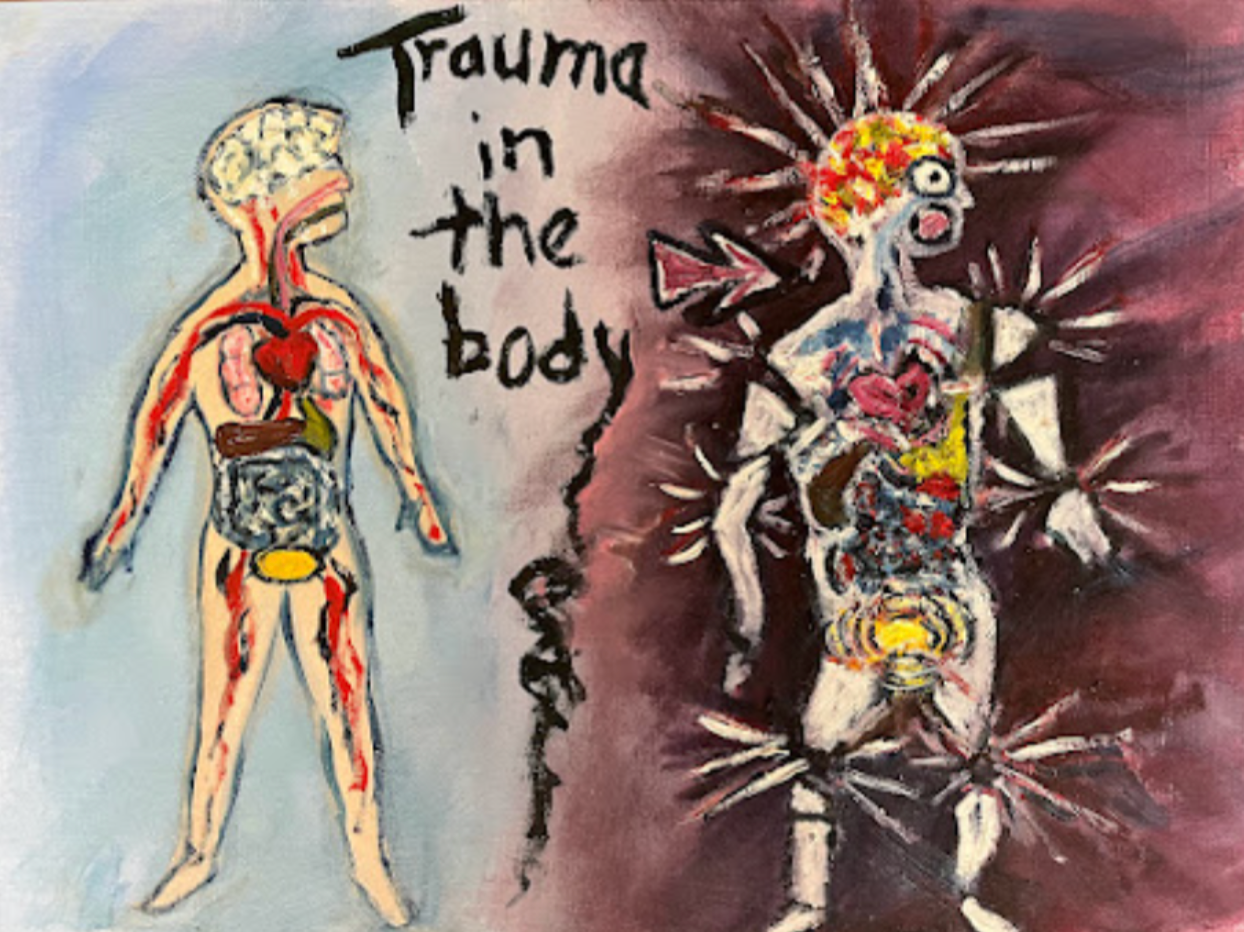
Given I spent my adult life in medical research, I did what I did best — hunted for information that would teach me what I’d not learned my whole life. I consumed research journals and Psychology Today articles on anxiety, stress, and PTSD. I read books, such as one my therapist recommended: Bessel van der Kolk’s The Body Keeps the Score: Brain, Mind, and Body in the Healing of Trauma. I read anything and everything to help me understand why my body felt like the painting above. Once I realized how totally unaware I’d been of how poorly I was treating myself, I was hungry for all the knowledge I could get. After all, I might be decades late, but I can be taught.
So then, of course, I did the opposite. I figured that if I read everything I could find, worked as hard as possible with my therapist as fast as possible, and pushed myself to relax and meditate and… Yeah. It might not have been the stomach virus anymore, but it was still that “hurry up and get well” mentality. So much for self-compassion and letting healing become a way of life.
Compassion?
I will say with total gratitude, that my therapist is a blessing and the most patient, compassionate person I have ever dealt with besides my husband and a few good friends. Like coming back to the breath when you get distracted in meditation, she kindly brings me back, again and again, to self-compassion…and at least the “suggestion” of patience with myself.
Her knowledge of Yoga and meditative techniques also rekindled the practices I had first started learning in the 1990s when I came across a wonderful book by the former Buddhist monk Jack Kornfield, A Path With Heart. It was all about the reminder that life is filled with suffering, but that we can still show ourselves and others compassion. It was such a help, as were books by Pema Chodron and other meditation practitioners.
This is not to say that this fixed my PTSD. No, nor the anxiety. In spite of all my work in life, that “word salad” still walks with me. Yet, progress does come and I recently had another “aha” moment.
The moment of insight
I was sitting on the couch, aware of those pesky tendrils of anxiety starting to spread through my body, as they often do, uninvited. My initial thought was one of “God, when will this ever go away?” and an answer immediately flashed across my brain: “Never.” But instead of being upset, I actually felt a calmness at that. A sense finally, of acceptance and the awareness I wouldn’t be failing if I just stopped fighting it.
In that moment, I was aware of a level of compassion coming in along with the anxiety. It occurred to me that the frantic, anxious part of me…WAS me. A piece of me. She was my lifelong companion, maybe even a friend of sorts — she sure could be as we’d traversed enough of my life together.
Finally, the awareness dawned on me that I could either spend the rest of my life hating her or…I could simply accept her…welcome her in. I could offer that part of me love and acceptance, and invite her to just “come on over, and sit with me and we will weather the storm together until it eases.”
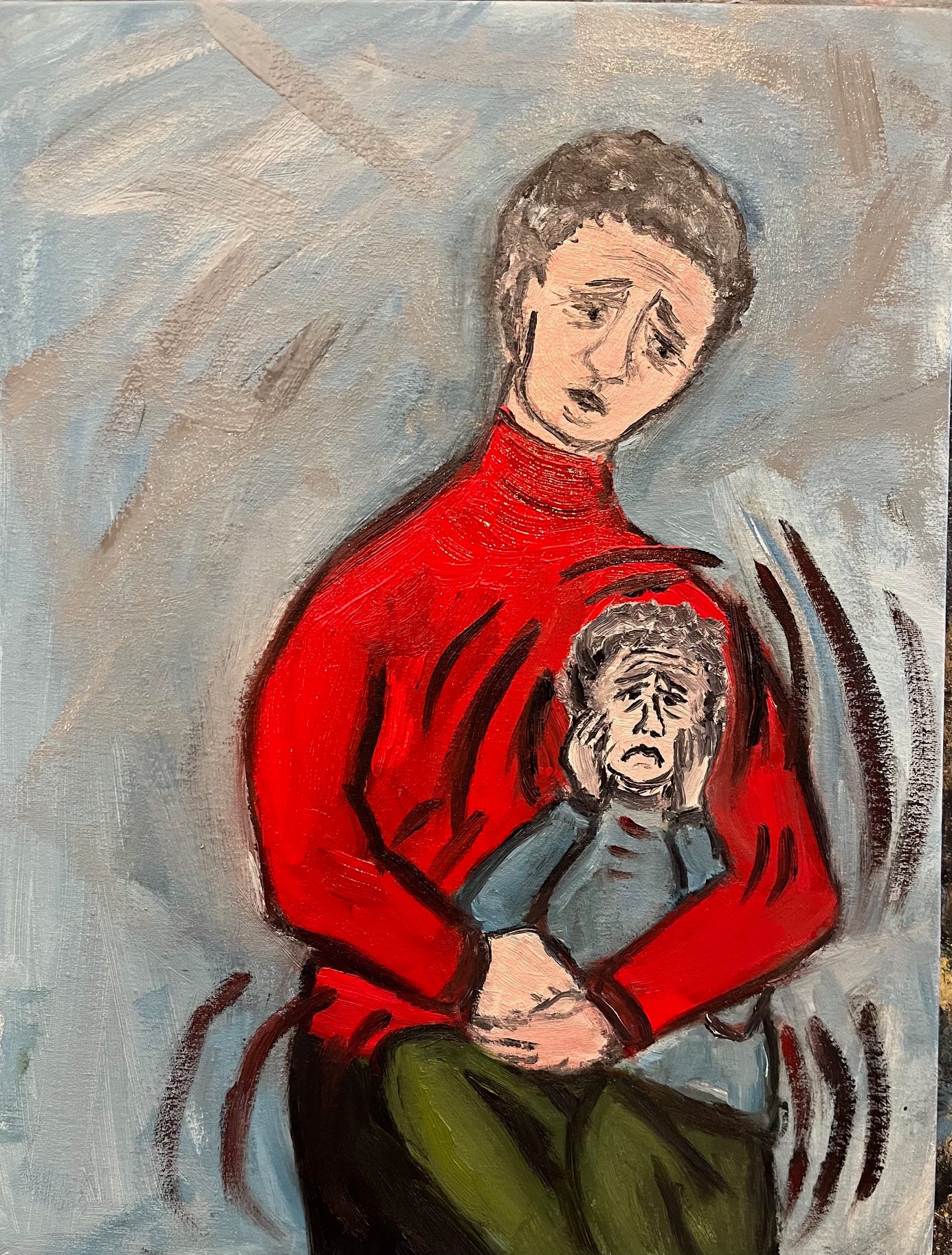
“Holding the baby”
This is not to downplay the discomfort or the need for my anxiety meds or continued therapy. But something shifted in that moment just a bit…something softened. To just stop the battle against myself was actually a relief.
After all, if I had a friend who was struggling and upset, what would I do with them? I knew without question — I’d hug them. I’d walk beside them and tell them I love them no matter what. It wouldn’t cure their anxiety, but it would give them relief to know they were loved, accepted, and not alone. So why wasn’t I doing this for myself?
I flashed on this image of “calm me” just holding that quivering stressed-out me and saying gentle words of love. And I remembered a quote I’d read years ago by the Buddhist monk, Thich Nhat Hanh, about holding ourselves like a mother holding and calming an upset infant. Sure, he was talking about managing anger but the same thing applies to anxiety:
Anger is like a howling baby, suffering and crying. Your anger is your baby. The baby needs his mother to embrace him. You are the mother. Embrace your baby.
Embracing the Tiger Within: Meditations on Transforming Difficult Emotions Thich Nhat Hanh
I figured, if it works for anger, then it might work for anxiety. And God knows, I struggle with anger and impatience too, so what could I lose to try?
Two sides of the same coin
And then, the other day I found the Psychology Today article by Leon F Selzer, PhD: “Why Anger is Nothing More Than Repressed Anxiety,” and if that didn’t set off waves of self-recognition, nothing would.
Dr. Selzer explaied how “anxiety and anger are two sides of the same emotional coin, kindred states of ‘agitated unease.’” That hit me. He went on to explain that “most people would prefer to ‘mutate’ their anxiety into anger…” He noted that anger gives a person the “illusion” of regaining control and it was a “pseudo-solution” to the self-shaming that went along with having anxiety.
Well, hello again. In one short article, he connected the dots between my anxiety, the shame I always felt at “failing to get rid of it,” and my anger and impatience. I resorted to that last one because at least getting angry and taking some action seemed better than being “weak, anxious and stuck.”
The “antidote”
I suddently understood what Thich Nhat Hanh was getting at, and why his antidote to anger had deep relevance as an antidote to anxiety. Imagine that — self-compassion as a better way of life than kicking yourself? Who would have thought.
Now no, it doesn’t mean I will not feel that familiar creeping sensation of anxiety at unexpected moments, or that I can stop working with a therapist, or doing all the self-caring things she recommends. I just finally understood for the first time in almost 7 decades, how nice it is to be nice to me. So, now, when things get upsetting, I can hold my own “baby” with care, and at least I don’t have to add “self-hate” to the word salad of things I live with.
If anyone else has felt that familiar sinking sensation of fear spreading through your nervous system, I would of course encourage them to seek their own therapist, mentor, or spiritual guide to help them explore and navigate ways to healing. But I can also add that for anyone, giving oneself a few moments of quiet attention, love, and “holding your own baby” is always a soothing and loving experience. May you all find a way to “comfort that inner being.”
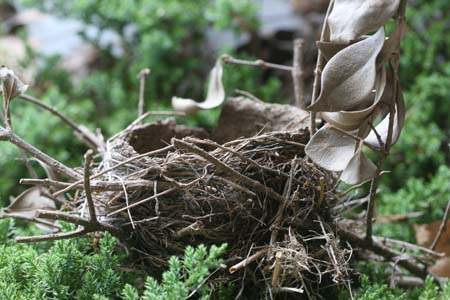
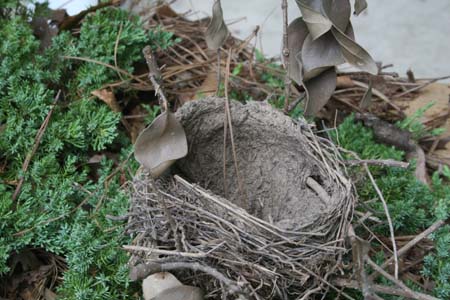
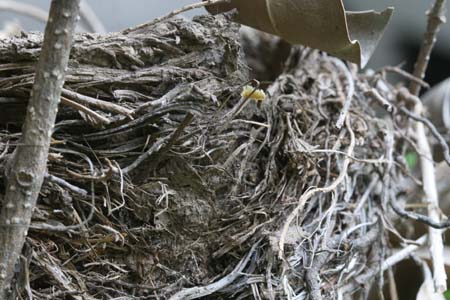
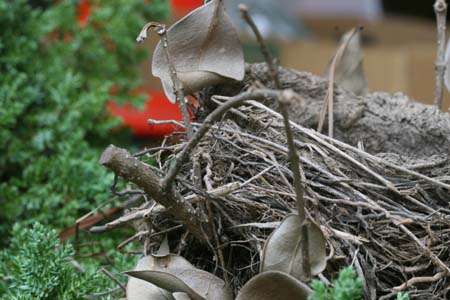
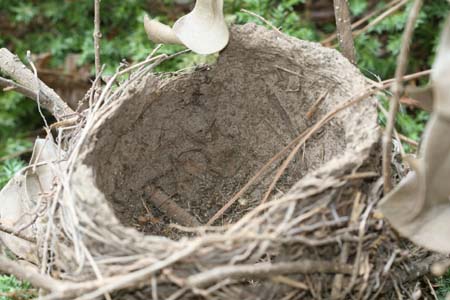
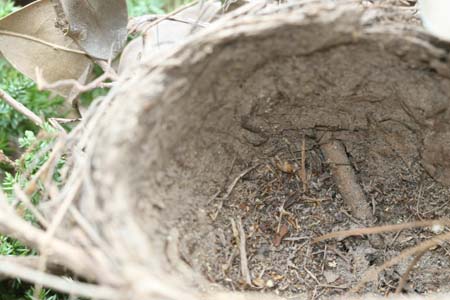
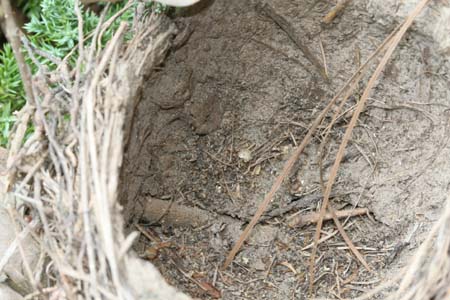
A friend of mine brought a bird’s next to meditation class last week, and at least to me, it was just amazing. The solidity of the construction stood out, with the intricately woven twigs, sticks, and grass, cemented in place with mud mortar. I loved how two or three main twigs formed it’s skeleton, their ribs showing through the mud walls of the nest here and there. And the patience it must take to thread grass and weeds and twigs together and in and out and through….using only a beak. I have two perfectly functioning hands and 10 good fingers and I can’t weave that well. So as a tool for our nature meditation that night, this bird’s nest was a treasure.
She was kind enough to let me borrow it and bring it home to photograph. At some point I’ll use this nest in an oil painting. But for now, my gift to all – the beauty of a bird’s nest:
A friend in my meditation class last night shared this piece of wisdom from his yoga instructor. The instructor noted that too often people lean forward and lead with their head when walking sitting or positioning themselves, instead of standing up straight and letting their chest lead. This posture apparently causes an imbalance in the spine, and then, pain.
My friend concluded that quite often, the same thing happens in life, and the effects are felt not just in the spine. So for today, the yoga instructor’s directive on what should take the lead in life:
Over the years I’ve read about or studied different kinds of meditation. Some wanted you to focus on a word or sound repeated over and over, others on a lit candle. More recently the focus was on trying to keep a totally blank mind and completely halt all the “noise” and the 10000 things running through your brain every minute. Of course I failed at all of them…as do most people. You’re so focused on a goal, on doing it perfectly, that when you can’t measure up, you give up out of frustration or despair.
On the flip side, I suspect that if you are lucky enough to achieve what these methods want…or at least you think you achieved it, the danger is that then you might walk around feeling so proud of yourself, so much better than others because “you achieved it.” You can try “not to go there,” but it’s hard, and even if you manage not to be proud, there is also the danger of feeling “overly holy and falsely humble” about your accomplishment.
One of the things I like about Buddhism is it’s emphasis on “Middle path.” No extremes of perfection or failure. This extends to its approach to meditation practice – “acceptance” of, in fact, it’s emphasis on the fact that you’ll never be perfect and it’s not about a goal. It’s always about “letting go and coming back to the breath.” Whether the teacher is Thich Nhat Hanh, from the Zen tradition, or Jack Kornfield from the Theravadan tradition, the point is not to “eradicate” what’s going on in you, but on simply to notice it and let it go on. You don’t waste a lot of energy either trying to get rid of all the thoughts, or giving them more importance than they’re worth. You just notice what is happening, acknowledge it, let it go, and come back to the breath.
Even that though, is easier said than done and human beings have a way of making anything a goal or contest. I think the one part of those instructions that I find most useful is: “Come back to the breath.” The reality is, we will be distracted for the rest of our lives. There’s bills, fights with people, retirement planning, kids, whatever. SOMETHING is always creeping in. That’s being human. And as nice as it is to say “notice it, don’t judge it, just let it go” even that is impossible. Something sticks in our throat and it replays in our heads over and over. Our anger, hurt, pride, despair, fear, will get hooked and we have a hard time letting that go. Accept it. We all do it. We always will. Instead of beating yourself up about any of this you simply, come back to the breath.
At first glance that might seem like a useless approach. Someone more “austere” might say “Well what kind of mental discipline is that?” The point is, it’s not about “discipline.” It’s not about self-flagellation, beating yourself up, getting rid of anything, or trying to be perfect. It’s about being human, and it’s about compassion. Being gentle with yourself. It’s about accepting and loving who you are. Even with all the noise in the brain, you can chuckle at your foibles and still say I’m a good person. I’m full of love, even when I’m distracted.
So why bother learning to treat yourself with compassion in your meditation practice? Because it is the way you train yourself to be compassionate with yourself in life. Instead of expecting yourself to be perfect at jobs, parenting, being a spouse, friend, being a human being, you simply note ‘I did my best. Yup, messed that one up, it happens.’ You pick up the pieces. You make amends. You come back to whatever it was you were trying to do and start over. You “come back to it” again and again and again, with no hope of perfection, simply the willingness to “show up and try again.” So if you can accept with compassion, an imperfect meditation practice and come back to the breath, you can learn to do the same for yourself in life.
Is there a benefit to treating yourself with compassion in life?
Yes. Aside from giving yourself some inner peace and acceptance, it is the only way you can exercise that “heart muscle” and learn to give that same gift to others. If you are so hung up on perfection in yourself, will you learn to cut somebody else any slack? Will you even notice anybody is there struggling, too, if you’re so wrapped up in your own struggle to be perfect? And if you can’t accept yourself as less than perfect, will you be able to accept anybody else’s mis-steps? Come back to the breath. Come back to life. Settle yourself, with compassion.
I often noticed how babies settle down when you give them a pacifier. It’s like they need that to stop whatever is winding up in them, settle down, and come back to calm. I’ve joked that maybe adults need them, too. Something that makes you shut your mouth, take a break from the world, focus on something small, and return to calm.
Given that they don’t have adult pacifiers, perhaps coming back to the breath is the next best thing?
PS People often say animals are intuitive and sometimes animals have more compassion than people. If you think the benefits of coming back to the breath and being peaceful, are limited to humans, check out the CNN article:
1) Sense of humor – Even in religion, a smile is the most important thing for compassion and inner peace.
2) Beginner’s Mind – Keep an open mind to new possibilities. You might write off the dog’s practice, but how do you know that on some level, he isn’t “feeling” the warmth of the compassion in the practice?
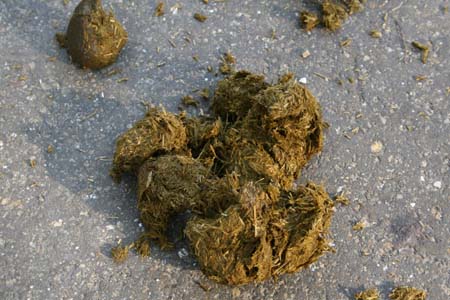
Okay, the gifts have been deep and meaningful all week. Humor is good meditation too. Here is an “excuse” shot – one of those you take just as an excuse to try out your new “macro” camera lens. I am sure everyone is familiar with “road apples.”
They are appropriate I think for a Friday, the end of the work week. For one, people often take off to visit places on the weekend and in that regard, these are special road apples. They come from one of our trips to Colonial Williamsburg in Virginia, left behind by the specially trained horses pulling the handcrafted colonial carriages. So, this should feed that “weekend wish to get away from it all.”
More to the point for a Friday, whether you were an 18th century farmer, or you work in a 21st century office, by the end of the work week, everyone has probably gotten their fair share of this stuff…. 🙂 Happy Friday.
One minute you are moving through your day, clearing tasks off of your to-do list and anticipating all the things you will still tackle during the rest of the afternoon. The next moment you’re wondering if you will make it through the afternoon, and can you ever get what is choking you, out of your throat? In an instant, life changes.
I talked the other day about “awareness and staying in the present moment” in relation to my racquetball game. Shift to the future and you blow the present shot. The same thing happens in life.
My meditation class talks every week about paying attention to what you are doing, and that anything can be a meditation if you do it mindfully, full of awareness. I never thought about this extending to swallowing pills. I also never thought about how I swallow pills as a possible life-altering moment.
It’s something we do automatically. Grab the pills, toss them back, throw in a mouthful of water, all while in motion through the day’s to-do list. As you tip your head back to swallow, your mind is already on the afternoon’s plans and everything you want to get done. Suddenly there is this sense of something horribly wrong.
It is said that when we are in pain, our world narrows. While that’s usually said about emotional pain and our tendency to pull away and close down our connections to the world, the same is true of physical pain.
In just a second or two, the brain, reacting to that sense of something horribly wrong, starts reeling in the attention and cranking down the focus. It shifts gears from 4 p.m. back to 2 p.m. Within another second or two, it registers panic and pain. It tries to rally its resources to deal with the emergency. Whatever was on your mind before evaporates. It is suddenly incredibly irrelevant. You may never get to it.
Now focused very much in the present the brain is frantically trying to get a clear picture of what the hell is happening. It’s processing emergency signals from several places in your body simultaneously – heart rate, throat, blood pressure, lungs, mouth, cervical nerves. The eyes bulge, hands go up to the throat, and the left brain finally grasps that the pills you swallowed without thinking, tumbled down the wrong way. In a one-in-a-million shot they’ve lodged side by side in your esophagus and are blocking the whole passage.
At the same time you’re looking for a waste basket to throw up in and get those things out of you, additional panic shoots through you. The brain has further grasped that not only can’t you swallow, but that the water you took with the pills has backed up into all of your air passages and is now choking you. Inside your head you hear the liquid close off passages. For an odd moment, like time standing still, you notice that the sounds in your head right now are the same as when you’ve dived underwater and everything is flooding with fluid. Except you’re not in someone’s pool. You’re standing in an office wondering if you’ll ever take another breath.
The breath. All those meditation classes. Come back to the breath. Breathe in your pain and fear, breathe out caring and calm. But even the breath has been taken from you. Panic. Focus. Panic. Focus. The battle in the brain begins because it knows if panic wins, you may lose the battle completely.
Suddenly the water drains out and you can breathe. The breath. Come back to the breath. You’ve been given another shot. Don’t blow it. The brain is in command. Stay in the moment. Just this moment. Breathe – just one breath. Assess. What’s your next move? Think. Take stock. Breathe again. Just one breath.
You determine you can’t swallow except for tiny amounts. Okay. Focus. One swallow at a time. Look around. What are your options? Get help. Someone to be here in case they have to call 911. You remember the pills are large. Hard. Coated. They’re not going to dissolve. You need assistance. Get to the ER.
Someone stays with you. They’re trying to help. It’s a comfort and calms you, even though you can’t really respond. You’re using all your focus and energy on “Breathe – just one breath. Swallow – slowly. You cringe. Intense pain shoots up your throat as the liquid shoves the pills against the esophagus wall and ever so slowly drips around them and down your throat. Breathe. It takes a few seconds to swallow saliva that you normally don’t even notice is there. A few seconds more and the swallow is finished. Take another breath.
The brain starts to race – how long will it take my husband to get here? How long to get down the street? How long to the ER? How long before they can do something to make this better? Panic. The brain takes charge again. Stop. Stay in the present. Breathe. Swallow.
Every shift of the car gears hurts. You want to be sick. Take a breath. Swallow. Another bump. Breathe. Rounding the corner. Still a mile to go. Breathe. Swallow. Traffic backing up. Panic rising. Breathe. Swallow. Close your eyes. The ER doesn’t exist. Just this moment. Breathe, swallow. Breathe, swallow. Lean forward because it doesn’t hurt so much. Breathe. Swallow. You turn into the hospital. The ride to the door might as well be an eternity. Close your eyes. Breathe, swallow.
You struggle through admissions. Whisper name, date of birth, insurance, address. Breathe. Swallow. The nurse typing in your vitals seems to be taking forever. Will you ever get relief? Come back to the moment. Breathe. Just one breath. You spot your blood pressure and heart rate. It scares you. Close your eyes. Breathe. Swallowing is harder. Lean forward. Get ready. Breathe, swallow, tighten your fist to take your mind off the pain in your throat. Breathe. Stay calm.
I know my husband is there. His presence is calming. I can’t respond to him. Can’t even focus on him because I am focused on breathe, swallow. For a second I feel his hand on my back. Its warmth relaxes me, radiates through my muscles. Calms them. But I can’t tell him yet. Just breathe. Swallow.
The doctor is approaching the room. Breathe. Swallow. You stare past the doctor and see a room across the department that looks just like the one your husband almost died in a little over a year ago . . . when he almost choked to death. Breathe. Swallow. The nurse pushes in the needle for the IV line. Breathe. Swallow. Meds are moving through your veins. Breathe. Swallow. Breathe. Swallow. Calm. The meds are calming. The muscles in your throat unlock. Breathe. Swallow. Suddenly, a tiny burp. Air is moving up. Breathe. Swallow. They give you water. Tiny sips. It slides down your throat. Pills shift and hurt. Breathe. Swallow. Ever so slowly, the burps get bigger. The sips of water larger. The medicine slows your heart rate. Your blood pressure has dropped. You can swallow and breathe without total concentration. Will you ever take another pill unawares?
Joan Didion wrote a book, The Year of Magical Thinking, about what it was like the year after her husband died of a massive heart attack. She was with him when it happened. It happened in an instant. In that moment as he fell, dead, everything changed.
Even as Kate Braestrup stared at her husband’s cereal bowl in the sink that morning, he already lay dead in his state police car, killed when another vehicle lost control and crashed into him. Her life changed in that instant as she described in her book, Here If You Need Me. Lee and Bob Woodruff wrote a book, In An Instant. He was covering a story for ABC News in Iraq when an IED exploded near his vehicle. In an instant he nearly died. In an instant everything in her day changed dramatically.
It happens so often. It happens to everyone. Yet we all try to ignore that an end will come. We pretend that reality doesn’t exist even though it does. In an instant we are reminded that though we think we are masters of our fate, we never are. It’s out of our hands.
Friday night, terrified after what had happened to my day, my body, and with the calming effects of the valium wearing off, I scrambled to put myself in a place that brought me back to a time where I felt I had power. I retreated to the movie, Patton, about the controversial, powerful, and legendary World War II general, George S. Patton, Jr. His nickname, given by his men, was “Old Blood and Guts.” He never retreated.
It’s a standing joke in my house, that especially when I was younger, I was Patton. I was the general. I ran the situations. Whatever needed doing, I gave the order or executed the action. Failure or retreat was not in my vocabulary. Back then, my thought was, work hard enough, push hard enough, refuse to be defeated or back off, and you can do, achieve, overcome anything.
In the movie, there is one scene where Patton, played by George C. Scott, speaks and my family looks at me and laughs. Patton, has been reprimanded and his command taken from him. Patton, like him or hate him, was a brilliant field commander. He also put his foot in his mouth constantly, and some of his actions were controversial. Yet he was a power to be reckoned with. He bludgeoned his way through things, though aware of the pecking order, did manage to yield some deference to God. In this scene he is speaking to his aide after being told he might be sent home from the war in disgrace:
“I feel I am destined to achieve some great thing, what I don’t know. But, this last incident is so trivial in it’s nature and so terrible in its effect, it can’t be the result of an accident. It has to be the work of God. The last great opportunity of a lifetime . . . an entire world at war, and I’m left out of it?! God will not permit this to happen!! I am going to be allowed to fulfill my destiny!!!” [LONG PAUSE] “His will be done.”
The last four words are said almost as an afterthought, Patton remembering that God just “might” have some say in things. For some reason, at that time in my life, maybe even now a little bit, my family saw a lot of me in that scene. 🙂
So Friday night, I took comfort from retreating to a place and time in life where I felt powerful and in control of everything. Yet, in truth, even as I watched that movie I knew it was just an illusion, a temporary salve for a traumatic day. None of us are really in command of our destinies, only our responses to life’s questions. Even the powerful General Patton learned that. He preferred to die in battle. Instead, in Dec of 1945 he was paralyzed from the neck down as a result of injuries in a car accident. He died a couple of weeks later from an embolism.
I took temporary sustenance from the movie, even as I am aware that we can only take charge of some things, our choices, but for the rest, there is just the one and only powerful tool we can use: stay aware in the present moment, and breathe.
I knew Phase II had arrived. Its symptom was unmistakable. I was tired. The amount of work coming from the dictionary job ran up against the short-term deadlines and heavier workload from the ethics board. Family needs took up more time. The ethics board work increased even more. And then there was the point of it all, my writing projects. I realized that I not only couldn’t keep spinning 20 plates on sticks forever, but I didn’t want to. Where some people revel in that level of activity or that challenge, I did not. That, in itself, was telling.
Going back to Mr. Shulevitz’s advice: “You must listen to yourself from your own depths and become acquainted with your own true self . . . learn which is you and which is NOT you. You are what you truly love.” My husband’s reminder felt viscerally real: I wasn’t getting any younger and I needed to stop trying to be what I was not.
I let go of the dictionary work. While it was a good job, I wasn’t meant to be a lexicographer. I throttled back on the ethics board work. It was time for that directive: “Be alone with yourself . . . Achieve inner silence.”In my case that came partly from renewing my dormant practice of meditation and prayer, as well as just, being alone. You can’t run from yourself. To be a writer, if you’re going to have anything worth saying, you must learn your own truth. And it’s only in the quiet moments that the voice within can be heard.
For the first time, I stepped back from my work and took a look at the big picture. I listened to Mr. Shulevitz and sorted out the voices without and within, I looked to see what themes kept repeating themselves in me and my work. That’s when things started to come clear.
I love nature. I loved being 10 and climbing trees and fences and running free in the neighborhood – that time of childhood where you are most capable, where adventure and innocence are at their crest, before the trials and tribulations of adolescence set in. I love castles, the Revolutionary War, diners and the sixties and the blue collar, ethnic world I grew up in. And mythology.
I noticed that I collected, and still do, every silly, touching or factual story about nature, animals, and zoos. I kept a nature journal of our backyard bird feeder and the pond area and collected 3 years of information. I identified with creatures either too small or too much in the background to get noticed, and I was that nature-geek, driven to learn about every tiny sea creature that lived under the ocean pier.
I also knew I’d probably never draw comic strips, or write romance novels, science fiction, or true crime. Nothing against any of those genres, by the way. In fact I am fascinated by the genres of comics and romance novels – they are unique worlds and they seem cool and fun. They just aren’t my talent. And no, I will not try to write any more picture books. In truth, my husband has that voice.
I started to define the projects that were me:
A mid-grade novel set in Williamsburg Virginia during the Revolution.A mid-grade novel set in a 1960s blue collar ethnic New England town, of course, set in a diner. A historical fiction set in 1200s England on the Welsh Marches borderlands. A chapter-book of Greek mythology stories. A fantasy trilogy involving the world of a groundhog living at a highway rest stop, who faces the battle of ultimate evil, personal despair, loss, and emergence into wisdom. And a present day Tween novel of a girl above the pier, in another diner of course, and a hermit crab below the pier.
There is also a love of tweaky, short non-fiction articles about history and . . . nature. I rediscovered a love of and need for essays, which I will write about separately.
I started collecting reference books for all of these projects. Nature guides. Historical fiction. Topographical and historical maps of England and Wales. I made a plaster of paris model of the castle that my lord built, incorporating the latest high-tech gadgets of the early 1200s.
I pinned my project papers everywhere – the study walls were covered on one side with the pier story – maps of the fictitious town, topographical maps of Narragansett Bay, schematic of the diner of my dreams, the one I’d have if I had the money. The other side of the study has the groundhog world – map of the rest, deep woods, nearby farms. The hallway, spare room and stairwell have 1700s Williamsburg, while the den downstairs houses maps of England, schematics of the castle, and the castle model itself.
I even have two webcams up on my computer that allow me to step into 1700s Williamsburg whenever I want. I can see the view down Duke of Gloucester Street or watch the goings-on at the Raleigh Tavern any time day or night. I even had a lobster-cam until that one broke. So I had to settle for the DVD, Realm of the Lobster, that has footage of the undersea world of the lobster in the Gulf of Maine. I found that in this cool marine store store, Hamilton Marine, up in Searsport, Maine. Great website and catalog! Everything from diesel boat cabin heaters and EPIRBS, to cold-water rescue suits and ship’s bells. My next purchase from them will be a hand-crafted wind bell that sounds like a harbor buoy. They even give you the choice of 13 different bells – each one sounding like a buoy in a different place – Bar Harbor, Portland Head, Camden Reach, Outer Banks, etc. I use anything that puts me in the place of my stories.
I started painting again and even did one for the pier story. I bought a new digital camera and started shooting pictures . . . once I stopped being afraid of the thing. It only sat in a box for 2 years. In both painting and photography, I noticed the themes of nature, broken things and overlooked things.
And the words mosaics and broken bits, kept surfacing.
Finally, exhausted, I left the ethics board job. It had gotten to be so much work I was too drained to write. Besides, it was no longer who I was. Revisiting Stage One, I collected outside information as it applied to the projects I wanted to do, from sources like Writer’s Digest magazine, The Writer, countless writing newsletters, market guides and writing books.
All of this I did silently. Alone. Immersed in my own world. And I came to accept that I will work alone. Others can prepare you, teach you, assist you, but when you finally stand at the edge of that dark forest- your own inner world – you must face that one alone. It’s that line from the movie, The Empire Strikes Back. Luke Skywalker is about to enter an area of the swamp where evil lives. He asks Yoda what is in there. Yoda’s response: “Only what you take with you.”
All that was left now was to pick which project came up on deck first. My groundhog story was fairly well outlined. The 1700s Williamsburg novel had some drafts done, characters fleshed out, rejection slips collected. The Under the Pier story had an equal amount of journaling, drafts, and character work finished. The other projects were much further back in the data collection and journaling stages. One day in confused desperation I asked God to please “pick a nipple for me.” A few days later we stopped at Science Safari, a tweaky science store for kids. Sitting atop the discards pile on the sale table outside, was a stuffed hermit crab. My husband and son spotted it. I knew who sent it, so I bought it. The answer had been sent: Start with Under the Pier.
UP NEXT: A Sidetrip to Essays – But the Bus NEVER Came Up This Far on the Curb Before!
THEN: Phase Three: Coming Into My Own – The Evolution of a Novel.

 Soul Mosaic