Before I continue with the rest of the story, I take a moment to note where I’m at in it. The preceding entries showed all the various influences on me from birth. And the rules I lived by that I took as normal life.
At this point, I was 14 years into that abuse. And I had no idea I was only halfway to an escape.
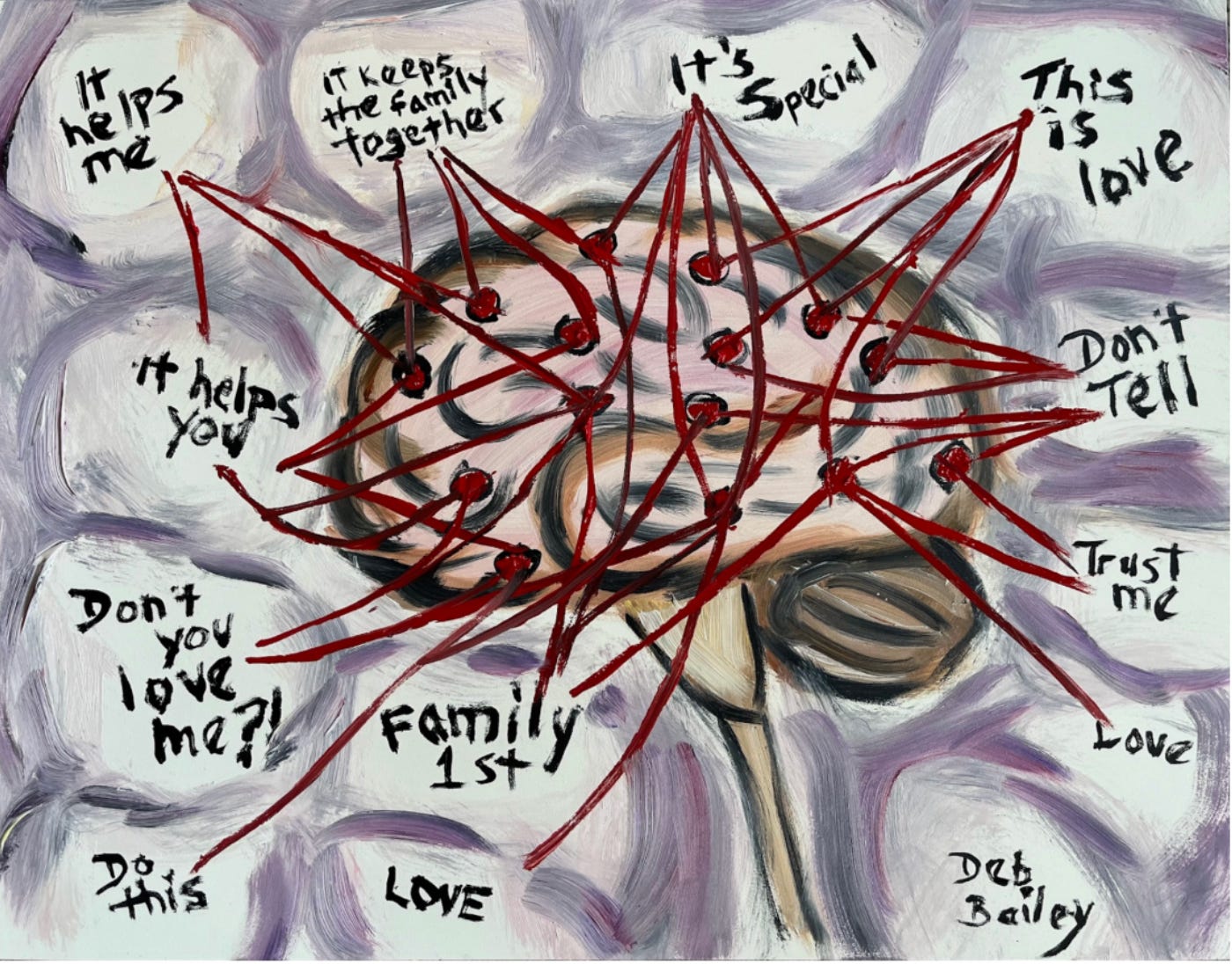
For all intents and purposes, I was controlled and didn’t realize it. I was manipulated and unaware. I was aware of my stress level whenever I crossed Dad. Aware of my relief and gratitude when he was kind and loving. And I was most aware that if he got upset, I blamed me.
I took it all in as any child would, and believed him. Why wouldn’t I? I had no idea that this was wrong. I had no role modeling that this was, in fact, truly aberrant behavior for a family. True, it felt wrong at times, but I assumed that was my mistaken judgment.
Painting by author
The trapped fly
If you’ve ever watched a spider wrapping a fly caught in its web, you might think of the spider as a vicious killer. But the spider isn’t breaking any laws. Nothing is calculated or premeditated. It’s just following the biology of its life cycle. Like all of us, the spider has to eat. And it responds to the thrashing of a fly trapped in its web out of instinct only. At least so far, science research hasn’t shown that the spider is finding pleasure in its actions.
In fact, given the process it uses, a spider could even be considered “humane.” It reacts quickly and efficiently. And with one exception, most spider species administer a venom into the trapped fly that not only immediately paralyzes it, but leaves it unaware of what is being done to it. It will then either digest the fly and eat it right then, or set it aside for a later meal. But the fly is mercifully unaware of anything. It doesn’t experience pain at that point, nor does it feel any apprehension of what might be in store for it.
The spider is just living by its life rules, and so is the fly. And to that end, there is no guile or treachery.
3. operating or proceeding in an inconspicuous or seemingly harmless way but actually with grave effect.
Insidious. Just the sound of the word makes my skin crawl. When I say it and feel the tactile sensations of the syllables as my mouth muscles form them and they roll off my tongue, I feel afraid. Listening to the word as I slowly enunciate each letter, it conjures sensations of evil. And that’s because it is.
It is something deliberate. Calculated. And executed before you even know what is being done to you. It is done so subtly and slowly that by the time you realize it, you’re in too deep. It’s too late. And all you can do is wonder if you were to blame because you didn’t see something coming, and feel stupid.
If ever there was a word that captured how he wove his web of control over me, “insidious” is it. He started on me from infancy. I will talk later about how I know that. But I was groomed, manipulated, and played like a puppet for years using the strings of his power, intermittent reinforcement of love, abuse, and brainwashing.
Like the fly, I was rendered helpless, and it all happened before I even knew what was being done to me. But unlike the fly, which was put out of its misery quickly and whose misery was just part of a natural cycle, I was NOT unaware of the sensations of apprehension, fear, and pain. It was definitely NOT part of a NATURAL cycle. And unlike the spider who was just following the rules of its species in a straightforward way, my father was most definitely choosing to break his in a calculating and stealthy manner. Nature…the spider… is actually merciful. My father was not.
In many stories, the place and the time period are considered characters in their own right. Certainly, I would agree given the unique flavor of where I grew up, and when.
Torrington, Connecticut:
Nestled in the valley between the foothills of a section of the Appalachian Mountains known as the Berkshire Hills, Torrington is built around the Naugatuck River, which flows south through that valley, right through the center of town. When the town was originally founded, it was located on the hillsides east and west of the river valley, where the climate was healthier and less swampy and mosquito-infested in the summer.
A lot of the surrounding county area was, and remains, rural, with dairy farms, state forests, and nature trails. It is hilly countryside, and as such, the geography itself gives a sense of “constriction” between those hills, and isolation from nearby areas because of them. There are a lot of hardwood forests, including things like oak and sugar maples, and in spite of steel-gray cold skies in November, Fall, with its amazing color display, is my favorite time of year there.
The town and surrounding areas are steeped in history. Whether it is of ancient Mohawk tribes living in longhouses, or the story of Connecticut as the Charter Oak State, the state is living history.
The latter story is based on the fact that the state was given a royal charter in 1662, allowing for self-governance. During the Revolution, the charter was hidden in an oak tree to prevent it from being confiscated by the British.
Many locations around Torrington and throughout the state have markers noting various sites of importance from the 1700s and during the Revolution. The culture of the area was heavily influenced by the strict ethics of the Puritans, who had moved there from England to have religious freedom. And throughout the area, there is still a strong sense of individual ruggedness. That ruggedness is further fostered by the climate, which can suffer extremely cold winters with blizzards, and summers and falls with hurricanes, tornadoes, and Nor’easters.
Torrington was and is a small former factory town in that Northwest corner of Connecticut. It was an industrial powerhouse in the 19th and part of the 20th century, providing employment, a decent standard of living, and a strong economic base for the towns there. Industry included things like brass production, arms manufacturing, skilled tool and die companies, and small factories providing parts for the automotive and aerospace industries. Most of those places shut down and moved south during the 1960s-1980s, and later those things moved overseas. So the employment and economy of the area have taken a hit. But during my childhood, especially with the ’60s space race, things related to aircraft and aerospace industries were still thriving.
Most people during the early and middle of the 20th century lived in the main town because they worked in the local factories. This allowed them to walk to work, shops, churches, and doctors. My grandparents did not have a car, nor did most of the older Slovaks. In fact, our house was just down the street from the church and school we attended, so easily within walking distance.
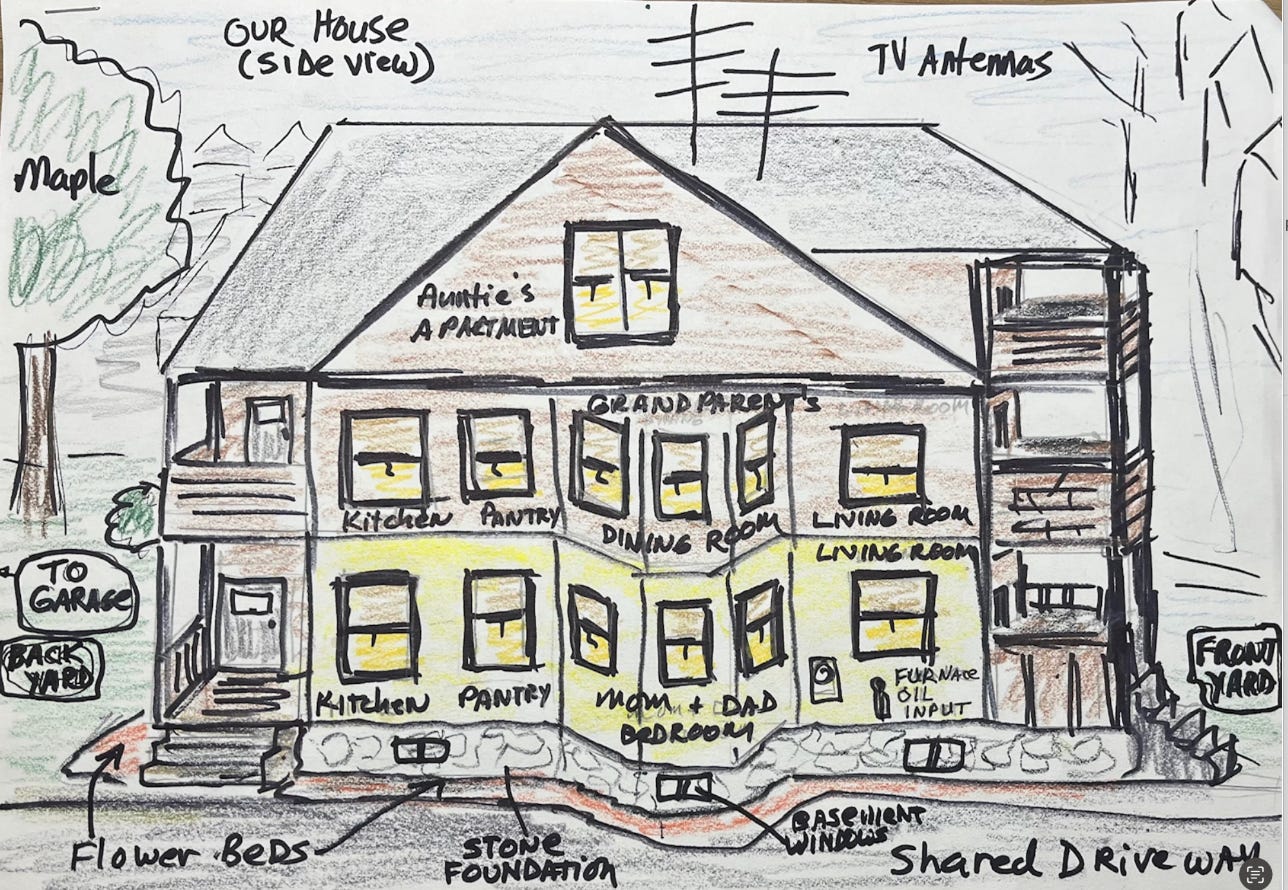
The homes in town, including the one we lived in, were multi-family 2- and 3-story homes, in keeping with the blue-collar, industrial flavor of the area. There were some single-family homes scattered around in town, but more of those were on the outskirts, in more residential or agricultural areas.
My back den is lined with a few boxes along one wall – FULL of printouts of animal stories I’ve found or read over the years. I’ve always felt I was supposed to do something with them – write about them, incorporate them in a story, paint them, something. But I never could figure it out, so hence, there they sit, in boxes and here I sit, drowing in animal stories.
In re-starting my blog I decided to focus on my art and art business, having taken a break from novel-writing. I realize that the focus of both of those topics is NATURE ie all my paintings and photos have to do with nature and animals. In my last few posts, I’ve shared some interesting NATURE and ANIMAL links.
It suddenly occurred to me that perhaps there is something I can do with some of those stories and new ones I come across – share them here. Sometimes just to share, sometimes to comment on. I may even try out some Haikus. But in some form or another, those tidbits of the natural world may finally have a use, and see the light of day.
So while some blogs focus on sports, or movie stars, or religion or politics, and certainly I may touch on one or two of those now and then, my blog must reflect my main interests and that is – the glory that is nature. My gift to you all, and my gift back to the natural world.
For years now, I’ve collected nature articles, everything from monkeys in the zoo, to whale fall carcass ecosystems, to little kitty cats stowing away on an airplane. I don’t know why, I just love them. I feel like I’m supposed to do something with them, but haven’t been sure what. Yet I expect it will make itself clear eventually.
I do know that I will spend more of my time in my blog focusing on interesting nature tidbits as that is my real love. After working on the Under the Pier novel, I have set it aside because I wanted to take a break from fiction, and focus on the nonfiction, nature aspects of life. When I decide to create a new story, I’ll know, but for now, I want to explore and indulge my love of nature. In fact, what reinforced that was all the research I did on Narragansett Bay creatures for that novel. That always just lit a fire in me. So….for the time being, I will focus on nature.
In fact that brings me to the other aspect of my blog – my art. That is the other thing I’ll begin to focus on because that is the other love in my life – my oil painting. In a nice sense of synergy, all my research on sea creatures has led me to begin developing a collection of sea creature paintings, as well as seascapes and such. I want to build a full collection of those creatures to eventually put on display. I’ll continue my detailed seascapes and landscapes and such, but the sea creatures paintings have a slightly freer, more impressionistic quality (at least as impressionistic as I’ll ever get 🙂 ) than my usual work.
Oh, and re – nature – still waiting for my ant farm ants. 🙂
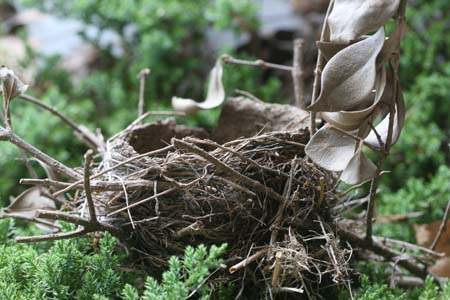
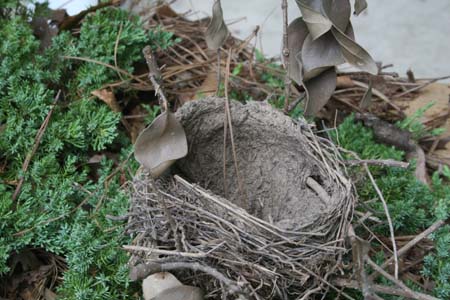
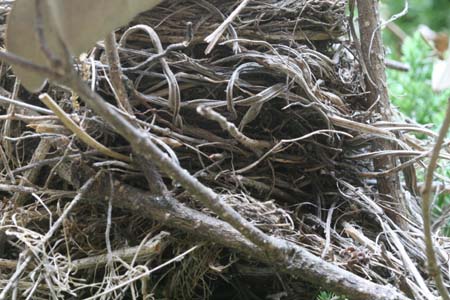
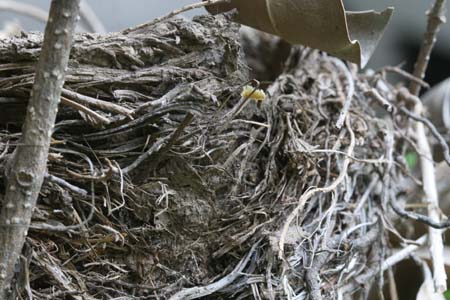
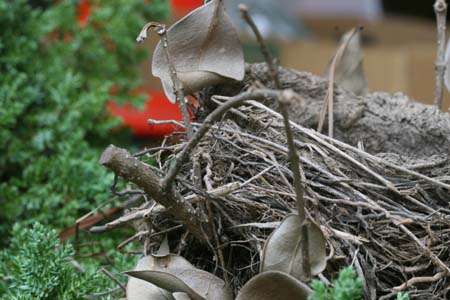
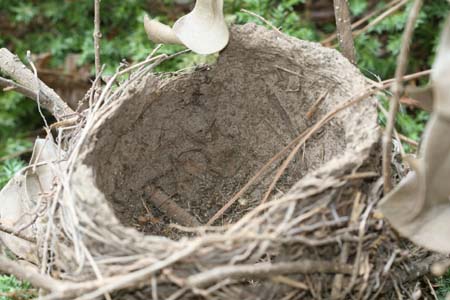
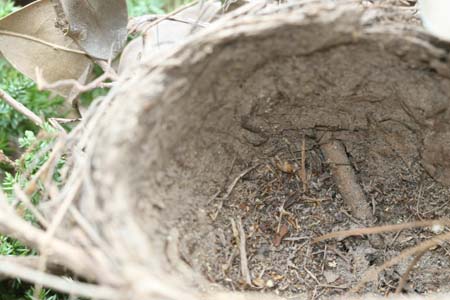
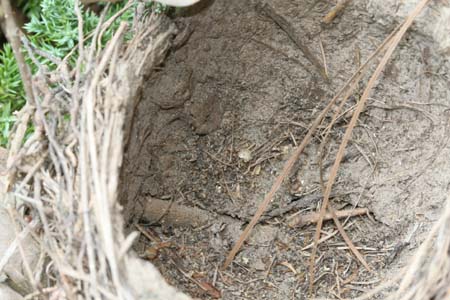
A friend of mine brought a bird’s next to meditation class last week, and at least to me, it was just amazing. The solidity of the construction stood out, with the intricately woven twigs, sticks, and grass, cemented in place with mud mortar. I loved how two or three main twigs formed it’s skeleton, their ribs showing through the mud walls of the nest here and there. And the patience it must take to thread grass and weeds and twigs together and in and out and through….using only a beak. I have two perfectly functioning hands and 10 good fingers and I can’t weave that well. So as a tool for our nature meditation that night, this bird’s nest was a treasure.
She was kind enough to let me borrow it and bring it home to photograph. At some point I’ll use this nest in an oil painting. But for now, my gift to all – the beauty of a bird’s nest:
For the animal side of the story, a lot of what I said about the human characters applies here. You have to decide on a protagonist, then add in one or two sidekicks and some secondary and background characters. They need personalities, backstory, lives, struggles, flaws and strengths – essentially character bios. Before I could start that process though, I had to figure out who were my main characters.
Unless your human world has people flying on magic carpets or walking on water, the rules of your characters’ behavior are pretty much established by real life. With animals, it needs to be more defined. I wanted to stay as close to reality as possible, though I was going to have the characters talk and think. Exactly what the boundaries would be for their behavior would be defined as I got more into the story.
When I initially started mapping out the story several years ago, I wanted a hermit crab with an anemone on his shell. In fact, I believe the early iterations of this book had that. I’d read that anemones and hermit crabs have a symbiotic relationship. The hermit crab carries the anemone around, thus assuring the anemone mobility and a steady food supply. The colorful, highly visible anemone offers the hermit crab some protection from predators that prefer to avoid the anemone’s stinging tentacles.
At first glance, it seemed like the perfect partnership, an underwater Batman and Robin, and I figured I was well on my way to having two of my three main animal characters. I’d even found out which anemone prefers to live on hermit crab shells: the Tricolor Anemone, alias Calliactis tricolor. (In the next post – Animal R&D cont. – I’ll share why I bother with the Latin names). In any event, I thought I was all set. Then, reality, or rather, geography, crashed in.
My story is set in New England, specifically, in the waters of Narragansett Bay. Hermit crabs with the Tricolor anemones on their shells live in the waters from North Carolina to Mexico…warmer waters.
No problem. I figured I just needed to look at the hermit crabs in New England and find out which ones had anemones on their shells, and which anemone it was. The answer to both: none. Hermit crabs in New England do not carry any anemones around on their shells. In fact, in the cold New England waters, there aren’t as many anemones even on the sea floor.
Well that shot a hole in my approach to animal character connections. My best idea for a duo against the threats of the deep and they didn’t live in New England. The closest I could come to an anemone riding a hermit crab shell in New England was something called a “snail fur hydroid.” It lacks the flash and intimidation factor of the Tricolor anemone. It’s more like this tiny lackluster matt of tentacles and polyps. In terms of effect, it’s kind of like having an earthworm when you hoped for a rattlesnake.
I was upset at first but then realized my good fortune. How much drama do you have between two characters who work well together, probably get along, and contribute pretty equally to their mutual success? Now consider being a hermit crab hauling around a thin fuzzy matt of tiny polyps – no bright colors, no flashy poisonous tentacles. Yeah, it’s got some small stinging polyps – like having a pellet gun instead of a shotgun. Are you going to feel like the hydroid is an equal partner in this situation? Maybe a little resentment there? And is the hydroid going to be very personable? Deep down it knows it’s an undersized second-rate threat, a poor substitute for an intimidating anemone. Maybe it’s going to have just a bit of an inferiority complex which means it’s going to be a royal pain to deal with? It’s going to overcompensate by being sarcastic, argumentative, insulting…and those are its good points. I suddenly realized the snail fur hydroid offered a much greater potential for conflict than an anemone.
Okay, no anemone. Just the hydroids. I thought I could at least have a large tough hermit crab. Well, forget that too. The hydroids were most likely to be on the shells of the smaller hermit crab – the long-clawed hermit crab.
So, my anemone has been shrunk to a matt of “snail fur hydroids” and my large tough hermit crab ended up as one of the smallest ones in the coastal New England waters. Yes, it’s one of the most common ones, but hardly the most dramatic, at least at first glance.
However, again, I considered conflict potential. A smaller hermit crab would have to fight harder for any shells or food or location resources. So, I went with the smaller hermit crabs.
I hoped to at least salvage the large flashy Moon Snail shell for my hermit crab, but the long-clawed hermit crab is too small to haul one of those around. Instead, I had to be satisfied with an underrate snail fur, on the outside of a tiny periwinkle or mud dog whelk shell dragged by a small hermit crab.
Do you see where this is going?
You can start out with a vision but often your vision won’t work in reality. You can give up, flip off reality, or reframe it by looking for the conflict potentials in what reality presents. I chose the last. This meant being a stickler for detail even as I might push the limits of reality on a few things. There are readers who will excuse a talking animal, but they’d never forgive a North Carolina anemone riding on a New England hermit crab.
So, at the end of all of this, I had my protagonist: the long-clawed hermit crab, Pagurus longicarpus, known in the story as “Carpus,” and the first sidekick: a snail fur hydroid. The snail fur hydroid belongs to the genus Hydractinia, so his name in the story became “Hydrac.”
I now had two characters who instead of being best friends probably had an antagonistic relationship. Since the animal side was going to mirror the same struggle as the human side: do I connect to others or run away? this seemed to match up better for the overall story structure. So I can thank the limits of geography and nature for ending up with two characters who fit the story problem better. At this point, it was time to flesh these two out with some research, add a third main character, and start adding in some other animals.
Coming up Next: Animal R&D – Picking the third main character, painting in the details and adding in the background.
I knew Phase II had arrived. Its symptom was unmistakable. I was tired. The amount of work coming from the dictionary job ran up against the short-term deadlines and heavier workload from the ethics board. Family needs took up more time. The ethics board work increased even more. And then there was the point of it all, my writing projects. I realized that I not only couldn’t keep spinning 20 plates on sticks forever, but I didn’t want to. Where some people revel in that level of activity or that challenge, I did not. That, in itself, was telling.
Going back to Mr. Shulevitz’s advice: “You must listen to yourself from your own depths and become acquainted with your own true self . . . learn which is you and which is NOT you. You are what you truly love.” My husband’s reminder felt viscerally real: I wasn’t getting any younger and I needed to stop trying to be what I was not.
I let go of the dictionary work. While it was a good job, I wasn’t meant to be a lexicographer. I throttled back on the ethics board work. It was time for that directive: “Be alone with yourself . . . Achieve inner silence.”In my case that came partly from renewing my dormant practice of meditation and prayer, as well as just, being alone. You can’t run from yourself. To be a writer, if you’re going to have anything worth saying, you must learn your own truth. And it’s only in the quiet moments that the voice within can be heard.
For the first time, I stepped back from my work and took a look at the big picture. I listened to Mr. Shulevitz and sorted out the voices without and within, I looked to see what themes kept repeating themselves in me and my work. That’s when things started to come clear.
I love nature. I loved being 10 and climbing trees and fences and running free in the neighborhood – that time of childhood where you are most capable, where adventure and innocence are at their crest, before the trials and tribulations of adolescence set in. I love castles, the Revolutionary War, diners and the sixties and the blue collar, ethnic world I grew up in. And mythology.
I noticed that I collected, and still do, every silly, touching or factual story about nature, animals, and zoos. I kept a nature journal of our backyard bird feeder and the pond area and collected 3 years of information. I identified with creatures either too small or too much in the background to get noticed, and I was that nature-geek, driven to learn about every tiny sea creature that lived under the ocean pier.
I also knew I’d probably never draw comic strips, or write romance novels, science fiction, or true crime. Nothing against any of those genres, by the way. In fact I am fascinated by the genres of comics and romance novels – they are unique worlds and they seem cool and fun. They just aren’t my talent. And no, I will not try to write any more picture books. In truth, my husband has that voice.
I started to define the projects that were me:
A mid-grade novel set in Williamsburg Virginia during the Revolution.A mid-grade novel set in a 1960s blue collar ethnic New England town, of course, set in a diner. A historical fiction set in 1200s England on the Welsh Marches borderlands. A chapter-book of Greek mythology stories. A fantasy trilogy involving the world of a groundhog living at a highway rest stop, who faces the battle of ultimate evil, personal despair, loss, and emergence into wisdom. And a present day Tween novel of a girl above the pier, in another diner of course, and a hermit crab below the pier.
There is also a love of tweaky, short non-fiction articles about history and . . . nature. I rediscovered a love of and need for essays, which I will write about separately.
I started collecting reference books for all of these projects. Nature guides. Historical fiction. Topographical and historical maps of England and Wales. I made a plaster of paris model of the castle that my lord built, incorporating the latest high-tech gadgets of the early 1200s.
I pinned my project papers everywhere – the study walls were covered on one side with the pier story – maps of the fictitious town, topographical maps of Narragansett Bay, schematic of the diner of my dreams, the one I’d have if I had the money. The other side of the study has the groundhog world – map of the rest, deep woods, nearby farms. The hallway, spare room and stairwell have 1700s Williamsburg, while the den downstairs houses maps of England, schematics of the castle, and the castle model itself.
I even have two webcams up on my computer that allow me to step into 1700s Williamsburg whenever I want. I can see the view down Duke of Gloucester Street or watch the goings-on at the Raleigh Tavern any time day or night. I even had a lobster-cam until that one broke. So I had to settle for the DVD, Realm of the Lobster, that has footage of the undersea world of the lobster in the Gulf of Maine. I found that in this cool marine store store, Hamilton Marine, up in Searsport, Maine. Great website and catalog! Everything from diesel boat cabin heaters and EPIRBS, to cold-water rescue suits and ship’s bells. My next purchase from them will be a hand-crafted wind bell that sounds like a harbor buoy. They even give you the choice of 13 different bells – each one sounding like a buoy in a different place – Bar Harbor, Portland Head, Camden Reach, Outer Banks, etc. I use anything that puts me in the place of my stories.
I started painting again and even did one for the pier story. I bought a new digital camera and started shooting pictures . . . once I stopped being afraid of the thing. It only sat in a box for 2 years. In both painting and photography, I noticed the themes of nature, broken things and overlooked things.
And the words mosaics and broken bits, kept surfacing.
Finally, exhausted, I left the ethics board job. It had gotten to be so much work I was too drained to write. Besides, it was no longer who I was. Revisiting Stage One, I collected outside information as it applied to the projects I wanted to do, from sources like Writer’s Digest magazine, The Writer, countless writing newsletters, market guides and writing books.
All of this I did silently. Alone. Immersed in my own world. And I came to accept that I will work alone. Others can prepare you, teach you, assist you, but when you finally stand at the edge of that dark forest- your own inner world – you must face that one alone. It’s that line from the movie, The Empire Strikes Back. Luke Skywalker is about to enter an area of the swamp where evil lives. He asks Yoda what is in there. Yoda’s response: “Only what you take with you.”
All that was left now was to pick which project came up on deck first. My groundhog story was fairly well outlined. The 1700s Williamsburg novel had some drafts done, characters fleshed out, rejection slips collected. The Under the Pier story had an equal amount of journaling, drafts, and character work finished. The other projects were much further back in the data collection and journaling stages. One day in confused desperation I asked God to please “pick a nipple for me.” A few days later we stopped at Science Safari, a tweaky science store for kids. Sitting atop the discards pile on the sale table outside, was a stuffed hermit crab. My husband and son spotted it. I knew who sent it, so I bought it. The answer had been sent: Start with Under the Pier.
UP NEXT: A Sidetrip to Essays – But the Bus NEVER Came Up This Far on the Curb Before!
THEN: Phase Three: Coming Into My Own – The Evolution of a Novel.
 Soul Mosaic