From the caves of the ancients, to now
So, after all these posts on the “Tools” I use to heal, tools which drove my decision to write, the final question to answer was: “What “form” of writing to use?
For me, it was a simple choice – STORY.
It is a method as old as humans themselves,
the method used around the campfires of ancient hunters and warriors,
the tool heard from caves, to feudal halls, to family hearths.
Story.
Story, in all its ugliness, joy, failure, and success.
Story, not as “happily ever after,”
Story, not as journalistic objective news reporting
because that is never possible.
Story, not as seen by others,
but Story, as what happened to me.
And when you write your own story
you need to put it ALL out there on the table,
see all the bits and scraps, pain and mess,
mistakes and breakthroughs,
spread out before you.
Only then can you start the long hard work
of examining each piece,
and then putting the pieces all back together.
Only then can you see the whole picture,
and what it can teach you.
What is “story?”
Because my academic background is science, not literature, I went looking to people steeped in both writing and psychology for the answer to this question. These were my favorite and most helpful answers:
“Story is the human instruction manual.”
Dara Marks, quoted in Jennifer Leigh Selig’s Deep Memoir
“Story is the medium we use to make sense of the experience.”
Sandra Marinella, MA, MEd – The Story You Need to Tell
“Story is where we came from. Story is where we’re going. Story is what connects us and binds us to each other. It is in the story of humanity, amongst love and fear and failure, that we make meaning of our lives.“
Jeff Goins blog
These quotes were rooted in soul, not just the usual “structural” answers like a story has a beginning, middle, and end. Or a story has conflict that should be resolved by the end.”
It is these first three quotes that inform how I write, and why.
Why does it work?
After starting with “the soul,” THEN I went on to my usual love, science, because I wanted to understand WHY story is such a powerful connecting force for humans. WHY did people gather around a primeval fire at night and share tales with each other? What did it provide them?
“The human mind is a story processor, not a logic processor.”
Jonathan Haidt, The Righteous Mind: Why Good People are Divided by Politics and Religion
“…when a well-crafted story is told, neural coupling occurs. Listeners literally sync their brain activity with the storyteller, transforming abstract information into deeply felt, meaningful experiences.”
Google search
“When presented with plain data, only the language-processing centers of the brain activate. However, when we encounter a story, our entire brain lights up-including areas responsible for emotion, sensory experience, and memory. This holistic activation is why stories resonate and stick.”
The article, “The Power of Story-Driven Content: Building Connections, Not Just Campaigns”
Studies have shown that stories aren’t just entertainment. They alter our brain chemistry during the telling. When a person is listening to a story, the brain is also releasing the hormone oxytocin, which helps to build empathy and trust. When a person tells a heartfelt story, that neural coupling between the teller and listener takes place. The brains of the teller and listener sync up, and slowly, sensory and emotional connections are made.
Given all of this, it explains why telling one’s story can be especially powerful when recovering from trauma:
“We need one another’s stories as we learn to navigate the world post-trauma. For anyone struggling with the isolation of trauma aftermath, writing authentically — alone and with peers — can be transformative…While we can never change what was done to us, we can transform how that history lives in us…We who are survivors of horror — of sexual violation, of physical abuse, of mental torture, of emotional manipulation…who are we, without the roots of a shared story?”
Jen Cross, Writing Ourselves Whole
The isolation of trauma has been the story of my whole life. It separated me from my mother, family members, friends…the world itself. It made me different. And it just plain broke my heart. As I write these words, I feel tremendous sadness…grief…at so many years lost to isolation. I don’t want another day of it. So, I write.
But if memoir is non-fiction, why use “story?”
“…one writes nonfiction and tells a story at the same time…because stories have a way of getting information across…Nonfiction is not about writing newspaper articles. It’s not about writing encyclopedia articles. It’s about telling stories.”
Harry Freedman, “The Art of Storytelling in Nonfiction,” ReedsyLive blog
The bottom line is that the techniques of storytelling make for powerful writing. They have the power to reach across the divide between two human beings and forge a bond of empathy where none existed before. Story is a must.
The pain left behind after trauma is not primarily a “logic-fact-based” pain. It is woven into the emotional circuits as well as our physical body tissues. So a powerful emotion-based tool is required. It is simply the right tool for the job at hand. You wouldn’t use a screwdriver to perform surgery. At least I hope not. So why use an equally wrong tool to heal from trauma?
Simply, story is a must.
How to use story in memoir
“Thinking the event is the story is the biggest mistake of student writers of memoir. The transformation of self is the story.”
Claire Dederer, in Theo Pauline Nestor’s Writing is My Drink, quoted in Jennifer Leigh Selig’s Deep Memoir
The events are the “illustration,” not the point. The point is the lesson learned – the insights gained by taking the risk to self-interrogate. Like I said in a post at the beginning of this book – the life events are the ingredients to make the cake. But those ingredients have to be transformed in the heat of the oven to blend, rearrange, reform, and become something totally new – the cake.
So while I share many events in my life, this memoir is about how I am being changed as I go through the process of telling my story. As I write, as I finally assemble a coherent full story picture, I can feel various hurts from life settling down. Those early parts of me screaming for my attention and love are starting to calm and quiet. With each post, yet another bit of something inside feels heard and the emotions “complete.” And it is this change that I seek to reveal through sharing the events of my story.
How much to share?
In one respect, all of it. But not exactly.
Yes, whatever I decide matters to the story I will tell. I am to give it all, fully, honestly, freely, as the gift to the reader:
In her book, Deep Memoir, Jennifer Leigh Selig instructs her students to:
“Own it all and give it all away…Own the wisdom you’ve gleaned from living your life…own what you know, own what you’ve earned, own what you’ve learned, and then, give it all away, a generous gift to your readers.”
But there is the question of what events are worth sharing to tell the story of reaching insights. Not every moment in my life is worth recounting.
Memoir is different from autobiography. The latter tells the story of EVERYTHING over my whole life. Memoir is more constrained, narrowed to a particular time period, experience, or topic.
My story is long, and yes, I am relating the whole story as it unfolds over my entire life because the abuse and its after-effects have been lifelong. So the constraints for this book are not time-based. Instead, they are “topic-based.” I need to share the lifelong story using only the events and details relevant to the experiences of being abused, escaping, then clawing my way back to eventually thrive in life.
What’s not relevant? How I learned to drive. What costumes I chose for Halloween. What my favorite foods are. How to do a blood crossmatch for transfusions in the hospital Blood Bank. I know all of these things and many more. But they do nothing to illustrate this particular life journey to healing. So they should not be included.
The book structure I’ve evolved during this first draft process
The last question I faced when I wanted to write my story was how to structure it. How do I tell it so that it flows logically to make sense to a reader? How do I make it engaging and relevant to the reader? And how can I be sure to deliver on the promise I make to the reader at the beginning?
Even where I should start was a confusion. Do I just start at the beginning and go to the end – a straight line? Or start at the end, go back to the beginning, then work my way forward – a circle? Or maybe not even have a time-based story at all but tell it in a series of “diary entries” that jump around in time but are arranged by themes?
The reality is that there are as many ways to frame a tale as there are tales in the world.
Before I started writing this book in June of 2025, I was swamped with memories and an overload of emotions. I could find no words to express anything I was feeling. So I was paralyzed. That’s when I started to paint the memories I had.
My husband, as often happens, nailed the issue. I kept his description of the problem. In fact, I laminated it and hung it up where I write:
“This book is a huge amorphous monster living in darkness, and I have to bring it out into the light to know it. To do that, I have to keep sticking my hand into the darkness and grabbing at it and pulling bits of it out into the light. Eventually, I will have grabbed and pulled all the parts out and have the materials. And I will figure out how they all relate. It’s like a plastic bag of water with soil in it. No matter how you grab at it, it squishes, and it’s muddy and constantly swirling and changing. So for now — take each painting and write. All the paintings are like tiles of my mosaic. Write to discover who I am, what I am, and what I deserve. Just get out of the way of the process, stop worrying about structure, and write. The book will show me where to go and how.”
So I began, first painting, then studying that “messy plastic bag,” until finally, some words came. And I just started writing about where I was at that point.
Over time, this is the framework that evolved:
- Introduction – How to dissect a life and why
- End of an Era – 2013-2022
- Where I was at the start of this writing (2025)
- Deaths of both parents (2013, 2021)
- Then emotionally coming apart because it was finally safe to let out ALL the emotions
- Deciding to confront things and consider writing this book (2022)
- Rules Before Starting (2025)
- What this books is…and is not
- Why write now?
- The mission
- “Packing for this Journey” and its Toolkit
- Time to go back to the beginning
- The Old Country – Return to the beginning and come forward (1955-2021)
- The abuse in that house: Infancy, Childhood, Teens, College, Young Adult (1955-82)
- The Crisis and Escape (1982-83)
- Breakdown (1984)
- Starting over (1984 – 1988)
- Staying alive, making mistakes, finding love, marriage, parenthood
- Adulthood – The Warrior Years (1988-20060)
- Fighting Dad
- Protecting Our kids
- Struggling to learn how to do a marriage, work, and parent
- Midlife and Mortality (2006 – 2012)
- A few years of peace
- Menopause
- My husband’s near-death episdoe
- Emotional breakdown
- The return of my old selves and PTSD exploding
- More mistakes
- Climbing out of the dark
- New directions and soulwork
- Finding new purpose
- Mom and Dad’s Decline and Deaths (2012-2022)
- Coming apart again when all the trapped emotions finally come up and demand to be heard (2022)
- The Undiscovered Country – The Journey of Alchemy – Descent into the Darkness to find the light (2022-present)
- The Nigredo phase – Part I – Dark Night of the Soul – Feeling the Pain
- The Tools that I needed to navigate the pain and start painting and writing – Art, Books, Body work, Talismans, Attitude, Writing etc.
- The Nigredo phase – Part II – Discovering all the issues and experiencing the emotions with no answers yet
- The Albedo – The Beginning of insights, realizations, and self-worth; starting to find facts, begin to understand why things happened and what they cost me
- The Citrinitas phase – More lessons and understanding take hold as I “return from the darkness to a new me”
- The Rubedo – Now: Embracing my power and mission; taking charge of my life fully, in the present moment
- Epilogue – What answers have I come to about rage, forgiveness, life directions? What is next in life? And what do I want if I have a choice?
- Coda – View from the Greek Chorus – My husband speaks
- Notes and Bibliography
- Appendix – resources, book lists, writing prompts, etc.
- Notes and Bibliography
- Index?
But how should the final book or books be structured?
I have liked this structure because it has helped me put back together, finally, all the broken pieces of my life that I’d lost along the way.
As I look forward to when I finish this first draft, I again have many questions:
- Is it still the right framework as I revise and work toward a final draft?
- Is it this too big?
- Of the posts I have written, certainly editing needs to happen. I need an editor to help me extract the most concentrated essence of the story.
- I have wondered if, from all these posts, there is really more than one book?
- If so:
- Should the first book be the story of the “Old Country” – the abuse, escape, warrior years, and life up to my parents’ deaths; and where I found myself at that point?
- And should the second be the “Undiscovered Country” – what I have gone through and learned in these last few years now that I was finally free to release and process ALL the emotions I’d had to keep locked up my whole life.
- Is there possibly even a third “related book” that is a collection of all the “Moments of Respite” that I have accumulated for myself over the years?
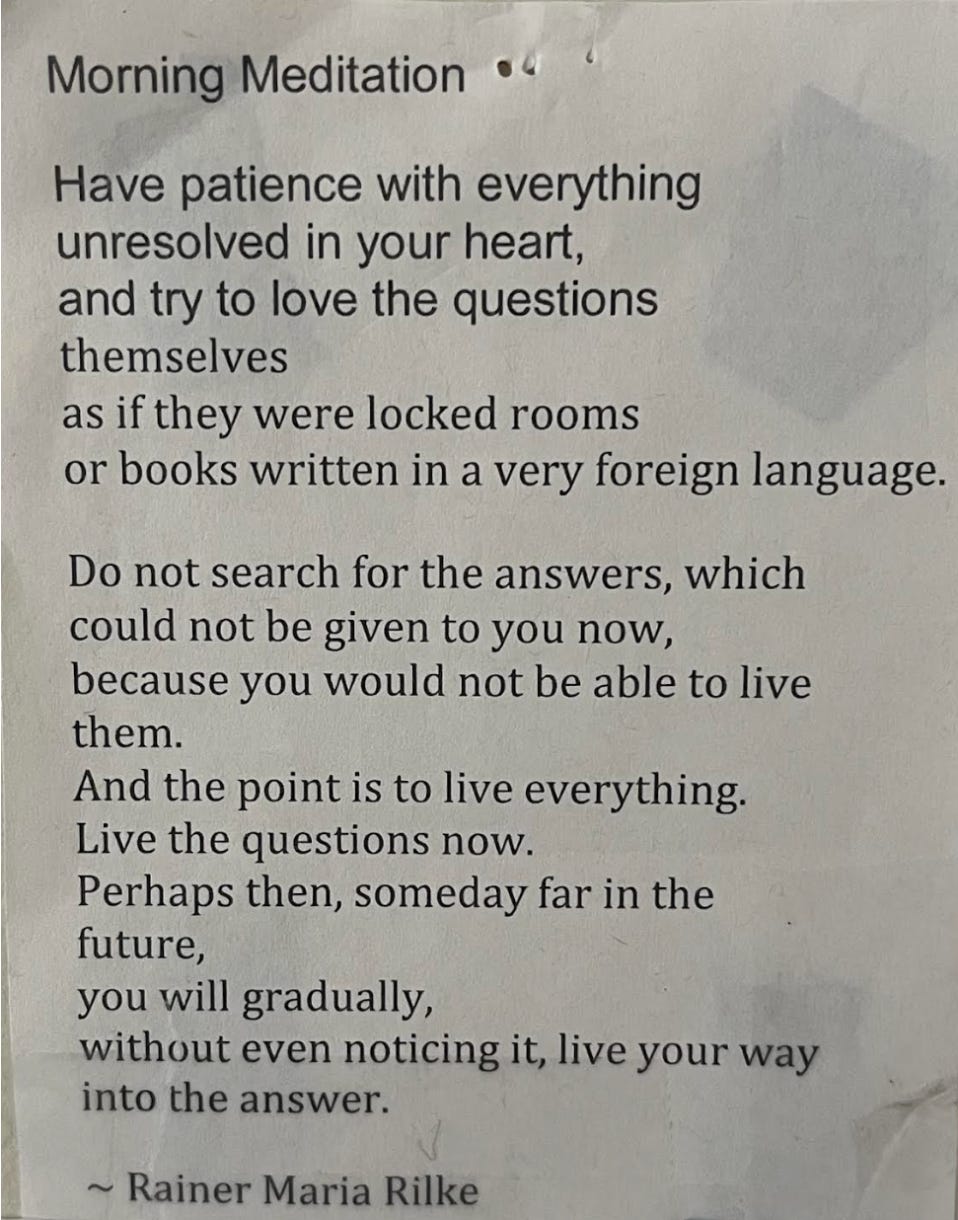
I do not currently have the answers. These questions are for “Future Deb.”
What I do know is to simply keep writing. This draft is not yet done. And there are more questions to explore and answers to write up.
When I get to the future, I trust the Universe will give me the answers to “What next” for this book.
It’s like the poem by Rainer Maria Rilke that I have pinned to the wall where I write:
Note:
I am seeking financial support to complete my memoir, work with an editor, and make a visit to my home state for fact-checking. Your help would mean the world to me as I take this step toward healing and giving voice to my journey.
Please like, comment, and share this post to help spread the word. The link for my fundraiser is on GoFundMe. Thank you for your support.
Tags: book review, books, life, memoir, writing


Leave a Reply