These next two posts will be a bit more technical. I know what I lived through and what I experience now. But I wanted to understand from experts what the mechanisms are that harmed me, and how I can help heal myself.
That said, I am not going to make this a science paper. For readers who may want to dig deeper, at the end of the next post I will provide some of the books, researchers/authors, and topics I used for my own answers. Also, in the text below, there are links to connect to. And, as I always recommend, a good therapist is priceless. They know the very latest information from new research.
What part(s) of the body are affected by trauma?
Most books and articles will talk about the “nature of trauma…its effects on a person.” Terms come up like HPA axis, stress hormones, body organs, immune systems, metabolic syndrome. So getting a short answer to “exactly what part of the body is affected?” is not that simple. And I am not being flippant when I say I wonder if the best answer to that question is “everything.” I am not a doctor. But I think that answer has a lot of truth to it.
When a traumatic event happens, the bottom line is that it impacts a person…the human being…the living organism and so, all its structures. The reverberations of that trauma course through the whole body. The degree of the effects depends partly on how severe, frequent, or long-lasting the trauma was. Part on the person themself. Maybe if it’s not severe or only happened one time, a person might weather it okay, fight off the stress effects, or quickly heal from any.
But what if one’s entire childhood, marriage, or life circumstance was a series of repeated traumatic events? Then those effects multiply and deepen. And they “cost” you in very real and multiple ways.
For easier reading, I am splitting this topic into two posts:
Part I – Trauma – it IS real; the brain and nervous system effects, and the emotions
Part II – The rest of the Body, the next generations, and helping the future
It’s NOT weakness or imagination
First – know that the wound is REAL. No one experiencing the effects of trauma, especially from intense or long-duration events, is weak, dramatic, imagining things, or faking it. Trauma wounds are REAL wounds. It’s just that, barring an external physical injury from abuse, they don’t show on the “outside.”
But that doesn’t make them “less” in terms of importance to your overall health, or in the magnitude of the damage done to you. Just because something doesn’t show on the outside doesn’t mean it might not be severe.
For me, I think one of the most difficult things is the fact that it DOESN’T show. That makes it easy for others, or even ourselves, to minimize it, or discount it completely. If you have a broken leg or are partly paralyzed, you and people around you can see the wound, allow for it, give you care, or cut you slack. There’s no denying it. And there’s no denying that even when you work to recover, it’s never the same.
I explained it to someone this way. Imagine an injury where your ankle is crushed into a hundred pieces. You undergo surgery after surgery. Maybe have pins or a rod inserted. Finally, the ankle is knit back together so it is whole again, in a fashion. And it is even strong enough for you to stand and walk. Maybe you have a permanent limp, maybe not. But as one of my doctors put it, even if you come back with 90-95% of your function, you will not be hiking with a fifty-pound backpack any more. That joint will never be the same as it was “before the injury.” And you may need tools, accommodations, or some adjustments to achieve the same things you could do before.
In the same way, when a person is emotionally shredded from decades of abuse, or their emotional integrity is blasted into pieces like shrapnel flying out from an exploding grenade, the trauma effects they suffer are real. They are not “overreacting or being too sensitive.”
What got left behind?
The truth is, you may recover, be very productive, successful…you will look strong at “the broken places,” as Hemingway described it. But those places are still there. They will flare up from time to time and remind you that your scars still need your care and nurturance.
“The reconstruction of the trauma is never entirely completed; new conflicts and challenges at each new stage of the lifecycle will inevitably reawaken the trauma and bring some new aspect of the experience to light.” Judith Herman, Trauma and Recovery
I deeply appreciated how author Daria Burke put it in her memoir, Of My Own Making:
“For all the celebration of survival, no one tells you to account for its cost. How survival…is not synonymous with wholeness. We don’t survive whole. We move on without acknowledging that some part of ourselves are too delicate for a new beginning. Thrust into an involuntary act of invention, we will…forge a new life from the fragments that endure. We will talk about …moving on, but seldom do we talk about the remains left in the wake of a premature ending. There is no warning that the road to reinvention is littered with the debris of the former self that we shed. What did I leave behind?”
She also talks about how these wounds get passed on to the next generation, something I’ll address in Part II. But to her question of what was left behind, I would also add the question: “What got ADDED?”
There are vulnerabilities, triggers, and emotional reactions that were welded into your nervous system during that chaos. An “emotional limp” was added to that invisible wound site.
Perhaps the best way to demonstrate this is the way a friend, a young man of color, described the effects of racism and trauma. Take a piece of clean, smooth piece of paper. Crumple it up. Then…try to smooth it out. You may flatten it well enough, but that sheet of paper will NEVER be pristine and uncreased, ever again.
If that doesn’t sum it up, perhaps some modern science can.
The Hidden Attackers
From the experts:
“The physiological changes suffered by chronically traumatized people are often extensive. People who have been subjected to repeated abuse in childhood may be prevented from developing normal sleep, eating, or endocrine cycles and may develop extensive somatic symptoms…”
Judith Herman, MD, Trauma and Recovery: The Aftermath of Violence — From Domestic Abuse to Political Terror 187
Bessel van der Kolk, MD, in an interview with Ezra Klein, said that “…the nature of trauma is that you get stuck there…” The Ezra Klein Show transcript: Ezra Klein Interviews Bessel van der Kolk, August 24, 2021
And Robert C. Scaer, MD, in his book, The Body Bears the Burden, noted:
“After trauma, the world is experienced with a different nervous system. The survivor’s energy now becomes focused on suppressing inner chaos….These attempts to maintain control over unbearable physiological reactions can result in a whole range of physical symptoms, including fibromyalgia, chronic fatigue, and other autoimmune diseases.” “The Body Keeps the Score: 10 Key Quotes from the book, Saniya Ahmad Khan955 Stories, July 31, 2024”
Scaer went on to detail exactly what he saw in patients:
“Clearly, chronic and prolonged exposure to unremitting life stress is associated with a cluster of vascular, hormonal, immunological, neuronal, and degenerative diseases that are largely attributable to exposure to abnormal amounts of glucocorticoids…the trauma changes the brain, which therefore changes the body. ….The pathophysiological, neurobiological, endocrinological, and immunological changes induced by trauma form a continuum with the subsequent pathological somatic manifestations of disease.”
(Note, from Google: “Glucocorticoids are a class of steroid hormones produced by the adrenal cortex that regulate metabolism, suppress the immune system, and reduce inflammation.“ I’ll talk about this later in Part II)
To put all of this simply: Trauma triggers the release of a flood of stress chemicals and hormones that travel silently throughout the body via the blood and lymphatic vessels. They infiltrate every cell, organ, biological control system, and nerve, and then lay siege to those structures. And that includes the body’s main control center – the brain.
The proof is in the brain scans
Modern science has shown that not only is the trauma wound real, but that it physically activates and changes the brain. One of the summer camps I taught at the museum was a “space-travel biotechnology summer camp.” The students were “space scientists” preparing for a long-range mission. Before they could go on, though, I explained that any space traveler had to pass a wide range of medical tests, including brain scans to determine if they were emotionally equipped for such a mission.
In my lecture, I showed them images of various human brain “PET scans”(Positron Emission Tomography – CT scan with colored dyes). The color patterns of the brain scans changed based on whether a person was healthy or calm versus stressed, or suffering from disease, trauma, or addictions.
In the painting, in the middle of the brain, I placed a PET scan image of a “brain on fire,” a brain from an abuse survivor. The pattern of colors in a healthy brain differs starkly from the scan pattern in a brain affected by severe trauma.
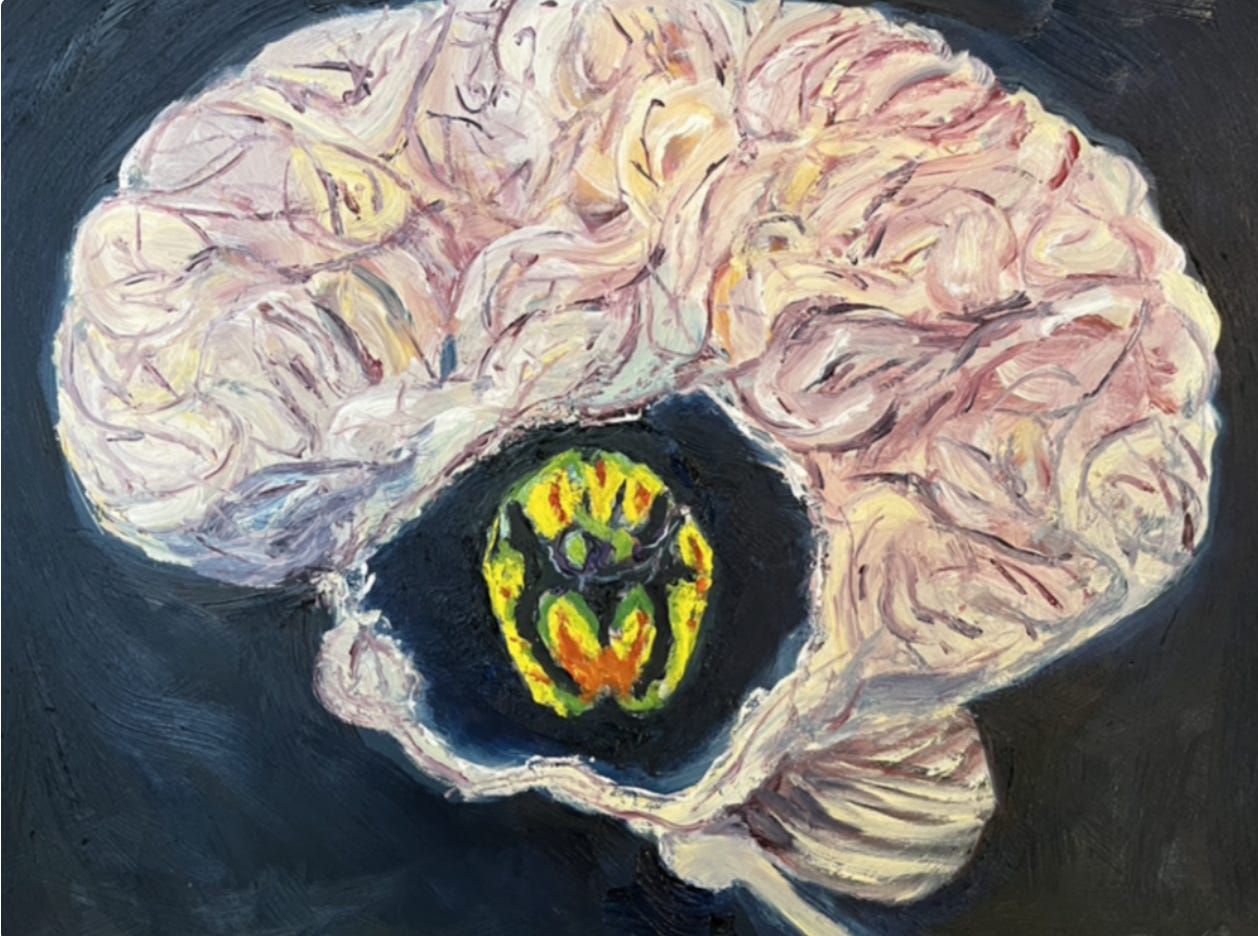
“…trauma does not unfold only in the mind but literally becomes lodged in the body. It is not a bad memory but an experience that is relived over and over again as if it is happening in the here and now. This is visible in brain scans: when people re-experience a traumatic event, the rational part of the brain shuts down while the emotional networks become overactive. The sense of time dissolves. What factually belongs to the past feels as though it is happening now….”
Ronald De Caluwe: “Trauma is Not a Memory: Insights from Dr. Bessel van der Kolk,” March 29, 2026
The two sides of the nervous system
There are two terms often tossed around when talking about a brain on fire or hyperactive, and they refer to two parts of the nervous system: the “Sympathetic system” and the “Parasympathetic system.”
Suffice it to say that the latter is the part that calms you, the part that you tap into when doing relaxation exercises, meditation, or deep breathing. So that is the part that counters normal stress.
The sympathetic system is the part that is activated by incoming stress, and that mobilizes to meet any perceived threat. So it is the one that drives the Fight/Flight/Freeze/Fawn reactions. I will talk more about those reactions when I write about “Trauma Behaviors” in an upcoming post.
This is also the system that starts the faulty memory preservation in traumatic events. (see below)
“When there is a high state of sympathetic nervous system activation, verbal memory is inactivated, and instead, things are imprinted as sensory and symbolic items.” (Herman 39)
So trauma hits the sympathetic system hard, and I suspect it may overwhelm that parasympathetic system at times, too.
Exactly what happens in the brain during “unsafety”
So the brain scan changes can show “changes” during different types of brain activity. What exactly is happening in that activity? Where in the brain are those changes taking place and why?
“Using brain scans, he (Kolk) demonstrates that traumatic memories are not merely ‘stories we recall” but deeply ingrained physical responses in specific brain regions. When someone relives a traumatic experience, the brain responds in a characteristic way…
It begins at the most primitive core…deep in the brainstem…This area, once danger is perceived, directly activates the body in a reflexive fight, flight, or freeze response…above this…the amygdala…at traumatic triggers — a smell, a sound, a glance…reacts with lightning speed. It recognizes threat patterns based on past experience, often before the rest of the brain has time to think logically. In traumatized people, the amygdala is frequently overactive, causing even harmless situations to feel threatening. At the same time, the prefrontal cortex – the rational brain – is deactivated…the awareness that something belongs in the past disappears. What remains is the immediate, overwhelming experience as if the trauma is happening again right now….Another crucial player is the insula, the brain region that links body and feeling…In people with trauma, this connection is often disrupted. Some can barely feel their body at all…
What all of this makes clear is that trauma is not a psychological weakness but a state of being — above all, a state of brain. You are not ‘emotionally unstable’ or ‘oversensitive ’-your brain has adapted to unsafety.”
Ronald De Caluwe: “Trauma is Not a Memory: Insights from Dr. Bessel van der Kolk,” March 29, 2026
Trauma-time emotional states
Okay, so there are chemicals moving around; the brain is being triggered, and it lights up on scans with various colors to show the areas being affected. But during all of this, what am I FEELING?
“One of the most confusing and exhausting consequences of trauma is… ’ being agitated and numbed out at the same time.’ You feel driven, irritable, and alert — as if something is constantly wrong — and at the same time you are inwardly numb, empty, or shut down…the body is in a state of threat, while the feeling system has partially shut itself down to avoid being flooded. You can barely tolerate anything, yet at the same time you feel dull and far removed from yourself.”
Ronald De Caluwe: “Trauma is Not a Memory: Insights from Dr. Bessel van der Kolk,” March 29, 2026
So that answered for the times I am feeling either detached, really irritable, or on guard. What about those sensations on Sunday afternoons when I am having an emotional flashback, and all I feel is either scared or that I am a “bad person”?
“Children who have suffered early trauma often live with a very deep sense of being ‘bad’ and ‘unwanted,’…their template for how they see themselves and how they think others see them. No matter how many times they are told that they are wanted and loved, while their head might know this — their heart is stuck in trauma-time.”
Beacon House, www.beaconhouse.org.uk/useful-resources/ “Developmental Trauma Close Up.”
Destruction of the emotional and thought processes
“Trauma isolates…Trauma shames and stigmatizes…Trauma degrades the victim…Trauma dehumanizes the victim.”
Judith Herman, MD, Trauma and Recovery, 214
If all the nervous system circuits are overreacting, chemicals and hormones are flooding the body, and emotions are on overload, what does that do to a person’s ability to learn, mature emotionally, and relate to others and the world?
Judith Herman details many of these in her book:
- severs integrative functions (see below)
- breaches attachments to family, friendship, love, community
- violates victim’s belief in a natural order
- undermines beliefs that give any meaning to life
- overwhelms ordinary adaptations to life
- shatters a person’s Identity formation, preventing its normal development and ability to relate to others
- damages the normal ability to separate from one’s family of origin and explore the wider world
- creates a living state of passive reactions/helplessness, with alternating rounds of submission then resistance
- induces constant state of vigilance and hyper-arousal, even as the victim may not remember why they are on guard
- damages learning and cognitive development processes
- causes severe guilt in those who may witness abuse of others even if they themselves are spared
To explain some of these, especially the “severs integrative functions,” I did some digging.
This basically means that “extreme terror and helplessness shatter the normal ability of the brain and self to stitch together thoughts, feelings, memories, and bodily sensations into one smooth, whole experience.” (Google search) This is due to a series of things happening in the abused person.
First, there is the disconnection of normal memory pathways. Where normal events are stored as a coherent story, trauma events are stored as broken fragments, as “frightening body sensations, intense emotions, or flashing visual images that cannot be placed properly into a chronological timeline.” Google article and https://anniewright.com/integration-in-trauma-recovery-what-it-means-when-the-work-clicks/
The other things that also happen are:
- Dissociation and splitting:* To protect against an overwhelming or “unsurvivable” experience, the mind sets up compartments, keeping part of the psyche cut off from awareness. This leads to a sense of unreality, amnesia, or altered consciousness during the event. [1]
- Intrusion vs. constriction: The victim becomes caught between two alternating states. One state is being flooded by all the broken pieces of the event that were not processed by the brain. This brings flashbacks and nightmares (Intrusion). The other is more of numbness and avoidance, where they may completely shut down (Constriction). [1, 2]
- Shattered identity and meaning: The sense of trust and safety a person carries within them, and their very relationship to others, is severed. The parts of their very identity – who they feel they are, their sense of a complete self – are broken apart. [1]
What happens to an abuse survivor when these things take place in your psyche?
“People subjected to prolonged, repeated trauma develop an insidious, progressive form of post-traumatic stress disorder that invades and erodes the personality….the victim of chronic trauma may feel herself to be changed irrevocably, or she may lose the sense that she has any self at all…the repetition of the trauma amplifies all the hyperarousal symptoms of post-traumatic stress disorder. Chronically traumatized people are continually hypervigilant, anxious, and agitated…Nightmares were universal with undisguised themes of violence and danger….Chronically traumatized people no longer have any baseline state of physical calm or comfort….complain not only of insomnia and agitation, but also numerous types of somatic (body) symptoms. Tension headaches, gastrointestinal disturbances, and abdominal, back, or pelvic pain are extremely common….tremors, choking sensations, or rapid heartbeat.”
Herman, Trauma and Recovery, 86-87
In those words, Dr. Herman summed up my life. But what really caught my attention, though, was the powerful and ACCURATE way she also described the impossible, unsolvable trap abuse victims, especially children, are caught in:
“Repeated trauma in adult life erodes the structure of the personality already formed, but repeated trauma in childhood forms and deforms the personality. The child trapped in an abusive environment is faced with the formidable tasks of adaptation. She must find a way to preserve a sense of trust in people who are untrustworthy, safety in a situation that is unsafe, control in a situation that is terrifyingly unpredictable, power in a situation of helplessness. …the development of abnormal states of consciousness in which the ordinary relations of the body and mind, reality and imagination, knowledge and memory, no longer hold.” Herman, 96
In a setup like this, which was my household, which was my father and the system he created, I now see I didn’t stand a chance. It was all about survival. No processing. No healing. No place of safety to retreat to for even a moment where I could re-center. Assess. Figure out what the hell was going on. Just constant bludgeoning with danger that dysregulated my brain and nervous system and took apart my whole being.
Even though I kept trying to resist, I often had to yield. And even though I never totally gave up my belief that what he was doing to me was wrong, it was too much. After a while, I felt so ashamed, dirty, and stigmatized that I gave up hope for something better, at least temporarily. Sometimes, just getting through one day at a time was the victory. It’s just that back then, I had no perspective to see how big a victory that was. I only know that back then, and into my present, I felt like a failure.
Up next
Part II – So if all of this is happening in the nervous system, thought processes, and emotions, WHAT was happening to the rest of my body???
Note:
I am seeking financial support to complete my memoir, work with an editor, and make a visit to my home state for fact-checking. Your help would mean the world to me as I take this step toward healing and giving voice to my journey.
Please like, comment, and share this post to help spread the word. The link for my fundraiser is on GoFundMe. Thank you for your support.
Tags: healing, mental-health, PTSD, therapy, trauma


Leave a Reply