The Post – Broken Pieces and the Nobel Prize

June 11, 2008

Several months ago, I was invited to join a friend to attend a presentation of the personal effects of a former Burroughs Wellcome scientist who had died. To say she was a scientist, is both a major understatement and a total truth at the same time. In reading the booklet she wrote about her life, it’s obvious that first, foremost, and in her deepest heart places, she was a scientist, and to her, that was her reward. No claim to fame, degree, paycheck, whatever, motivated her. She was motivated by total love of what she did and a passion to do it above anything. So yes she was a scientist to the core.

But she was no ordinary scientist. Gertrude B. Elion. She was born in 1918 and unlike most women then, was fortunate enough to go to college, attending a women’s college in New York City, Hunter College. Unlike most women, even those in college, she pursued a degree in Chemistry. There were other women in that field, most planning to teach, but only a small number, Gertrude included, wanted to become laboratory scientists. She was motivated to pursue this dream after watching a beloved grandfather die a difficult death from stomach cancer. She felt the branch of science with the most potential for medical breakthroughs for cancer, would be chemistry. Thus, her choice.

Her grades in high school were good enough to qualify her for free tuition, and she graduated summa cum laude. However, reality awaited her upon graduation, as she noted: “What had made me think that graduating “summa cum laude” would open any doors for me to a research laboratory?” The most common response she received during an entire summer of job-hunting was “We have never had a woman in the laboratory; we think you would be a distracting influence.”

After short stints in secretarial school, and teaching biochemistry in nursing school, she had a reprieve from a young chemist friend who brought her into his lab for free initially, but eventually was able to pay her a small salary. World War II gave her the break she’d been unable to get. As she put it, “it opened the doors for women to work in chemistry laboratories. While the men were away, employers had to take a risk.”

Okay, so she was admirable in that she loved chemistry enough to work for nothing, and to keep trying until she got a real job in it. No question, a great achievement for a woman at that time. And certainly she was in the minority, but still, there were other women who managed to achieve the same thing she did in a difficult time. So what else made her special?

She managed to parlay a number of pharmaceutical jobs and part-time graduate college attendance into a Master’s degree and a job at Burroughs Wellcome. She followed the company when it left New York and moved to some unheard of, at that time, place in North Carolina called Research Triangle Park. She and a few others began to do ground-breaking research with nucleic acids, something very few others were doing at that time, and things even fewer people had ever heard of. Who knew what purines and pyrimidines were in June of 1944? Even she didn’t know.

She stayed with that job and career through the 1950s, described by her as the “golden age of nucleic acid biochemistry.” It was a time of discoveries in various synthesis processes and pathways, and the discovery of the structure of DNA. Her work over the next several years involved developing better treatments for childhood leukemia, delving into the field of immunosuppression and transplantation, developing a new treatment for gout and other chemotherapeutic agents. So again, no question a remarkable career, one anyone could take pride in. But wait…there’s more.

She and her group started into the study of antiviral treatments, again, a new area of research, and began working with the herpes virus. That group of researchers came up with an exciting new antiviral agent, acyclovir. It showed a great deal of activity against herpes viruses and thus began a number of studies to determine just how effective the drug could be. This culminated in the development and eventual FDA approval of the herpes drug: Zovirax. Over time she watched as their drug’s use expanded to include treatment for mucocutaneous, ocular, and oral herpes, genital herpes, herpes encephalitis, shingles, and chicken pox. The drug was also used to protect immunosuppressed patients undergoing bone marrow or organ transplants or cancer chemotherapy, from activation of any latent herpes infection in their bodies.

She retired in 1983 and one would think these achievements would be sufficient for satisfaction for her life’s work. However, retirement was anything but quiet. She was asked to stay on at Burroughs Wellcome as Scientist Emeritus and a consultant. She became president of the American Association for Cancer Research, and served on the National Cancer Advisory Boards, a Steering Committee for Filariasis for the World Health Organization, and continued to work with the team at BW that had brought Zovirax to market. She was there to watch the expansion of the antiviral team and their newest research project, a new antiviral drug called: azidothymidine…also called zidovudine, or Retrovir, or maybe the most wellknown name for the drug by most people: AZT….for the treatment of AIDS.

Finally, in 1988, she and her colleagues George Hitchings and Sir James Black were notified they had been given the Nobel Prize in Physiology or Medicince. When asked if this wasn’t what she had sought after all her life, Gertrude replied:

“Nothing could be farther from the truth. It never occurred to me that I might be considered for this award. My rewards had already come in seeing children with leukemia survive, meeting patients with long-term kidney transplants, and watching acyclovir save lives and reduce suffering.”

So a Nobel Prize winner, thus an amazing scientist, but at heart, just a true blue scientist.

If all this wasn’t enough to pack into one professional life, retirement and the award brought more. She was now in great demand by the press, television, universities, various boards, and continued to receive even more honors. She was elected to the National Academy of Sciences, National Inventors’ Hall of Fame, and the National Women’s Hall of Fame. She was given the National Medal of Science and many honorary degrees. These last ones gave her the PhD she was never able to get on her own, being too busy with her work. Before her death she mentored students at the Duke University Medical Center as a Research Professor of Pharmacology and Medicine, guiding students through research into brain tumor biochemistry, pharmacology, and chemotherapies of various kinds.

So…all this from someone who might be a “distraction in the lab,” couldn’t finish secretarial school, and worked for nothing in her first laboratory job, just because …she wanted to be a scientist. QUITE an AMAZING scientist, but in her heart, she was simply – scientist. Dedicated. Passionate. Successful beyond anyone’s wildest dreams, but still, scientist. That was her biggest reward.

Ah yes, the personal effects. There were many books, framed degrees, posters, papers, awards, etc. on display in a small conference room. Everyone was allowed to select a couple of items if they wanted. My friend and I went, curious about what a Nobel-Prize-winning scientist would have in her office and on her desk. What sorts of things does a Nobel Laureate value, or have to inspire and guide them? Does a Nobel Laureate have the sorts of things an ordinary person would? Or are they beyond the ordinary and more into something amazing and unexpected?

Among all the many amazing degrees and awards, came my answer. Super-scientist she might be, but human to the core. I selected one item and for me, it was most interesting. I would love to know the story behind it. It’s s simple, silver-framed poem by someone I’ve never heard of. I have searched for information on the author of the poem but can find none.

The poem’s title is: Broken Pieces.

For sure, given this blog’s focus, it fits to be mentioned here. And I love it’s words and thoughts and find them inspiring. But I guess it was not the sort of thing I initially expected a Nobel Laureate to have given they are so amazing and famous and why would they need encouragement? But Gertrude, for all her honors, was a humble person who knew who she was at her core. And she spent much of her career studying the tiny broken building block pieces that made up each of us. So maybe there remained a humility and an awe of just what it takes to create a person. Or perhaps it’s a poem written for someone else and she just liked it or it had sentimental value for her. I’ll never know the story behind the piece, but it’s presence in her office, and it’s message intrigued and inspired me. Perhaps it will intrigue and inspire others.

So for all, in today’s Gift post below, the poem: Broken Pieces, from the desk of Gertrude B. Elion, chemist first, famous person second.
The Gift – A Nobel Prize Winner’s Personal Item: Broken Pieces

June 11, 2008

From the private effects of Nobel Prize winner: chemist, Gertrude B. Elion, a simple framed poem:

Broken Pieces

Have you ever wondered about
The perfection that you are?
Have you ever, even for one instant,
Contemplated
The intricate network
Of race and color,
Of beliefs through time
That it took to produce
You,
One whole unique and sculptured
You?
Have you ever wondered
In your quiet moments
The collection of priceless
Broken pieces
That it took to have
You
Here in this moment?

– Antonia JoanMarie Catherine Bernard, May 8, 1991

The Gift

June 9, 2008

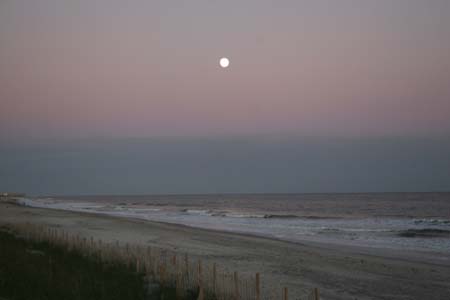
Well, after yesterday’s gift post about sunrises, I was in the mood for a sunrise picture. Alas, the closest I had on hand was a picture of a sunset. I’ll need to get more pictures and next time get a sunrise.

But, no worry for now. I mean if you’ve waited through darkness to make it to enjoy the sunrise, then no doubt you can hang around long enough that next day to enjoy the sunset as well.   🙂    So, a sunset to enjoy, after the joy of the sunrise.

The Gift

June 8, 2008

“We can only appreciate the miracle of a sunrise if we have waited in the darkness.”

Author Unknown

The Gift – A CNN Video Extra

June 7, 2008

I got up this morning to see the CNN webpage article:New RFK Funeral Train Photos, Something’s Happening Here.

Some of the photos are new, some are already on my other post. The power of this video is listening to the man give his, even today, emotional eyewitness account of what it felt like to be on that train and see all those people along the entire journey:

” young, old, black, white, yellow, all there together driven by one concern, a love hopefully for a great man and a loss of their future. Bobby Kennedy at that time made a lot of people believe that it wasn’t only the rich who had a great time to be in America, America was for everybody, everybody had a chance. It was an incredibly emotional train ride. It was unrelenting.”

The Gift

June 7, 2008

I believe that unarmed truth and unconditional love will have the final word in reality. This is why right, temporarily defeated, is stronger than evil triumphant.

Martin Luther King, Jr.

The Post – A Couple Last Thoughts: That Last Campaign…and Now

June 7, 2008

I picked up the book, The Last Campaign: Robert F. Kennedy And 82 Days That Inspired America. I had to revisit that place, and learn more about what it was that so inspired me. Obviously, I was not alone in feeling that if I come back to those people along the tracks of his funeral train:

One of the pictures in the book is of a group of people in an inner city neighborhood, gathered together next to the tracks, some holding an American flag. The caption notes:

“No one had imagined that on a steamy Saturday afternoon two million people would spontaneously head for 226 miles of tracks: wading through marshes, hiking across meadows, filling tenement balconies, clambering onto factory roofs, standing in junkyards and cemeteries, looking down from bridges, viaducts, bluffs, and waving hand-lettered GOODBYE BOBBY signs.”

The question at the end of the jacket flap copy, sums it up best:

“Four days after Robert Kennedy was assassinated, two million grieving Americans — weeping, waving flags, saluting, and kneeling in prayer — lined the tracks to watch his funeral train carry his body from New York to Washington. One of the reporters on this train, Sylvia Wright of Life magazine, saw a bridal party standing in the tall grass of a Delaware meadow. As the car carrying Kennedy’s casket passed, the party tossed their bouquets against its side, causing Wright to ask herself, “What did he have that he could do this to people?”

Certainly no one, not even his friends, not myself, would say RFK was a perfect man. In his early years he could be arrogant, rude, restless, impatient. He had a quick temper, and could be aggressive, intolerant, opinionated. He made enemies. Lots of them.

And the book’s author astutely wonders what must have gone through RFK’s mind as he walked in the march during Martin Luther King Jr.’s funeral. After all, RFK as Attorney General, authorized the wiretapping of King’s phones in the early 60s as a way to monitor such marches. Perhaps it’s a case of two people who early in their relationship, don’t understand each other and view each other with suspicion, yet over time, grow to realize the depth, value, and goodness of the other. Whatever went through his mind that day, or for that matter, in the turbulent painful years after his brother’s death, by 1968, what came out in Robert Kennedy was a gentleness… a person troubled by Vietnam, poverty, racial injustice.

You can speculate, and many have, on what might have been different, had he succeeded in reaching the presidency. Many describe it saying simply, this country would have been different and “…even his enemies would concede, he meant what he said.” It is likely Vietnam would have ended sooner, with so much less carnage. Things like the bombing of Cambodia, and the killings at Kent State, would have been avoided. Watergate might never have happened, and the young and minorities would have had a champion in the White House that could have addressed poverty, racial discrimination and disillusionment. But, it didn’t happen, so no one can say.

For myself, the question now is, will the hopeful future leaders in this election incorporate this vision and lead us where those men of the past – Medger Evers, Martin Luther King, Jr. Robert Kennedy, and others – were trying to take us? Can they?

The end of the book’s Prologue provides a hint of an answer:

“The stars may never be aligned as they were in 1968, and Americans may wait decades for another year as pivotal….Or perhaps not. There are things that Robert Kennedy did and said during his campaign that only the brother of a martyred president could have done and said, but there are others that another candidate could easily do and say, if the American people demanded them. John Nolan, who scheduled many of Kennedy’s appearances that spring, believes ‘ What he did was not really that mystical. All it requires is someone who knows himself, and has some courage.'”

It would be nice to not have to wait decades more for some future mystical pivotal moment, when maybe it can be now that another inspires such hope again…..

The Post – 1944: Wait, or Go

June 6, 2008

From the book: Ike At D-Day

“The rain he worried about. The Camel cigarettes he chain-smoked. The letter he wrote in case of failure. Gen. Dwight Eisenhower’s defining moment comes to life in an excerpt from Michael Korda’s best-selling new biography.

As June 6, 1944—the date set for the massive Allied invasion of France—loomed, one man bore the full weight of that decision. Gen. Dwight D. Eisenhower, the supreme commander, would alone decide whether the assault would go forward.”

The above excerpt from Michael Korda’s book, on the Smithsonian website, touches on the crux of the D-Day decision….and today’s gift post on decisions about waiting or acting.

Today’s gift post, though from a fictional adventure movie, notes how often in life waiting means loss…loss of time, loss of a rare window of opportunity, loss of the whole ballgame. There are of course, many times where it’s best to wait, assess, not rush in. But there comes a time where making a choice, taking a risk, is the only option.

In 1944, General Dwight D. Eisenhower had the unenviable task of deciding whether to send thousands of men into a battle that could mean the beginning of the end of the war, or the end of those men, and the loss of the war for the Allies.

Eisenhower was caught between a bad weather forecast….and a worse one, between optimal tides or terrible ones, between the right position of the moon for paratroopers or having to wait several weeks for another chance if he delayed. He had hundreds of thousands of men, thousands of ships, and tons of supplies crunched together in close quarters in British ports that needed time to get rolling if his decision was “Go.” And he had to decide between the risks of going and losing men and possibly the war, or waiting and losing the advantage of surprise and the loss of secrecy.

To wait meant keeping all those men in a readiness state indefinitely locked up on bases so German spies wouldn’t find out critical information. It meant waiting until the tides and the moon were in the right positions again. And it meant rolling the dice again on the weather. Who was to say it wouldn’t be this bad then, or even worse? And what then? Wait again? And again? How long can you postpone the inevitable without things blowing up and losing your chance completely?

Yet to go….with fog, clouds, stormy seas, how could the planes deploy airborne troops or provide air cover? Would the ships carrying soldiers be swamped and sink before even reaching the shores of Normandy? The fate of so much depended on one man’s decision to wait or to go.

The dilemma is described below in excerpts from the website article: , Ike: World War II’s Indispensable General, Part IV: The Great D-Day Decision, by Carlo D’Este: I’ve tried to excerpt only those parts that give the nuance of the problems, and the flow of the decision. The article itself is much longer and very well done. Consider visiting the link for the whole article. For now, the excerpt:

“The weather in late May 1944 was exceptional – and deceiving. Admiral Sir Bertram Ramsay, the naval commander-in-chief for Operation Overlord, the cross-Channel invasion of Normandy wrote in his diary on May 29, “Summer is here and it is boiling hot!” However, as an experienced sailor Ramsay knew better than to trust this as an especially good harbinger for D-Day. [1] At the end of May it was not the condition of the sea but rather the cloud cover over the English Channel and Normandy that was of primary concern. There was only a three-day window in early June upon which the operation could commence. The moonlight required by the three airborne divisions that were to be landed by parachute and glider the night before the invasion to secure the vital flanks, and the low tides necessary to carry out the landings and the demolition of Rommel’s underwater obstacles in the forty minutes after first light, would only be present during the three day period from June 5 to 7. Any delay due to inclement weather meant postponement for a minimum of another two weeks – a possibly fatal delay that might threaten the Allied foothold if the notoriously bad Channel weather closed down re-supply through Cherbourg and over the beaches before a breakout….Every element of the Overlord plan could be controlled except the volatile weather.

…The chief meteorologist [Stagg] disclosed that a series of depressions moving in from the west would make the weather in the Channel for the next three of four days “potentially full of menace” in the form of completely overcast skies and winds of up to Force 4 or 5, and a cloud cover of five-hundred feet to as low as zero. The seriousness of the occasion could be read in their faces and in the almost deathlike silence….

Saturday June 3, 1944….Without preamble, Stagg delivered the bad news. “Gentlemen, the fears my colleagues and I had yesterday . . . have been confirmed,” he said. His latest forecast offered little but wind, waves and clouds lasting until at least June 5. One by one, Eisenhower questioned his three invasion commanders. “Could the Navy manage it? Ramsay thought not. The assault might go ashore all right, but if the weather worsened there could be no adequate build-up.” The air C-in-C, Trafford Leigh-Mallory replied that his aircrews would not be able to see what they were attacking. Of the three, only the ground force commander, Gen. Sir Bernard Montgomery thought the invasion should proceed….

Eisenhower had no choice except to provisionally postpone the invasion for twenty-four hours. The armada waited in grim anticipation of some glimmer of hope from the weather gods. Some of the troops crowded aboard landing craft like cattle were already seasick from the heavy tides without ever having embarked from their harbors and ports. A short time later Bull emerged to announce, “The Supreme Commander has made a provisional decision to hold up the operation on a day-to-day basis. Some of the forces will sail tonight but General Eisenhower and his commanders will meet again at 4:15 a.m. tomorrow (Sunday) morning to hear what you have to say.” At that time Eisenhower would have to decide the fate of Overlord….

Sunday, June 4, 1944: Some naval forces had to be recalled and there was a measure of disarray and some loss of life when several landing craft overturned in the rough seas. At the 4:15 A.M. meeting Stagg reported no change….the predicted bad weather would arrive within four to five hours. “In that case, gentlemen, it looks to me as if we must confirm the provisional decision we took at the last meeting,” said Eisenhower. “Compared with the enemy’s forces ours are not overwhelmingly strong: we need every help our air superiority can give us. If the air cannot operate we must postpone. Are there any dissentient votes?” None were offered. Overlord was officially on hold….

As predicted, a full-blown gale not only rendered any hope of launching the invasion the morning of June 5 unthinkable, it now threatened to wreck the entire invasion timetable. While the armada literally treaded water, the participants had become virtual prisoners in their encampments, and aboard naval vessels; final briefings postponed and sealed instructions revealing their target remained unopened….

At the late evening briefing ‘Eisenhower presided over one of the most important councils of war in military history.” The assembled generals, admirals and air marshals, could distinctly hear the sounds of rain and the wind howling in rage outside. Eisenhower’s trademark smile was missing, replaced by an unmistakable air of solemnity…’

Although the weather was plainly vile, Stagg reported to the tense commanders there was a glimmer of hope for June 6: while the weather would remain poor, visibility would improve and the winds decrease barely enough to risk launching the invasion….

This was arguably the most important weather prediction in history: a mistaken forecast for D-Day could turn the entire tide of the war in Europe against the Allies. After consulting with each of the invasion commanders, Eisenhower swiftly learned time had run out. He had to make a decision for or against, then and there….

He [Eisenhower] was obliged to weigh not only the decision itself but its longer-term impact. There was utter silence in the room. The only sounds to be heard were the howling wind and rain. Beetle Smith, a man rarely emotional about anything, was awed by “the loneliness and isolation of a commander at a time when such a momentous decision has to be taken, with full knowledge that failure or success rests on his judgment alone…

Although he later agonized over what he had wrought, it seemed clear what his decision must be. Like Stagg earlier, the time for equivocation was long past. In retrospect, it may appear to have been almost casually made but it was, in fact, a decision that he had long since prepared himself to make. His heart and his head told him that he must trust Stagg and his weather forecast. The invasion must go ahead. It was a very slender thread upon which to base the fate of the war, but it was all Eisenhower had and he embraced it. “Finally he looked up, and the tension was gone from his face.”

Still pondering, Eisenhower said, “The question is, just how long can you hang this operation on the end of a limb and let it hang there?” [5] Despite the presence of men accustomed to making life and death decisions, it was as if Eisenhower’s query was merely rhetorical. No one in the room responded; it was equally clear to them that the time for discussion had passed and that the matter rested solely with Eisenhower. “I am quite positive we must give the order,” he said. “I don’t like it but there it is . . . I don’t see how we can do anything else.” With that low-key pronouncement, the invasion of Normandy would take place the morning of June 6, based on the most important weather forecast in history.”

____________

Few of us will ever have such a weighty decision on our shoulders. I for one, am glad. I would never want to have stood in his shoes that day. And once the invasion began, there were no doubt, thousands of more decisions made, from generals down to privates, imperfect decisions made under fire, with much uncertainty, but were made because time had run out and someone had to decide. Right or wrong, they showed much courage by not running from whatever they faced. So today, a nod of honor to so many who gave so much, and showed so much courage.

In our own lives, we are faced with decisions, big or small, of wait or go. They are never easy. Always, someone or something’s fate rests on a decision. Always the decision is fraught with questions like: “Have I done all I could?” “Did I miss any important factors?” “Is this the right time?” “What if I am wrong?” And yes, waiting has its own costs.

No one has a crystal ball to tell you what to do. From what I’ve seen in my own life, most decisions demand to be made at a time that doesn’t seem quite right yet, with less than optimal circumstances. I’ve also noticed that the decisions that seemed like bad choices and that I expected to blow up in my face, often turned out best. And I’ve come to conclude that big decisions or small, we all show a touch of the heroic whenever we step up to be counted. Ask any parent out there if all the decisions they made were correct. I suspect no one will raise their hands. But good parents still try, and they make decisions, sometimes wrong ones, but they make them….because they have to…it’s their job….and they just do the best they can.

The best I guess any of us can ever do in life, is do our best to cover the bases, to analyze and prepare, then when the time for decision comes, make your choice…then release the outcome into higher hands. It takes courage…especially that last step about “releasing.’ But whether it turns out right or wrong, sometimes to not decide is worse. And Monday-morning quarterbacking is easy. Standing alone in the moment with your decision, is a lonely place. Take comfort in knowing it is also the place of heroes, big and small.

The Gift – Extra

June 6, 2008

For anyone interested, a couple of good articles yesterday and today, on Robert Kennedy

CNN online article: When Robert Kennedy Gave His  All

WRAL-TV online article: RFK’s Oldest Child Discusses Legacy 40 Years Later

The Gift

June 6, 2008

“How much of human life is lost in waiting.”

Professor Oxley, in Indiana Jones and the Kingdom of the Crystal Skull