Archive for August, 2026

Albedo – Trauma Insight – Those Lifetime Costs

August 27, 2026

“…survival…is not synonymous with wholeness. We don’t survive whole.”
Daria Burke, Of My Own Making

The Superfund site

“Something in me…screams…This is not all I am. I had something more in mind to do….We are reclaiming what another human being…decided to ruin, to take for themselves…Many of us don’t die. But our trajectories are forever altered.”
Jen Cross, Writing Ourselves Whole

And Cross goes on to so eloquently point out that they didn’t just TAKE from us; they left us with a MESS to clean up, comparing us to an “oil spill,” a Superfund site in need of cleanup that will never be quite the same. :

“We spend the bulb and blossom of our lives cleaning up a toxic waste site. Meanwhile, we watch our friends come into full flower: making connections, reaching out, writing books, making marriages and families, developing their crafts, their skills, themselves. We watch them build careers, and wonder what is wrong with us that we can’t do what they’re doing. But we are still salvaging the superfund site inside of us. We painstakingly wipe off every blade of grass and feather of every bird that is a necessary part of our inside selves. The oil is never completely eradicated. Some of the areas impacted never recover…never become what they ought to have been…And then we simply have to mourn their loss, grieve what might have been….Meanwhile, those who polluted us are allowed to continue…”

I agree with every word…and deeply feel the effects of both what was taken…and what was left…and what goes forward…

“The past is not the past…We all bring every second of our lives to who we are today.”
Andre Dubus III, with Melanie Brooks, in Writing Hard Stories – Celebrated Memoirists Who Shaped Art From Trauma

About costs

Let me first be clear… I have managed to reclaim a lot in life. And Cross notes the same in her book when she indicated that we can become a hybrid of what we were meant to be; that we can go on, go forward, and still thrive.

But too often society “glosses over” that whole in-between section, the blatant, cold, hard reality that exists in between “the abuse and the thriving.” So for once, I want to be very specific about just what this life of mine has cost me…about the fact that no matter how good we make it – there were…and ARE…costs we incurred.

And by “we” I mean not just myself, or other abuse survivors, but society in general.

But first, let me talk about my personal costs in this.

The weight of the past

There was the intensity, the frequency, and especially the duration of the assaults. An entire life derailed, detoured into his needs. I became an appendage…like some science-fiction “psychological protein drink” for his needs. From infancy on, he used and abused me.

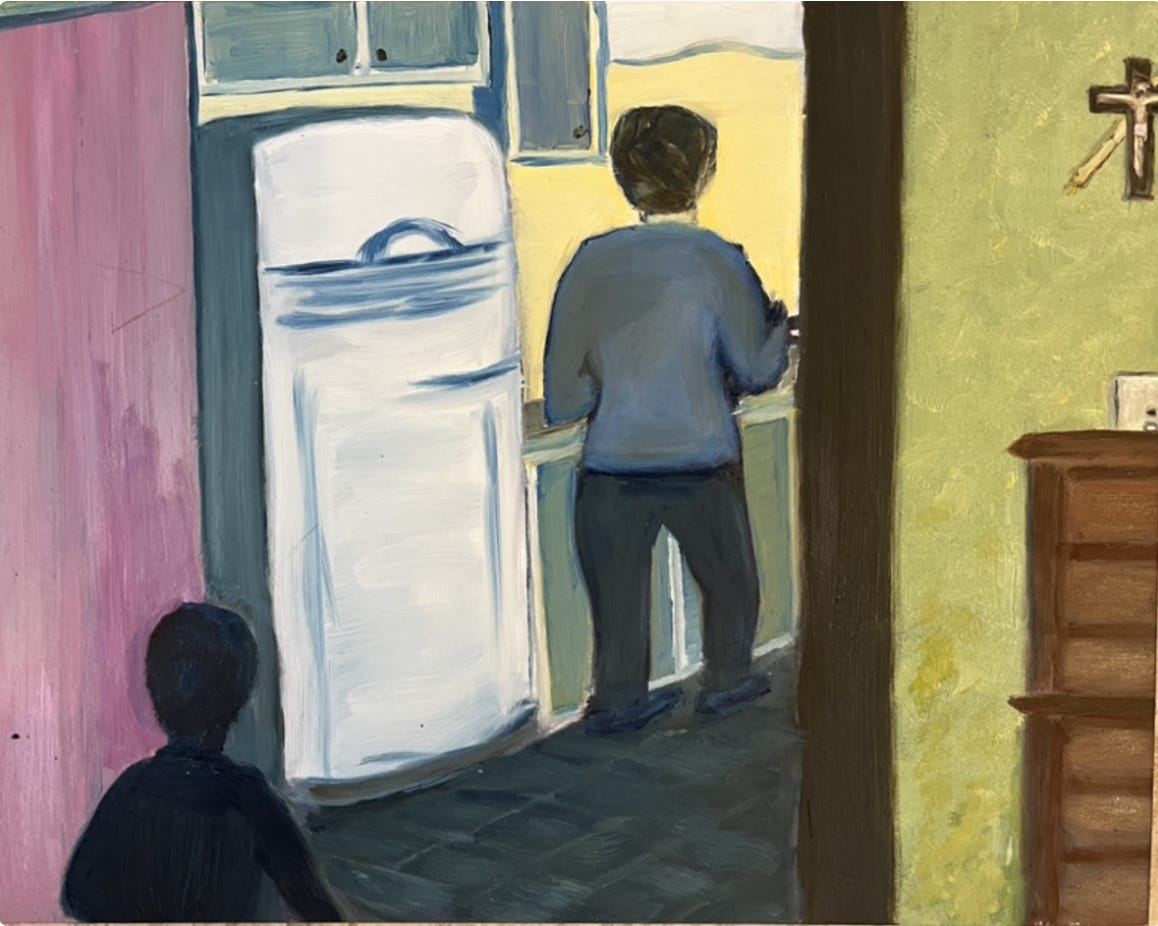
Painting by author

But then, add on two more huge boulders to this painting:

Graphic by author

Those two capture the weight of all the following years- 1983- 2013: escaping, disintegrating, crawling back up, learning, healing, recovering, rebuilding, then standing guard. And every encounter with him drained me. Re-traumatized. Reminded me of the rules I was supposed to live by…his rules. Each time I confronted him, it knocked down some of my progress. And I would have to start back and rebuild that.

Then, after his death in 2013, there began the slow unraveling of emotions and stressors I’d held in check all my life, until he was gone.

So even once I was out of that house, there were the aftereffects of all of that – The pain. The exhaustion of all those years…a lifetime lost to fighting him.

Development and Relationships

I made a list one day of all the various things I knew were impacted by my abuse. Things lost, taken, or broken.

And the first thing I lost…RIGHT FROM THE BEGINNING – was INNOCENCE. I lost the opportunity to experience life just as it was for an infant. To sample my surroundings on my own, without being “tainted”…without the exposure to sensations in my body that my mind and emotions were nowhere near ready for.

There was the theft of “normal.” Even as there probably is no normal in life, still, there is usually an “average path” to development. No one gets perfect parents. But many get caring ones. Ones trying hard to do it right. Ones that try to give you “age-appropriate” experiences. Love. Life as good as they can make it. And who approach parenthood as adults providing for their children, not the other way around.

Our house didn’t even come close to normal. The house was a vacuum cleaner set up to funnel all the nurturing and need fulfillment to my father, not to the kids.

Then, there was brain and cognitive development.

“The prolonged activation of stress hormones in early childhood can reduce neural connections in the thinking area of the brain dedicated to learning and reasoning, thus limiting cognitive ability. Continuous trauma can weaken remaining neural pathways to the thinking part of your brain and strengthen neural pathways to the survival part.”
Amanda Merck in Salud-America, “4 Ways Childhood Trauma Changes a Child’s Brain and Body“ February 6, 2018

In another section of that same article, she notes that trauma overloads the developing child’s system in other ways — including hormonally – which affects brain development: “Hormone level changes early in life when brain development is most rapid can have a drastic impact on brain architecture and function….”

I struggled with things in elementary school. From math to paying attention. A few of the nuns I had pointed out learning issues to my parents. The fact that I did as well as I did was due to a combination of the intensive nature of the nuns’ methods and my love of learning. But it wasn’t always easy.

Social and emotional development were hijacked as well. We were not supposed to get too close to anyone outside the family. Everything was supposed to be “family-first” or “family-only.” Outside friendships were kept to a minimum. That meant no ability for normal childhood and teenage friendships, emotional development, or age-appropriate social skills. For that matter, even intra-family relationships were pretty much blocked. My father disrupted the connection between my mother and me or with other family members.

So while I had “some” friends in early childhood, and a couple in my teen years, the relationships were always awkward, ineffective, and superficial, flooded with insecurity, neediness, and low self-esteem. Little wonder that in adulthood, I had so much trouble with my relationships with women friends and often chose unhealthy ones.

And then, of course, how do you develop into a healthy, mature, sexual adult when the whole lifetime experience was drowned in incest?

“…a father’s dominance, possessiveness…can undermine or destroy a girl’s heterosexual development. More abusive is the father who ignores his natural role as a protector of his young daughter’s sexuality, and because of a need for male dominance, violates her normal sexual development through incest. She will spend the rest of her life reclaiming her sexuality and the fact that as a woman she does have rights.”

It was hard enough not having much of a relationship with my mother, and carrying that wound of insecurity and neediness into my friendships. But then add in what Dad did to me. It was so confusing. I basically was terrified of men even as I was attracted to them. And I was trying to figure out who I was sexually. It wouldn’t have mattered to me what my eventual orientation was, but given my usual draw toward men, I couldn’t understand why I had that transitional same-sex experience with an early friend. It’s only been in the last few years that I could make sense of all the ways I was still struggling with any kind of relationships, and with an identity of any kind.

And identity, or the lack of…talk about another huge core wound…

I coulda been a contender… If I had an identity…

I could have been a doctor…a marine biologist…an English teacher…any one of the many dreams I had. And none of them were possible because I wasn’t the sort of person who could reach for those things. I was not equipped for life, relationships, or any opportunities or career directions life might have gifted me.

Those required a healthy, mature, young adult with well-developed cognitive, social, and leadership skills. I had none of those. I didn’t even have a separate identity.

Jen Cross, in her book, Writing Ourselves Whole, captured the magnitude of the “identity destruction.”
“My stepfather had tried to occupy every fragment, every nook and cranny, every inch of my psyche — he believed, and trained me to believe, that he had a right to every thought in my head, every emotion, every instinct….In my adolescence, a grown man fed identity to me, shoved it down my throat.”
xix, 53

The one difference in my life was that last line- he started feeding the identity he wanted me to have, from infancy on. The fact I managed to eventually have any of my own thoughts was a sheer miracle.

I felt so inferior and immature compared to my peers. While they were busy carving out careers, traveling, moving up in their jobs, I was hanging on, struggling, afraid to travel and hoping to God no one wanted more out of me in my job than I felt I could give. Not a prescription for ANY kind of success, personal or professional. I wanted to do what I felt I could and be left alone beyond that. I was afraid.

Being a lab person, I mapped out my “failure” this way. I was “Person #1. I’d spent most of my childhood, young- and middle-adult years running from opportunities. I did them. I was high-functioning. But I tried to avoid things in jobs that other people were actively seeking.

Person #2 was my perception of an “average peer.” From this, I felt it was clear that by mid-life, they had left me far behind.

Chart by author

I’ll come back to this later with a slightly different analysis of this graph. But for most of my adult life, I felt like “a fraud.” On paper, my resume looked good. Under my surface facade of “competent,” I felt broken and terrified.

It is only now in my seventies that I feel I have the emotional stability and depth to handle those early career dreams. But…it’s too late.

And there is one other aspect of “identity” that is lost sometimes – the sense that part of you died and was lost for good. Judith Herman spoke of this aspect in her book, Trauma and Recovery. She noted that even when a traumatized person moves forward, they sometimes retain a distorted sense of reality and more go through the motions of life than actually being connected to it.

Health

And then there was health. Those same stress-hormone-driven-changes in my brain were also taking place in my body. Even as a child, my heart and circulatory system, immune system, endocrine system, and sex-development organs were all being adversely affected. And my glucose levels. And the levels of inflammation in my body.

We all have seen those “Diagnoses and Medical ‘word salad lists’” splashed across our medical history charts. Here’s a list of just some of the things people who’ve been sexually abused or traumatized in life may have on their charts:

  • Prediabetes/Type II Diabetes
  • GAD (generalized anxiety disorder)
  • Depression, major, recurrent, in complete remission
  • PTSD (post-traumatic stress disorder)
  • Postmenopausal hormone replacement therapy
  • OSA (obstructive sleep apnea)
  • Obesity (unspecified)
  • Adenomatous polyp of colon
  • Irritable Bowel Syndrome
  • Diverticulosis
  • Urinary incontinence, urge
  • Chronic sinusitis with recurrent bronchitis
  • S/P appendectomy
  • S/P cholecystectomy
  • S/P hysterectomy with oophorectomy
  • Primary osteoarthritis of left hip
  • Trochanteric bursitis of left hip
  • Osteoarthritis of left sacroiliac joint

And it goes on and on and on. The list can also include things like: autoimmune diseases (Lupus, Rheumatoid Arthritis), cancer, heart disease, lung disease, and so, yes, like Bessel van der Kolk said in his book – our bodies DO keep the score for all the damage done to us right from childhood.

Even if you are a high-functioning survivor, there are still any number of emotional, inflammatory, endocrine, GI, Urinary, or other health issues. And unnecessary surgeries.

I had my gallbladder out when I was in my twenties. It turned out there was nothing wrong with it. The symptoms were related to abuse. I have dealt with a lifetime of side effects from that surgery. At least now, unlike then, it is standard procedure for gastroenterologists to ask young women with GI issues if there is any history of sexual abuse.

I am aware every time I visit the doctor that damage has been done to my body, and some of those items on those lists are on my chart.

Photos by author

There are also the costs that came because it took me a lifetime to learn to love myself and give myself the compassion I deserved.

And there is one last health effect to mention – that caused by silence…and the weight of carrying secrets…

Silence

I had to be silent…keep secrets…for way too many years. And I have paid a health cost in that.

“Major secrets can be stressful….keeping secrets from those close to us can affect our health, including our immune function, the action of our heart and vascular systems, and even the biochemical workings of our brain and nervous systems…keeping back thoughts, feelings, and behaviors can place us at risk for both major and minor diseases.”

Researchers James W. Pennebaker, PhD, and Joshua M. Smyth, PhD, summarized their findings from several years of work and hundreds of studies in their book, Opening Up By Writing It Down: How Expressive Writing Improves Health and Eases Emotional Pain. In short, they distilled it all down to this formula: “A secret plus a confession equals catharsis.”

They went on to explain that while speaking about it can help, acquiring understanding and meaning is key to releasing those events from our psyches. Those were the critical elements to healing…to transformation.

In fact, research demonstrated that those who wrote about and found meaning in their abuse actually demonstrated improved immune function. So the very act of opening up has the potential to improve one’s physical as well as emotional health.

TIME!!!!

Why so impatient?! Because so much of my life was lost to him. So much taken. Whatever I have left is precious, and I HATE when life or some person WASTES MY TIME.

There is the lost time of being a child. Abuse makes us grow up too fast. We have to parent our parents. Deal with adult issues and sexual drives long before we are ready. Time. Precious, innocent time stolen. And there is the fact that I cannot depend on having a future. I only have now.

Author and professor of divinity at Duke University, Kate Bowler, spoke of this same mindset after a serious cancer diagnosis. Even though she is now in remission, she feels that the “future” was no longer something she had. Her sense of time was totally altered.

And author Daria Burke spoke of an altered and rushed sense of time in decision-making. The chaos of the abusive household refined her skills for survival such that she would quickly assess each crisis moment and make a rapid judgment on how to navigate it. I do the same thing.

So there is no longer a sense of time as something available to me, or that I can depend on.

Inheritance

There are “gained costs” too. And not in a good way. When abusive parents inflict pain on their children, they not only take from them; they “dump” on them. Those parents hand their children their own scars. The pain they carry in life. Their misguided beliefs. Their unhealthy relationships and behaviors. As Daria Burke wrote in her book Of My Own Making, she worried about not just the damage done to her and what she lost or left behind, but also what of her mother’s problems she carried within her. Would she too become the very thing her mother was because of what she lived through?

I have spent my life determined to NOT be either my mother or my father. Yet I carry their scars. I am all too aware of their behaviors and mentality in dealing with life. So it was all the more reason I have worked so long and hard with a therapist in life. To correct all that misguided programming.

And there is one huge cost in my life – financial….

Financial – Therapy

One afternoon, I pondered the question…exactly how much money, out-of-pocket, not counting costs paid by my insurance, have I had to spend to heal? It’s a daunting question.

I tried to figure out a way to estimate it, while at the same time, afraid to see that final total. And again, a total out of my pocket, not counting whatever my insurance paid at the time.

For the years when I first got out of my parents’ house, I worked full-time in the hospital lab. At the time, I had good insurance coverage that paid for some years of off-and-on therapy. So I didn’t even count those years. However, if it were today, with insurance coverage being so much poorer, that amount would be on top of whatever amount I figured.

These are wild guesses, possibly underestimating the costs. I took the hourly rate, multiplied it by the rough number of hours in the various time periods, and for a while divided that number in half since my health insurance in those years usually covered about half the costs of the therapy.

I will preface my comments by noting that there are all levels of therapists, counselors, and social workers whose range of experiences vary, along with their costs. There are group therapy sessions that are less expensive. And now, unlike the past, there are online counselors and therapists at reasonable rates. Often, too, employers may offer therapy services through an agency they contract with, again, making the costs more affordable.

Some of these options were not available to me, and also, because of the severity and length of my abuse, I needed PhD-level therapists who specialized in trauma. The years 2009-2026 we had much less or no insurance help.

So again, this is simply what we incurred. It was our choice to go this route, and fortunately, between our jobs and insurance at those times, we made it work. We weren’t rich. It was our choice. Just know there is a wide range of options available.

My best guesses:

  • 1984-1986 — $ 0.00
  • 1988-1990 — $4800.00
  • 1994-1999 — $7200.00 (including the course on effective marriage skills)
  • 2007-2008 — $1200.00
  • 2009-present — about $3500/year (including many EMDR sessions and poor or no insurance)

Wild guess lifetime total: >$70,000.00

I have many mixed feelings about that. It sucked. We carried this as one of our “costs of living,” monthly bills.

I will simply say that my husband and I made a choice to break a multi-generational cycle, to heal me, to teach him and me the emotional skills we never got at home. We chose to do this for our sakes, for our marriage, and for our son and his future. How each person handles this, to what extent, for how long, is a personal choice. It has been worth it to save our lives.

But…it is a shame that any survivor has to pay any amount to heal.

Bottom line on a personal scale

The costs are huge. Lost past. Lost savings. Having to clean up the mess in the present, emotionally and physically. Lost opportunities in life. Lost friends. Jobs. Joy. Health. Time. TIME!!!!! It’s the root cause of my impatience now. I REFUSE TO WASTE ANY MORE MOMENTS in life!

And the reality is, these were “LOST” …they were STOLEN….TAKEN.

I could spend the rest of my life in bitter resentment. But that, too, would be a cost. And that is ONE cost, I will NOT pay. My goal my whole life has been about “What can I get back? What can I still do? What can I reinvent? How can I NOT let HIM win?!”

And I will talk about that in the last post of this Albedo section – Healing. Because despite all, there are ALWAYS possibilities if one refuses to quit. And I will claim any and all that I have the chance to get.

But before I go into that, just some observations about the costs of abuse on a larger scale.

Note:

I am seeking financial support to complete my memoir, work with an editor, and make a visit to my home state for fact-checking. Your help would mean the world to me as I take this step toward healing and giving voice to my journey.

Please like, comment, and share this post to help spread the word. The link for my fundraiser is on GoFundMe. Thank you for your support.

Albedo – Trauma Insight – HOW Did I Survive That House?

August 25, 2026

About that can of worms

So I have three questions:

  • How did I survive that house?
  • What has that past cost me…healthwise, lifewise, financially?
  • And last – What in God’s name happened in our home that such abuse could take place?

For the remainder of this Albedo section, I will deal with those first two questions.

On that last one, I can see other people out there – including, and especially other women – shaking their heads at women like my mother, or like me, who endured that abuse. I can hear them defiantly pronounce: “THAT would never happen to me. I would have never stayed.”

I have a response for them:
“Yes. Yes, it could happen to you. More than you think….And yes, given the right circumstances, you, too, would have stayed.”

When people are so sure of how they would act in a hypothetical situation, especially a bad one, I think they are often just trying to separate themselves from that reality so they can feel better…or safer:

“Finding something wrong with battered women makes it possible for the rest of us to distance ourselves from them: ‘If I am different from battered women, I will not be battered. If she is different from other women, I do not have to do anything to help her.’”
From Alyce D. LaViolette’s and Ola W. Barnett’s book: It Could Happen to Anyone – Why Battered Women Stay.

That third question – WHY could it happen to anyone? – is a particular can of worms that I will deal with in the next book section – Citrinitas. That “yellow stage of greater insights” is the next stage in healing. It is the “returning.” The learning. The finally coming to see it for what it truly was, and understand it all.

For now, let me wrap up Albedo.

(more…)

Albedo – Trauma Insight – Anger & Anxiety – Two Sides of the Same Coin?

August 22, 2026

“So, is it anger or is it anxiety may be a misleading question! It would be more accurate to say it is the threat system activation gone haywire…”
Shlomo Radcliffe, RP, DCP, CAMS-II, Radcliffe Blog and Resources, “Anger and Anxiety: Is It Anger or Is It Anxiety?

The Albedo discovery

Previously, in the “Nigredo/Dark Night” posts for this book’s “Undiscovered Country” section, I wrote at length about the emotion of rage. There was a July 2026 assessment of my rage in that moment. There were posts on the nature and the why of rage. And lastly, there was an entry about the choice and gift it offered. So, not a small amount of time has been spent on this topic.

Yet there was one aspect of rage I hadn’t ever considered, something I just recently discovered. The article was entitled: “Why Anger is Nothing More Than Repressed Anxiety,“ by Leon F. Seltzer, PhD, and its subtitle read: Anger is best perceived paradoxically as an “offensive defense” against anxiety.

Given that anxiety was the last emotion that I associated with rage, I knew I needed to investigate this more.

(more…)

Albedo – Trauma Insight – “Letting Go of the Side of the Pool” – Why I Couldn’t Leave

August 21, 2026

“Scared animals return home, regardless of whether home is safe or frightening.”
Bessel van der Kolk, MD, The Body Keeps the Score: Brain, Mind, and Body in the Healing of Trauma

Why couldn’t I leave?

“…we are hardwired to seek out and trust the familiar, even when the familiar isn’t safe or good for us….we are hardwired for hope”
Daria Burke, Of My Own Making 71

“Many abused children cling to the hope that growing up will bring escape and freedom.”
Herman 110

I know I did. I thought that somehow, once I grew up, the abuse would just magically end…somehow it would all be over with. Then, like a “responsibility fulfilled,” some “debt paid,” I could then be free to go on and live out my dreams. And of course, there would be no “aftereffects.” I would just magically be fine.

“But the personality formed in an environment of coercive control is not well adapted to adult life. The survivor is left with fundamental problems in basic trust, autonomy, and initiative. She approaches the tasks of early adulthood — establishing independence and intimacy — burdened by major impairments in self-care, cognition and memory, in identity, and in the capacity to form stable relationships. She is still a prisoner of her childhood; attempting to create a new life, she reencounters the trauma.”
Herman, 110

That totally sums it up. I was so damaged by the abuse that I “couldn’t” make that break. Because I wasn’t a “whole” person, I was totally unable to envision even having the right to my own life.

It was like all the studies said — I had not been allowed my own identity, and I couldn’t develop one later because I’d missed all the developmental stages. I couldn’t break from my family of origin; I was afraid to go out into the world, and I feared any deep relationships.

Add to it that it was constantly communicated that for me to want something for myself was wrong. That my claiming my own life would hurt my parents’ feelings.

Then there was inertia and learned helplessness. The longer that something goes on, the harder it is to change it. Because you’ve already invested so much time in the status quo, you feel like a fool. Because you feel ashamed of all you had to do to survive. Because you feel so weighed down and exhausted by it all that even getting up and showering, going to work, anything, takes all you’ve got, and there’s nothing left for dreaming, moving forward, creating a new life. Because…what’s the point – you’re dirty and worthless anyway.

In a previous post, I said that what you think is what you feel is what you do. In this post I would expand that motto:

What you think is what you feel is what you do….or don’t do. And the longer it goes on, the longer it goes on…

(more…)

Albedo – Special Behaviors – Infancy Trauma – Part II

August 20, 2026

Mother hunger and my house

“For girls without mothers or maternal figures suffer an injury that author and licensed professional counselor Kelly McDaniels calls mother hunger, the feeling of terminal brokenness, of primal fear of abandonment, or disordered boundaries, a wound that resides deep within the right brain as a result of not receiving adequate nurturance, protection, and guidance in the early years of maternal attachment.”
Daria Burke, Of My Own Making

Author Daria Burke followed her above quote with an assessment of her own pain:
“In my case, my self-image had been all but shattered…The emotional neglect I suffered left me feeling insecure, unworthy, and with a persistent sense of needing validation of my place in the world. Please, perfecting, and performing at the highest levels became cornerstones of my identity…survival tools…

There’s a huge abyss of pain within me that’s been there my whole life and is centered around my mother. Yes, she was always there…physically. We had clothes, food, and supervision. But… there was emotional abandonment, disinterest, lack of protection from Dad, and the feeling I was sacrificed for family security.

There were things I think she knew. But she didn’t fight him. And so often she didn’t look at me. When he was at me emotionally all weekend for “payback” because I’d avoided his ‘advances,’ I didn’t have her protection or care either. So many times, it was a “turned back.”

Painting by author

Whether that was her payback to me because she sensed his over-interest in me, or her way to survive an impossible situation for both of us, I don’t know. One therapist suggested “pathological denial.” If you don’t turn around, you don’t see, and if you don’t see, it doesn’t exist. She might not be able to deny his violent temper and abuse, but other things I think she tried to rationalize. Yet, still, she KNEW something was off.

(more…)

Albedo – Special Behaviors – Infancy Trauma – Part I

August 19, 2026

My Behaviors now –

I have written in past posts about my struggles with friendships, especially with women. I was clingy, insecure, deferred to others’ opinions versus having confidence in my own, and needed constant reassurance that people cared. And I didn’t always select the healthiest of relationships. Over time, I came to realize I’d been looking for my mother my whole life. Not the best foundation for a healthy adult relationship.

I don’t deny any of that. And I fully acknowledge that, try as I might to do better, the pattern repeated even as I didn’t want it to. I was mystified by my neediness and ashamed because my adult self viewed me as acting like a child. While I managed my professional life like the forty or fifty-year-old adult I was, why was I acting like an insecure teenager in my friendships?

As I worked with various therapists to overcome these insecurities, I kept failing. No matter how much we talked it through, I just could NOT get past it. Until one day, during some recent work with my current therapist, we struck on the problem.

We were doing a yoga exercise that involved my being on my back in a vulnerable position. Even as I relaxed into the pose, I found myself getting more and more anxious, afraid, and downright terrified. She called a halt to that work, and instead we discussed what had happened. She was quiet for a moment, then mentioned something about “somatic memories” and “object constancy.”

I’ll get into those in the next post. But for now, she basically explained that the reaction I’d had, as well as the insecurities and some other reactions we’d worked on, were all from a very early “pre-verbal” stage of life.

Trying to understand exactly what that meant, I asked my therapist if that was related to the sexual assault my father inflicted on me during a car ride when I was three. It was an assault I still remember clearly, but given my age, would that have been “pre-verbal?”

She shook her head and quietly said, “No. It would have been much earlier than that.”

I took that in for a moment. “How much earlier than being three?”

“Infancy.”

(more…)

Albedo – Trauma – Behaviors, Reactions, & Triggers

August 17, 2026
Photo and painting by author

What you think is what you feel is what you do.

I wrote this motto for myself a long time ago after a session with one of my therapists. It is one thing I use to calm me and remind me to take a moment to “pause” before acting. But it’s also been my way to understand my many behaviors and reactions in life.

Trauma altered my sense of safety, body integrity, physiology, and the way I think and feel. And it follows that all of that then generates what I do…or want to do. They are the root cause of the many different reactions that take place before I even have time to think…unless, like now, I teach myself to pause for a moment, breathe, and remember that these things are not my true self, but trauma reactions:

(more…)

Albedo – Trauma – Its Nature & Effects – Part II

August 14, 2026
Painting by author

Somatic/Body Health Issues

In the last post, I showed how high stress and trauma have the nervous system and emotional issues running at high intensity. Given that, it follows that the rest of the body systems somehow get pulled into the chaos, too … and end up paying a price for their involvement.

For anyone who says stress is all in your head, here is my strong rebuttal….

I’m not going to go into each system but instead do an overview of the “biggies” for health issues. I’ll note some of these when I write the post about my own personal costs from trauma. And to most effectively summarize here just how much the body gets pulled into the trauma, I give you the “HPA” axis.

Suffice it to say that the “HPA axis” is a loop of three organs that work together to run so many vital body functions. They are the hypothalamus, pituitary gland, and the adrenal gland.

The hypothalamus is a tiny gland weighing only four grams – not even a quarter of an ounce. It is the connecting link between the nervous system and the endocrine (hormonal) systems.

When the nervous system is on fire, it starts screaming to the HPA axis, in particular, to the hypothalamus, to literally “DO SOMETHING!!!”

(more…)

Albedo – Trauma – Its Nature & Effects – Part I

August 13, 2026

These next two posts will be a bit more technical. I know what I lived through and what I experience now. But I wanted to understand from experts what the mechanisms are that harmed me, and how I can help heal myself.

That said, I am not going to make this a science paper. For readers who may want to dig deeper, at the end of the next post I will provide some of the books, researchers/authors, and topics I used for my own answers. Also, in the text below, there are links to connect to. And, as I always recommend, a good therapist is priceless. They know the very latest information from new research.

What part(s) of the body are affected by trauma?

Most books and articles will talk about the “nature of trauma…its effects on a person.” Terms come up like HPA axis, stress hormones, body organs, immune systems, metabolic syndrome. So getting a short answer to “exactly what part of the body is affected?” is not that simple. And I am not being flippant when I say I wonder if the best answer to that question is “everything.” I am not a doctor. But I think that answer has a lot of truth to it.

When a traumatic event happens, the bottom line is that it impacts a person…the human being…the living organism and so, all its structures. The reverberations of that trauma course through the whole body. The degree of the effects depends partly on how severe, frequent, or long-lasting the trauma was. Part on the person themself. Maybe if it’s not severe or only happened one time, a person might weather it okay, fight off the stress effects, or quickly heal from any.

But what if one’s entire childhood, marriage, or life circumstance was a series of repeated traumatic events? Then those effects multiply and deepen. And they “cost” you in very real and multiple ways.

(more…)

Albedo – Trauma – Terms & Definitions

August 11, 2026

My definition of trauma

If I had to describe trauma, I’d liken it to a “horcrux” from the Harry Potter books: a piece of another, something alive, inserted into you by that other. It’s their pain, their wound, their “intrusion” placed inside of you and stored there, even as you have no idea what’s happening to you, or why.

But given my science background, I don’t stop with just my opinion. I like to survey a wide range of sources to see if there is a general consensus on the facts.

Another viewpoint

Author Pat Schneider, in her Forward to the book, Writing Ourselves Whole, by Jen Cross, describes it this way:

“Trauma…is a rupture, a bifurcation, a disassembly. Trauma marks the moment when what was ended, and something new emerged.”

Painting by author

Reading the above, I always ask, “What happens when what “was” was snuffed out right at the start…and you don’t even get to see what was before it was taken?”

Maybe author Jen Cross, in her book Writing Ourselves Whole, hinted at the answer:

(more…)