Posts Tagged ‘crab’

The Post – How Long Do Fiddler Crabs Stay Pregnant?

February 23, 2008

I spotted this question on a Google search and decided to follow up on it. It has been the question in our house – Scarlett O’Hara seems to get bigger every day with the larval crabs she’s carrying. How long will she carry them? What will she do with them? I’ve learned that female fiddler crabs usually like to hang on to the babies until the right set of tides and conditions so that their babies will be carried out to the open ocean. Apparently they do this because the larval crabs stand a better chance of finding food, and of not becoming someone else’s food, out in the open ocean. That gives them the best chances for reaching adulthood.

The question in our minds here is: we have no outgoing ocean tides in the “aquarium estuary” so when will she release them?

We’ve noticed she keeps hanging out on top of the water filter. In fact yesterday she was deep down INSIDE the water filter. She’s also been ripping the filter backing apart and eating whatever she’s pulling off the fibers. Since fiddler crabs like to eat a lot of microscopic algae, I assume that’s what she’s found. I keep wondering though, is she going to release her babies in the “currents of the water filter?” If so, I wonder how she will decide which currents are “outgoing tide” to that imaginary open ocean we don’t have. 🙂

Anyway, two good articles I came across in my search:

1) When ‘in a pinch’ won’t do: Ultra-picky female fiddler crab cited in UCSD (Univ of California at San Diego) study.

Apparently the female California fiddler crabs are VERY picky about their mates and have REALLY high standards for what kind of “house” the male is offering them. On average the female passes up 23 offers before finally selecting a male. In one case a female passed up 106 offers before choosing her mate. Now…I don’t know who to be more impressed with – the female fiddler crab who passed on 106 males before choosing one? Or the human researcher who followed this female fiddler crab around and kept track of how many males she turned down before choosing? In any event, an interesting article on the life cycle habits of the California fiddler crab.

2) The SC and C FAQ Database: it has a large number of questions and answers about crabs, shrimp, and crayfish. Question # 16 is about 3 pregnant female fiddler crabs and how long their gestation period lasts. Apparently in an aquarium, the female will release the eggs in about a week. We shall see. …Also it has information on what to feed the newly released babies, which might actually let them survive in an aquarium and grow to adults. Hmmmm 100,000 grandchildren. Needless to say my husband is thrilled with the news we might actually be able to help the babies survive in a tank! 🙂 Now all I need to do is find micro-plankton, like Infusoria, to feed to them…..

The Post – Pregnant Scarlett O’Hara and the Proud Father

February 21, 2008

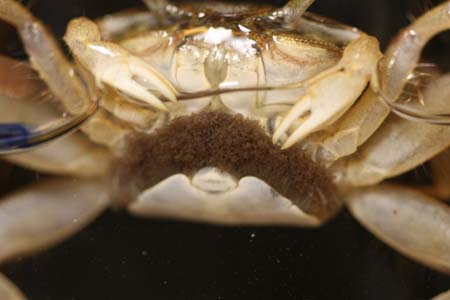
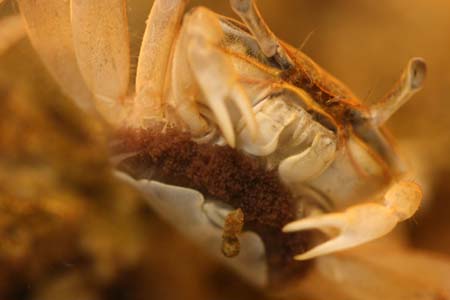
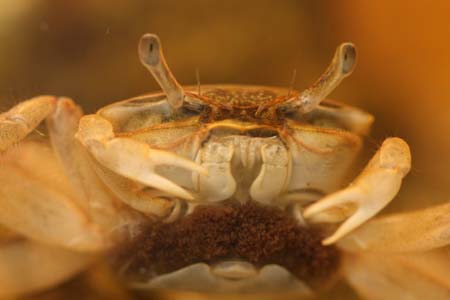
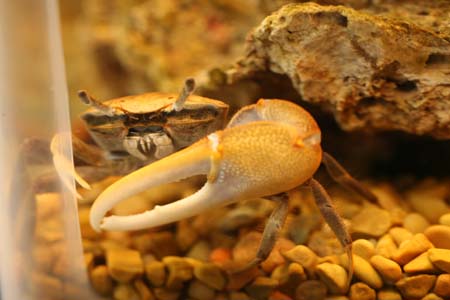
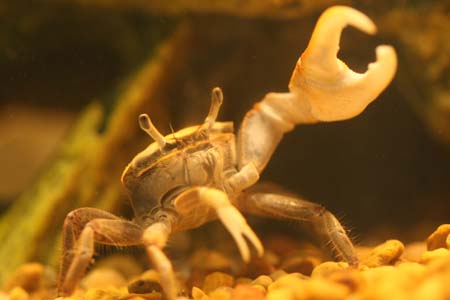
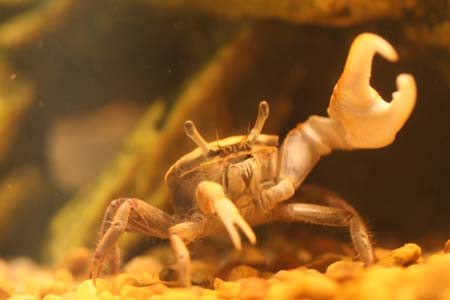
I am going to be out of the office today, so a brief, fun posting with pictures of pregnant Scarlett O’Hara carrying her larval fiddler crab babies. Also a shot or two of the proud father, Admiral Byrd, who is STILL waving his claw. I am determined to get a really good shot of him doing that claw wave, but these aren’t too bad.

fiddler-crabs-feb-18-2008-326.jpg fiddler-crabs-feb-18-2008-303-450px.jpg fiddler-crabs-feb-18-2008-313-450px.jpg

Here are some shots of “the babies.” They are the brown mass of egg-looking things tucked in that shelf on her abdomen. They’re not the sharpest shots, but then, Scarlett O’Hara is not the most cooperative super-model. She won’t stand still. Also, it’s hard to get a shot where she’s not moving her claws. She is CONSTANTLY shoving food in her mouth – she is a two-fisted, non-stop eater. I guess though, she is eating for a few thousand? 🙂

fiddler-crabs-feb-18-2008-220-450px.jpg fiddler-crabs-feb-18-2008-259-450px.jpg fiddler-crabs-feb-18-2008-268-450px.jpg

Admiral Byrd spots me and tries to hide in the corner of the tank against the live rock. The grayish streak is the silicone sealant in corner of the tank. I think he likes to hide behind that strip and also the thermometer strip (not seen) because it blocks his vision of me – that whole “if he can’t see me, then I don’t exist and he’s safe,” mentality? What do you want from a creature with a brain the size of a pinpoint?

The other two pictures are classic Admiral Byrd poses. He sometimes spends all day with his large claw in the air, sometime both claws in the air. While I know he’s either trying to scare me off or encourage the ladies, sometimes when he has both claws up, he looks like he’s paying homage to the god of the tank, the aquarium light above. He is also very pragmatic when trying to show off for the ladies. He’ll have his large claw up to get their attention, while using his smaller claw to shove food in his mouth. A guy has to eat, right?

See you tomorrow!

The Post – Okay, So Now That You’ve Met My Fiddler Crabs, Who is This Deb Bailey Writer Person?

February 12, 2008

I’ve been promising the “where have I been, what am I doing, and where am I going?” piece. You’ve met the fiddler crabs and know that I’m doing some kind of strange book involving crustaceans and humans. And since it’s fiction, not nonfiction, God only knows what it’s about, right? You’re aware I am interested in everything from Nancy Drew, photography, and Tonka trucks (the old metal ones only!!!) to borescopes, poodles, and Buddhism. So, you know I’m odd.

My story as a writer – short version. Plan A: I had a dream. Left a job. Wrote a bunch of stuff. Submitted it. Waited for the money to roll in. It didn’t. So I was forced to move to Plan B: Take a step back. Scratch my head. Get a grip, then do what every writer since the cave man has done – learn my craft and build a business. SLOWLY. While earning paychecks to keep the bills paid.

I decided this story might be useful? Or at least entertaining, to any new writers who have illusions about how this business works. Maybe it will either inspire or make you laugh when you want to cry, so you realize you are not alone. Or you will run screaming from the room and say you never want to be a writer. That’s always a fair answer, too. But I have to tell you, writing . . . it’s a life-long affliction.

If you were born infected with the desire to write, you can run, but you can’t hide from that voice pulling at you to put words down. If you are honest, you will admit to secretly ripping a strip off of a paper napkin while driving because you just CAN’T let that thought go by. You might even admit to having torn bits of envelopes, doctor bills, the back of your son’s first draft of a term paper, or your hand, covered in scribbles of things you JUST CAN’T let escape from your brain without being written down. If it progresses to the more advanced stages, you may find yourself living with your walls, stairwells, garage, kitchen table and living room floor, covered in maps, sketches, notes, paintings, story outlines, books, articles, and half-written manuscripts. Let’s not even discuss what’s packed into storage boxes, onto book shelves, under the pool table or in desk drawers. Like I said, it’s an affliction. You just learn to live with it. And like Stephen King said, he’d do this job even if they didn’t pay him.

In any event, I will split this over a few posts. I think that way, it will also give living examples to the three stages of writer development as outlined by author and illustrator, Uri Shulevitz. The man has a tremendous body of work, has won awards from the Caldecott Medal to the Golden Kite Award, and I think, knows a few things about this business.

I have this old faded email from 8/27/96 from the Children’s Writing email group, where someone very kindly shared Mr. Shulevitz’s comments from a conference. By the way, if you want to write for children, that email group is a great group to be subscribed to. The writers range from the famous to the beginner, and the people there are generous, knowledgeable, and good-hearted. Just don’t show up and say – “I want to write for kids. What do I do?” Or the ever popular, “I wrote something. Where should I send it?” Do some of your own homework, first. Get a copy of:

Children's Writer's & Illustrator's Market 2008 (Children's Writer's and Illustrator's Market)  

Children’s Writer’s & Illustrator’s Market 2008 (Children’s Writer’s and Illustrator’s Market) Read the beginning pages. They have great basic get-started information about the profession – and it is a profession – of children’s writing. For that matter, Writer’s Digest Book Club has a ton of great writing books, some slanted for children’s writing. Just get or borrow some of these books, read them, then come to the list with your questions. They’ll be happy to help. To subcribe, send a message to:

childrens-writers-subscribe@yahoogroups.com

You can also visit the group’s home page at:

http://groups.yahoo.com/group/childrens-writers.

To finish up today’s post and set the stage for the rest of this project, I’ll leave you with Mr. Shulevitz’s thoughts about the process a person goes through to become a writer. Most of us will travel this road I suspect, unless you’re Isaac Asimov, who could write almost perfect first drafts, and over his life wrote or edited over 500 books, an estimated 90,000 letters and postcards, and whose works have been published in 9 of the 10 major categories of the Dewey Decimal System. He missed out only in Philosophy. If you’re not another Asimov, here’s the stages:

The Three Stages of Writer Development (as paraphrased by the email author who apologized for not being as eloquent as Mr. Shulevitz):

Stage One: The Journey of Apprenticeship

Learn about the craft with an open mind. Set aside your preferences. Experiment, experience, try new techniques, look at different eras and styles. Copy other writers to understand their techniques. Survey all styles of children’s books to see what makes the best, good, and the worst, bad. In short: Gather Outside Knowledge

Stage Two: Search Inside

a) Find your own voice and vision. Seek solitude. Be alone with yourself. Seek a sanctuary where you can sort out the voices within and without. Achieve inner silence.

b) Be who you are. You must listen to yourself from your own depths and become acquainted with your own true self and sort out all you have gathered in your apprenticeship. Sort out what you learned from your apprenticeship and learn which is you and which is NOT you. You are what you truly love. Find themes which continue to repeat themselves within you and your work. Examine what may be to some, unpopular beliefs.

c) You will work alone in the end. Any teacher can only take you to your own frontier. You will have to take it from there.

Stage Three: Joy of Working

After the first two stages, you are ready to begin WORKING. You know yourself so well you can lose yourself in your work. Your work will be free and spontaneous because you know yourself so well, but not yet easy or simple.

And by the way, he notes: Sometimes you might have to go back to Stage One or Two once in a while.

UP NEXT: My apprenticeship

The Post – Admiral Byrd was NOT Worshipping Me or The Aquarium Light

February 11, 2008

Over the last 2 days my husband noticed that Admiral Byrd has been spending a LOT of time, meaning almost ALL of his time, up on top of the gravel hill or the decorative cave rock, or the live rock, or just about anywhere else in the tank, waving his claw. He looked so funny up on the cave rock. He seemed to be staring up at the aquarium tank light, waving his claw as if paying homage to a god. We figured either he held the aquarium light or my hand in high esteem.

My husband has joked that he thinks the crabs go inside the live rock so much because it’s actually their holy site. He thinks they’ve cobbled together a crude altar made of gravel and on the altar they’ve fashioned a shrimp pellet image of their deity, the hand that feeds them . . . basically mine. As he put it, imagine that every day a hand comes down out of the sky and places steak or shrimp or pancakes in front of us. That’s what it must be like every time my hand drops algae or shrimp pellets near them.

In any event we weren’t sure why Admiral Byrd decided to spend an entire day paying homage to me or the light. Why all of the sudden? There’s been nothing new going on in the tank otherwise, all three crabs have been actually pretty placid, out and about feeding, and generally happy. Was this some sort of designated crab “Holy Day” that just happens to coincide with Lent?

As it turns out, alas, neither the aquarium light nor my hand are the object of Admiral Byrd’s devotions. Melanie Hamilton is.

From the Fiddler Crab page on the Chesapeake Bay Program’s bay restoration site:

“When looking for a mate, he stands near the edge of the burrow, often alongside a string of other males and their (similarly well-maintained) burrows, while the females, returning from foraging, walk past. The male waves his large fiddler claw until he attracts the attention of an interested female, who then stares at him for a short period.. The male resumes his claw-waving, and if the female remains receptive, the male runs toward her, then runs back to his burrow, and repeats this motion several times until she either moves on or follows him to the burrow. ”

Apparently, mating behaviors take place not just when the female forages, but also when she molts. I happened to notice this pale, upside down body lying under the water filter this morning and immediately my heart hurt. I thought “Oh no! Melanie Hamilton died!” But not so. Looking closer, I saw that it was the pale ghost of Melanie Hamilton. It was that eerie translucent white, like Scarlett O’Hara’s was, though much more petite given that Melanie Hamilton is so dainty. Melanie Hamilton sat right behind it. I would have gotten pictures for this blog but she had tucked herself and her tiny ghost so far under the water filter that I could not get a shot. If only I had fiber optic cable, maybe I could get footage! I have concluded that the fiddler crabs have designated the “under the water filter space” as the “molting place.” All 3 have used it now. I think it has enough stretching room to shrug off the old shell, but is sheltered enough to keep everyone else away while their new shell hardens.

Admiral Byrd of course, was well aware of events in the tank. He was standing just a few inches from the water filter hoping to catch her eye. Alas, while Admiral Byrd is a true romantic and his efforts were truly heroic – I mean he has to be exhausted after almost 24-hours straight claw-waving – Melanie Hamilton is having none of it. She has turned her back on him and remains secluded under the water filter.

But anyway, the mystery is solved. Admiral Byrd doesn’t give a darn about the tank light or the hand that feeds him. He apparently can sense the approach of “molting” and was doing the crab Valentine’s Day equivalent of serenading his lady.

Sorry no pictures, though. I told my husband if he ever decides to spend money on expensive jewelry or clothes for me, I would prefer one of those borescopes like they use for colonoscopies. That would work GREAT in the tank for closeups of everybody! 🙂

Coming up this week:

Now that you’ve gotten to know me a bit – a cross between sea life maniac and soulful – I’ll start to introduce some of the projects I’m working on. I’ll share what I’ve done, what I’m doing and where I see myself going. Children’s writer and illustrator, Uri Shulevitz, described three stages of a writer’s development at a conference about 12 years ago. I’ve kept them as a kind of road map in my development and will use them to describe what I’m doing.

Also to come, a Writer’s bio page of what I’ve already written.

Happy Monday!

The Post – As Promised, What Photography Teaches You About Writing

February 6, 2008

As I mentioned earlier, photographing fiddler crabs helped me to “be one with them.” Armed with the heart of a crab, maybe I can get that across in the book.

In a broader sense, there are some similarities between the arts of photography and writing:

1) Narrow the topic:

The viewfinder of a camera sets the limits on how much you can fit in the picture. A photo is a one-moment slice of an event. You can’t show everything, so you have to choose. What will you focus on?

Good writing, especially essays and short pieces, needs limits too. Start with too broad a topic and the piece runs too long, lacks focus and depth, and leaves the reader wondering it’s about. You can’t say everything, so you have to choose what you will say. Choose a specific slant and give the reader depth for that one topic.

2) Composition – Create the Scene:

Part of the art in a good photograph is its composition. What did you include and why? How did you choose to portray it? What angle was it shot from? Lighting? Shadows? Contrast?

In a good story, “show don’t tell” is done with scenes. You’re the director. How will you set it up? Who will be in it and who will be left out? Why? What will they say and do? What are they holding? Wearing? Where are they? Is it frigid or tropical? Are they scared or serene?

3) Detail is the life of the creation:

The camera’s eye doesn’t miss much and often sees more details than the photographer did when taking the shot. The details that show up in the picture bring it alive, especially in things like still life and macro photography. The details ARE the photo.

In writing, specifics are the spice that creates the picture. Something doesn’t smell good, it has a licorice herbal aroma that wafts through the sunlit cottage and makes you salivate with anticipation. Something doesn’t feel rough and hurt you, it has a gritty surface that grinds against the tender flesh of your palm until it strips the skin raw and bloody. Specifics create the image.

4) Deliver the vision:

You can see the image you want in your mind’s eye, but if you can’t work the camera, all you’ll get is a dark blur. Master the technology.

The most amazing story may run through your mind. Yet if what appears on paper lacks organization, moves too slowly, leaves out needed plot points, has poor sentence structure, bloated dialogue, or no sensory details, no one will get it. Master your craft.

5) Know what you want to say:

A photograph may be wordless, but it will still speak to the viewer if the photographer knows what he’s looking for.

In writing, you may have a 500-page novel but you still need to be able to sum it up in a line or two. If you can’t do that, you don’t know what your story is about.

In the future, 10 or so things an oil painting taught me about the writing process. Stay tuned.

The Post – There really IS a deeper process at work here

January 29, 2008

Some lighter fare on tap in the next few days…photos of Admiral Byrd waving his claw, Scarlett O’Hara and her molted ghost self, and . . . even the ever reclusive Melanie Hamilton! Finally caught her sitting on her “front porch” – ie the open hole in the Live Rock – at 6:30 this morning. Stay tuned.

For today: So does staring into a tank of fiddler crabs, never mind shooting photographs of them at 6:30 in the morning, REALLY have anything to do with writing?

The answer? It all depends. You mean you wanted a definite answer? Here’s a clue – Mindfulness and heart. Still confused?

Simply said, it’s what you bring to the situation. You can sit there and stare at them and your mind could be on the bills, what you’re going to buy at the grocery store, what you could be doing instead of sitting in front of a tank of crabs. You could sit there and nod, “Yup, they’re crabs. Eyestalks. Sideways walk. They all look alike. So what?”

Or you can sit there and notice that Melanie Hamilton has much tinier front claws than Scarlett O’Hara. That she is timid and almost never comes out of her crevice in the live rock…except early in the morning when the sunlight streams into the kitchen and hits that side of the tank. She loves to sit in the sunlight on her front porch. Or that Scarlett O’Hara, who normally never stops eating and never hides out, suddenly after molting has stopped eating and has refused to move from under the water filter. Or that Admiral Byrd, normally fearless, crawled into his tunnel cave after discovering Peter Lorre’s lifeless body and started twitching and wouldn’t eat.

The difference is how you watch. Are you fully present? And did you bring your heart? The heart makes all the difference.

I am taking an online spirituality course with some friends, studying the writings of Thich Nhat Hanh (pronouced Tick Naught Han). He is an 80-year-old Vietnamese monk who endured the horrors of the Vietnam War, came to America to try and stop it, and was deemed a threat by both the Communist and non-Communist regimes in Vietnam. While searching for peace, he found himself everybody’s enemy. He was nominated for the Nobel Peace Prize by Dr. Martin Luther King, Jr. for his efforts to stop the war, and in his later years one of his many healing works has been to heal the souls of former American servicemen haunted by that war. Having lost close personal friends to that war, he has every reason to hate Americans. Instead he’s spent half his life healing people around the world, including Americans.

He tells a story in one of his books about a young man who wanted to learn to draw lotus flowers. So he went to a master to apprentice with him. The master took him to the lotus pond and left him sitting there for 10 days. Can you imagine in today’s busy world, signing up for lessons to learn something quickly, only to be left sitting at a pond for 10 days?

The real essence was what the young man did with that time. He could have gotten impatient (something I know a lot about), and grumbled, sighed, walked away, went shopping, took a nap, try to do something USEFUL with that time instead of just sitting there. Instead for the whole time, he watched the flowers bloom when the sun was high. He watched them close into buds at night. He watched one flower wilt and drop its petals into the water, then studied the stalk, the stamen and the rest of the flower.

On the 11th day the master returned and brought him a brush to paint with. Although his picture showed his naivete of technique, a childish style, the lotus he painted was beautiful. Deep beauty shone from the painting. He had become the lotus and as such, even with poor technique, he could paint something that moved another’s heart.

Mindfulness and heart. He paid attention to the lotus. He worked from his heart. Writing, really good writing that moves people’s souls, comes from the heart, not the brain. You can write a technically beautiful book but without heart it’s a sterile desert emotionally.

I started out watching fiddler crabs not sure what to expect. I certainly didn’t expect them to have personalities and subtle differences in appearance and actions. And I most certainly didn’t expect to feel such upset as I watched Peter Lorre tumble off his rock, dead.

With any luck, at least a little part of me has become the crab. With just a little more luck, maybe that crab heart will come through in my book. I’d trade a whole bunch of technical expertise for just a handful of heart.

By the way, if of interest to read a good summary of Thich Nhat Hanh’s life, check out this link at Parallax Press.

http://www.parallax.org/about_tnh.html

The Post – Scarlet O’Hara Lives! And How I Came to Love Fiddler Crabs

January 25, 2008

After almost 10 days without a sighting, FINALLY yesterday afternoon, I spotted Scarlet O’Hara. I wasn’t sure at first if she was just a corpse, dangling upside down inside the Live Rock with her eyestalk hanging down, but shining the flashlight into the rock’s cavity at 5 minute intervals, I was able to determine that a) she actually had moved her position, and b) on the second and third times, she reacted to the light beam and flinched. This latter point was important because it meant the movement was deliberate, not the result of her just being bobbed around in the cavity by the water’s movement.

Relieved to know she wasn’t dead, I went ahead and did the water change. (More on that below) Then last evening, Scarlett O’Hara emerged from the Live Rock Cavity, and slowly started moving around. She resembled a patient just released from the hospital – someone tentative in her steps and tired after her ordeal.

Okay. Right about now, I’m sure anyone reading this is wondering what the hell I am talking about. Let me back up to the beginning and give you the Readers’ Digest version of events. I am contemplating setting up a separate blog – Crab logs – to capture all the events since the beginning of this endeavor, for those purists who only want the “lab notebook stuff.”

As I’ve mentioned I am writing a mid-grade novel called Under the Pier. At least that’s the “working title.” The protagonist of the “under” the pier side is a hermit crab. While I had no trouble pinning down facts about the creatures in that world, those chapters lacked “heart.” They read more like a nature guide. My husband read the first few animal chapters and noted that frankly, he didn’t care about the creatures. That’s a death knell for any book, whether the characters are human or animal. The whole point of reading a story is to feel what the characters feel, live through the story struggle with them, and stay along for the ride because… you CARE about them. If my husband didn’t care about them at chapter 2, I had a problem. So, back to research.

It occurred to me that I just hadn’t captured what it felt like to be an undersea creature. Since I can’t live underwater, an aquarium is the next best thing. I couldn’t have a marine hermit crab like the one in my story as a pet because that meant setting up a salt water tank, something reputed to be very difficult. PetsMart had something called “freshwater crabs.” A freshwater aquarium meant cheap, at least cheaper than a saltwater one, and easier. I’d had aquariums as a kid. I figured I could set up a small tank very inexpensively, get a couple crabs, and voila….live research that would teach me how to emotionally bond with something I normally eat in garlic butter. As I’ll describe below, “cheap” didn’t take place, but emotional bonding did. My husband noted that I bought myself $4 worth of fiddler crabs, and $100 worth of support gear. 🙂 In reality, it’s been way more than that by now, but . . . more about that later.

Anyway, I bought two males, not through any particular strategy. Those 2 just happened to wander into the net the teenage employee swished through the store’s tank. I rushed home with my new “pets” and all my gear and rapidly set up the tank. Normally, when you set up an aquarium, they recommend getting everything established before bringing home your fish. However in this case, I figured why bother setting it up ahead of time when the saleslady made it sound like all these guys needed was some water and a bubbling air tube. Again, more later.

The larger male immediately ran around his new tank, explored every aspect, took command of the gravel hill (they need an area where they can be out in the air for up to 50% of the time), and showed no fear. Given his apparent “explorer” mentality, we named him after the South Pole explorer, Admiral Byrd. The smaller male immediately bolted under the water filter and stayed there for 2 or 3 days. Even when he came out, he skulked around in the background. My husband noted that he acted like the Peter Lorre character in the movie, the Maltese Falcon, so we named him Peter Lorre.

I’m going to skip over the travails of learning I should have set up the aquarium first before buying the crabs, the fact the people had us buy the wrong food (how are bottom-dwelling crabs supposed to eat krill shrimp that only float on the water’s surface and don’t sink?), and the many things that made me realize these crabs really do need more than a bubbling air tube if they were to live longer than the 2 weeks PetsMart’s written guarantee said they would.

As it turned out, Peter Lorre made it about 3 weeks before he died. I think his poor little body just wasn’t up to the stresses of toxic nitrite and nitrate levels, not to mention the fluctuating salinity levels (see below). By the time I learned about Live Rock and how it speeds up the nitrogen cycle in the tank and makes things healthy and non-toxic, Peter Lorre just stopped walking one day, tumbled off the live rock, and dropped headfirst to the bottom of the tank, dead. I was heartbroken…he was the quiet timid one, and I did like him. My husband couldn’t understand how I could care about him given that I ordinarily do not hesitate to go to a seafood restaurant and consume his cousins with great enthusiasm. Doing a twist on that line from the Godfather movie about things not being personal, but business, I said to my husband, “This is personal, not lunch.” When things get personal, you go to Google for answers.

Now, for any aquarium geeks – a couple things. Live Rock, as mentioned above, is rock taken from a tropical coral area, and contains microscopic sea life and bacteria. By adding a1 pound chunk of cured Live Rock (ie has been allowed to sit in a salt water tank and age and no longer smells like a salt marsh) to the tank, it essentially seeded the tank with nitrogen-fixing bacteria. They speed up the establishment of the Nitrogen cycle. That’s where toxic ammonia and nitrites generated by the biologic wastes in the water, are converted to nitrates. Eventually the levels of ammonia, nitrites and nitrates drop to zero. The Live Rock also has the benefit of leeching calcium into the water. This comes in handy for keeping things like pH and calcium at stable levels. Crabs need high calcium for molting. Anyway, once I added Live Rock to the tank, the toxic conditions subsided rapidly. But not in time for Peter Lorre.

I also learned that the crabs I bought were “red-jointed fiddler crabs,” otherwise known as Uca minax. Sometimes PetsMart sells the yellow-clawed ones, Uca pugnax, or mud fiddler crabs, but I definitely got the red ones. While these crabs can survive in freshwater, it apparently shortens their lifespan considerably. I read somewhere that they can live a year or more if kept at the right salinity. I figured salinity meant “marine.” After all, if they weren’t freshwater crabs, then they were salt water crabs. I went out and bought aquarium salt and made it up to the regular marine aquarium specifications, a minimum specific gravity of 1.020. I eagerly added the water to the tank figuring my guys would react with glee. Instead, Peter Lorre went into a daze and foamed bubbles out of his shell. Admiral Byrd bolted out of the water like I’d just added sulfuric acid and literally tried to climb the walls of the tank to get out. I didn’t understand it. I’d followed the directions and they “should” have liked the water, but obviously they didn’t. Even fiddler crabs deserve not to be in pain so I added some plain water to dilute things. They settled down.

In hunting around some more on Google, I discovered that these crabs are in reality, brackish water critters. That is that “estuary” type environment where the rivers meet the sea. The water is neither freshwater nor saltwater. Brackish water has a much lower level of salinity. Further, I found a study of fiddler crabs in the rivers of Delaware that really illuminated the problem. Uca minax – the red-jointed guys – prefers water with a specific gravity of around 1.008 – 1.018. Any higher than that and the LD50 (the time it takes for 50% of the population to die) is 2- 3 weeks. Same if you put them in freshwater.

Interestingly, according to the study, the yellow-clawed guys LIKE the higher salinity. If I’d had Uca pugnax crabs instead of Uca minax, they would have loved the higher salinity water. But my guys hated it. They needed….brackish. That’s how it goes with me. I start out to have a simple freshwater tank, then accept I must make it marine, only to find out I have to actually set up a brackish tank…something by the way, very few people do probably because there’s no books on the subject. In any event it’s been quite the adventure, and I sure have learned a lot, becoming a bit of an expert now on maintaining a good brackish water environment, a source of pride for me. However, this should explain now, my husband’s comment about $4 worth of fiddler crabs, and a $100 worth of support gear. It goes without saying I needed a gauge to monitor specific gravity not to mention water conditioner, solutions to decrease the ammonia until the Live Rock bacteria kicked in, and test strips to check the water…a lot. 🙂

Anyway, end of geek moment and back to the story:

Well, now that Peter Lorre was dead, Admiral Byrd was beside himself. He sat in his little cave tunnel near Peter Lorre’s dead body and just twitched. I thought he’d eat Peter Lorre given that they are scavengers, but apparently fiddler crabs don’t eat their friends. I removed Peter Lorre and gave him a proper pet burial in our front yard, next to the gerbils, hamsters, and pet rat buried out there. Then I set out to buy Admiral Byrd more friends.

I found this amazing aquarium store on the outside of Raleigh, NC – Fish Pros – Fishprosnc.com SALT WATER TANKS and ALL KINDS OF GEAR and PEOPLE WHO KNOW WHAT THEY’RE DOING!!!!. In fact some of their staff are marine science students or professors at NC State University nearby. In any event, I left there with not just ONE more friend for Admiral Byrd, but three. And this time, there would be WOMEN!

I figured keep the numbers even, so I bought 2 females and one more male. The man at the store noted that having the females would produce some neat “claw-waving” mating behavior in the males – the crab equivalent of “Hey baby, check me out!” Also, since females weren’t territorial, it was possible to have more crabs in the tank without having fights. Needless to say, Admiral Byrd perked right up when he saw he had friends, and when he realized there were ladies, well, he hasn’t stopped waving his claw since.

In any event, the male struck my husband as the “Rhett Butler” type, so, the new guy became Rhett Butler. That meant following the Gone With the Wind motif for the ladies names. The larger female demonstrated an overbearing, fearless, almost aggressive streak. She became Scarlett O’Hara. The more timid, fragile female, is Melanie Hamilton.

Again, for whatever reason, we lost one of the crabs – Rhett Butler lay dead in the back of the tank. No outward evidence of “foul play” ie – Admiral Byrd killing him off for territory or women. Again, another pet burial in the front yard. However, since then, the remaining three crabs have done fine. Yes, the women get fed up with Admiral Byrd chasing them around. And Yes, Melanie Hamilton got tired of Scarlett O’Hara stepping on her to get to the food pellets. Melanie Hamilton spends most of her time living INSIDE of the Live Rock chunk. She does peek out the front or side entrances long enough to grab a food pellet and pull it inside, and every now and then she will climb out and wander around, but she’s very skittish and races back in the rock at the slightest provocation.

My Scarlett O’Hara concern started about 10 days ago. She enlarged the front entrance to the Live Rock, ie, pulled out a bunch of gravel and tunneled under it to get inside it with Melanie Hamilton. For a few days I could see them both crammed inside the Live Rock if I shined a flashlight into one of the rock’s openings. But for the last 10 days I could not find a trace of her. At first I figured she went in there to molt. Molting takes a few hours. So, I figured give her another day or so to rest and she’d be back out. No dice. No matter how often I shined the light into the rock, all I could see was Melanie Hamilton. By yesterday I’d decided Scarlett must have died and I needed to pull the rock out of the tank, if only to remove her dead body for burial.

However, just before I did that, I shined the light into the Live Rock and lo, that’s when I saw Scarlett O’Hara. She was clinging to the roof of the cavity, and I could see her eyestalks hanging down. Since she emerged from the rock, all is back to normal. Scarlett O’Hara and Admiral Byrd run the tank and wander constantly, seeking food. Melanie Hamilton peeks out of her cave and pretty much stays out of sight. As odd as it sounds – I am so HAPPY!!! I really felt bad at the thought she died. Seeing everybody doing their usual thing, it’s like “aaahhh, back to normal.”

Oh – one last geek moment, a moment of pride for me. I did a 33% water replacement in the aquarium yesterday – almost double the 18 % change the time Admiral Byrd freaked out about the salinity, and more than the recommended 25%. I didn’t have much choice given that the water really needed changing. I added the water and held my breath, keeping a close eye on Admiral Byrd. Apparently, this time I did it right. The tank water was at a 1.010 specific gravity, and so was the new water I was adding. Not only that, but the other parameters were great : pH 8.0, total hardness (GH) >300 ppm, total alkalinity (KH) 300 ppm, chlorine and nitrite 0, and nitrates “okay” at 20 ppm. (I’ve been using the Jungle Laboratories brand Quick Dip 6 Tests in One strips). And Admiral Byrd? He just kept right on eating through the whole thing. Never once climbed the walls…he never even left the water. SUCCESS!!!

Now I’m saving my allowance to buy …. two land hermit crabs!!!! Stay tuned soon for their adventures.

And stay tuned…working on getting pictures of Admiral Byrd, Scarlett O’Hara, and Melanie Hamilton…if she ever comes out of her cave!