A moment before continuing the story, to state the “rules of the road” for this book
Before continuing with posts about my life, I want to share what I think is a vital part of any memoir – stating the rules, goals, and cautions for the book. So this is the first of a 2-part set of posts that will form the introduction to my memoir. That introduction will give all readers clear information about the how and why of my approach.
The “hows and whys” of my writing
Since there are so many good books on how to write a memoir, mine does not and will not be a textbook on all the nuances, methods, and rules.
But the following things jumped out at me as I studied all the different books on the subject. So I wrote myself some clear guidelines:
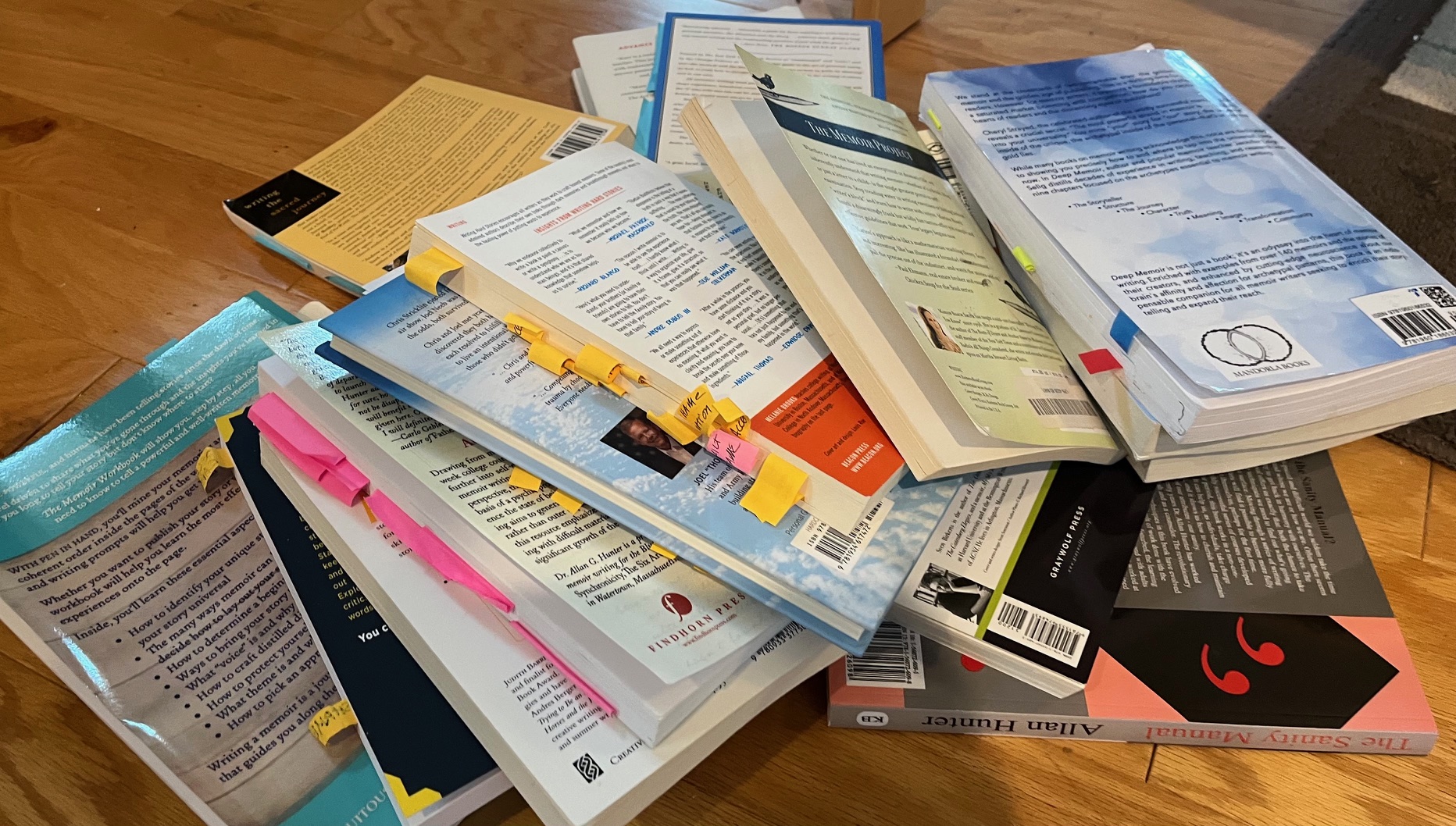
Photo by the author of just “some” of the many memoir-writing books in her home library
What About the Risks?
So you’re considering writing your memoir. You take stock of what stories, events, and insights most impacted your life. You examine your life and make a list of obstacles encountered, successes and failures — and how you dealt with either. Your soul says “there‘s bits here that might be helpful to share,” so you sit down at the computer, get ready to open a vein and…you freeze.
There is no question that many writers experience tremendous fear when writing, no matter the topic. There are many books and articles out there on how to write, what to write, and even how to overcome the fear of writing. I have more than a few of each kind on my bookshelf.
Fear of writing
On that last item, fear of writing, I have a book — The Courage to Write: How Writers Transcend Fear by Ralph Keyes — that I’ve kept since it was first published in 1995. So, it’s not a new problem. I suspect the first time a cave person scrawled an image on a stone wall it might have given them pause when they stepped back to assess their work.
The idea of putting ourselves out on the page…even if we never show it to anyone, may stop us before we ever start. And I am not even talking about whether the writing is any good or not. First, there is the possibility of triggering powerful emotions never before confronted. That is immediately followed by self-judgment: Am I really like that?
The pages never read aloud
We all have those “pages we never read aloud” to anyone — things we don’t want anyone to know about us, and for that matter, things we may not even want to admit to ourselves. And yet there is no escaping their reality when the words sit there — stark black letters blazing tracks across the white page.
Even if we’re not writing about our own mistakes or faults, there is no question that subjects of a serious nature will impact any writer’s willingness to venture there. It’s one thing to talk about how a car engine works and know you will be judged on how well and accurately you write the piece. But to write about victimization, shame, or messy emotions, and to say on the page what someone drilled into you NEVER to speak about, invites some powerful ghosts to come stomp all over your courage.
While you may have shared those stories with therapists, relatives, or close friends, it is a whole other matter to actually know that thousands of perfect strangers know your secrets. And that doesn’t take into account in a digital age, putting things out in places where people can respond immediately, and with things like: “What’s the big deal? Get over it” or worse.
So that brings me back to my original question — is writing a memoir worth it?
The power of transformation
I have been reading a book on memoir writing that is great…actually, I’ve read many over the last few years. But the one I speak of right now — Deep Memoir, by Jennifer Leigh Selig, PhD — just nails soooo many important themes.
One theme in particular, in a chapter near the end of the book, really caught my attention. In that section, the author dug into the power of writing a memoir to transform you — change you not just by looking back at the past and making observations about what happened THEN, but to change you RIGHT NOW as you are writing.
As soon as I read that sentence, my gut tightened because I knew exactly what she meant. I’d be writing about some issue of anger or shame that I’ve carried for years and even as I was typing the words, I could feel some slight shift in me…a softening, compassion, a lowering of terror.
All I know is that in those moments, I am like a crucible holding individual chemicals. And as I am held over the fire in that writing process, the chemicals start to melt, mix, react, and become something new. The process taking place in that “writing crucible” changes me and it’s not about the ingredients I started with. It’s the process.
But what about the risks?
But the book also notes some authors who have experienced extreme emotional trauma such that after they published their book they said they would never do it again. Jessmyn Ward, writing about five men in her life who died, said she doesn’t know if she could go through that process again. Carmen Maria Machado, after writing about intimate partner abuse, said she probably would not. And Pat Conroy, writing about his childhood abuse in his novels, experienced suicidal despair, attempted suicide, and had another suicidal breakdown later, after another book. So the risks to one’s mental health are not imaginary or inconsequential, especially when writing about traumatic events.
Physical illness is another way traumatic material can wreak havoc on a writer. Kate Bornstein was already experiencing sleep and eating disturbances, along with having to seek therapy because her writing triggered a borderline personality disorder. But she also suffered gut problems so severe they had to remove part of her intestine, something she attributed to her writing. She said the writing “gets you right in your gut…and I took that as a sign that I was on the right track.”
All of that aside, there are the “normal fears” about writing a book. What if people hate it? Or don’t get it? Or maybe worse, what if they love it and the response overwhelms you? Fear of success is just as strong as fear of failure. Especially if you’ve lived through abuse, you may have lived your life in the shadows and sudden public awareness is too much. Or there are the stories about writers who’ve encountered rejections and relationship breakups; angry responses from others who don’t like what was shared; or for some, even lawsuits.
What risks am I facing?
So, based on all of the above, in terms of writing my memoir I realize it might:
Trigger my own pain, health, and emotional reactions to revisiting painful things
Expose all my hidden details to the public
Deliver reactions from others that I may fear, or be emotionally devastated by
Change my life
As to “change my life” — well it already has. And will continue to. Just look at the fact I am writing here and saying truths I’ve not put out publicly before. So change is a given. And the remedy for that is just “one day at a time.”
Regarding the first three risks, I have given those a lot of thought. I have put in place some support systems for me as I do this. Also, I drafted a list of things to share with readers at the beginning of the book — things such as rules and boundaries for how I chose to write the story; trauma-trigger cautions for readers, given the topic; and most importantly, the purpose for writing.
What is memoir REALLY for?
The last one matters most because in the end, if I am going to write a memoir, it is not about just making a laundry list of all the things I lived through. It is REALLY about: because of what happened, what did I do with it? It is about coming back. It is about hope. It is about connecting on a universal level with a reader who might have a different story but still experienced similar emotions.
The “decision-maker”
Having thoroughly rattled myself with the risks, I did one last thing before answering the question — I made a comparable list of “why it’s worth it to write a memoir.” I figured it would be blatantly obvious after that, what I should do.
Digging into all of the books in the above picture (and several more) I compiled a list. It was an illuminating…actually an eye-opening experience. And so I came to my decision.
I will share in a separate post, what I put on that list. It will, no doubt, make clear my logic and maybe be helpful to anyone else considering whether to write their memoir or not. It goes without saying — but I will say it anyway — that each person has to make their own list and determine what their own risk/benefit ratio is for writing and then make their own decision.
The bottom line
But for me? Is writing a memoir worth it despite everything above? And despite the fact it’s taken me seven decades to come to this point?
I knew Phase II had arrived. Its symptom was unmistakable. I was tired. The amount of work coming from the dictionary job ran up against the short-term deadlines and heavier workload from the ethics board. Family needs took up more time. The ethics board work increased even more. And then there was the point of it all, my writing projects. I realized that I not only couldn’t keep spinning 20 plates on sticks forever, but I didn’t want to. Where some people revel in that level of activity or that challenge, I did not. That, in itself, was telling.
Going back to Mr. Shulevitz’s advice: “You must listen to yourself from your own depths and become acquainted with your own true self . . . learn which is you and which is NOT you. You are what you truly love.” My husband’s reminder felt viscerally real: I wasn’t getting any younger and I needed to stop trying to be what I was not.
I let go of the dictionary work. While it was a good job, I wasn’t meant to be a lexicographer. I throttled back on the ethics board work. It was time for that directive: “Be alone with yourself . . . Achieve inner silence.”In my case that came partly from renewing my dormant practice of meditation and prayer, as well as just, being alone. You can’t run from yourself. To be a writer, if you’re going to have anything worth saying, you must learn your own truth. And it’s only in the quiet moments that the voice within can be heard.
For the first time, I stepped back from my work and took a look at the big picture. I listened to Mr. Shulevitz and sorted out the voices without and within, I looked to see what themes kept repeating themselves in me and my work. That’s when things started to come clear.
I love nature. I loved being 10 and climbing trees and fences and running free in the neighborhood – that time of childhood where you are most capable, where adventure and innocence are at their crest, before the trials and tribulations of adolescence set in. I love castles, the Revolutionary War, diners and the sixties and the blue collar, ethnic world I grew up in. And mythology.
I noticed that I collected, and still do, every silly, touching or factual story about nature, animals, and zoos. I kept a nature journal of our backyard bird feeder and the pond area and collected 3 years of information. I identified with creatures either too small or too much in the background to get noticed, and I was that nature-geek, driven to learn about every tiny sea creature that lived under the ocean pier.
I also knew I’d probably never draw comic strips, or write romance novels, science fiction, or true crime. Nothing against any of those genres, by the way. In fact I am fascinated by the genres of comics and romance novels – they are unique worlds and they seem cool and fun. They just aren’t my talent. And no, I will not try to write any more picture books. In truth, my husband has that voice.
I started to define the projects that were me:
A mid-grade novel set in Williamsburg Virginia during the Revolution.A mid-grade novel set in a 1960s blue collar ethnic New England town, of course, set in a diner. A historical fiction set in 1200s England on the Welsh Marches borderlands. A chapter-book of Greek mythology stories. A fantasy trilogy involving the world of a groundhog living at a highway rest stop, who faces the battle of ultimate evil, personal despair, loss, and emergence into wisdom. And a present day Tween novel of a girl above the pier, in another diner of course, and a hermit crab below the pier.
There is also a love of tweaky, short non-fiction articles about history and . . . nature. I rediscovered a love of and need for essays, which I will write about separately.
I started collecting reference books for all of these projects. Nature guides. Historical fiction. Topographical and historical maps of England and Wales. I made a plaster of paris model of the castle that my lord built, incorporating the latest high-tech gadgets of the early 1200s.
I pinned my project papers everywhere – the study walls were covered on one side with the pier story – maps of the fictitious town, topographical maps of Narragansett Bay, schematic of the diner of my dreams, the one I’d have if I had the money. The other side of the study has the groundhog world – map of the rest, deep woods, nearby farms. The hallway, spare room and stairwell have 1700s Williamsburg, while the den downstairs houses maps of England, schematics of the castle, and the castle model itself.
I even have two webcams up on my computer that allow me to step into 1700s Williamsburg whenever I want. I can see the view down Duke of Gloucester Street or watch the goings-on at the Raleigh Tavern any time day or night. I even had a lobster-cam until that one broke. So I had to settle for the DVD, Realm of the Lobster, that has footage of the undersea world of the lobster in the Gulf of Maine. I found that in this cool marine store store, Hamilton Marine, up in Searsport, Maine. Great website and catalog! Everything from diesel boat cabin heaters and EPIRBS, to cold-water rescue suits and ship’s bells. My next purchase from them will be a hand-crafted wind bell that sounds like a harbor buoy. They even give you the choice of 13 different bells – each one sounding like a buoy in a different place – Bar Harbor, Portland Head, Camden Reach, Outer Banks, etc. I use anything that puts me in the place of my stories.
I started painting again and even did one for the pier story. I bought a new digital camera and started shooting pictures . . . once I stopped being afraid of the thing. It only sat in a box for 2 years. In both painting and photography, I noticed the themes of nature, broken things and overlooked things.
And the words mosaics and broken bits, kept surfacing.
Finally, exhausted, I left the ethics board job. It had gotten to be so much work I was too drained to write. Besides, it was no longer who I was. Revisiting Stage One, I collected outside information as it applied to the projects I wanted to do, from sources like Writer’s Digest magazine, The Writer, countless writing newsletters, market guides and writing books.
All of this I did silently. Alone. Immersed in my own world. And I came to accept that I will work alone. Others can prepare you, teach you, assist you, but when you finally stand at the edge of that dark forest- your own inner world – you must face that one alone. It’s that line from the movie, The Empire Strikes Back. Luke Skywalker is about to enter an area of the swamp where evil lives. He asks Yoda what is in there. Yoda’s response: “Only what you take with you.”
All that was left now was to pick which project came up on deck first. My groundhog story was fairly well outlined. The 1700s Williamsburg novel had some drafts done, characters fleshed out, rejection slips collected. The Under the Pier story had an equal amount of journaling, drafts, and character work finished. The other projects were much further back in the data collection and journaling stages. One day in confused desperation I asked God to please “pick a nipple for me.” A few days later we stopped at Science Safari, a tweaky science store for kids. Sitting atop the discards pile on the sale table outside, was a stuffed hermit crab. My husband and son spotted it. I knew who sent it, so I bought it. The answer had been sent: Start with Under the Pier.
UP NEXT: A Sidetrip to Essays – But the Bus NEVER Came Up This Far on the Curb Before!
THEN: Phase Three: Coming Into My Own – The Evolution of a Novel.
 Soul Mosaic