Posts Tagged ‘photographs’

What Kind of Visuals Am I Using…and Why

January 11, 2025
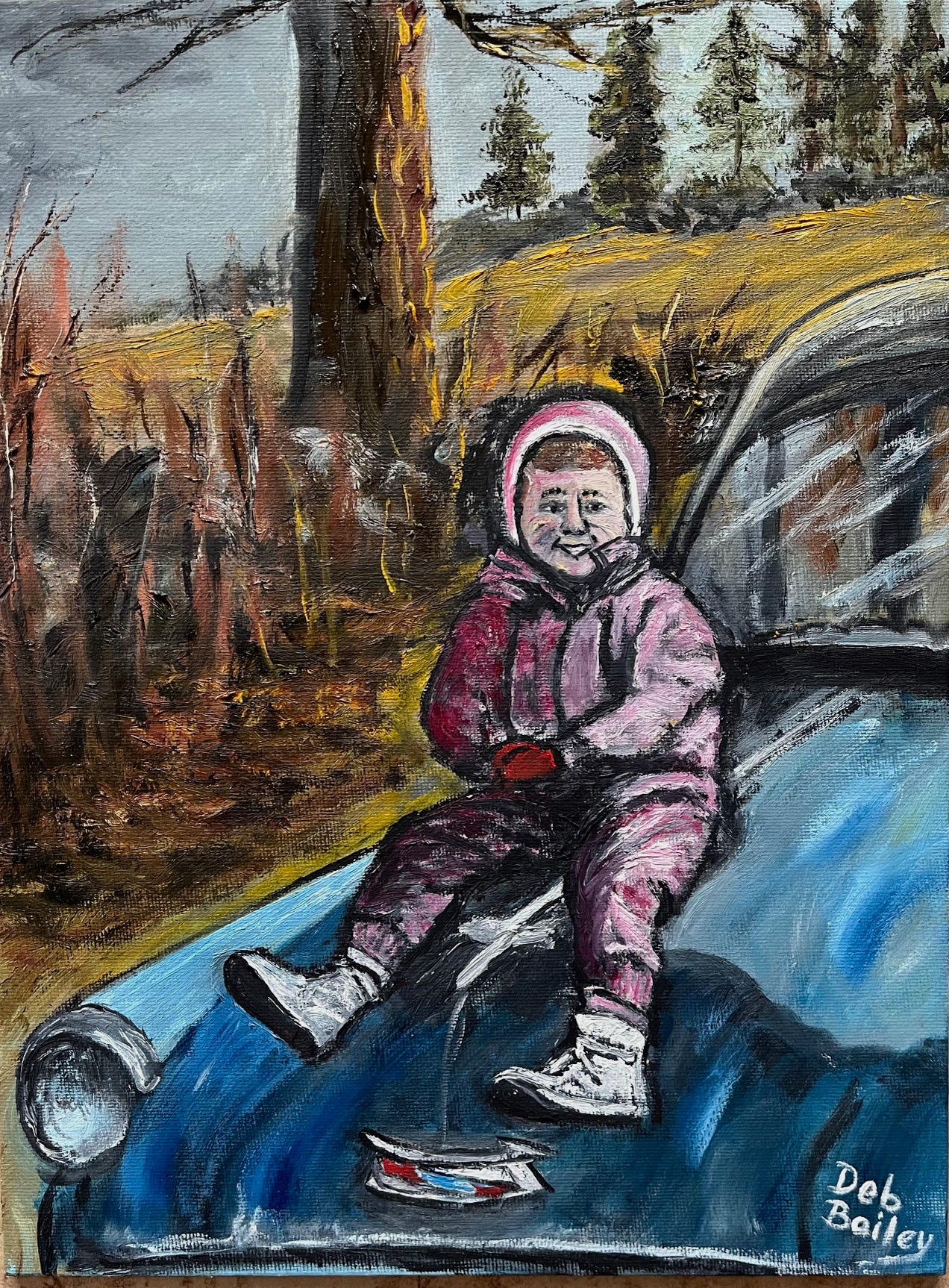
Painting by the author of the author as an infant in a pink snow suit sitting on the hood of her parents' 1954 Chevy Belair sedan
Painting by author – Author as an infant on hood of her father’s car

Driven to paint

Before I share below a sampling of the visual elements I am using in my book, I thought I would share the “WHY” I not only used them, but HAD to use them.

Rebuilding my life

The book incorporates the story not only of the abuse I endured, but also of my journey from my parents’ house—the depression and despair—to my rebuilding, and my creating of a meaningful life.

Even after the initial crises of my escape and recovery with the help of good therapists and friends, I would return for rounds of therapy off and on throughout adulthood. Given all of the life lessons I had missed out on during my early phases of life, I looked at it as “preventive maintenance.” Why “wing something” when I wasn’t sure how to handle it and risk messing it up, then have to fix it? Better to learn as I went along.

The traumas of life

This approach worked well, and I thought I had finally put the past to rest…until midlife. Menopause hit. My husband almost died. The dog did die. My son left for college. All at once. But even worse, those new traumas blasted open a well of trapped emotions I never realized were even there. Like opening Pandora’s box, it unleashed a flood of unresolved depression, anxiety, flashbacks, nightmares…severe PTSD. At the time, I had no idea what was going on. Desperate and having major anxiety, I began working with a skilled trauma specialist who was and remains a godsend in my life.

This was fortunate because, in addition to everything that I was dealing with, I also began navigating the last chapters of my parents’ lives and their deaths. It was then that I realized just how much work I still had to do.

The past comes calling to claim its due

Those first decades of adulthood had been about building a life. Now, it was about returning to the past to address the well of unfinished business and unresolved pain that had come forward to claim its due. It had patiently waited a lifetime…my son came first all those years. But now, it was time for me…and that long-suffering child.

However, I had no tools to reach the pain, to know how much was there, or to express it. I only knew its presence through the agony of body memories and nightmares. That was when I made the discovery that art heals.

(more…)

The Post – Some BEAUTIFUL, Award-Winning Sea life Pictures

January 28, 2011

It’s been a very hectic week, so hence, the quiet on the blog front. But it is Friday and just making it through the week deserves a “something special” gift for all of you. So here it is, from Carol Grant. You just HAVE to check out her pictures.

Carol Grant, winner of 2009’s Nature Conservancy Photo contest, explains her photographic motivation: “I want to help our underwater world because it is where I feel most at home.” To learn more about Carol, click here

Click on slideshow of her work to see some amazing shots of her underwater world view.

The Post – In Art: What is Not There, Makes it Useful

February 10, 2008

I had about three other posts in mind for today. Each one flooded my brain though, making it impossible for me to find the “simple thread” at its heart. That means they’re meant for another day when my mind can absorb them and sift through the layers to the simple truth at their cores. Sometimes, what is not there, makes it useful. By clearing something away, you see what is waiting there to be discovered. As soon as I set these other topics aside, my eyes landed on what is meant to surface today.

There is a book from the 6th century B.C. written by Lao Tsu, called the Tao Te Ching. The book is described as the essence of Taoism, contained in 81 chapters, which are more like 81 poems or pages because the entire book is about 5000 words. Don’t let it fool you. The shortest entries are the hardest to decipher. What is not there makes it useful.

Entry Eleven is one I could actually figure out-at least most of it. We won’t discuss those last 2 lines whose meaning in view of the rest I still haven’t figured out.

Thirty spokes share the wheel’s hub;
It is the center hole that makes it useful.
Shape clay into a vessel;
It is the space within that makes it useful.
Cut doors and windows for a room;
It is the holes which make it useful.
Therefore profit comes from what is there;
Usefulness from what is not there.

While Lao Tsu probably wrote them as rules to live by, I realized that they also apply to the creative arts:

Michaelangelo said that the sculptures he did were already there, fully formed in the rock. He just released them by cutting away all that was not the sculpture.

In photography, the photo’s essence is all about what to include and what to exclude. Even when you print the photo, it is often cropped first, to remove the things that don’t contribute the the unity of the photo. Leave in too much, and you dilute the power of what remains.

I recently took an oil painting seminar on color theory. The artist, Caroline Jasper, shared her process of creating seascapes. She started with some photographs of boats docked in a small port town. Her next step was to make some quick sketches, deciding which boats and buildings to keep and what to cut. By eliminating the excess, what remained had power. Only then did she proceed to actually painting the scene.

In writing, the same is true. Whether fiction or nonfiction – there is a slant, a premise, a particular viewpoint. By the very nature of selecting a perspective, some things will be excluded because they don’t support the main focus of that piece.

If there is any process in writing where “what is not there makes it useful” it would have to be editing. It is the writing equivalent of cutting away the excess stone, cropping the photograph, deciding what elements stay in the painting and which are removed. If anyone doubts the importance of removing what is not needed, consider the Gettysburg Address experience.

On November 19th, 1863, many dignitaries, including President Lincoln, gathered to dedicate the cemetery for the thousands of soldiers who died during the Civil War battle that took place there in July of that year. The main speaker was the famed orator of the day, Edward Everett. A former US Senator, US Representative, Governor of Massachusetts, and President of Harvard University, Everett was held in high esteem. Lincoln’s invitation to attend was actually an afterthought. Everett delivered a well-crafted masterpiece that was 13,607 words long and took 2 hours to deliver. Lincoln spoke for 2-3 minutes and delivered a speech that ran approximately 10 sentences long and had about 272 words. Lincoln considered his speech a failure, yet that is the speech everyone remembers to this day. Edward Everett, himself acknowledged that reality in a letter to Lincoln the very next day. He told Lincoln:

“I should be glad if I could flatter myself that I came as near to the central idea of the occasion, in two hours, as you did in two minutes.”

To remove the excess is to enhance the power of the creation. When I set the other topics aside, this one came up to be discovered. What was not there, made it useful.