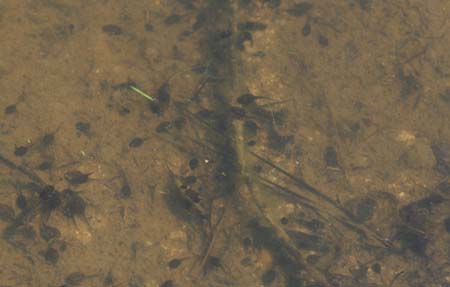
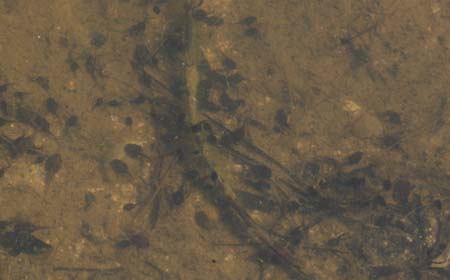
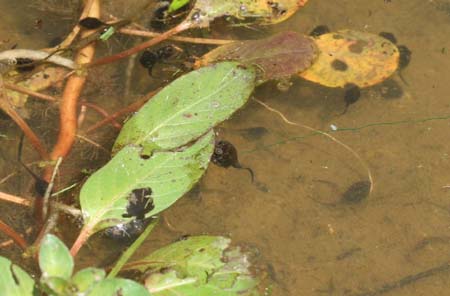
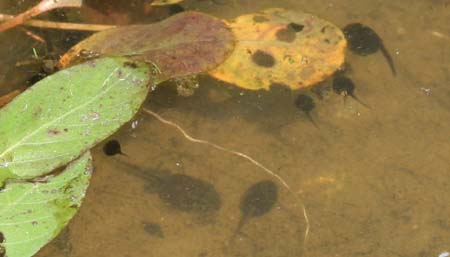
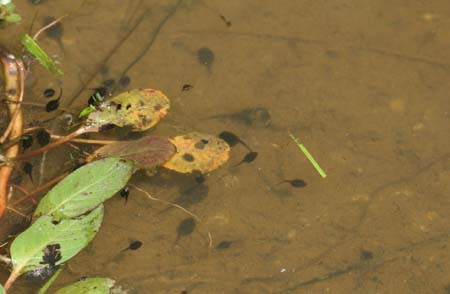
I was outside the other day standing at the edge of the pond. I looked down and at first just noted all these black “dots” in the shallows at my feet. Then I noticed the black dots darting around submerged sticks and hovering near floating leaves. The dots were “tadpoles.” I managed to get a few shots and here they are. Enjoy! Soon to come up, the first entry for “Under the Pier – Creature Features.” It will be “Gobies.” I’ll have a short description of them along with pictures of both a pen and ink and an oil painting that I did of them. Up soon!
Posts Tagged ‘pond’
The Post – Tadpole Pics
July 21, 2008The Post – A Sidetrip to Essays – But the Bus NEVER Came Up This Far on the Curb Before!
February 16, 2008Before I start talking about the Under the Pier process, I need to address the one side that calls to me in a big way – essays. I’ve sold a couple already and I yearn to do more. While this blog is a collection of all the bits of me, perhaps the one area of my soul most fed, is the ability to “speak in essays.”
I have spent most of my time over the last 12 years calling myself a children’s writer, though I have noticed that a lot of my focus is geared toward adults. Is this a contradiction or betrayal of a certain writing path? I don’t think so. Perhaps Madeleine L’Engle handled it best. She used to hate it when she was referred to as a children’s writer, as if that was all she was or it was a special category considered “not quite a writer.” She insisted on being referred to as a writer and considered her children’s writing just one aspect of her career, though certainly not the easiest or least important. Her observation there was: “If I have something that is too difficult for adults to swallow, then I will write it in a book for children.”
So in the same vein, I am first drawn to writing for children as there is the very alive open child within me who wants to speak. However, like everything else in my life, I do not fit neatly into categories. The label “children’s” writer is not totally accurate because I find, I just write. Who it fits, I leave for the readers to determine.
As to my essays, they run the range – spiritual, humorous, nature-based, flippant. One current essay is a list I keep of irreverent things to put on my tombstone: “But it was HER fault, really!” “But I had the right of way!” or “But the bus NEVER came up this far on the curb before!” – the last one from a moment at Colonial Williamsburg where my husband and son expressed concern at how close to the bus stop curb I was standing. When I reassured them the bus never comes that far up, they offered to put that one on my tombstone. 🙂
I love to write essays because my right brain revels in being able to take a single quote or line of dialogue, a comic, photograph, painting or a life question, and just write. Something that starts in the specific and ends up at a universal truth. A journey where I start with the concrete and wander around always surprised where I end up, usually someplace emotional.
In a lot of respects, though I’ve started this blog in the midst of writing a novel for upper middle-grade/Young adult readers, a lot of it so far has been more essays, journaling, unearthing the soul of the writer, rather than a lot about the Children’s Writing business. That’s okay. I need to have that soul of the writer to do that novel. The reality is, that novel has been a journey to answers in life. Maybe in a way, novels are just one long essay because the characters in those fictions worlds still ask the same life questions we all do.
This blog is also my “raw material” that I can mine at will for whatever projects come along. It’s my toy box of thoughts that I can spin into something for adults or children. Truth, is truth.
My “internship of the essay craft” has involved continuing education classes at nearby Duke University, as well questions. Always, questions. They are the catalyst for life, for growth, for wisdom. At least to me, if I stop asking questions, I stop growing. I lose the path to peace
The internship has also included reading countless books. Fiction, philosophy, spirituality, nature guides, and of course, books on essay writing. One in particular is my favorite, and has been the most useful for seeing how to first collect, then transform life experiences. I recommend it highly:
Leaving a Trace: On Keeping a Journal – The Art of Transforming a Life into Stories, by Alexandra Johnson. She teaches memoir and creative nonfiction writing at Harvard and has been published extensively. The book is divided into three parts. It’s possible to only use one of the three at a particular time in life, or ever. The first is about having a journal – creating one, the various types, what raw material to collect; the second part is about transforming your life – finding the patterns and meaning in what you’ve collected; the third section is called “Crossover: Moving a Journal into a Creative Work.”
Whether you just collect raw material, mine it for meaning, or use it to create fiction and nonfiction works, the process changes you. Like that overly used cliched example of a rock thrown in a pond, change one thing and it touches places unseen. Even keeping a list of favorite phrases over a lifetime does something deep inside to your soul and alters your outlook on life.
So I am a writer for all ages. I love to write essays, whoever reads them. They are my journey to answers. They are the playground of the right brain, and the compost pile that fertilizes the rest of my works.
The Post – Reflections on a Belted Kingfisher
February 7, 2008The first time I saw the belted kingfisher, I nearly missed him.
It was that brief time in the early morning when the pond and woods behind us are still shrouded in night’s shadows. The sun hasn’t yet come up and the view is mostly dark silhouettes that blend together against the steel-gray mirrored surface of the pond. It’s the time of day when nothing is quite what it seems.
In the pond, there is this large tree trunk that lies on its side, a casualty of Hurricane Fran in 1996 when the wind snapped a large oak tree into three chunks and threw the largest one into the pond. It has remained there since, a gift to the wildlife. Everybody hangs out there, from spiders, fish and ants, to hawks, muskrats (at the same time no less), and ducks. It is the inter-species resting place, the sunning spot for 10 or 12 turtles, and the staging area for birds fishing in the pond.
On this particular morning I looked out, my eyes barely open, at the odd collection of shapes and shadows in the backyard. You couldn’t make out anything clearly. I think if an elephant had been out there, you might just have mistaken it for fog. As my eye skimmed the pond’s surface, I noticed this shape – rather clearly defined, which is why it caught my eye. It looked almost like a bird.
Being a bird-watcher, I immediately woke right up and looked closer. It was the image of a bird, perfectly outlined on the water. But where was the bird? I didn’t see one anywhere. I dug out the binoculars and scanned the area until finally I could make out a similar shape on the tree trunk right above the water. It had blended so well into the darks of the woods behind it, you could barely make it out. I never would have seen it if I hadn’t noticed its reflection in the pond.
It was a belted kingfisher. He is a maniacal-looking bird. He’s got a white ring around his neck that makes it look like he had been leashed, but escaped. His blue-gray feathers stick straight up out of his head like he stuck his foot in an electrical outlet. He has large wild eyes and a fishing technique that would do the Three Stooges proud. Essentially, he jumps up, flaps his wings, then flings himself at the water. He doesn’t so much dive as plows in a full body flop, through the surface of the pond. He’s effective – he always comes up with a fish – but he gets failing grades for aesthetics.
I see him out there a lot now, especially now that I know what to look for. And it’s usually on those foggy mornings.
It occurred to me that life can be like that. There are gifts or important truths, understandings, that we often don’t see. They blend into the background fabric of our lives, and we overlook them unless something reflects them back at us and they catch our eye. Without that moment, we’d never know they were there.
I think the thing I keep in mind now is that Belted Kingfisher rule: When something catches your eye in life’s fog, take the time to look because some things in life can only be seen on reflection. You never know. It might be a gift.
The Post – There really IS a deeper process at work here
January 29, 2008Some lighter fare on tap in the next few days…photos of Admiral Byrd waving his claw, Scarlett O’Hara and her molted ghost self, and . . . even the ever reclusive Melanie Hamilton! Finally caught her sitting on her “front porch” – ie the open hole in the Live Rock – at 6:30 this morning. Stay tuned.
For today: So does staring into a tank of fiddler crabs, never mind shooting photographs of them at 6:30 in the morning, REALLY have anything to do with writing?
The answer? It all depends. You mean you wanted a definite answer? Here’s a clue – Mindfulness and heart. Still confused?
Simply said, it’s what you bring to the situation. You can sit there and stare at them and your mind could be on the bills, what you’re going to buy at the grocery store, what you could be doing instead of sitting in front of a tank of crabs. You could sit there and nod, “Yup, they’re crabs. Eyestalks. Sideways walk. They all look alike. So what?”
Or you can sit there and notice that Melanie Hamilton has much tinier front claws than Scarlett O’Hara. That she is timid and almost never comes out of her crevice in the live rock…except early in the morning when the sunlight streams into the kitchen and hits that side of the tank. She loves to sit in the sunlight on her front porch. Or that Scarlett O’Hara, who normally never stops eating and never hides out, suddenly after molting has stopped eating and has refused to move from under the water filter. Or that Admiral Byrd, normally fearless, crawled into his tunnel cave after discovering Peter Lorre’s lifeless body and started twitching and wouldn’t eat.
The difference is how you watch. Are you fully present? And did you bring your heart? The heart makes all the difference.
I am taking an online spirituality course with some friends, studying the writings of Thich Nhat Hanh (pronouced Tick Naught Han). He is an 80-year-old Vietnamese monk who endured the horrors of the Vietnam War, came to America to try and stop it, and was deemed a threat by both the Communist and non-Communist regimes in Vietnam. While searching for peace, he found himself everybody’s enemy. He was nominated for the Nobel Peace Prize by Dr. Martin Luther King, Jr. for his efforts to stop the war, and in his later years one of his many healing works has been to heal the souls of former American servicemen haunted by that war. Having lost close personal friends to that war, he has every reason to hate Americans. Instead he’s spent half his life healing people around the world, including Americans.
He tells a story in one of his books about a young man who wanted to learn to draw lotus flowers. So he went to a master to apprentice with him. The master took him to the lotus pond and left him sitting there for 10 days. Can you imagine in today’s busy world, signing up for lessons to learn something quickly, only to be left sitting at a pond for 10 days?
The real essence was what the young man did with that time. He could have gotten impatient (something I know a lot about), and grumbled, sighed, walked away, went shopping, took a nap, try to do something USEFUL with that time instead of just sitting there. Instead for the whole time, he watched the flowers bloom when the sun was high. He watched them close into buds at night. He watched one flower wilt and drop its petals into the water, then studied the stalk, the stamen and the rest of the flower.
On the 11th day the master returned and brought him a brush to paint with. Although his picture showed his naivete of technique, a childish style, the lotus he painted was beautiful. Deep beauty shone from the painting. He had become the lotus and as such, even with poor technique, he could paint something that moved another’s heart.
Mindfulness and heart. He paid attention to the lotus. He worked from his heart. Writing, really good writing that moves people’s souls, comes from the heart, not the brain. You can write a technically beautiful book but without heart it’s a sterile desert emotionally.
I started out watching fiddler crabs not sure what to expect. I certainly didn’t expect them to have personalities and subtle differences in appearance and actions. And I most certainly didn’t expect to feel such upset as I watched Peter Lorre tumble off his rock, dead.
With any luck, at least a little part of me has become the crab. With just a little more luck, maybe that crab heart will come through in my book. I’d trade a whole bunch of technical expertise for just a handful of heart.
By the way, if of interest to read a good summary of Thich Nhat Hanh’s life, check out this link at Parallax Press.