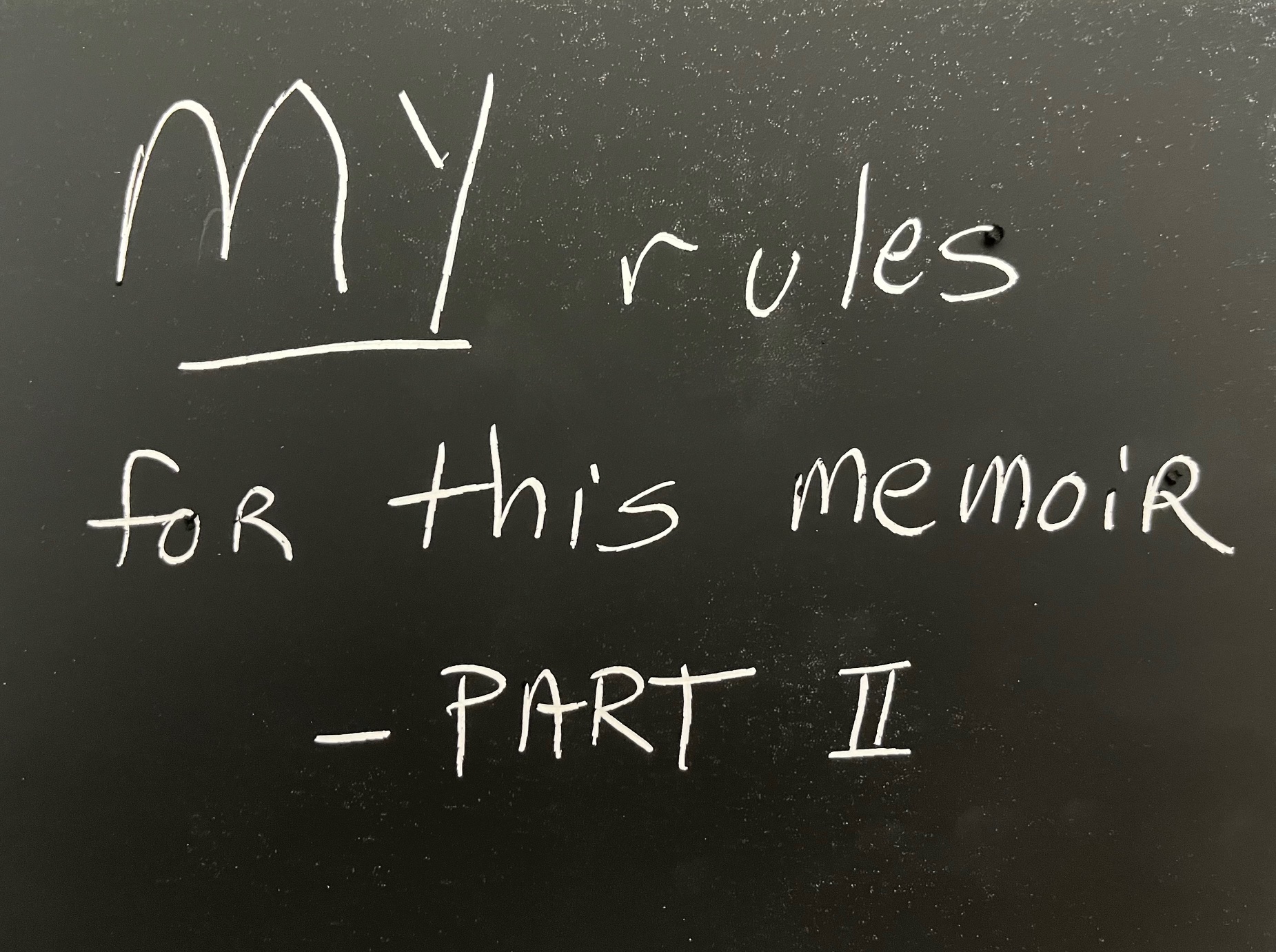
As promised, here is the second half of my rules for this memoir. These will be right at the front of the book so the reader is also clear about what I have in mind.
Caveats, cautions, and purpose
Before departing on this journey, here are 7 key points:
I did the best I could
That is the truth, not only of my life but of this book. I have done the best I could to portray the things I lived through accurately. Each person remembers an event differently because each experiences it from a different angle or context. No one’s memory is perfect or objective. However, I did the best I could, and no experiences here have been “fabricated.”
It is my story…only
This is the story of my experiences. Except for those who allowed mention of them, I will say little about others in my life, in particular, other family members. I respect their privacy and processes in life. If needed, I will omit or alter the names of certain persons or locations. As the author, I have the power and choice to share about myself. But I will not make those choices for others because to do so removes their privacy and their right to their own story. As to who I am, my name is my own. I do not use a pen name.
(Quote from the book – Courage is Calling, by Ryan Holiday)
“If you’re going to speak out: Sign your name.”
Trigger Caution — Tidy terms vs real sensations
Society has “tidy” names for the horrendous acts that sear a permanent “brand-mark” of trauma onto your soul. There is a vast gap between the words “sexual assault” and the reality of something forced into your orifices while every fiber in your body recoils against the invasion, your mind screams in rage, and your person is physically powerless to resist. And if you are a child in that situation, add in confusion, terror, and disorientation. If you say the words “child abuse” they do not begin to depict the sensations experienced by a 7-year-old pinned to a wall with their father’s fist in their throat, as they wonder if they will choke or be able to breathe again. They belie the true physical and emotional reality of what it is to live through that.
Since this story deals with the journey to thriving after almost three decades of “untidy” experiences, some of the paintings capture the kinds of moments never immortalized in the family photo album. Others reveal the emotions — fear, rage, loneliness – that have been carried for a lifetime. And yet others – celebrate triumphs and joy. All of these were my portals to remembering; untangling the knots of trauma locked in my brain and body; finding words, insights, and healing; and then, finally, meaning. While I have avoided “graphic” portrayals — as that serves no purpose — there are stark realities in the paintings that the reader should be aware of.
Shame
All of the paintings and words in this book tell my story — the good, the bad, and… the shame-filled. That last one is the scariest to reveal to another because it is human nature to hide our mistakes, our embarrassment, and our frailties. No one wants to show moments of helplessness or to appear needy, foolish, or weak. Yet admitting shame — a quality we all carry — takes down the walls, levels the field between us, and provides the glue of connection.
Further, for anyone who has endured abuse of any kind, that experience creates “shame on steroids.” The shame of what was done. The shame of not being able to stop it. The shame of thinking “Why didn’t I know better, fight back, or act sooner?” The: “How could I have been so…” and just fill in the blank here. Such a human thing to try to hide it, yet in sharing our humanness, we take away shame’s power over us. We reclaim our power…and maybe help another to reclaim theirs.
“When somebody has the courage to speak about something shameful that was done to them, society is propelled into action. Someone can help them stop it.”
(Ryan Holiday quotes from the book – Courage is Calling)
So, for whatever my sharing can give to another, I risk shame.
No judgment or commandments
There will be no sentences that start with “Just get over it,” “Move on,” “You should…” or a myriad of other variations people carelessly throw at another. No one knows the pain you have lived better than you. And no one gets the right to judge, dictate a healing process, hurry you, or assume they know better.
Process
The book is built around the framework of paintings I’ve done as a way to thaw the trauma frozen in my body’s tissues, brain, and heart. To reach them, untangle the mess, and find words to describe it all, I needed to paint. The tactile sensations of moving a brush across a canvas triggered memories and details I had not been able to reach, opening me up to avalanches of feelings and insights stored for decades. And once I opened those emotional gates, there was no turning back. With paint, clarity emerged, and words followed. I can’t speak to what another person needs for their healing process. This was mine.
Purpose
I will speak more on purpose and method later, but in short: I wrote to heal…to understand…to share with others anything that might serve them…to give my life meaning and redemption through courage…and to give all hope that in life, no matter how much abuse, one can thrive.
(From Book – Deep Memoir pg 77, by Jennifer Leigh Selig, PhD)
‘‘You too are driven by the desire to understand…Beneath your desire for knowledge writhes the hunger to understand and love yourself.”
Now…on to the journey…
Tags: art therapy, book review, books, commandments, Courage is Calling, Deep Memoir, emotional abuse, emotional triggers, fight back, healing, imperfect memory, Jennifer Leigh Selig, Jennifer Leigh Selig PhD, judgment, love yourself, memoir, orifices, painting, physical abuse, portals to remembering, process of writing, purpose, Ryan Holiday, sexual abuse, shame, thriving, tidy terms, trauma, writing a memoir
 Soul Mosaic
Leave a comment