Posts Tagged ‘healing’

Why Write…Now?

July 3, 2025

Death. Talismans. Madonna

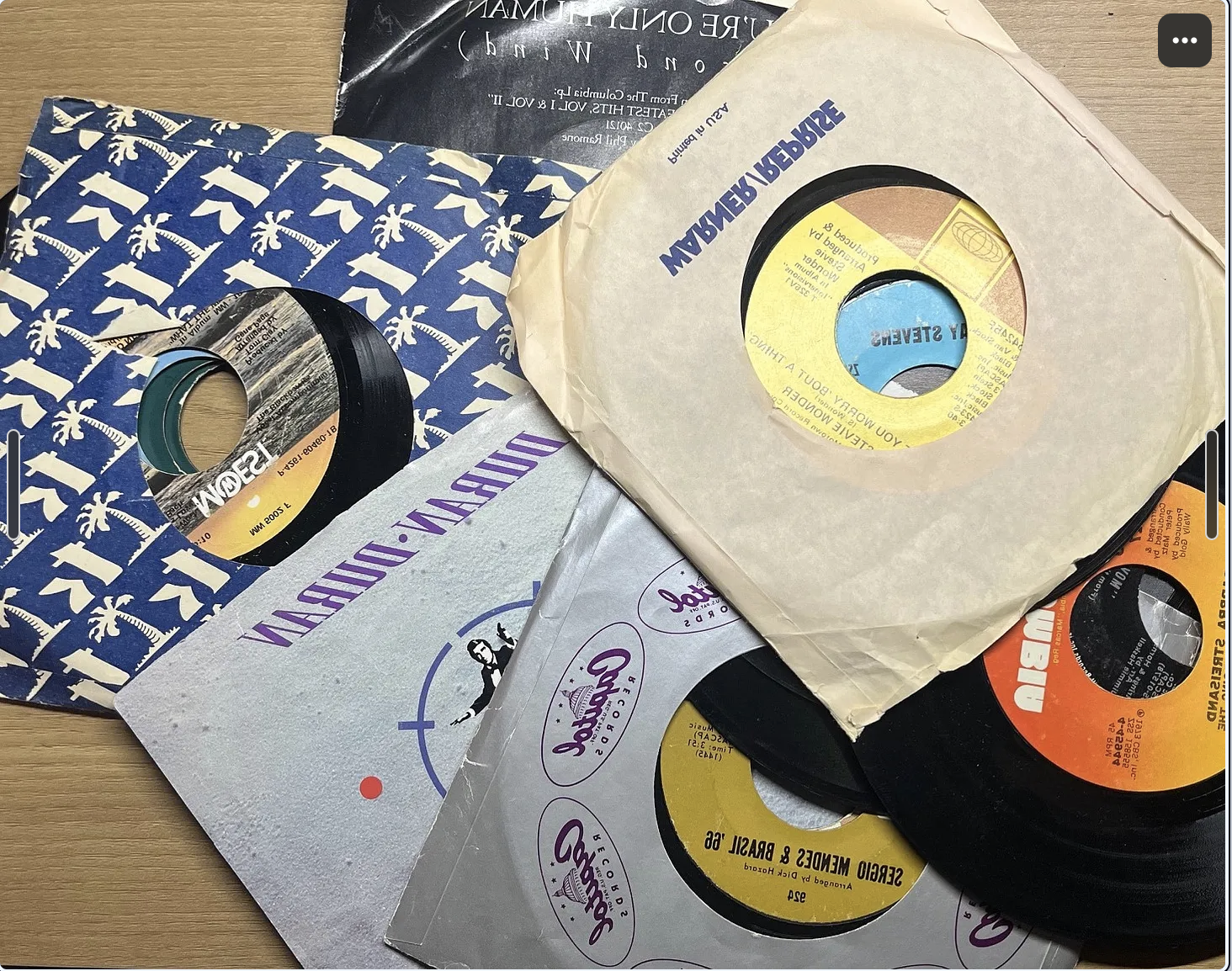
Author photo of her 1960s 45 record collection

“Why write…now?” Three simple words, but a vital question that demands an answer to the motive for my change of heart.

Dr. Edith Eva Eger, in her 2017 book, The Choice, about her experiences both as a Holocaust survivor and a psychotherapist, talks about the question, “Why now?” Whenever she was confronted with a new patient, her approach was always the same–questions. I loved her description:

“Why now?…This was my secret weapon. The question I always ask my patients on a first visit. I need to know why they are motivated to change. Why today, of all days…Why is today different from yesterday, or last week, or last year? Why is today different from tomorrow?”

But before I can even answer why I would write now, I need to answer the question that came before it: “Why write?” I had actually tried three times before to write something about sexual abuse, wanting to help someone else in the same situation. I tried articles for adults, a picture book for small children, a chapter book for older kids. No matter what I did, it didn’t come out right. The message was wrong…missing…useless. What could I tell a child that might help their situation? “Go tell an adult, and they can help you.” First, I am not a therapist. And second, if I said that, would I be opening them up to a world of more hurt with a simplistic answer?

Even when professionals try to intervene, there are no guarantees that it will be better. Sometimes if a child tells, they risk breaking up their family, retribution for speaking, possibly being removed from the home and put in foster care, or maybe ending up in a worse situation. If authorities remove the offending parent, the entire family’s financial stability might be at risk. I so wanted to make a useful contribution. But what message could I give to anyone?

(more…)

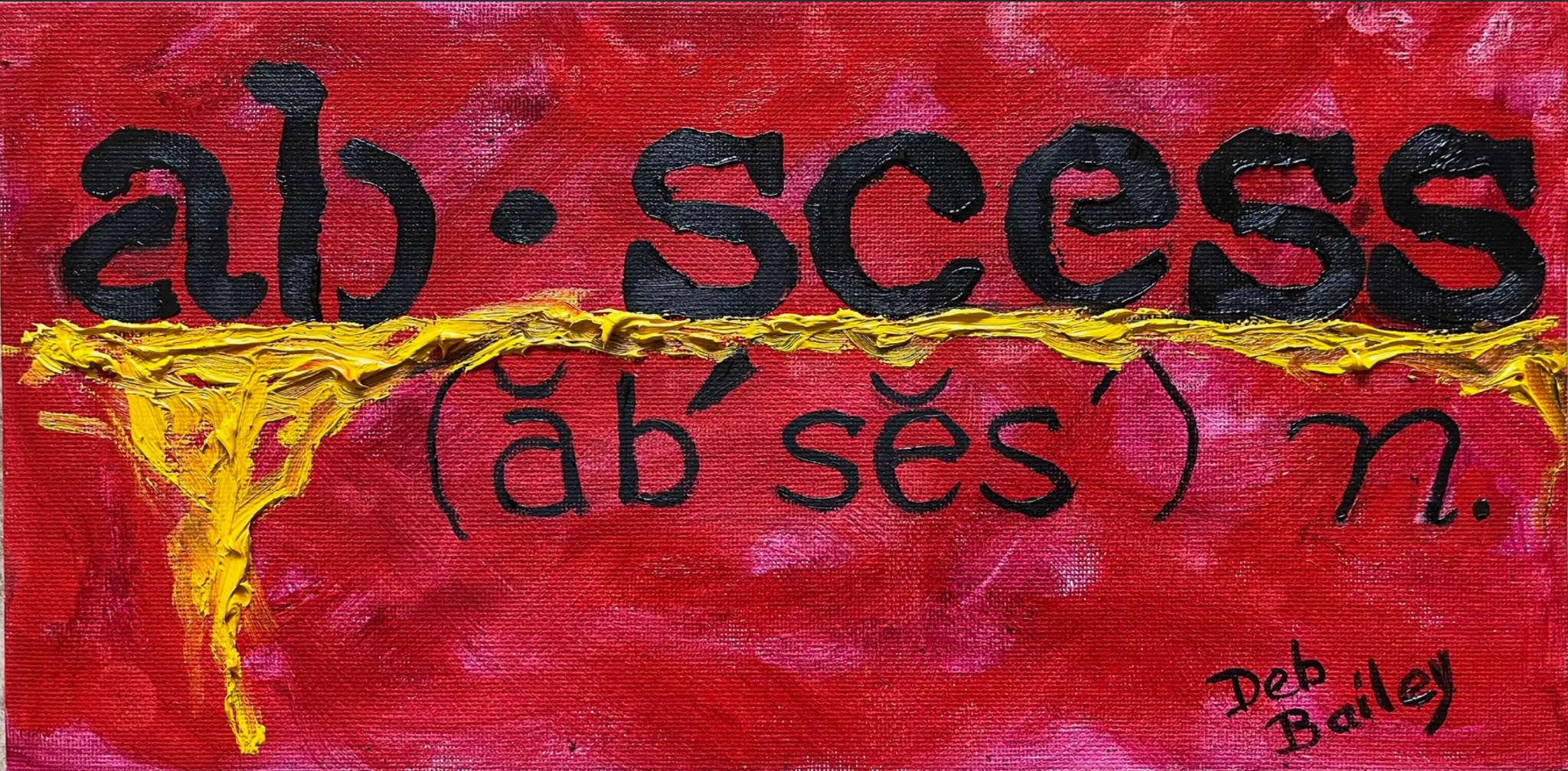
Let’s Not Talk Forgiveness, But “Abscess”

June 3, 2025

What this book is…and is NOT about…

Painting by the author

So let’s get something straight right now – because I am a direct person, all my friends know that, and I prefer to be clear. This is not a book about a person’s journey from harm to forgiveness. If you are looking for a tome on the blessings of forgiving your abuser or how to achieve it, I recommend you look elsewhere.

My journey is about healing…restoring my soul from a lifetime of trauma and pain that was inflicted on me, and that I have carried way too long. And just to be clear, to me, forgiveness and healing are not the same things. They may both come about, or not, but they are not the same thing, and for me, both are not required. So first and foremost, I write to heal.

If I am to be totally honest, I don’t give a shit about forgiveness anymore…about whether it comes or not. In fact, the next person who tells me that I must forgive because it is the only way to happiness, or repeats that all-too-often quoted trope, that withholding forgiveness is like drinking poison and expecting the other person to die, I will tell you to just keep on walking. Unless I am in a bad mood, in which case I may say it slightly differently.

(more…)

Impasse…

January 20, 2025

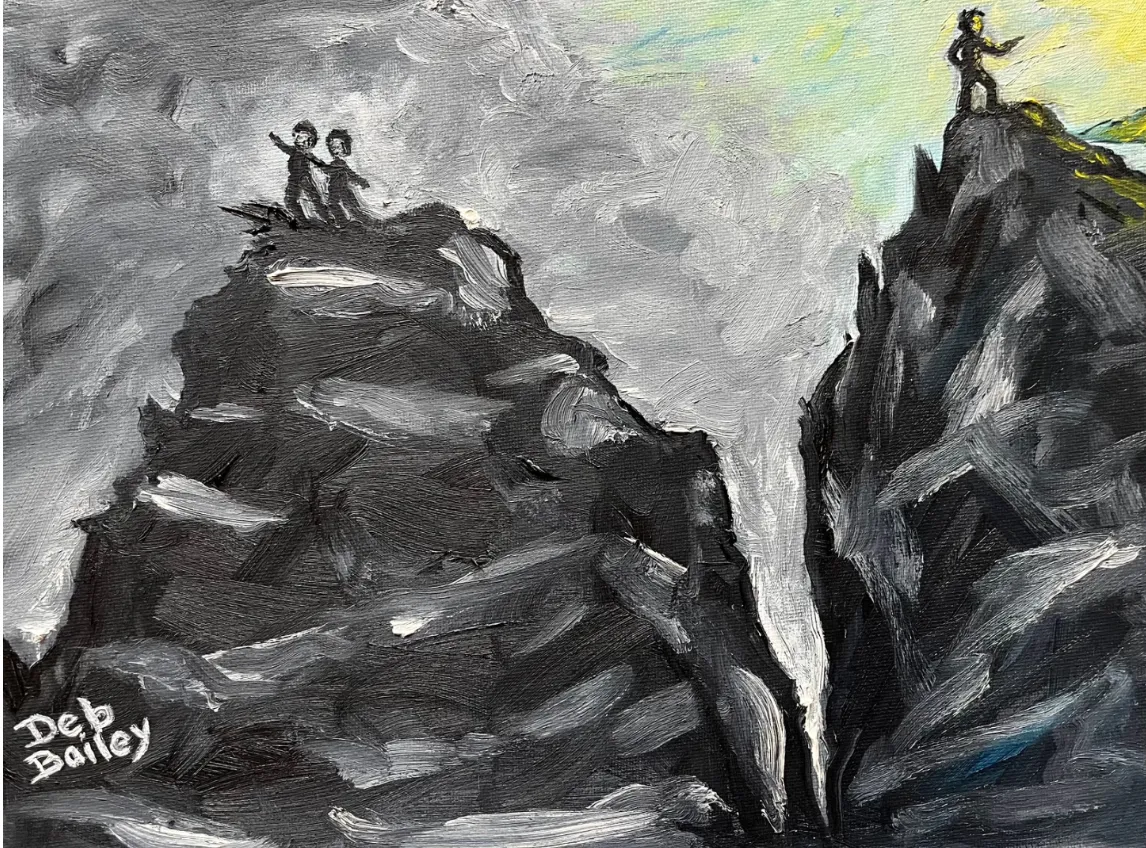
Some gaps may not be bridgeable…

Two peaks with a widening gap between them. On one peak shrouded in dark clouds are two people looking in one direction; on the other, a solitary figure looking out over a serene sunny landscape. Sometimes, you just can't follow other people's paths but must set out on your own and blaze your own trail. And sometimes the gaps are not bridgeable no matter how hard you try

Painting by the author

Journal entry, 1982: “Impasse”

“The point in a conversation that is an impasse – both love each other very much. Both want desperately to make each other happy. One doesn’t want to hurt the other with his opinion but feels compelled to say it.  The other wants desperately to agree, to be able to agree so all can be happy again, but can’t.

Both search to say something that would make it better…want to find those magic words. And “I love you,” may be true, but isn’t enough – it doesn’t dispel the present problem. The love is there, but so is the problem – each looks to the other to back down – to say the one thing they long to hear just to make the problem go away – but can’t, and each knows the other can’t but just hoped they would…and at this point no one knows what to say – all you can do is just walk away – confused – emotionally drained – completely mystified as to a solution.”

The missing link

How do you go from being a submissive, beaten-down child in an abusive family system to a healthy adult who stands up for herself? When does that miraculously happen? It’s not like you leave that house, flip a switch, and suddenly you’re an independent, healthy, assertive human being. In there somewhere is a missing link in the maturation process — years of trial-and-error efforts to heal and learn how to become that adult.

(more…)

What Kind of Visuals Am I Using…and Why

January 11, 2025
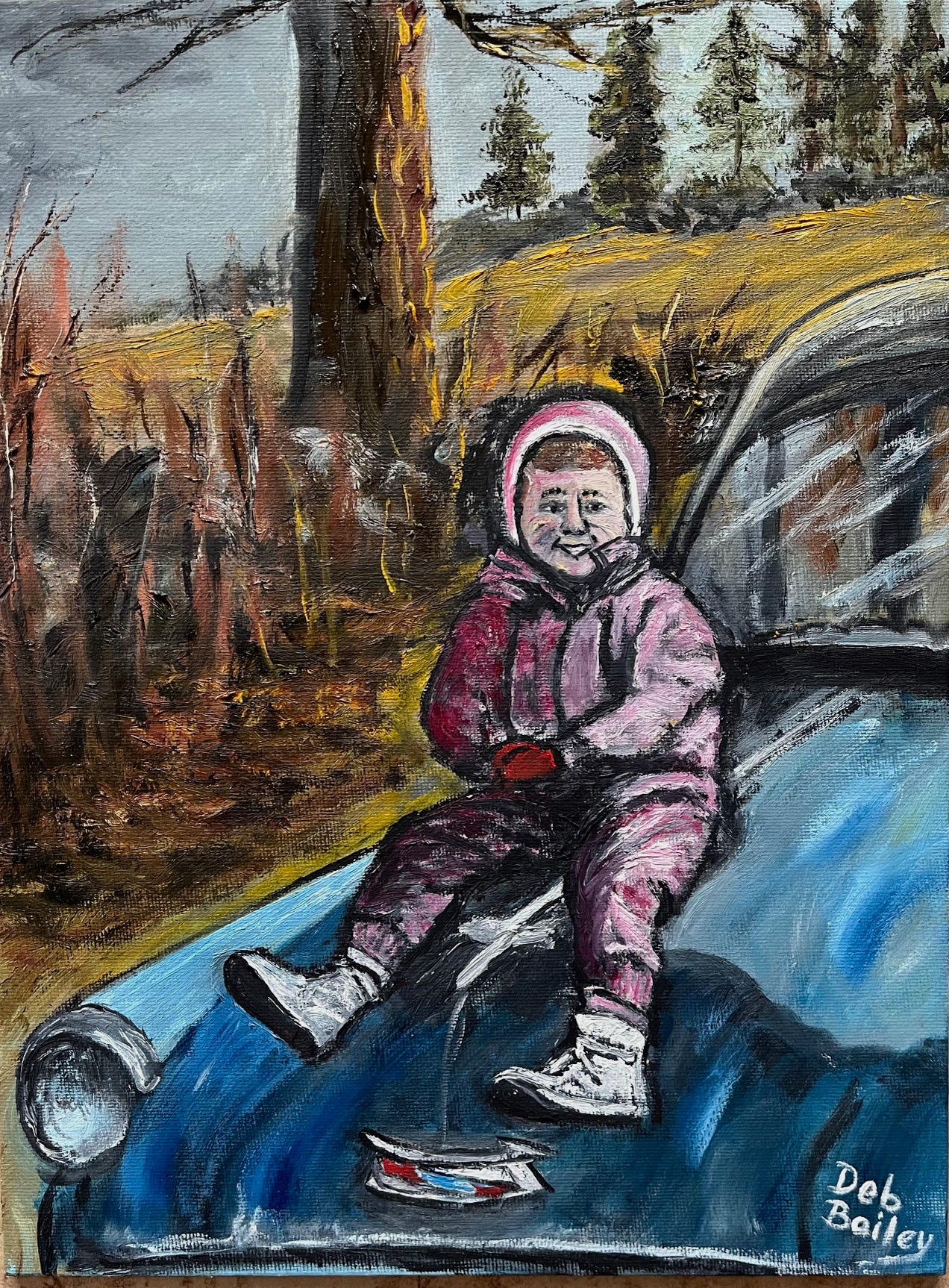
Painting by the author of the author as an infant in a pink snow suit sitting on the hood of her parents' 1954 Chevy Belair sedan
Painting by author – Author as an infant on hood of her father’s car

Driven to paint

Before I share below a sampling of the visual elements I am using in my book, I thought I would share the “WHY” I not only used them, but HAD to use them.

Rebuilding my life

The book incorporates the story not only of the abuse I endured, but also of my journey from my parents’ house—the depression and despair—to my rebuilding, and my creating of a meaningful life.

Even after the initial crises of my escape and recovery with the help of good therapists and friends, I would return for rounds of therapy off and on throughout adulthood. Given all of the life lessons I had missed out on during my early phases of life, I looked at it as “preventive maintenance.” Why “wing something” when I wasn’t sure how to handle it and risk messing it up, then have to fix it? Better to learn as I went along.

The traumas of life

This approach worked well, and I thought I had finally put the past to rest…until midlife. Menopause hit. My husband almost died. The dog did die. My son left for college. All at once. But even worse, those new traumas blasted open a well of trapped emotions I never realized were even there. Like opening Pandora’s box, it unleashed a flood of unresolved depression, anxiety, flashbacks, nightmares…severe PTSD. At the time, I had no idea what was going on. Desperate and having major anxiety, I began working with a skilled trauma specialist who was and remains a godsend in my life.

This was fortunate because, in addition to everything that I was dealing with, I also began navigating the last chapters of my parents’ lives and their deaths. It was then that I realized just how much work I still had to do.

The past comes calling to claim its due

Those first decades of adulthood had been about building a life. Now, it was about returning to the past to address the well of unfinished business and unresolved pain that had come forward to claim its due. It had patiently waited a lifetime…my son came first all those years. But now, it was time for me…and that long-suffering child.

However, I had no tools to reach the pain, to know how much was there, or to express it. I only knew its presence through the agony of body memories and nightmares. That was when I made the discovery that art heals.

(more…)

MY Rules for Writing My Memoir – Part II

December 13, 2024
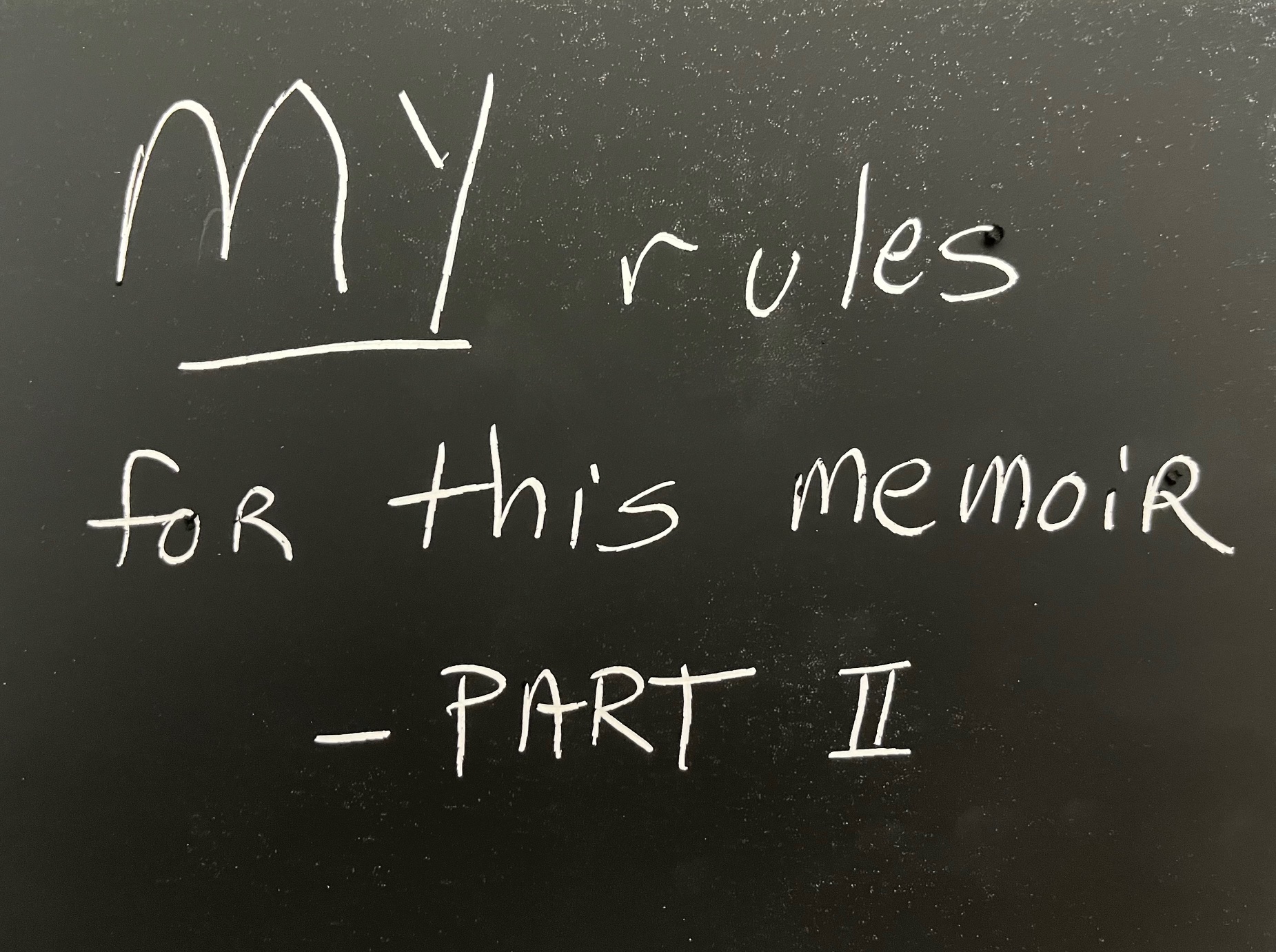
White handwritten message on black background, like chalk on a blackboard. Message states these things are MY rules for writing this memoir - part II
Photo by author

As promised, here is the second half of my rules for this memoir. These will be right at the front of the book so the reader is also clear about what I have in mind.

Caveats, cautions, and purpose

Before departing on this journey, here are 7 key points:

(more…)

If You Don’t Love Me, Have I Failed?

November 30, 2024

(Published on Pure d’esprit as: How to Love Yourself-Even if it Takes a Lifetime)

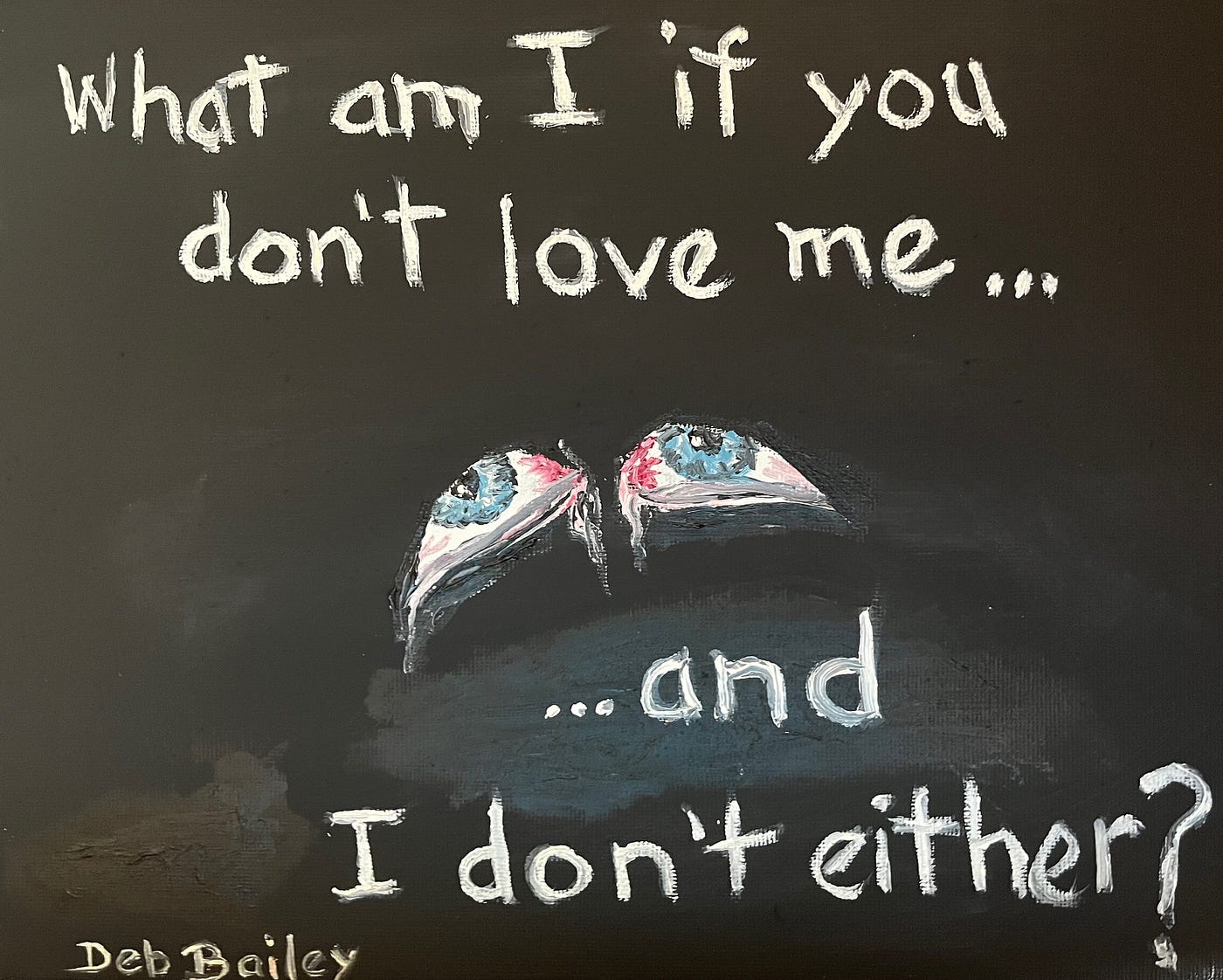
Oil painting of a black background, white letters and two eyes that are tear-filled and red. Words sayd: What am I if you don't love me...and I don't either?
Painting by the author

NOTE: While I work on that list of reasons to write a memoir, let me share this recent post of mine from the Medium platform publication, Pure d’esprit. I will follow-up later with posts that get into the origin of why I felt this way, the shame carried, and lifelong self-hate that had to be recognized and confronted.

So what am I if you don’t love me…and I don’t either?

At the end of the day it really comes down to this question. In life, sometimes the only one we can count on at times to be in our corner IS ourselves. Parents may fail or abuse. Spouses may walk. Friends disappoint. At the end of the day, if we measure ourselves by those around and outside of us…and they fail us, does that mean we have failed?

That answer took me 69 years. I had almost 30 years of childhood abuse to rebuild from. For a lifetime I hated that younger person I was. Viewed her as weak, stupid, a victim. And I was never going to be a victim again. So, of course I shunned a whole part of me…the part that actually saved me.

About that younger part of me…

That younger part of me had struggled through some of the worst years of my life and kept going. She had trudged through all kinds of abuse, through no or few friends. Through suicidal times. Circumstances crushed me and challenged me to ask myself: “Why should I stick around?”

She instead listened to a small voice inside that kept telling me: “Just hang on. You can always choose to ‘leave’ tomorrow. But just hang on, even one more day. You might miss something.” That small voice wouldn’t relent and she kept listening. “You can hate yourself. But, just hang on anyway, even a little while longer.” I don’t know why she listened, but she did.

Over the next several years I slowly rebuilt me. Got strong, fierce, determined. No one was going to ever do that to me again…a good thing for sure, though I think the pendulum swung a little too far with that tough side of me.

Never be weak again…and then…

Eventually, though, life got better. I even found love with a true soul-mate. And while I continued to soften emotionally, to myself I was not very kind. I had learned to “value” me in some things, in that present moment. I valued being strong, not that “weak stupid younger part.” Her, I despised. I sealed her off and tried to forget her. She was dead to me. Besides, I was too busy raising a son, having a life, to think about her anymore

Then 2006 came along. My husband almost died. My son left for college. The dog died. Menopause hit. And I could no longer face doing the medical research work I had done for a decade. I was in a total spiral. Lost. And it was then, brought to my knees and realizing I was no longer that “tough strong” person anymore, that I began the rest of the journey to healing. And she, who I had hated for a lifetime and abandoned, was the key to my healing.

The return

It has taken a lifetime to return to her…to me actually…that younger part of me. It took me a lifetime to recognize just how brave she was, how much courage she showed. And that the only reason I survived and grew was because of the strength she showed. I finally realized what a truly amazing and special person my younger self was, and what a debt of gratitude…what a debt, period, I owed her…as well as an apology. But even there, strong, loving, gracious — that younger part of me showed me love. Reminded me that at any point we are all just doing the best we can. And she welcomed me back with full love, reminding me also, that is is “better late, than never.”

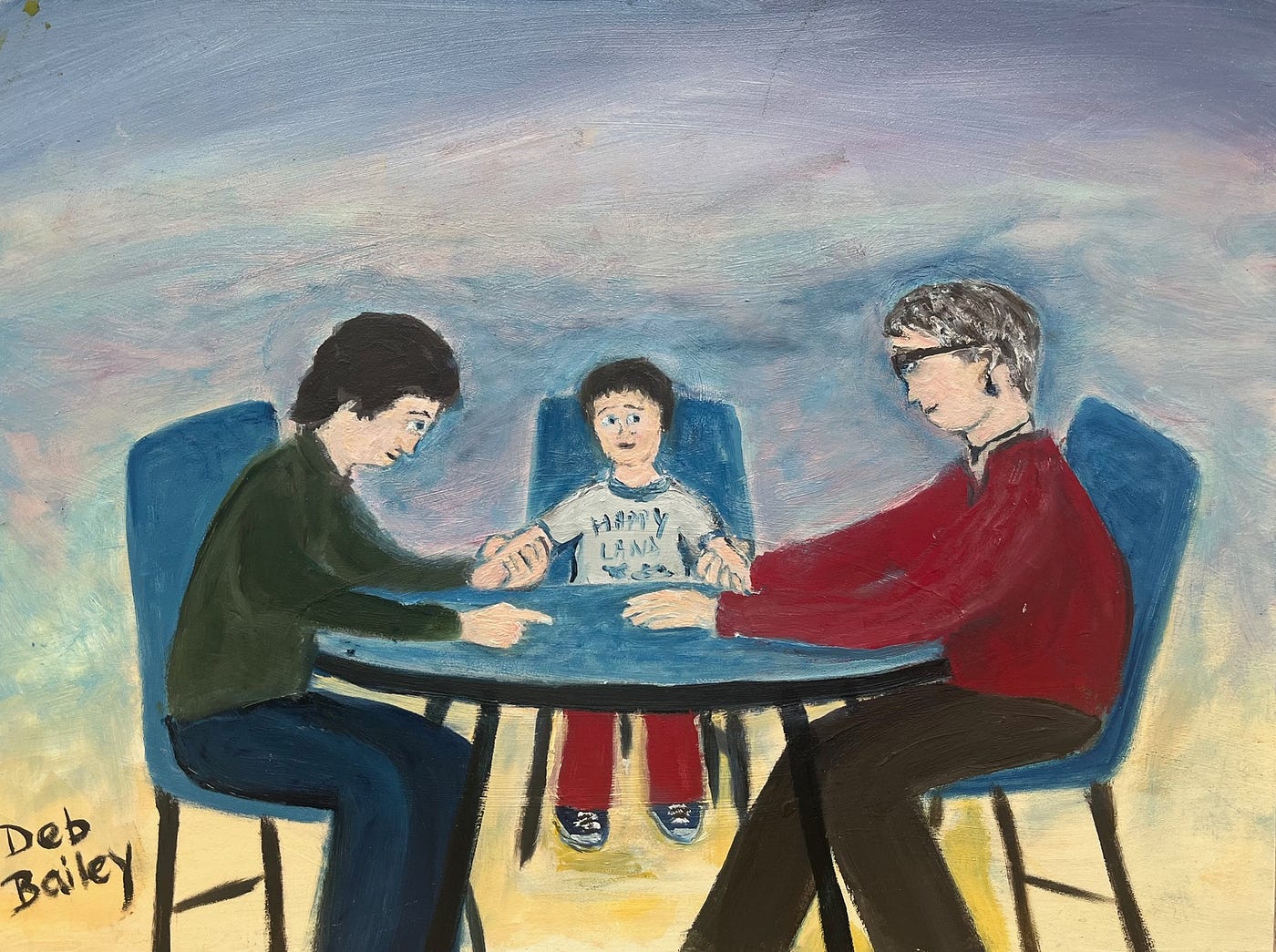
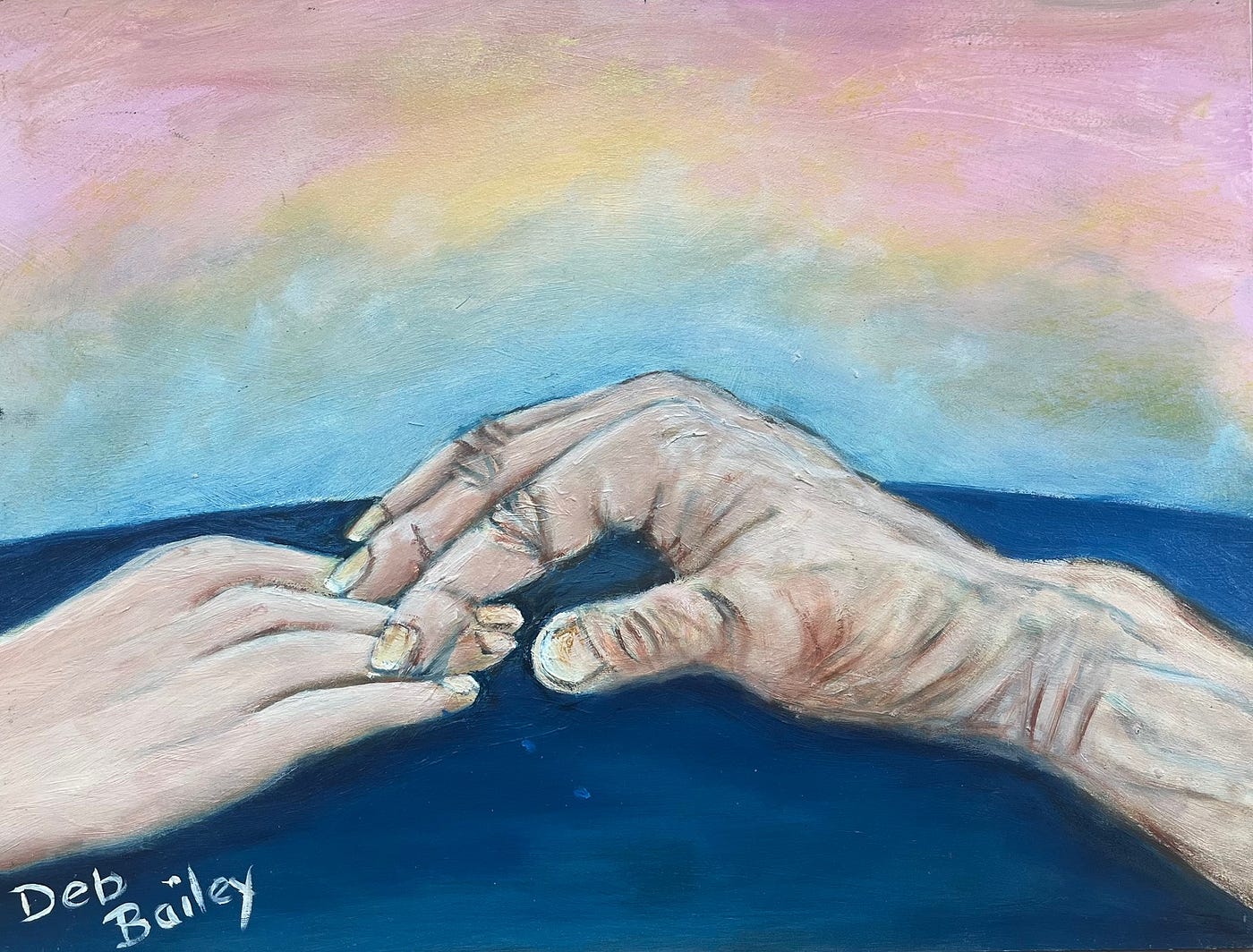
It is never too late to start loving yourself. And whether it takes a lifetime, whether it is a messy imperfect process, it only matters that you finally reach across the table and reconnect, and truly LOVE yourself. Just start. Even a little. The rest can follow later…even if it’s a lot later.

Painting of the 3 different ages of the author who have been at odds with each other for a lifetime, now reaching for each other to make amends. One is the young child, the next is the young adult who was hated by the holder adult for years. The third is the older adult making amends with them both.
Painting by the author
Light blue pink pastel background with a dark blue tabletop and two hands stretched across and reaching for each other - one from an older version of the author, and the other, the hand of the author at a younger age.
Painting by the author

Writing About Sexual Abuse – Things to Consider

November 25, 2024

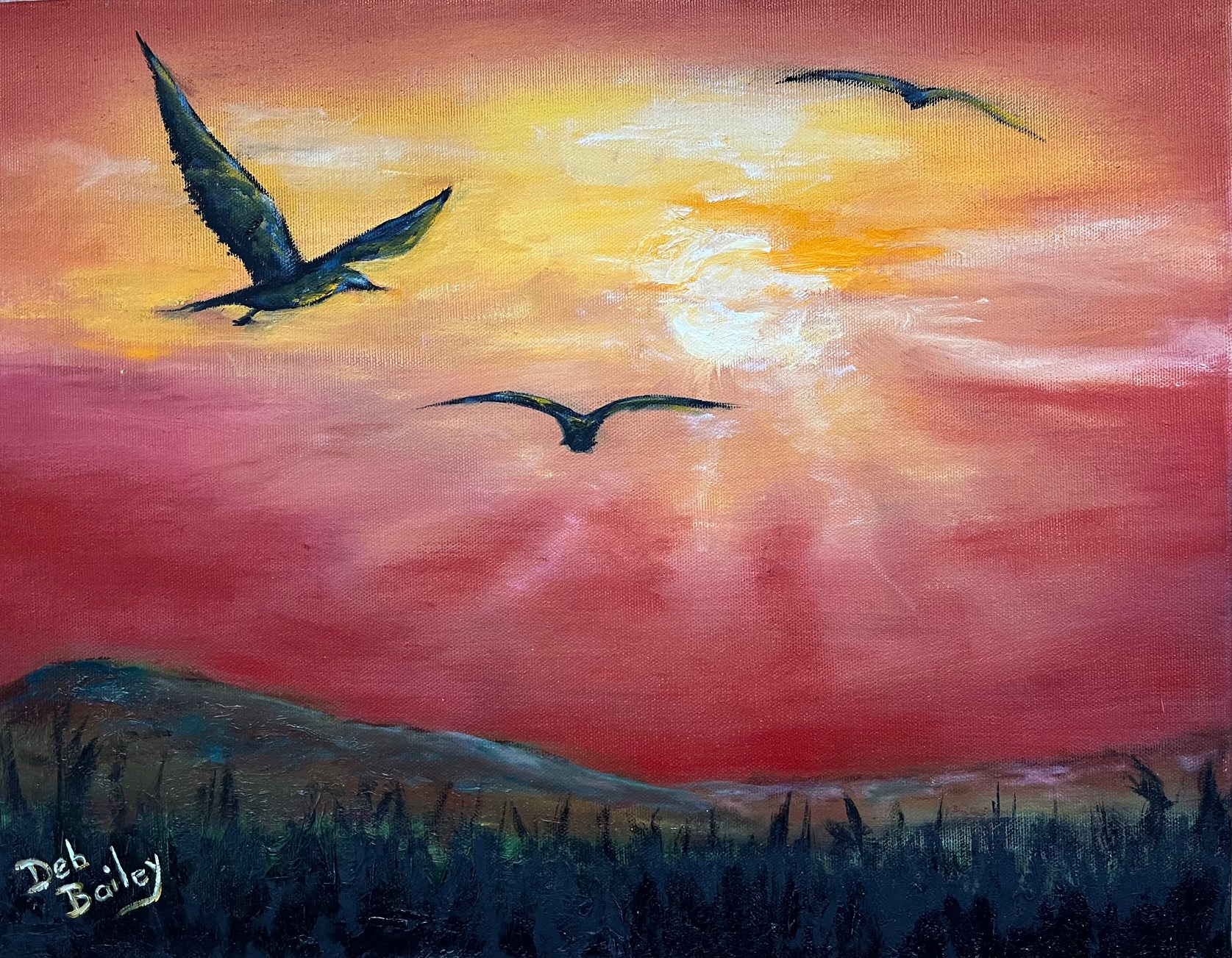
(Published on Medium Pure d’esprit as: Difficult Stories: Considerations of Risk and Courage When Writing About Sexual Abuse…or Anything)

Oil painting of a red-orange-yellow sunrise sky over dark hills, with 3 birds majestically soaring overhead. Symbolizes the freedom of the author to speak her truth after 7 decades of silence.
Painting by the author

Difficult stories

Difficult stories… Well, maybe every story is difficult in its own way because no matter the topic, every writer must take a risk to write, and then find the courage to share that part of their soul.

To me, the bottom line is: To write is to be brave, period. And it is a topic I have wrestled with for years, so I will speak from my own experience.

Trying to write about sexual abuse – childrens’ books

I have contemplated writing my story for a long time…in fact, I tried–magazine articles, children’s picture book, middle-grade chapter book, another magazine article…but none of them seemed to work out.

My first thought was to write fiction–thus I could convey “something” about sexual abuse that might be helpful to someone, yet avoid speaking about me directly…and publicly.

I thought I should write for children — because maybe I could offer them some help on how to avoid being abused, or how to get help in abusive situations. But …what could I say?

For one, I am not a mental health professional so I could not give them current or professional advice. Second, the childrens’ books I saw out there on the subject made it sound like all the child had to do was go to a helpful adult, tell them what was happening, and the adult would make it all better. To me that seemed like REAL fiction, a betrayal of the reality, which might offer no change or a situation that was even worse.

For one thing, often in abusive situations there are no safe adults to go to. And even if outside agencies get involved it doesn’t necessarily make things better. Families may be broken up and kids may get put into the same sitution elsewhere. Even if the family stays together, the abuser may have gotten just minimal help so they might not be “that” safe. And maybe there would be repercussions to the child for “speaking,” from the abuser or other family members. So I just felt I could offer little to help kids.

Trying to write about sexual abuse – magazines

I tried magazine articles hoping to bring more awareness of just how prevalent sexual abuse is and how damaging it is. And while editors were sympathetic, none offered to publish them.

But maybe that was for the best. Frankly, at the time I wasn’t sure how best to write it or exactly what I needed to say that would be a useful and universal message. And I still had a lot of work to do on me. So it was not time.

The message and “giving witness”

Now, decades later, and after years of work with a trauma specialist, I am writing to adults. While someone needs to write to children, I accept I don’t have the talent, voice, or message, at least not at this point. But I can speak to adults. Memoir is my strong suit, and….this time, I know my message:

“In spite of what you did to me, despite how I still struggle, I THRIVE.”

I can give witness not only for myself but for all the others who were harmed and might not be able to speak…or who didn’t survive to be able to speak. As novelist Pat Conroy said:

“I write for the people who can’t speak”

Maybe my story might give someone hope to find their own answers for healing.

Questions that must be answered first

But there are some issues I needed to face to do this, and I think it is true for most writers there are questions each must consider before writing. Because no matter how valid, important, or useful any writing might be, the writer has to make it through the process. Some questions to consider:

  • What are the risks of writing? Physically, emotionally, relationship-wise….
  • What, if any, are compelling reasons to do it despite the risks?
  • And…should I take on that battle?

To the last question — “Should I”? For myself, after seven decades of silence, THAT ONE IS A DEFINITE YES…I am writing. And I will use my own name, not a pen name. But it has taken me a lifetime, and I have thought long and hard. And as to exploring the risks and benefits, I will share my findings in a separate post, and simply leave it that is was a rich, illuminating, and gratifying exercise to do.

The real nature of writing: Courage, honesty, power

But for now, my reason for bringing up the subject of difficult writing is because #1 we are all writers. And in the end, it is not about the subject matter. It is about courage and honesty. It is a supreme act of courage just to put your words on a page even if you share them with no one. Because if you write honestly, you must still face them yourself. It is another level of courage to share them with another.

So the topic of “courage to write” is something I have been exploring a great deal and will write more about. I imagine it is a subject many of us can relate to. One thing I can say about the times I have taken a risk, dug deep for courage, and did the thing I believed was right, I could feel my soul soar.

For now, a gift of inspiration — two quotes I came across and share here for all:

“A word after a word after a word is power.”―Margaret Atwood

‘’You too are driven by the desire to understand…Beneath your desire for knowledge writhes the hunger to understand and love yourself.” — Gloria Anzaldua

The Post – A Murderous Time

March 18, 2008

I am tired. I am tired of struggling and believing and hanging in there. I want to sell everything, and just take off and not have to be responsible anymore. I am tired of struggling and struggling and struggling in life, of reaching for dreams or challenges, trying to live my beliefs, stay open to others, all while life just keeps pounding you. Life, can be murderous. Someone said it’s not the big things that get you, but the accumulation of all those small aggravations, like being nibbled to death by ducks.

Now often those are the words of the tired 2-year-old, and we all have one. Usually when the 2-year-old speaks it, the 52-year-old understands, knows it’s just a rant, and keeps going. It’s those moments in life though, when the 2-year-old utters it, and the 52-year-old agrees, that I know I have to stop and attend to my heart. Those are the times I reach for wisdom others have culled from their lives and put into words.

So for today, I simply leave everyone with the wisdom from others who have been there and lived through it to see the other side:

___________________________
In a murderous time
the heart breaks and breaks
and lives by breaking. It is necessary to go
through dark and deeper dark
and not to turn.
From “The Testing-Tree” by Stanley Kunitz
________________________________
“The only way out is through.”
Unknown
________________________________

“As a species, we should never underestimate our low tolerance for discomfort. …Never underestimate our inclination to bolt when we hurt. …Being compassionate enough to accommodate our own fears takes courage… We need to be told that fear and trembling accompany growing up and that letting go takes courage. Finding the courage to go to the places that scare us cannot happen without compassionate inquiry into the workings of ego. So we ask ourselves, “What do I do when I feel I can’t handle what’s going on? Where do I look for strength and in what do I place my trust?”

The Buddha taught that flexibility and openness bring strength and that running from groundlessness weakens us and brings pain. But do we understand that becoming familiar with the running away is the key? Openness doesn’t come from resisting our fears but from getting to know them well. Rather than going after those walls and barriers with a sledgehammer, we pay attention to them. With gentleness and honesty we move closer to those walls…get to know them well. We begin a process of acknowledging our aversions and our cravings. We become familiar with the strategies and beliefs we use to build the walls…Without calling what we see right or wrong, we simply look as objectively as we can.

….We can begin to pay attention to our methods of escape. …We can misuse any substance or activity to run away from insecurity. When we become addicted to the lord of form, we are creating the causes and conditions for suffering to escalate. We can’t get any lasting satisfaction no matter how hard we try. Instead the very feelings we’re trying to escape from get stronger….Transformation occurs only when we remember, breath by breath, year after year, to move toward our emotional distress without condemning, or justifying our experience.”

Pema Chodron from the book, The Places That Scare You

_____________________________

“Abandon any hope of fruition.”

Mind training slogan #28, of the 59 mind-training slogans or Lojong teachings of Atisha Dipankara, an eleventh century Buddhist teacher who brought these teachings from India to Tibet. These teachings show us how to transform difficult moments…what we most dislike about ourselves….the greatest obstacles in our lives – anger, resentment etc., into the means to awaken our open heart.

For a full teaching by Pema Chodron on this particular slogan, see her book: Start Where You Are : A Guide to Compassionate Living by Pema Chodron, Copyright 1994, Shambhala Publications.

You can also click on the link at the bottom left of the “Tonglen and Mind Training” web page or click here

Two excerpts from her teaching:

“Our next slogan is “Abandon any hope of fruition.” You could also say, “Give up all hope” or “Give up” or just “Give.” The shorter the better.

One of the most powerful teachings of the Buddhist tradition is that as long as you are wishing for things to change, they never will. As long as you’re wanting yourself to get better, you won’t. As long as you have an orientation toward the future, you can never just relax into what you already have or already are.”

” In Boston there’s a stress-reduction clinic run on Buddhist principles. It was started by Dr. Jon Kabat-Zinn, a Buddhist practitioner and author of Full Catastrophe Living. He says that the basic premise of his clinic-to which many people come with a lot of pain-is to give up any hope of fruition. Otherwise the treatment won’t work. If there’s some sense of wanting to change yourself, then it comes from a place of feeling that you’re not good enough. It comes from aggression toward yourself, dislike of your present mind, speech, or body; there’s something about yourself that you feel is not good enough. People come to the clinic with addictions, abuse issues, or stress from work-with all kinds of issues. Yet this simple ingredient of giving up hope is the most important ingredient for developing sanity and healing.”

For a complete list of the mind training slogans: click here

________________________

“You gain strength, courage and confidence by every experience in which you really stop to look fear in the face. You are able to say to yourself, ‘I have lived through this horror. I can take the next thing that comes along.’ You must do the thing you think you cannot do.”

“People grow through experience if they meet life honestly and courageously. This is how character is built.”

Both, by Eleanor Roosevelt, who also instructed us to:

“Do One Thing Every Day That Scares You.”

So now, I will try to see if the 2-year-old, and 52-year old, can reach agreement in their hearts, to struggle on and “do the thing you think you cannot do.”

The Post – There really IS a deeper process at work here

January 29, 2008

Some lighter fare on tap in the next few days…photos of Admiral Byrd waving his claw, Scarlett O’Hara and her molted ghost self, and . . . even the ever reclusive Melanie Hamilton! Finally caught her sitting on her “front porch” – ie the open hole in the Live Rock – at 6:30 this morning. Stay tuned.

For today: So does staring into a tank of fiddler crabs, never mind shooting photographs of them at 6:30 in the morning, REALLY have anything to do with writing?

The answer? It all depends. You mean you wanted a definite answer? Here’s a clue – Mindfulness and heart. Still confused?

Simply said, it’s what you bring to the situation. You can sit there and stare at them and your mind could be on the bills, what you’re going to buy at the grocery store, what you could be doing instead of sitting in front of a tank of crabs. You could sit there and nod, “Yup, they’re crabs. Eyestalks. Sideways walk. They all look alike. So what?”

Or you can sit there and notice that Melanie Hamilton has much tinier front claws than Scarlett O’Hara. That she is timid and almost never comes out of her crevice in the live rock…except early in the morning when the sunlight streams into the kitchen and hits that side of the tank. She loves to sit in the sunlight on her front porch. Or that Scarlett O’Hara, who normally never stops eating and never hides out, suddenly after molting has stopped eating and has refused to move from under the water filter. Or that Admiral Byrd, normally fearless, crawled into his tunnel cave after discovering Peter Lorre’s lifeless body and started twitching and wouldn’t eat.

The difference is how you watch. Are you fully present? And did you bring your heart? The heart makes all the difference.

I am taking an online spirituality course with some friends, studying the writings of Thich Nhat Hanh (pronouced Tick Naught Han). He is an 80-year-old Vietnamese monk who endured the horrors of the Vietnam War, came to America to try and stop it, and was deemed a threat by both the Communist and non-Communist regimes in Vietnam. While searching for peace, he found himself everybody’s enemy. He was nominated for the Nobel Peace Prize by Dr. Martin Luther King, Jr. for his efforts to stop the war, and in his later years one of his many healing works has been to heal the souls of former American servicemen haunted by that war. Having lost close personal friends to that war, he has every reason to hate Americans. Instead he’s spent half his life healing people around the world, including Americans.

He tells a story in one of his books about a young man who wanted to learn to draw lotus flowers. So he went to a master to apprentice with him. The master took him to the lotus pond and left him sitting there for 10 days. Can you imagine in today’s busy world, signing up for lessons to learn something quickly, only to be left sitting at a pond for 10 days?

The real essence was what the young man did with that time. He could have gotten impatient (something I know a lot about), and grumbled, sighed, walked away, went shopping, took a nap, try to do something USEFUL with that time instead of just sitting there. Instead for the whole time, he watched the flowers bloom when the sun was high. He watched them close into buds at night. He watched one flower wilt and drop its petals into the water, then studied the stalk, the stamen and the rest of the flower.

On the 11th day the master returned and brought him a brush to paint with. Although his picture showed his naivete of technique, a childish style, the lotus he painted was beautiful. Deep beauty shone from the painting. He had become the lotus and as such, even with poor technique, he could paint something that moved another’s heart.

Mindfulness and heart. He paid attention to the lotus. He worked from his heart. Writing, really good writing that moves people’s souls, comes from the heart, not the brain. You can write a technically beautiful book but without heart it’s a sterile desert emotionally.

I started out watching fiddler crabs not sure what to expect. I certainly didn’t expect them to have personalities and subtle differences in appearance and actions. And I most certainly didn’t expect to feel such upset as I watched Peter Lorre tumble off his rock, dead.

With any luck, at least a little part of me has become the crab. With just a little more luck, maybe that crab heart will come through in my book. I’d trade a whole bunch of technical expertise for just a handful of heart.

By the way, if of interest to read a good summary of Thich Nhat Hanh’s life, check out this link at Parallax Press.

http://www.parallax.org/about_tnh.html