I am one of those people who, when I get in the shower, relax and let everything slip from my mind. Which is precisely what my subconscious is waiting for!
The minute the mind goes blank and focuses on the snuggly warmth of hot water cascading over my skin, the subconscious starts talking. Some mornings just a word or two, and other mornings…a mile a minute. Everything from items for the grocery list, to what I need to write, connections for things I have been trying to figure out, or flashes of insight out of nowhere about a long forgotten question.
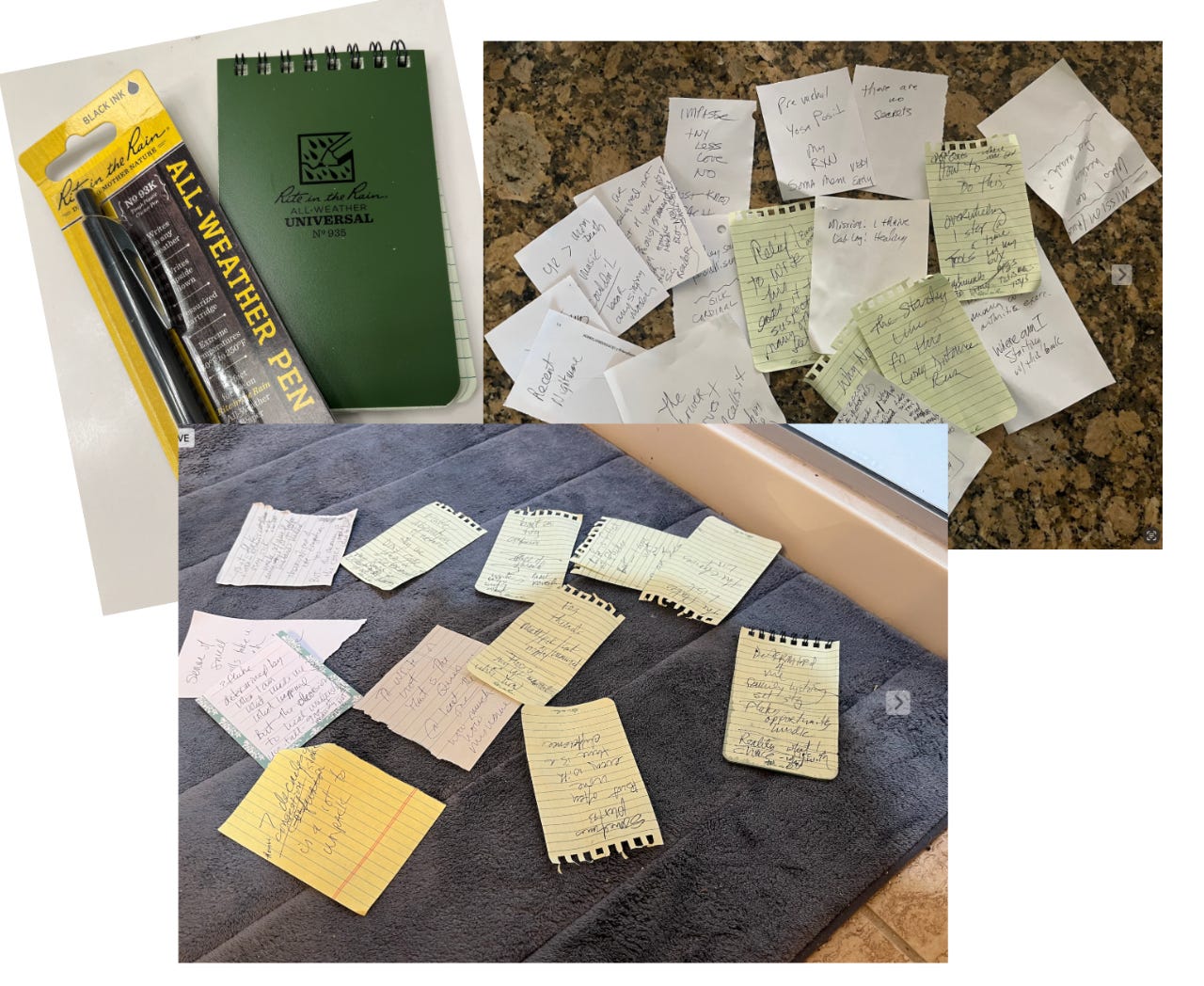
Aware that I can’t trust my memory to remember any of these things in my head until after my shower, I needed a way to capture them. Then I remembered that the nature researchers at the museum I taught at use waterproof field notebooks and pens to capture observations. So, I bought myself a package of “write in the rain” memo pads and a waterproof pen. And voila! I no longer have to worry about remembering.
Now, when a flash of insight pops in my head, I grab the notepad and pen which I keep on the shelf in the shower stall, jot it down, and fling it out of the shower and onto the floor. Afterward, I just collect them all and take action! And should the “thought flood” continue after I am out of the shower, I have another stack of recycled papers that I use to scribble more notes.
Today’s message – change the viewpoint
So the same thing happened this morning, related to my blog post yesterday, about why I write, draw, and paint my memories of abuse. In that post, I talked about looking back at the past in an intense “post-mortem” examination, like an autopsy…dig deep and see what it REALLY looks like, not just what I remembered it looking like.
Photo by author
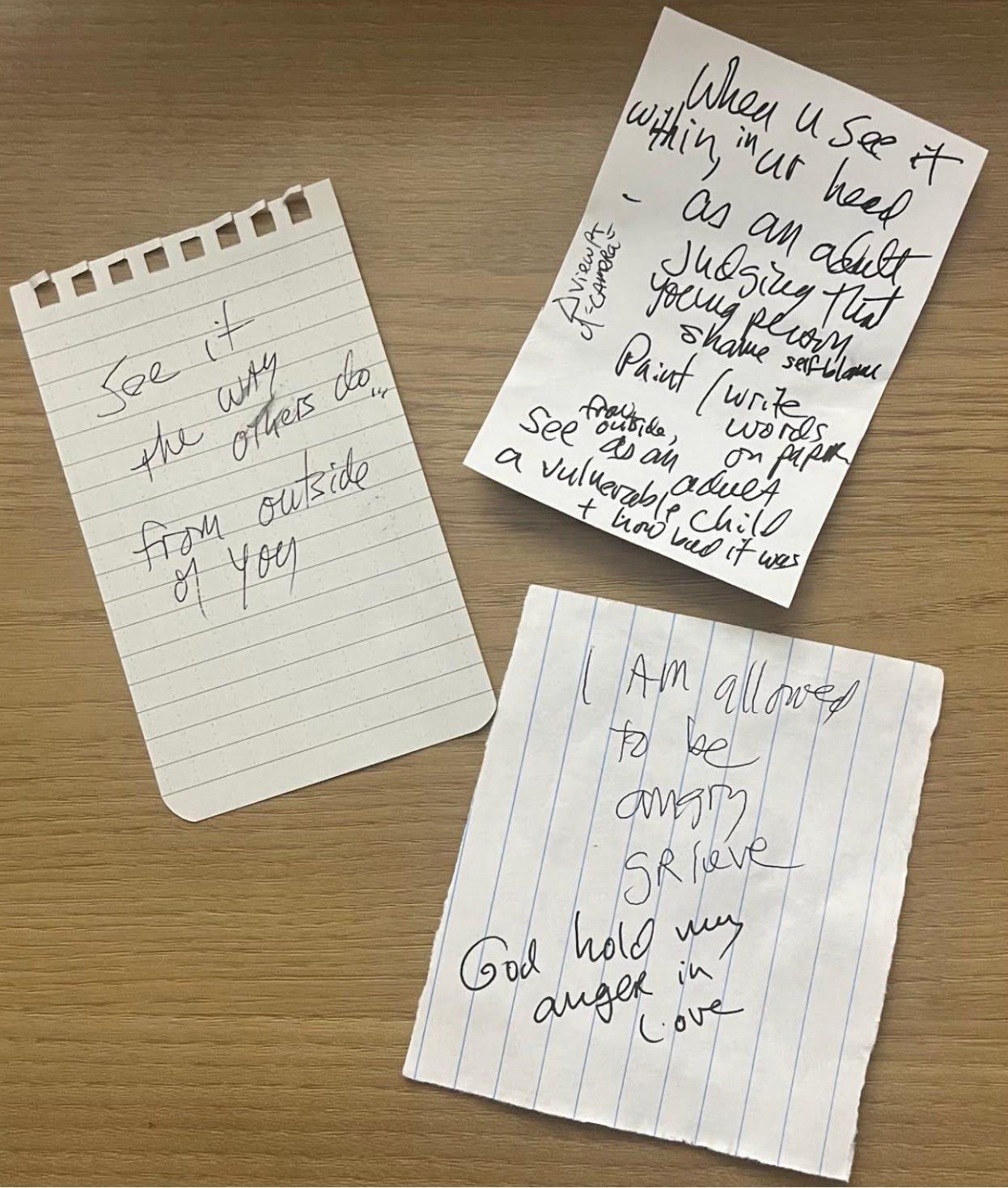
In the middle of today’s shower, these ideas flowed out about why I needed to get those images out onto paper, in paint, and words. The note about “anger and grief,” I will come back to another time. But the others were key thoughts for today:
I had to change the viewpoint. I needed to, instead, see my young self the way others would have seen me if they were standing there at that moment. The insight said, “Put yourself outside of you,” as if you were an observer seeing an adult doing to another child, the things done to you. In that moment, how would you react to that scene?
When I remember something done to me in the past, I may know it was done in my childhood or my teens, or my young adulthood. But my current-day, “adult” brain isn’t seeing me for the true age I was at the time…isn’t seeing what I was capable of knowing, understanding, or doing.
Instead, I’ve been inserting the “adult me” into that memory. So I am thinking of the me in those moments, as I currently am, and judging the me in that abuse scene, as if I were my current age.
Looking at the memory from within, I am seeing me with the eyes of judgment, shame, and intense self-blame. Statements like, “How could I have been so stupid? Why didn’t I fight back in that moment? Why didn’t I know better???!!!!” I judge the me of “then,” with the knowledge base of “present-day” me.
It has taken me a lifetime to understand how awful I am treating me, and how grossly unfair those judgments and questions are.
The shocking discovery
Four years ago, I realized I needed to write this book. But I couldn’t find words. They, and tons of mixed emotions, were choking me and rendering me unable to say a word. So, I started drawing and painting. And I made a shocking discovery.
When I painted myself as that young child, pinned to the wall after supper, held there by my father’s fist….When I painted that small, scared child sitting by the stove and saying “I don’t want Daddy to come home,” …or, when I painted the Saturday afternoon image of my father pushing my young child’s head into his lap, I was shocked…horrified…then enraged.
The female elder in me now, the old adult, the woman who has been a mother for over 30 years, didn’t see an adult me in those paintings. I saw a helpless child. A child trying desperately to endure and sustain through absolutely abysmal situations. Situations she NEVER should have been put in.
Instead of judging me and hating me for not fighting back, I saw the total impossibility of that. How in God’s name could my little person have been able to stop him when my mother could barely pull him off of me? How could that young child have even understood what he was doing to me on that couch, much less that she was not to blame?
When I paint the scene I have carried in my head, I no longer hate myself. I am, instead, filled with horror FOR me, and compassion. Anger at him. And intense respect and admiration that my young self was able to keep going DESPITE being confronted with those things.
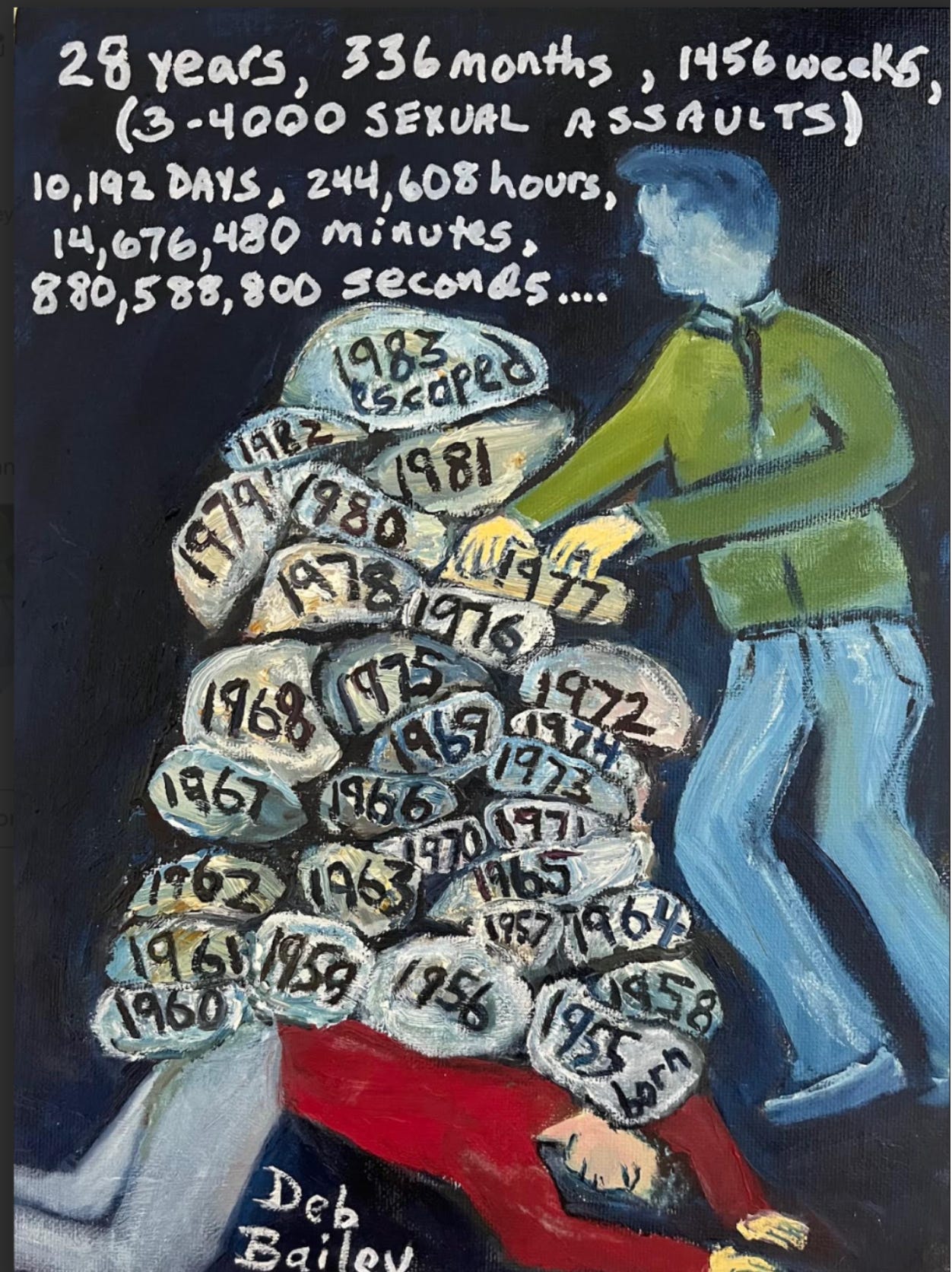
For years, I especially hated my teen and young adult self. But in doing these paintings, I then did the math for how many thousands of times over the years, from infancy to 28, that I was assaulted — physically, mentally, verbally, and sexually, I am now more upset that I judged me so terribly. That child, and teen, and young adult were doing the absolute best they could in that moment.
How could I have expected that young adult to have had the maturity she should’ve had for her age, after years of thousands of assaults? Those assaults and stress affected my cognitive and neurological development. My nervous system development. And assaults that robbed me of having any semblance of a decent childhood development process?
Now, looking at those pictures and writing those scenes, I am, instead, flat-out blown away that I fought back or held onto myself as much and as well as I did. And I NEVER could have made those realizations without doing those drawings and paintings, and writing out in black-and-white words on paper – just what was done.
My husband told me one day that he always heard and believed what I told him about my abuse. But he said that the paintings were so powerful that they made things so intensely real for him in a way that just saying it couldn’t. Powerful, yes.
Changing the picture
So, yes, I am revisiting the memories for a “second look” to see what I missed. But I am also revisiting them WITH DIFFERENT EYES. I have shifted my “viewpoint camera” from within me, to “OUTSIDE of me” and that has made all the difference.
Viewed in that way, THIS is how the picture changes:
Painting by author
I now feel so much compassion and love for my younger self. I feel remorse over judging her so harshly, and, instead, have such total respect for her….
Now, back to the next pieces on my “Wider Circle” – grandparents, school, and God.
The alarm hasn’t yet gone off, but I am awake. I’ve been so since about 5:30, like many mornings. The oblivion of sleep, its escape from reality, at least on the nights I have no nightmares, is over. While my regular blanket keeps me groggy and warm, the weight of the other blanket starts pressing me into the mattress. It is the heavy sensation of feeling scared, hopeless, and like I have done something wrong and will soon be in trouble. I neither want to stay in bed nor get up. I wish I could just sleep in oblivion all day. Getting up means facing another day of writing, struggling to live with the pain it releases, and holding the chaos I feel inside.
I get up anyway, because by now, in my 7th decade, I know that this is part of my life, my existence, at least for the time being. Even as I felt great last night, felt ready to take on the world, yet again, this morning, the black cloud was there to greet me when my eyes opened and consciousness returned. But life has taught me that, like the weather, everything eventually changes. You just have to wait long enough. So for now, I just focus on my “routine.”
The routine. It is something I had to create after I retired from teaching at Raleigh’s North Carolina Museum of Natural Sciences. When I was working, I didn’t have time to feel all of this. I had to get up, get moving, battle traffic, and then revel in the last job of my life — which was my total joy.
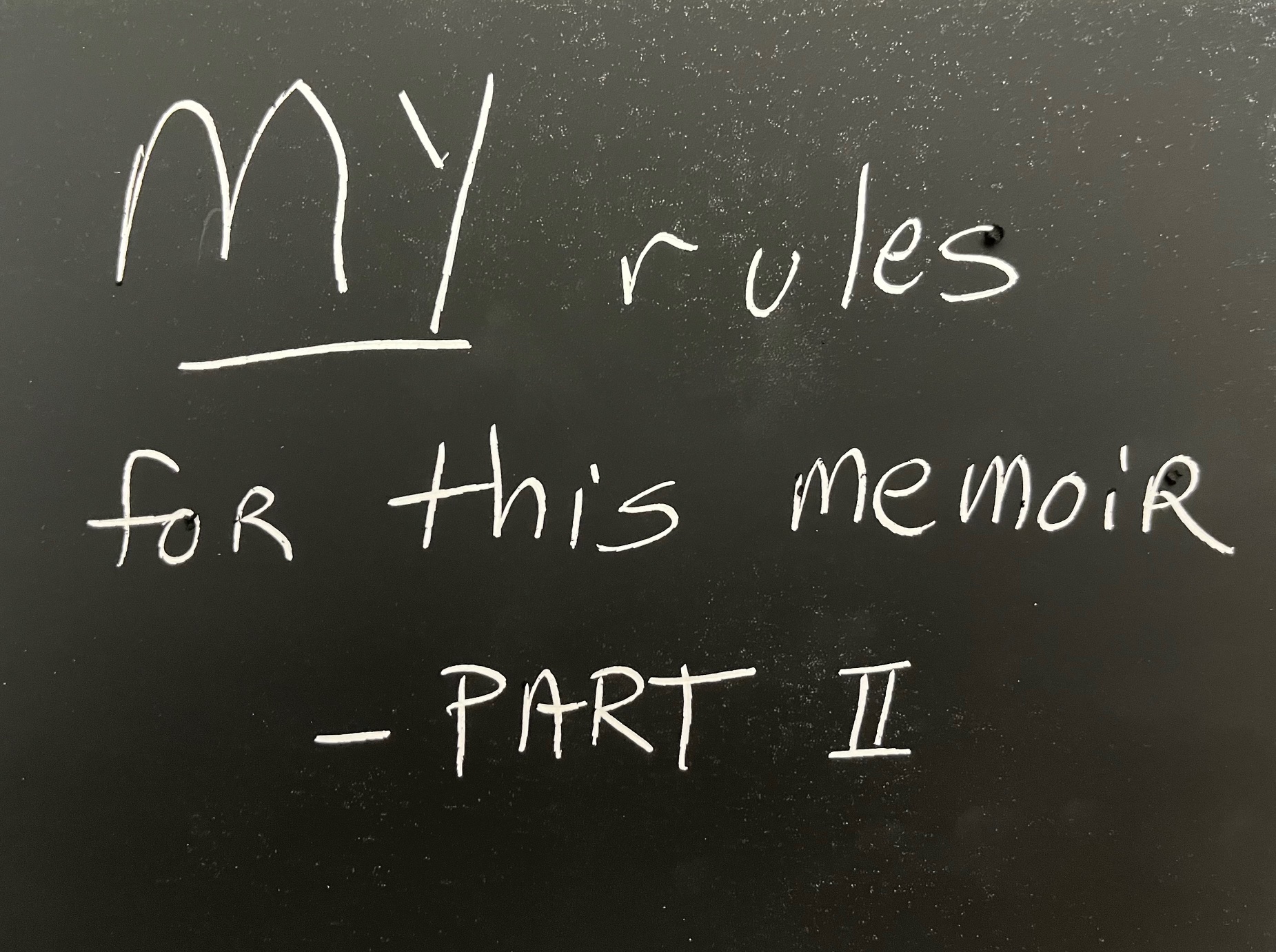
As promised, here is the second half of my rules for this memoir. These will be right at the front of the book so the reader is also clear about what I have in mind.
Caveats, cautions, and purpose
Before departing on this journey, here are 7 key points:
A Humorous Twist on the Old Masters’ painting style
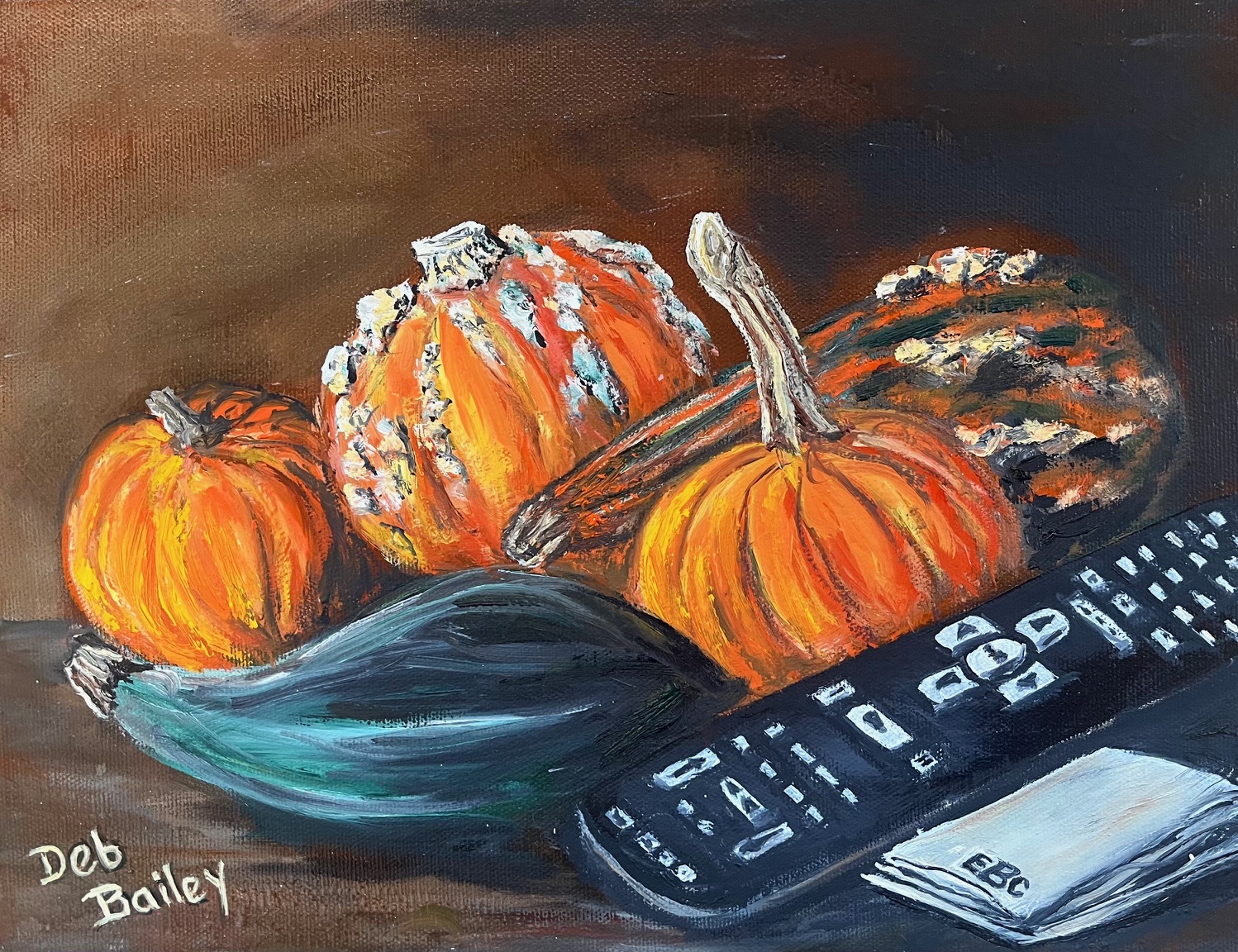
“The Old Masters with a TV Twist” – Painted by the author
The need for stress reducers during intense writing
There is no question that writing a memoir about abuse …frankly, about anything serious in one’s life if you are emotionally open and honest, can get intense. It takes energy to face it, feel it, process it, and extract the meaning behind the events. So, in order to maintain a healthy outlook it is important to have some activity for a “tension-breaker.” For me, that is art — both looking at good art as well as creating my own oil paintings.
The Old Masters paintings
I happen to love the Old Masters – whether the styles and color tones of the Northern Renaissance, such as Rembrandt, Albrecht Durer, Pieter Bruegel the Elder, or Hieronymous Bosch; or the Italian Renaissance painters and sculptors. I have a lot of books on the various artists or on the time period.
Giving the Old Masters a “modern” twist
Recently I decided to have some fun with the topic and created the above painting – The Old Masters With a TV Twist. I love the idea of throwing in some current-day object(s) to give a modern twist to the classical still-life painting approach! So there will be more of these coming along!
BTW, if you want to know more about the “Old Masters” – here you go:
For anyone who might enjoy watching the progress of my paintings from blank canvas to finished “masterpiece” please check out my Facebook page: Paintings of Light and Hope:
Photo link by author
You can also view my art progress on Instagram (if you’re not on Facebook)
I am not a marine scientist so I cannot weigh in on the scientific merits of the free vs. captive dolphin debate. However, I am an artist and there, I can serve the marine mammals. If seeing them in captivity is supposed to forge an emotional connection, then maybe seeing them lovely portrayed in a painting can do the same.
I also have a friend who expressed an interest in having a painting of a fish underwater. I think the original will have to be hers, but the prints will become my gift to the world and to dolphins in particular.
This morning, on a quest to see how I might approach this endeavor, I spent some quality time on Google images. Did a search on the term “dolphins underwater” and went to the “images” heading. There I found many photos to inspire me. I never actually copy a photo, but I do glean a “feeling” of the animal, it’s emotions, how it holds itself in the water, its soul.
But it’s not just the animal I need to “feel” but it’s environment. I need to “feel the fluidity, denseness, and motion” of the water around it along with how the light cuts through the layers of liquid. I need to feel the “temperature” of the environment – cold Arctic waters or warm Caribbean. And is it clear or cloudy with plankton, debris, dirt.
I often print out a few key pictures and just stare at them. Soak up their soul, shapes, colors….until I’ve internalized the animal and its space.
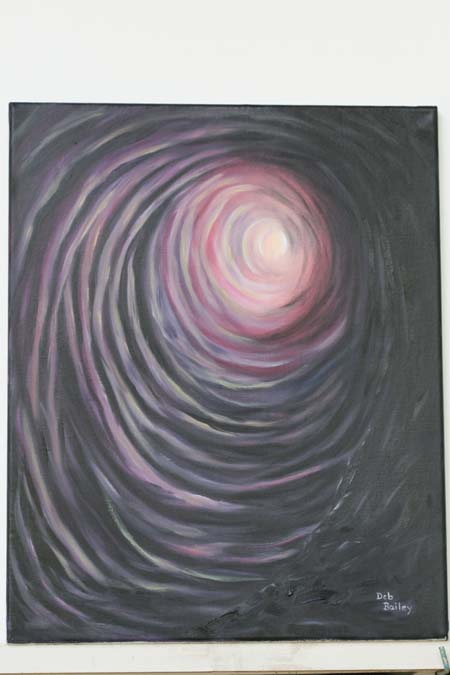
I had this idea last summer about selecting an emotion, and trying to put it on canvas…just let whatever arose in me when thinking of and feeling that emotion, flow down through the paintbrush, into the oil paints and emerge on the canvas. I started two of them – one called “Insight” and the other called “Uncertainty.”
Uncertainty is half-finished…I think. Maybe more than half. Maybe less. I’m uncertain. 🙂 Actually, sorry, just couldn’t resist joking around. It is not finished yet, though after staring at it on the garage wall for a year, I sense now what to do to finish conveying that. Sometime this week, I’ll post pictures of the current state of that painting, then get back to work on it.
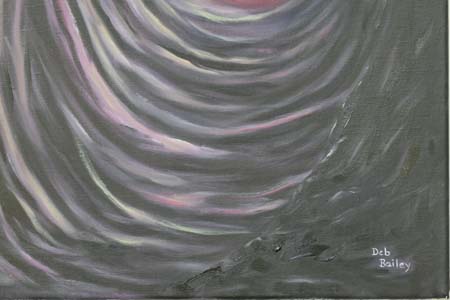
The one I have here today, Insight, I just finished this week. It was actually “just about” complete last year, but I kept staring at it and feeling it lacked enough depth. This past week I did a bit more and feel better with it. So I think it’s done. Unless I change my mind. : ) Even in insight, there is uncertainty.
In actuality, I think that was the thing I discovered about insight as I painted it. I know for myself, and maybe others feel this too, that when someone speaks of “gaining insight into something” the perception is that lightbulbs go off, the sun blindingly breaks through blackness, angels sing, and music blares because now, having insight, everything is solved.
I realized as I painted and thought about it, that insight is much more subtle, less certain, and often still pretty tentative. You have that lightbulb moment, yes. Out of TOTAL darkness where you can’t see your hand in front of your face, there is suddenly a glow up ahead that shows a way out. However, it is still not without shadows and dark crevices. Just because you gained some insight into something doesn’t mean you solved it all and now all your problems are over. Like Jesus sending the Apostles back out to fish in the morning after they spent an entire night catching nothing, gaining an insight doesn’t free you from the fact that you still have work to do and probably some things still to clarify.
Yet, there is that glow, a highlight showing the way, hope out of despair, and maybe hope is insight’s biggest gift.
Insight:
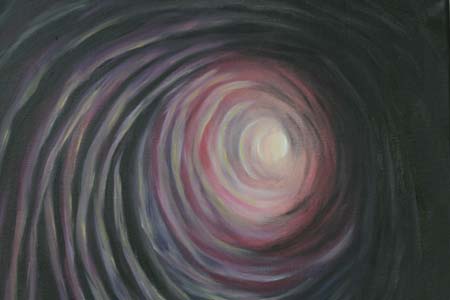
Close-ups of the top and bottom halves of the painting:
Companies have “Product Pipelines.” Teachers have “Lesson plans.” Movies have “Coming Attractions.”
Given that, I thought it was important to take a moment today to let everybody know “what’s coming” in the next few months on Soul Mosaic. The list below is not complete by any means, just some of the highlights farthest along in the planning stages:
Fiddler Crabs:
It remains to be seen whether the babies will make it or not, but I will continue to keep you posted. I see from the blog numbers this is a subject of high interest, so I will keep the updates coming.
As of today, the numbers of babies in the nursery tank has dropped dramatically. I am both sad and relieved. If thousands survived, they might have taken over my entire downstairs. However, I hope some make it. The parameters in the tank are good except for nitrites…the bane of all new tank setups. I am on my way right now to do a water change and see if that helps.
Hermit Crabs:
The next addition to the household in the near future will be 2-3 hermit crabs. I will be chronicling that from the very beginning, including what gear I buy and why, what happens when I “bring the babies home,” and how “life with hermit crabs” goes. Stay tuned for updates on when that will be happening.
Writing Posts:
There will be more posts to come on both My Author Journey, and the journey of Under the Pier as it moves through its process. I am pleased to report I am almost done with the second draft and will be starting both the third draft soon as well as putting together a submission proposal for a couple of editors. I will be sure to document the journey as it progresses. Topics still to come over the next several weeks and months in both of these areas:
1) Essays
From animals to God, geeks to kids, essays are how I speak. So more to come in this department
2) General Writing Journey
– The Writer’s House – That Swarming Bacteria, Proteus mirabilis
– Broken Bits – Encouragement for the Writer’s Soul From Beyond the Grave: A Nobel Laureate “Speaks”
– Writing Sanity: Do Something For Someone 3) More Topics for Under the Pier – Journey of a Novel
– Research Part III: Animal Character R&D
– Research Part IV: Setting as Character
– Three: The Mystical Number for Character Dynamics
– Test, Review, Retest, Analyze, Conclude
– Research Biblio- Diner Books
– Research Biblio – Nature Guides
– Writing the First Draft: If I Find One More Envelope Shred With a Story Note on It I’m Going to Scream!
– The First Draft is Done; What Now?
– So What’s Scribbled On All Those Revision Board Lists?
– What Writings Books Did I Use and Which Ones Did I Find Helpful?
– What Was Writing the Second Draft Like?
– What’s Coming Up for the Third Draft?
COMING SOON!!! A New Blog Category: Creature Features
As part of my preparation for Draft 3 of Under the Pier, I need to refresh my memory on all the critter descriptions. To really have those fish, birds, snails, and crustaceans breathing on the page requires vibrant details. So since I have to do a biology review of sorts, I thought I’d turn it into a creature of the day review for all of us. So – “Creature Features” coming VERY soon. (Appetizer: Did you know that an oyster toadfish can sound like an underwater foghorn?)
Photos and Art:
– New Macro photos coming soon. Since it’s Spring that means I can go back outside and crawl around the pond. Who knows what I’ll catch with my macro lens.
– “Photographic Journey of a Painting” – I will follow the journey of one of my oil paintings from rough sketches to explore composition arrangements, initial layers of paints, through finished product.
– Possibly Pastel: Given that I will be taking a 2 day seminar on Pastels in April, I may start exploring pastel art works and sharing those as well.
The Confusion:
What to do with the years and years worth of animal articles I have collected? – I have a box of news articles from the web collected over MANY years. It’s one of my quirks. I see an article about an animal, a cat who flew cross-country trapped in a plane’s insulation, a zoo animal playing with fabric softener dryer sheets, a 6-legged octopus, and I HAVE to print it out and keep it. My husband finds them for me now and sends them to me. Just like my feeling compelled to keep writing down the words “Mosaic” and “Broken Bits” over and over for the last few years until finally I realized it was my blog’s title and theme, I feel compelled to collect these articles.
The confusion in my mind is: WHAT SHALL I DO WITH THEM? I know I am supposed to do something with them… I FEEL it. But …what?
(Anybody have any flashes of insight????) …And Last But Not Least: And Then There’s Bear
So, lots to come in the next few months, so stay tuned.
I knew Phase II had arrived. Its symptom was unmistakable. I was tired. The amount of work coming from the dictionary job ran up against the short-term deadlines and heavier workload from the ethics board. Family needs took up more time. The ethics board work increased even more. And then there was the point of it all, my writing projects. I realized that I not only couldn’t keep spinning 20 plates on sticks forever, but I didn’t want to. Where some people revel in that level of activity or that challenge, I did not. That, in itself, was telling.
Going back to Mr. Shulevitz’s advice: “You must listen to yourself from your own depths and become acquainted with your own true self . . . learn which is you and which is NOT you. You are what you truly love.” My husband’s reminder felt viscerally real: I wasn’t getting any younger and I needed to stop trying to be what I was not.
I let go of the dictionary work. While it was a good job, I wasn’t meant to be a lexicographer. I throttled back on the ethics board work. It was time for that directive: “Be alone with yourself . . . Achieve inner silence.”In my case that came partly from renewing my dormant practice of meditation and prayer, as well as just, being alone. You can’t run from yourself. To be a writer, if you’re going to have anything worth saying, you must learn your own truth. And it’s only in the quiet moments that the voice within can be heard.
For the first time, I stepped back from my work and took a look at the big picture. I listened to Mr. Shulevitz and sorted out the voices without and within, I looked to see what themes kept repeating themselves in me and my work. That’s when things started to come clear.
I love nature. I loved being 10 and climbing trees and fences and running free in the neighborhood – that time of childhood where you are most capable, where adventure and innocence are at their crest, before the trials and tribulations of adolescence set in. I love castles, the Revolutionary War, diners and the sixties and the blue collar, ethnic world I grew up in. And mythology.
I noticed that I collected, and still do, every silly, touching or factual story about nature, animals, and zoos. I kept a nature journal of our backyard bird feeder and the pond area and collected 3 years of information. I identified with creatures either too small or too much in the background to get noticed, and I was that nature-geek, driven to learn about every tiny sea creature that lived under the ocean pier.
I also knew I’d probably never draw comic strips, or write romance novels, science fiction, or true crime. Nothing against any of those genres, by the way. In fact I am fascinated by the genres of comics and romance novels – they are unique worlds and they seem cool and fun. They just aren’t my talent. And no, I will not try to write any more picture books. In truth, my husband has that voice.
I started to define the projects that were me:
A mid-grade novel set in Williamsburg Virginia during the Revolution.A mid-grade novel set in a 1960s blue collar ethnic New England town, of course, set in a diner. A historical fiction set in 1200s England on the Welsh Marches borderlands. A chapter-book of Greek mythology stories. A fantasy trilogy involving the world of a groundhog living at a highway rest stop, who faces the battle of ultimate evil, personal despair, loss, and emergence into wisdom. And a present day Tween novel of a girl above the pier, in another diner of course, and a hermit crab below the pier.
There is also a love of tweaky, short non-fiction articles about history and . . . nature. I rediscovered a love of and need for essays, which I will write about separately.
I started collecting reference books for all of these projects. Nature guides. Historical fiction. Topographical and historical maps of England and Wales. I made a plaster of paris model of the castle that my lord built, incorporating the latest high-tech gadgets of the early 1200s.
I pinned my project papers everywhere – the study walls were covered on one side with the pier story – maps of the fictitious town, topographical maps of Narragansett Bay, schematic of the diner of my dreams, the one I’d have if I had the money. The other side of the study has the groundhog world – map of the rest, deep woods, nearby farms. The hallway, spare room and stairwell have 1700s Williamsburg, while the den downstairs houses maps of England, schematics of the castle, and the castle model itself.
I even have two webcams up on my computer that allow me to step into 1700s Williamsburg whenever I want. I can see the view down Duke of Gloucester Street or watch the goings-on at the Raleigh Tavern any time day or night. I even had a lobster-cam until that one broke. So I had to settle for the DVD, Realm of the Lobster, that has footage of the undersea world of the lobster in the Gulf of Maine. I found that in this cool marine store store, Hamilton Marine, up in Searsport, Maine. Great website and catalog! Everything from diesel boat cabin heaters and EPIRBS, to cold-water rescue suits and ship’s bells. My next purchase from them will be a hand-crafted wind bell that sounds like a harbor buoy. They even give you the choice of 13 different bells – each one sounding like a buoy in a different place – Bar Harbor, Portland Head, Camden Reach, Outer Banks, etc. I use anything that puts me in the place of my stories.
I started painting again and even did one for the pier story. I bought a new digital camera and started shooting pictures . . . once I stopped being afraid of the thing. It only sat in a box for 2 years. In both painting and photography, I noticed the themes of nature, broken things and overlooked things.
And the words mosaics and broken bits, kept surfacing.
Finally, exhausted, I left the ethics board job. It had gotten to be so much work I was too drained to write. Besides, it was no longer who I was. Revisiting Stage One, I collected outside information as it applied to the projects I wanted to do, from sources like Writer’s Digest magazine, The Writer, countless writing newsletters, market guides and writing books.
All of this I did silently. Alone. Immersed in my own world. And I came to accept that I will work alone. Others can prepare you, teach you, assist you, but when you finally stand at the edge of that dark forest- your own inner world – you must face that one alone. It’s that line from the movie, The Empire Strikes Back. Luke Skywalker is about to enter an area of the swamp where evil lives. He asks Yoda what is in there. Yoda’s response: “Only what you take with you.”
All that was left now was to pick which project came up on deck first. My groundhog story was fairly well outlined. The 1700s Williamsburg novel had some drafts done, characters fleshed out, rejection slips collected. The Under the Pier story had an equal amount of journaling, drafts, and character work finished. The other projects were much further back in the data collection and journaling stages. One day in confused desperation I asked God to please “pick a nipple for me.” A few days later we stopped at Science Safari, a tweaky science store for kids. Sitting atop the discards pile on the sale table outside, was a stuffed hermit crab. My husband and son spotted it. I knew who sent it, so I bought it. The answer had been sent: Start with Under the Pier.
UP NEXT: A Sidetrip to Essays – But the Bus NEVER Came Up This Far on the Curb Before!
THEN: Phase Three: Coming Into My Own – The Evolution of a Novel.
I had about three other posts in mind for today. Each one flooded my brain though, making it impossible for me to find the “simple thread” at its heart. That means they’re meant for another day when my mind can absorb them and sift through the layers to the simple truth at their cores. Sometimes, what is not there, makes it useful. By clearing something away, you see what is waiting there to be discovered. As soon as I set these other topics aside, my eyes landed on what is meant to surface today.
There is a book from the 6th century B.C. written by Lao Tsu, called the Tao Te Ching. The book is described as the essence of Taoism, contained in 81 chapters, which are more like 81 poems or pages because the entire book is about 5000 words. Don’t let it fool you. The shortest entries are the hardest to decipher. What is not there makes it useful.
Entry Eleven is one I could actually figure out-at least most of it. We won’t discuss those last 2 lines whose meaning in view of the rest I still haven’t figured out.
Thirty spokes share the wheel’s hub;
It is the center hole that makes it useful.
Shape clay into a vessel;
It is the space within that makes it useful.
Cut doors and windows for a room;
It is the holes which make it useful.
Therefore profit comes from what is there;
Usefulness from what is not there.
While Lao Tsu probably wrote them as rules to live by, I realized that they also apply to the creative arts:
Michaelangelo said that the sculptures he did were already there, fully formed in the rock. He just released them by cutting away all that was not the sculpture.
In photography, the photo’s essence is all about what to include and what to exclude. Even when you print the photo, it is often cropped first, to remove the things that don’t contribute the the unity of the photo. Leave in too much, and you dilute the power of what remains.
I recently took an oil painting seminar on color theory. The artist, Caroline Jasper, shared her process of creating seascapes. She started with some photographs of boats docked in a small port town. Her next step was to make some quick sketches, deciding which boats and buildings to keep and what to cut. By eliminating the excess, what remained had power. Only then did she proceed to actually painting the scene.
In writing, the same is true. Whether fiction or nonfiction – there is a slant, a premise, a particular viewpoint. By the very nature of selecting a perspective, some things will be excluded because they don’t support the main focus of that piece.
If there is any process in writing where “what is not there makes it useful” it would have to be editing. It is the writing equivalent of cutting away the excess stone, cropping the photograph, deciding what elements stay in the painting and which are removed. If anyone doubts the importance of removing what is not needed, consider the Gettysburg Address experience.
On November 19th, 1863, many dignitaries, including President Lincoln, gathered to dedicate the cemetery for the thousands of soldiers who died during the Civil War battle that took place there in July of that year. The main speaker was the famed orator of the day, Edward Everett. A former US Senator, US Representative, Governor of Massachusetts, and President of Harvard University, Everett was held in high esteem. Lincoln’s invitation to attend was actually an afterthought. Everett delivered a well-crafted masterpiece that was 13,607 words long and took 2 hours to deliver. Lincoln spoke for 2-3 minutes and delivered a speech that ran approximately 10 sentences long and had about 272 words. Lincoln considered his speech a failure, yet that is the speech everyone remembers to this day. Edward Everett, himself acknowledged that reality in a letter to Lincoln the very next day. He told Lincoln:
“I should be glad if I could flatter myself that I came as near to the central idea of the occasion, in two hours, as you did in two minutes.”
To remove the excess is to enhance the power of the creation. When I set the other topics aside, this one came up to be discovered. What was not there, made it useful.
Some lighter fare on tap in the next few days…photos of Admiral Byrd waving his claw, Scarlett O’Hara and her molted ghost self, and . . . even the ever reclusive Melanie Hamilton! Finally caught her sitting on her “front porch” – ie the open hole in the Live Rock – at 6:30 this morning. Stay tuned.
For today: So does staring into a tank of fiddler crabs, never mind shooting photographs of them at 6:30 in the morning, REALLY have anything to do with writing?
The answer? It all depends. You mean you wanted a definite answer? Here’s a clue – Mindfulness and heart. Still confused?
Simply said, it’s what you bring to the situation. You can sit there and stare at them and your mind could be on the bills, what you’re going to buy at the grocery store, what you could be doing instead of sitting in front of a tank of crabs. You could sit there and nod, “Yup, they’re crabs. Eyestalks. Sideways walk. They all look alike. So what?”
Or you can sit there and notice that Melanie Hamilton has much tinier front claws than Scarlett O’Hara. That she is timid and almost never comes out of her crevice in the live rock…except early in the morning when the sunlight streams into the kitchen and hits that side of the tank. She loves to sit in the sunlight on her front porch. Or that Scarlett O’Hara, who normally never stops eating and never hides out, suddenly after molting has stopped eating and has refused to move from under the water filter. Or that Admiral Byrd, normally fearless, crawled into his tunnel cave after discovering Peter Lorre’s lifeless body and started twitching and wouldn’t eat.
The difference is how you watch. Are you fully present? And did you bring your heart? The heart makes all the difference.
I am taking an online spirituality course with some friends, studying the writings of Thich Nhat Hanh (pronouced Tick Naught Han). He is an 80-year-old Vietnamese monk who endured the horrors of the Vietnam War, came to America to try and stop it, and was deemed a threat by both the Communist and non-Communist regimes in Vietnam. While searching for peace, he found himself everybody’s enemy. He was nominated for the Nobel Peace Prize by Dr. Martin Luther King, Jr. for his efforts to stop the war, and in his later years one of his many healing works has been to heal the souls of former American servicemen haunted by that war. Having lost close personal friends to that war, he has every reason to hate Americans. Instead he’s spent half his life healing people around the world, including Americans.
He tells a story in one of his books about a young man who wanted to learn to draw lotus flowers. So he went to a master to apprentice with him. The master took him to the lotus pond and left him sitting there for 10 days. Can you imagine in today’s busy world, signing up for lessons to learn something quickly, only to be left sitting at a pond for 10 days?
The real essence was what the young man did with that time. He could have gotten impatient (something I know a lot about), and grumbled, sighed, walked away, went shopping, took a nap, try to do something USEFUL with that time instead of just sitting there. Instead for the whole time, he watched the flowers bloom when the sun was high. He watched them close into buds at night. He watched one flower wilt and drop its petals into the water, then studied the stalk, the stamen and the rest of the flower.
On the 11th day the master returned and brought him a brush to paint with. Although his picture showed his naivete of technique, a childish style, the lotus he painted was beautiful. Deep beauty shone from the painting. He had become the lotus and as such, even with poor technique, he could paint something that moved another’s heart.
Mindfulness and heart. He paid attention to the lotus. He worked from his heart. Writing, really good writing that moves people’s souls, comes from the heart, not the brain. You can write a technically beautiful book but without heart it’s a sterile desert emotionally.
I started out watching fiddler crabs not sure what to expect. I certainly didn’t expect them to have personalities and subtle differences in appearance and actions. And I most certainly didn’t expect to feel such upset as I watched Peter Lorre tumble off his rock, dead.
With any luck, at least a little part of me has become the crab. With just a little more luck, maybe that crab heart will come through in my book. I’d trade a whole bunch of technical expertise for just a handful of heart.
By the way, if of interest to read a good summary of Thich Nhat Hanh’s life, check out this link at Parallax Press.


 Soul Mosaic