Posts Tagged ‘trauma’

Moments of Respite — A New England Fall…and Survival, in the Palm of My Hand

December 4, 2024

How to survive and sustain through abusive times

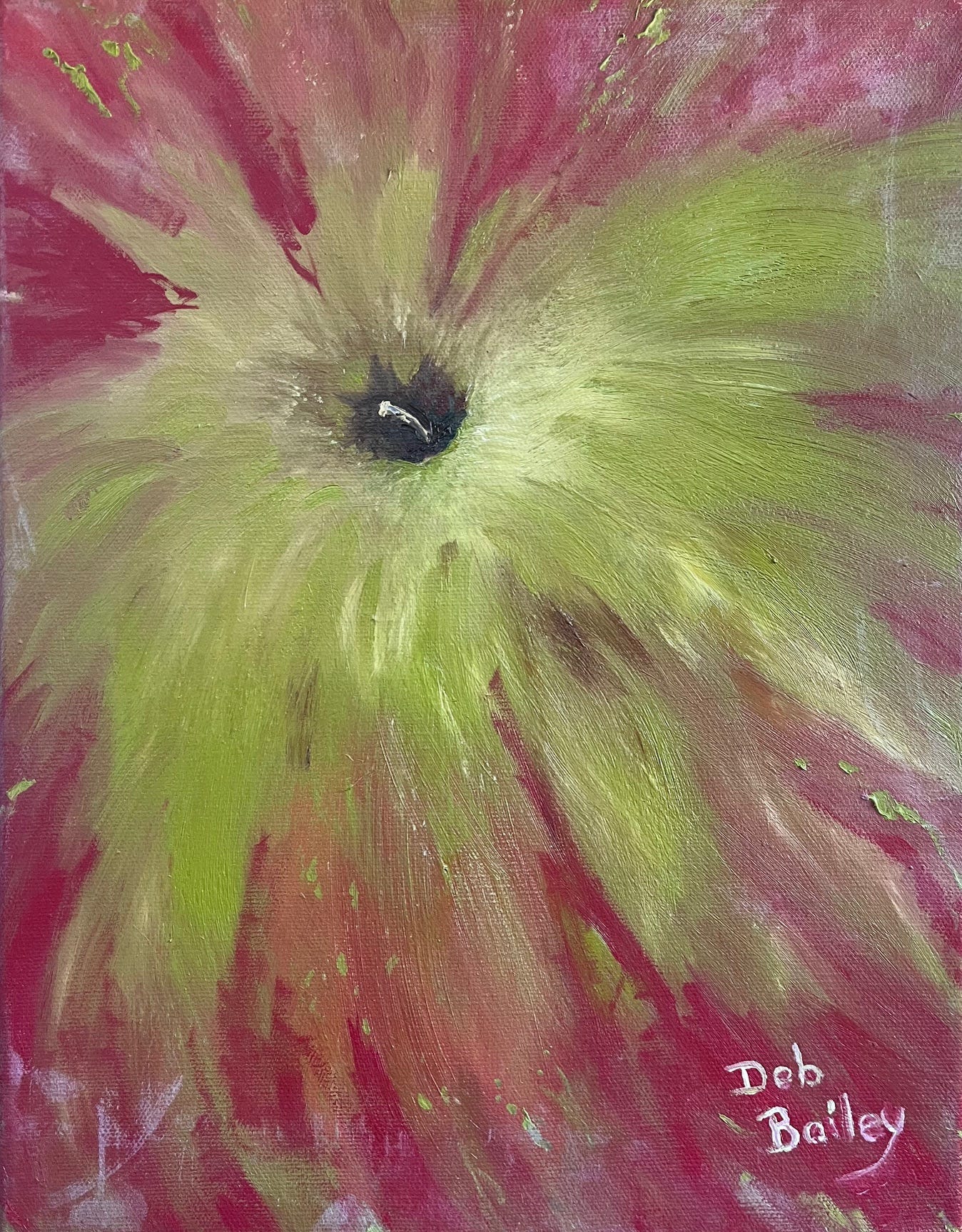
Brightly colored crisp fresh fall apple just harvested from the orchard. Bright red with streaks of lime green across the top and sides, it sits there ready for you to bite into with a crunch
Painting by the author

Why try?

Throughout my life, as is true for many of us, there are difficult days when the weariness of spirit becomes like a hand shoving us down against the mattress as we try to get up. The body struggles and the mind asks: Why bother? Why try?

Moments of “respite”

Decades ago, through years of childhood abuse, I found a way to survive — not a “dissociation” thing, but by living “Moment to Moment.” There would be the bad things and at that moment you just did whatever you must to get through it. Later though, when alone, I took comfort…escape…in a moment here, a quick experience there, but essentially in some small “detail” that I could lose myself in even for a little while. In those breaks, I could eke out sustenance where none seemed possible. And that let me keep going. At the time, I didn’t recognize consciously what I was doing–I just did it intuitively I guess– but it was my survival. Now I call them my “Moments of Respite.”

When autumn is in full color, I am reminded of one of the Moments of Respite from my late 20s — during a lonely day full of despair and a sense of abandonment.

Nature’s abundance

I grew up in New England, where the cold of fall harvest days conjures up images of steely gray skies and bare orchard trees. Even now, remembering that day gives me a reprieve from current problems…

Pulling into the dirt driveway of the farm I parked near the barn, the only car in the lot. Dried leaves crunched underfoot as I approached the building, and the air was heavy with that sweet smell of damp earth and composting plant matter. The sun hung low in the sky as the late afternoons were already taking up the appearance of night sooner than I wanted.

Inside the dimly lit barn, my breath visible in front of my face, bushel baskets of nature’s bounty were arrayed in rows before me. Grease pencil writing on cardboard signs listed the varieties there: Early McIntosh. Golden Delicious. Baldwins and Cortlands. Empires and Granny Smiths. So many to choose from thanks to nature’s gift to us of abundance… of flavors and textures, colors and sensations.

Questions, questions, questions

That gift though, presented the dilemma — which one or ones to choose? Even the questions came in abundance: Sweet apples or tart? Crunchy or soft? All? How much money was in my wallet? (Farmers then didn’t take credit cards and there was no Venmo or Squarespace.)

More questions followed. Would it be pies for the freezer? Or applesauce? Caramel or candy-apples, or baked ones? The type of apples makes a difference, of course, depending on how you are going to use them. And then there was just that simplest of delights, eat them fresh and raw before they made it into anything!

I walked the rows of baskets, gravel of the barn floor grinding against my boot soles. Back and forth, assessing the red ones, the green-red stippled. The sizes. The shapes. You look for the best ones with the fewest bruises…unless, of course you waited too long and there aren’t many left to choose from.

Even before I finished shopping, I couldn’t wait any longer to sample one. I was buying the basket anyway so I grabbed the largest one off the top, rubbed it against my jacket and tore into it.

The joy of a fresh apple

When you eat apples that are fresh off the tree, the sensations come all at once: the aroma of sweet and spice mixed together; the snap of crisp skin giving way under your teeth; a flash of tanginess as the soft flesh hits your tongue, and the syrupy juice that sprays out and runs down your chin. It is an overload of delight. In that moment, that “Moment of Respite” — the despair temporarily evaporated. In the raw air of a fall evening, drowned in the sensations of a fresh apple, I felt the totality of an autumn miracle right in the palm of my hand. And refreshed, I could go on.

It’s all in the details…

So many times in my life, those Moments of Respite saved me, fed me, gave me the energy to try again. For all the times when your world may be torn apart, life is sustained in the small details. It is those precious details that preserve the life-blood of our souls. You can draw a circle and color it in with a red crayon and call it an apple. Or you can underpaint it with burnt umber to put in the shadows, then layer in increasingly bright pigments of cadmium red, cinnabar green, lemon yellow, and titanium white. You can vary the intensity of the colors and the depth of the layers. Whatever you choose, the details make it all the richer for the moment. And it is in seeing the details that we are reminded there is more to life than just the pain we are struggling with at the moment.

Finding the calm

Moments of Respite provide the reminder that life still offers little worlds of richness and sensory escapes where our overwrought nervous system can retreat to find calm…where we can bind our wounds, restore our minds, and then return, ready for another round of the battle.

I no longer live in New England, and my life is much happier and serene. But even now, whether I am holding a crisp fresh apple from the store or the leaves hint at shades of crimson and burnt sienna, the evenings get a chill and the light departs sooner than I want, that moment comes flooding back. And I remember that Moments of Respite can make any chaos seems a little less daunting.

What is the REAL Truth of the People We Think We Know, and Do We Ever Know?

December 1, 2024

What lives in the heart of another, what REALLY goes on behind closed doors, and who do you believe?

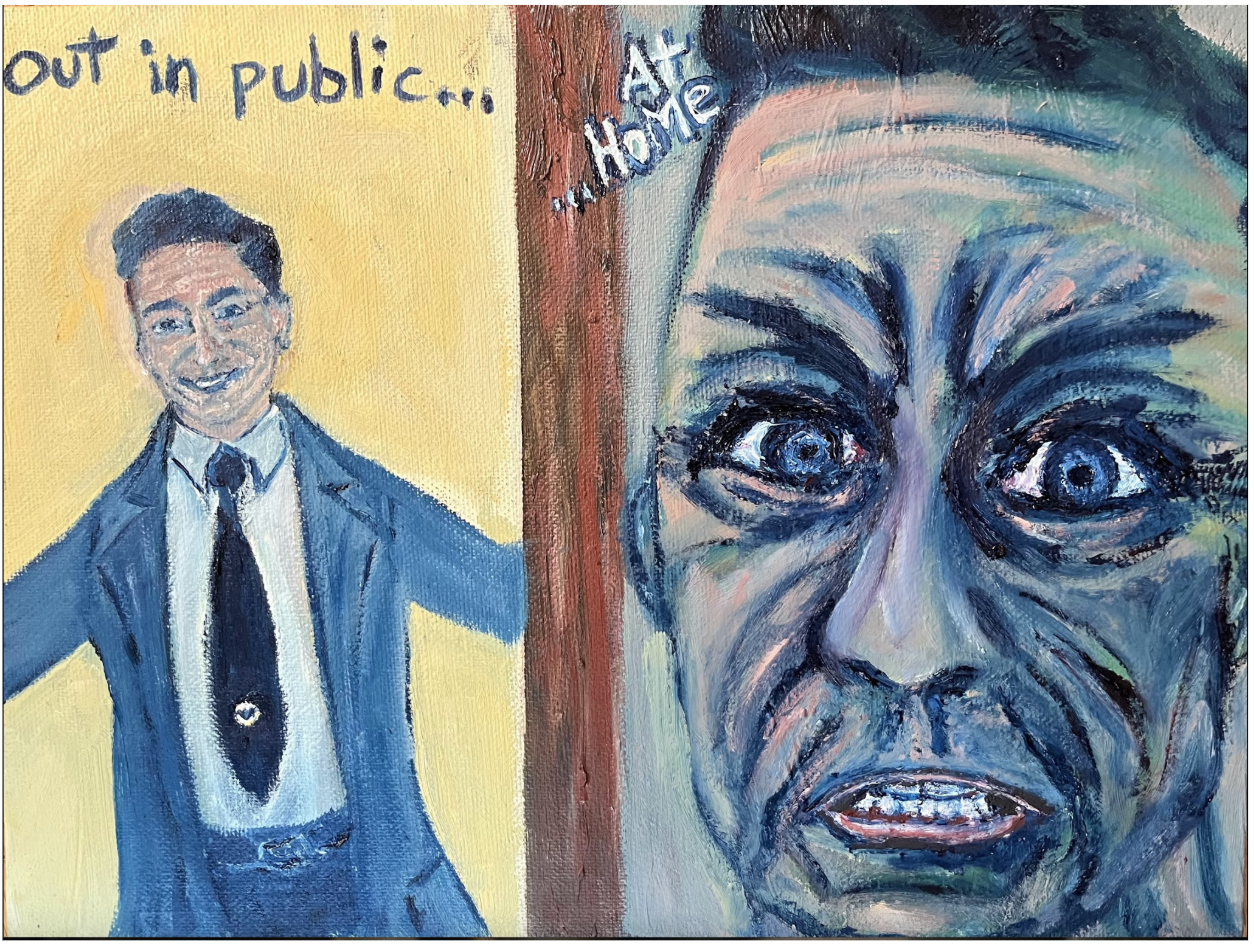
Oil painting showing two faces of her father - smiling happy relaxed man in suit on the left, with a light yellow background; on the righ a closeup of him, furious, teeth gritted, rage-filled eyes, done in tones of dark blues and gray and red
Painting done by author

Before I get started, let me first say this piece is not about the average failings we all have where we wish we had done better. We all have dark places in our hearts that we try to overcome with our better sides. And most of the time we actually do. There is not a one of us out there that is perfect. But there are those who carry much darker sides, inflicting harm on others without caring and often taking pride in their ability to fool others.

Why can’t people just leave it alone?

Domestic abuse, child abuse, incest….these are messy topics, uncomfortable topics, topics many would rather avoid than deal with. For many people it comes down to, “he said, she said,” and how do you prove it? And if you know the person accused personally or through their fame, who do you believe? Do you even want to believe it might be true? Why can’t it just be simple and why do people have to bring this stuff up?

The Steven Tyler picture

(more…)

If You Don’t Love Me, Have I Failed?

November 30, 2024

(Published on Pure d’esprit as: How to Love Yourself-Even if it Takes a Lifetime)

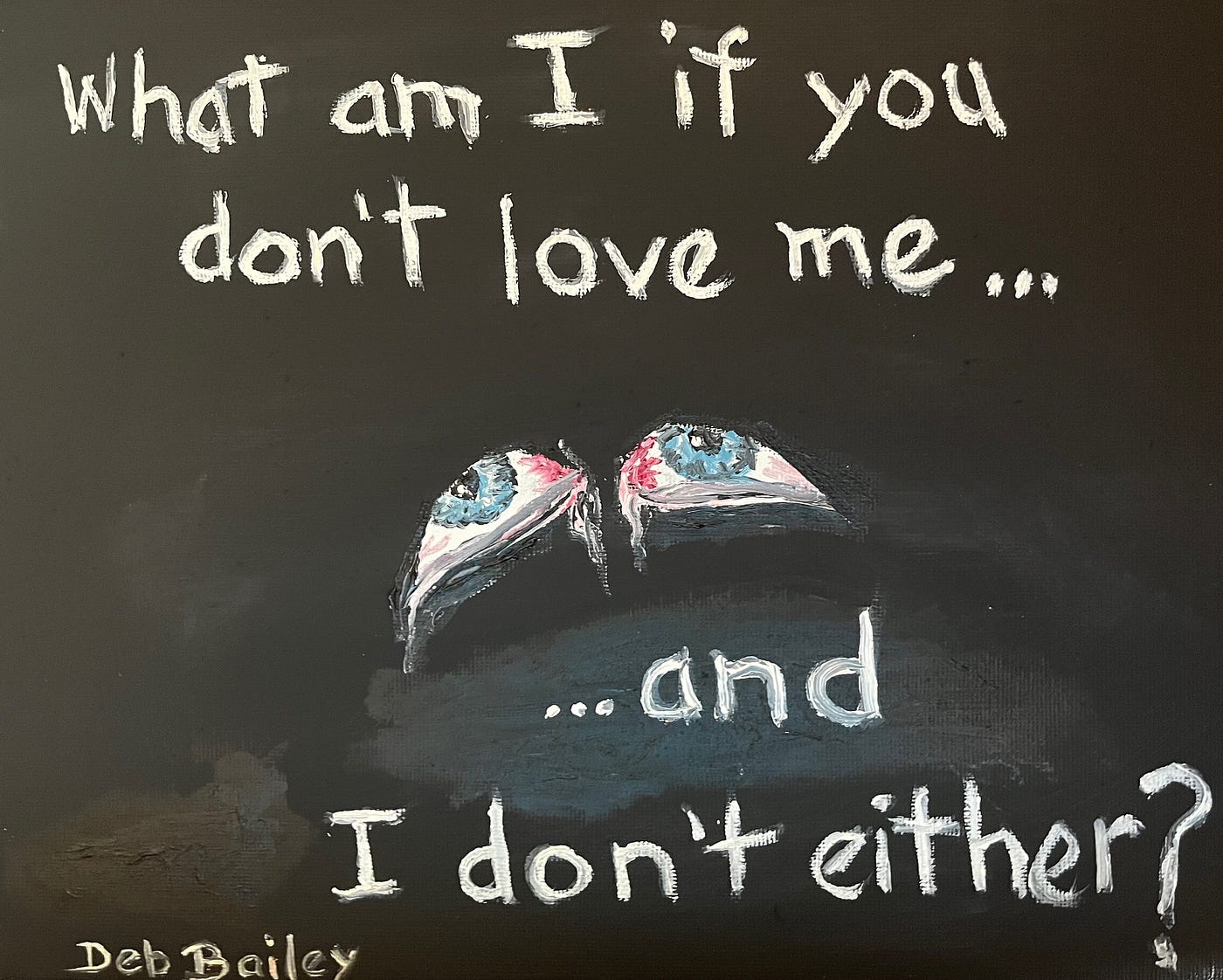
Oil painting of a black background, white letters and two eyes that are tear-filled and red. Words sayd: What am I if you don't love me...and I don't either?
Painting by the author

NOTE: While I work on that list of reasons to write a memoir, let me share this recent post of mine from the Medium platform publication, Pure d’esprit. I will follow-up later with posts that get into the origin of why I felt this way, the shame carried, and lifelong self-hate that had to be recognized and confronted.

So what am I if you don’t love me…and I don’t either?

At the end of the day it really comes down to this question. In life, sometimes the only one we can count on at times to be in our corner IS ourselves. Parents may fail or abuse. Spouses may walk. Friends disappoint. At the end of the day, if we measure ourselves by those around and outside of us…and they fail us, does that mean we have failed?

That answer took me 69 years. I had almost 30 years of childhood abuse to rebuild from. For a lifetime I hated that younger person I was. Viewed her as weak, stupid, a victim. And I was never going to be a victim again. So, of course I shunned a whole part of me…the part that actually saved me.

About that younger part of me…

That younger part of me had struggled through some of the worst years of my life and kept going. She had trudged through all kinds of abuse, through no or few friends. Through suicidal times. Circumstances crushed me and challenged me to ask myself: “Why should I stick around?”

She instead listened to a small voice inside that kept telling me: “Just hang on. You can always choose to ‘leave’ tomorrow. But just hang on, even one more day. You might miss something.” That small voice wouldn’t relent and she kept listening. “You can hate yourself. But, just hang on anyway, even a little while longer.” I don’t know why she listened, but she did.

Over the next several years I slowly rebuilt me. Got strong, fierce, determined. No one was going to ever do that to me again…a good thing for sure, though I think the pendulum swung a little too far with that tough side of me.

Never be weak again…and then…

Eventually, though, life got better. I even found love with a true soul-mate. And while I continued to soften emotionally, to myself I was not very kind. I had learned to “value” me in some things, in that present moment. I valued being strong, not that “weak stupid younger part.” Her, I despised. I sealed her off and tried to forget her. She was dead to me. Besides, I was too busy raising a son, having a life, to think about her anymore

Then 2006 came along. My husband almost died. My son left for college. The dog died. Menopause hit. And I could no longer face doing the medical research work I had done for a decade. I was in a total spiral. Lost. And it was then, brought to my knees and realizing I was no longer that “tough strong” person anymore, that I began the rest of the journey to healing. And she, who I had hated for a lifetime and abandoned, was the key to my healing.

The return

It has taken a lifetime to return to her…to me actually…that younger part of me. It took me a lifetime to recognize just how brave she was, how much courage she showed. And that the only reason I survived and grew was because of the strength she showed. I finally realized what a truly amazing and special person my younger self was, and what a debt of gratitude…what a debt, period, I owed her…as well as an apology. But even there, strong, loving, gracious — that younger part of me showed me love. Reminded me that at any point we are all just doing the best we can. And she welcomed me back with full love, reminding me also, that is is “better late, than never.”

It is never too late to start loving yourself. And whether it takes a lifetime, whether it is a messy imperfect process, it only matters that you finally reach across the table and reconnect, and truly LOVE yourself. Just start. Even a little. The rest can follow later…even if it’s a lot later.

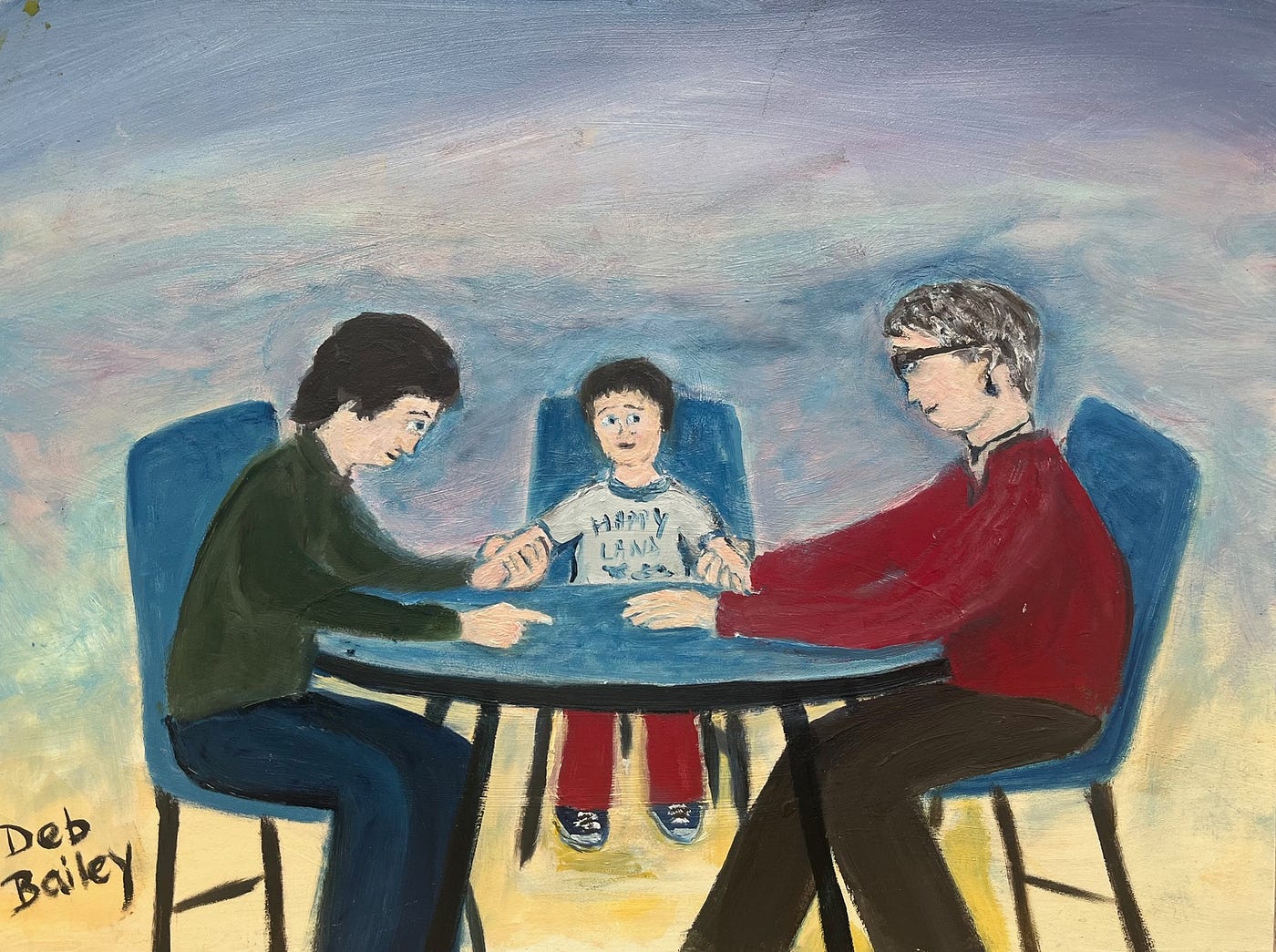
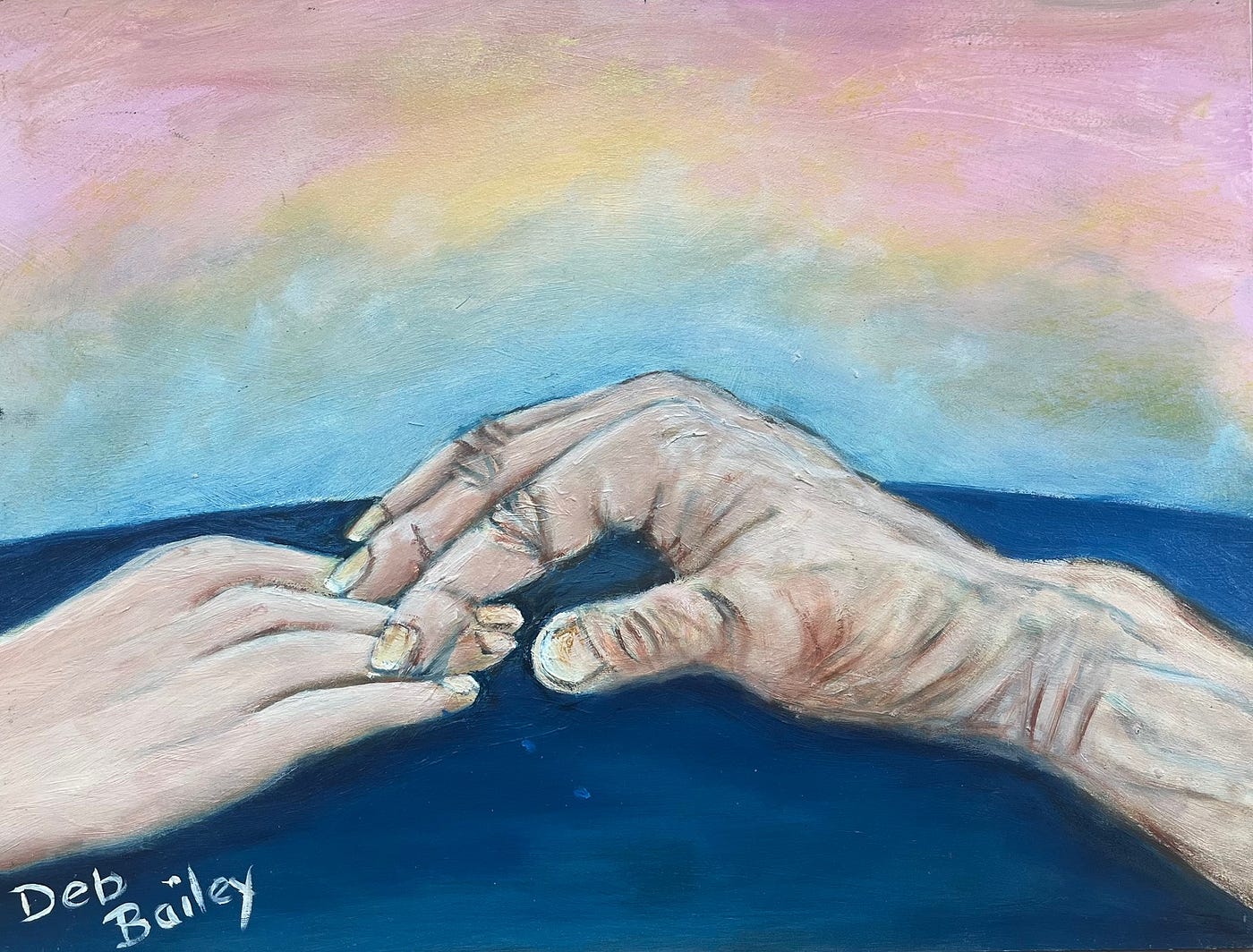
Painting of the 3 different ages of the author who have been at odds with each other for a lifetime, now reaching for each other to make amends. One is the young child, the next is the young adult who was hated by the holder adult for years. The third is the older adult making amends with them both.
Painting by the author
Light blue pink pastel background with a dark blue tabletop and two hands stretched across and reaching for each other - one from an older version of the author, and the other, the hand of the author at a younger age.
Painting by the author

Is Writing a Memoir Worth it? 1/3 – RISKS

November 26, 2024
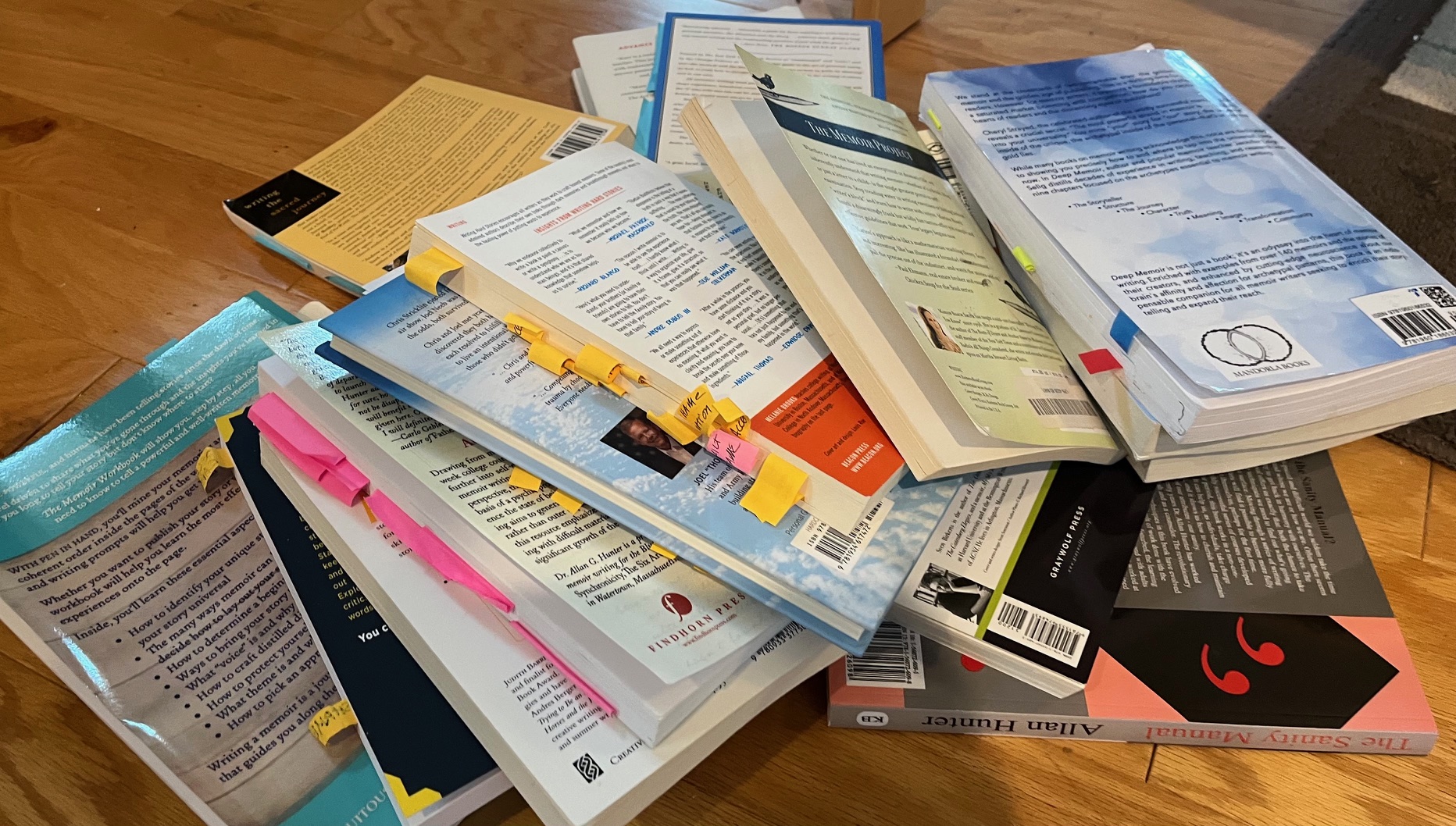
Pile of over 20 books on memoir writing the author has read to learn how to do this. They have many stick tags and notes sticking out of them.
Photo by the author of just “some” of the many memoir-writing books in her home library

What About the Risks?

So you’re considering writing your memoir. You take stock of what stories, events, and insights most impacted your life. You examine your life and make a list of obstacles encountered, successes and failures — and how you dealt with either. Your soul says “there‘s bits here that might be helpful to share,” so you sit down at the computer, get ready to open a vein and…you freeze.

There is no question that many writers experience tremendous fear when writing, no matter the topic. There are many books and articles out there on how to write, what to write, and even how to overcome the fear of writing. I have more than a few of each kind on my bookshelf. 

Fear of writing

On that last item, fear of writing, I have a book — The Courage to Write: How Writers Transcend Fear by Ralph Keyes — that I’ve kept since it was first published in 1995. So, it’s not a new problem. I suspect the first time a cave person scrawled an image on a stone wall it might have given them pause when they stepped back to assess their work.

The idea of putting ourselves out on the page…even if we never show it to anyone, may stop us before we ever start. And I am not even talking about whether the writing is any good or not. First, there is the possibility of triggering powerful emotions never before confronted. That is immediately followed by self-judgment: Am I really like that?

The pages never read aloud

We all have those “pages we never read aloud” to anyone — things we don’t want anyone to know about us, and for that matter, things we may not even want to admit to ourselves. And yet there is no escaping their reality when the words sit there — stark black letters blazing tracks across the white page.

Even if we’re not writing about our own mistakes or faults, there is no question that subjects of a serious nature will impact any writer’s willingness to venture there. It’s one thing to talk about how a car engine works and know you will be judged on how well and accurately you write the piece. But to write about victimization, shame, or messy emotions, and to say on the page what someone drilled into you NEVER to speak about, invites some powerful ghosts to come stomp all over your courage.

While you may have shared those stories with therapists, relatives, or close friends, it is a whole other matter to actually know that thousands of perfect strangers know your secrets. And that doesn’t take into account in a digital age, putting things out in places where people can respond immediately, and with things like: “What’s the big deal? Get over it” or worse. 

So that brings me back to my original question — is writing a memoir worth it?

The power of transformation

I have been reading a book on memoir writing that is great…actually, I’ve read many over the last few years. But the one I speak of right now — Deep Memoir, by Jennifer Leigh Selig, PhD — just nails soooo many important themes.

One theme in particular, in a chapter near the end of the book, really caught my attention. In that section, the author dug into the power of writing a memoir to transform you — change you not just by looking back at the past and making observations about what happened THEN, but to change you RIGHT NOW as you are writing

As soon as I read that sentence, my gut tightened because I knew exactly what she meant. I’d be writing about some issue of anger or shame that I’ve carried for years and even as I was typing the words, I could feel some slight shift in me…a softening, compassion, a lowering of terror. 

All I know is that in those moments, I am like a crucible holding individual chemicals. And as I am held over the fire in that writing process, the chemicals start to melt, mix, react, and become something new. The process taking place in that “writing crucible” changes me and it’s not about the ingredients I started with. It’s the process.

But what about the risks?

But the book also notes some authors who have experienced extreme emotional trauma such that after they published their book they said they would never do it again. Jessmyn Ward, writing about five men in her life who died, said she doesn’t know if she could go through that process again. Carmen Maria Machado, after writing about intimate partner abuse, said she probably would not. And Pat Conroy, writing about his childhood abuse in his novels, experienced suicidal despair, attempted suicide, and had another suicidal breakdown later, after another book. So the risks to one’s mental health are not imaginary or inconsequential, especially when writing about traumatic events.

Physical illness is another way traumatic material can wreak havoc on a writer. Kate Bornstein was already experiencing sleep and eating disturbances, along with having to seek therapy because her writing triggered a borderline personality disorder. But she also suffered gut problems so severe they had to remove part of her intestine, something she attributed to her writing. She said the writing “gets you right in your gut…and I took that as a sign that I was on the right track.”

All of that aside, there are the “normal fears” about writing a book. What if people hate it? Or don’t get it? Or maybe worse, what if they love it and the response overwhelms you? Fear of success is just as strong as fear of failure. Especially if you’ve lived through abuse, you may have lived your life in the shadows and sudden public awareness is too much. Or there are the stories about writers who’ve encountered rejections and relationship breakups; angry responses from others who don’t like what was shared; or for some, even lawsuits.

What risks am I facing?

So, based on all of the above, in terms of writing my memoir I realize it might:

  • Trigger my own pain, health, and emotional reactions to revisiting painful things
  • Expose all my hidden details to the public
  • Deliver reactions from others that I may fear, or be emotionally devastated by
  • Change my life

As to “change my life” — well it already has. And will continue to. Just look at the fact I am writing here and saying truths I’ve not put out publicly before. So change is a given. And the remedy for that is just “one day at a time.”

Regarding the first three risks, I have given those a lot of thought. I have put in place some support systems for me as I do this. Also, I drafted a list of things to share with readers at the beginning of the book — things such as rules and boundaries for how I chose to write the story; trauma-trigger cautions for readers, given the topic; and most importantly, the purpose for writing. 

What is memoir REALLY for?

The last one matters most because in the end, if I am going to write a memoir, it is not about just making a laundry list of all the things I lived through. It is REALLY about: because of what happened, what did I do with it? It is about coming back. It is about hope. It is about connecting on a universal level with a reader who might have a different story but still experienced similar emotions. 

The “decision-maker”

Having thoroughly rattled myself with the risks, I did one last thing before answering the question — I made a comparable list of “why it’s worth it to write a memoir.” I figured it would be blatantly obvious after that, what I should do.

Digging into all of the books in the above picture (and several more) I compiled a list. It was an illuminating…actually an eye-opening experience. And so I came to my decision.

I will share in a separate post, what I put on that list. It will, no doubt, make clear my logic and maybe be helpful to anyone else considering whether to write their memoir or not. It goes without saying — but I will say it anyway — that each person has to make their own list and determine what their own risk/benefit ratio is for writing and then make their own decision. 

The bottom line

But for me? Is writing a memoir worth it despite everything above? And despite the fact it’s taken me seven decades to come to this point?

A very short, simple, but emphatic answer: YES!

My “benefits” list will come soon. 

Writing About Sexual Abuse – Things to Consider

November 25, 2024

(Published on Medium Pure d’esprit as: Difficult Stories: Considerations of Risk and Courage When Writing About Sexual Abuse…or Anything)

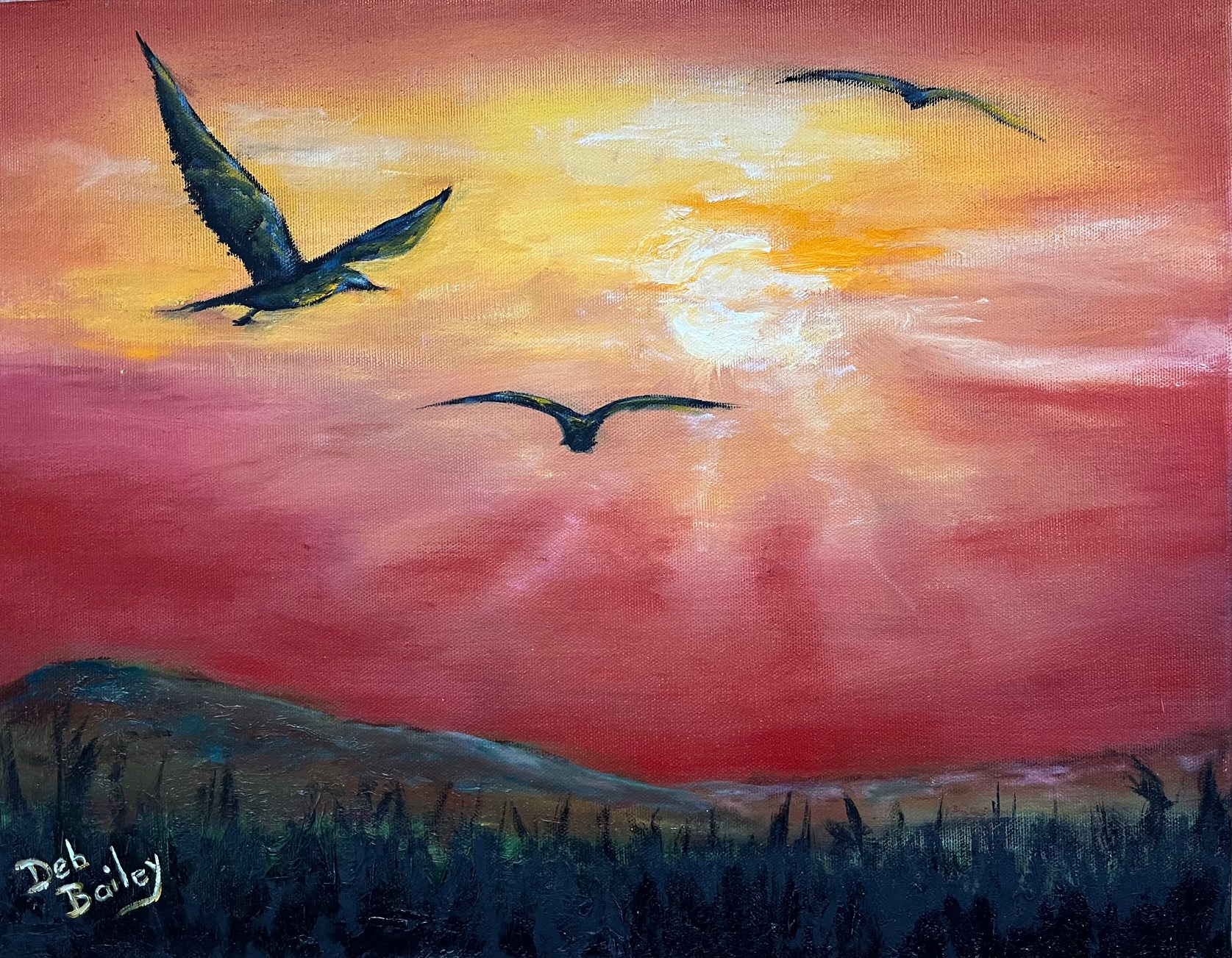
Oil painting of a red-orange-yellow sunrise sky over dark hills, with 3 birds majestically soaring overhead. Symbolizes the freedom of the author to speak her truth after 7 decades of silence.
Painting by the author

Difficult stories

Difficult stories… Well, maybe every story is difficult in its own way because no matter the topic, every writer must take a risk to write, and then find the courage to share that part of their soul.

To me, the bottom line is: To write is to be brave, period. And it is a topic I have wrestled with for years, so I will speak from my own experience.

Trying to write about sexual abuse – childrens’ books

I have contemplated writing my story for a long time…in fact, I tried–magazine articles, children’s picture book, middle-grade chapter book, another magazine article…but none of them seemed to work out.

My first thought was to write fiction–thus I could convey “something” about sexual abuse that might be helpful to someone, yet avoid speaking about me directly…and publicly.

I thought I should write for children — because maybe I could offer them some help on how to avoid being abused, or how to get help in abusive situations. But …what could I say?

For one, I am not a mental health professional so I could not give them current or professional advice. Second, the childrens’ books I saw out there on the subject made it sound like all the child had to do was go to a helpful adult, tell them what was happening, and the adult would make it all better. To me that seemed like REAL fiction, a betrayal of the reality, which might offer no change or a situation that was even worse.

For one thing, often in abusive situations there are no safe adults to go to. And even if outside agencies get involved it doesn’t necessarily make things better. Families may be broken up and kids may get put into the same sitution elsewhere. Even if the family stays together, the abuser may have gotten just minimal help so they might not be “that” safe. And maybe there would be repercussions to the child for “speaking,” from the abuser or other family members. So I just felt I could offer little to help kids.

Trying to write about sexual abuse – magazines

I tried magazine articles hoping to bring more awareness of just how prevalent sexual abuse is and how damaging it is. And while editors were sympathetic, none offered to publish them.

But maybe that was for the best. Frankly, at the time I wasn’t sure how best to write it or exactly what I needed to say that would be a useful and universal message. And I still had a lot of work to do on me. So it was not time.

The message and “giving witness”

Now, decades later, and after years of work with a trauma specialist, I am writing to adults. While someone needs to write to children, I accept I don’t have the talent, voice, or message, at least not at this point. But I can speak to adults. Memoir is my strong suit, and….this time, I know my message:

“In spite of what you did to me, despite how I still struggle, I THRIVE.”

I can give witness not only for myself but for all the others who were harmed and might not be able to speak…or who didn’t survive to be able to speak. As novelist Pat Conroy said:

“I write for the people who can’t speak”

Maybe my story might give someone hope to find their own answers for healing.

Questions that must be answered first

But there are some issues I needed to face to do this, and I think it is true for most writers there are questions each must consider before writing. Because no matter how valid, important, or useful any writing might be, the writer has to make it through the process. Some questions to consider:

  • What are the risks of writing? Physically, emotionally, relationship-wise….
  • What, if any, are compelling reasons to do it despite the risks?
  • And…should I take on that battle?

To the last question — “Should I”? For myself, after seven decades of silence, THAT ONE IS A DEFINITE YES…I am writing. And I will use my own name, not a pen name. But it has taken me a lifetime, and I have thought long and hard. And as to exploring the risks and benefits, I will share my findings in a separate post, and simply leave it that is was a rich, illuminating, and gratifying exercise to do.

The real nature of writing: Courage, honesty, power

But for now, my reason for bringing up the subject of difficult writing is because #1 we are all writers. And in the end, it is not about the subject matter. It is about courage and honesty. It is a supreme act of courage just to put your words on a page even if you share them with no one. Because if you write honestly, you must still face them yourself. It is another level of courage to share them with another.

So the topic of “courage to write” is something I have been exploring a great deal and will write more about. I imagine it is a subject many of us can relate to. One thing I can say about the times I have taken a risk, dug deep for courage, and did the thing I believed was right, I could feel my soul soar.

For now, a gift of inspiration — two quotes I came across and share here for all:

“A word after a word after a word is power.”―Margaret Atwood

‘’You too are driven by the desire to understand…Beneath your desire for knowledge writhes the hunger to understand and love yourself.” — Gloria Anzaldua

The Power and Unexpected Gift of Adversity – Part II: Quiet Power

November 24, 2024

Relating to the post with the scarred lioness, I received a kudo from one of the editors who liked my description of her showing “quiet power.” And that really summed her up when I looked at the picture. In fact, it sums up what I feel at this point 7 decades into life…quiet power.

When he gave a kudos comment, I responded:

And that really is the crux of that description…I have lived through a lot. Life may yet surprise me, overpower me, lay me low, gift me. But no matter what…quiet power to take any of it in.

For a good many situations in life, I have already experienced them or something similar. I have had time to consider what my life values are and what I will and won’t compromise on. And, I still know how to fight, though these days I pick my battles because I won’t waste precious energy and time on useless things.

So as I said in the article–win lose or draw, I know what I can draw on, what I can take, and I will give it my very best. Beyond that none of us can know the outcome. That too is quiet power…the awareness that some things are beyond our power and all we can do is bring our best self to the table. After that it will go how it will go. But at least we will always know we did our best.

The Power and Unexpected Gift of Adversity

November 23, 2024

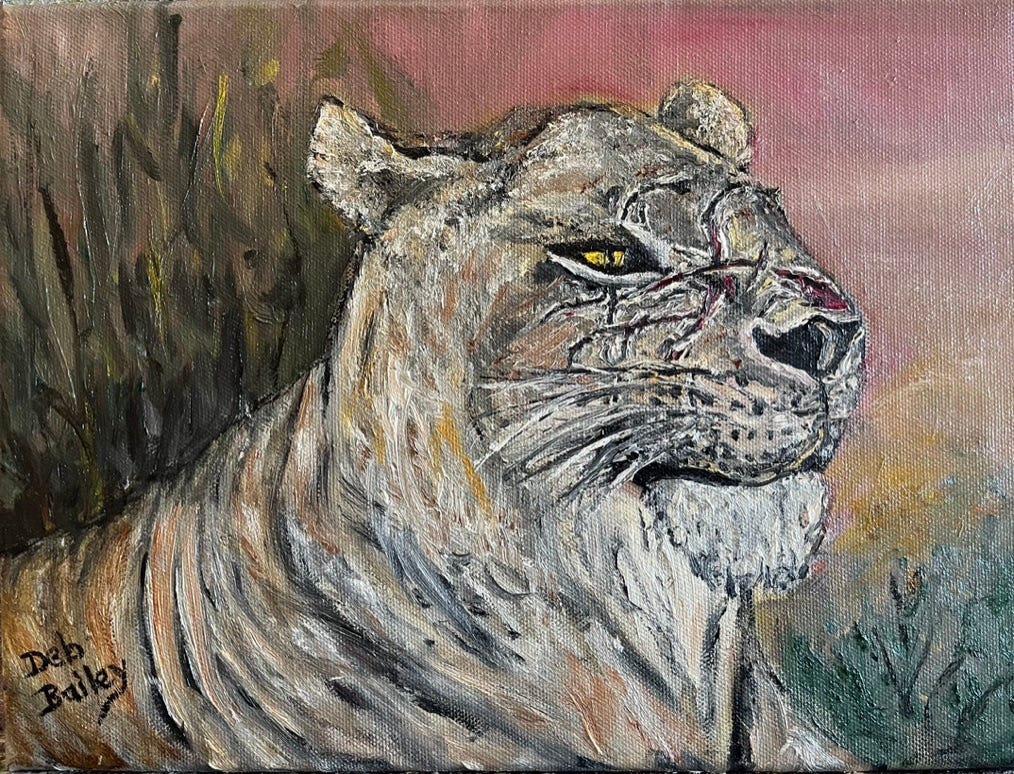
The battle-scarred lioness thrives with quiet confidence

A scarred and elder lionness resting in the evening savannah grasses. Her face shows the scars of many battles, but also the quiet confidence she has gained from them, and the awareness she can still fight when needed, but knows not to waste her energy
Painted by the author

Have I said that I love being older? And no, I am not being facetious. I truly DO love being older. No, I am not fond of arthritis, pre-diabetes, or fatigue. But I have received some “gifts” from life that may at first seem not so “gift-like.” And while I can’t say I wished for or enjoyed the experiences, I AM grateful for the strength they gave me.

Quiet power

Friends of mine traveled to Africa not long ago. As they shared pictures of savannah landscapes, giraffes nibbling on tree leaves, spectacular sunsets, one picture jumped out at me and I knew immediately that it was “mine.”

There in the photo, on the side of the road some distance from their vehicle, lay a lioness. She was not young — her face testified to the fact she had fought and survived a number of battles in life. “Experienced” is a good way to describe her — not old, but not a novice.

Her demeanor as she rested in the twilight, seemed one of perfect ease. Not oblivious, she was certainly scanning and vigilant. But there was no evidence of fear or anxiety. In fact, to me she seemed almost …bored is not the right word, but maybe “unimpressed.” As if to say “is this the best you can throw at me for a challenge?”

What I saw, looking at her in that photo, was quiet power — the sense that she could be there alone, apparently at ease, not because there were no possible threats in the bushes, but because in spite of whatever might come at her, she would meet it as she always did. Because she had done it before. She emanted this sense that she knew what to do, knew her own power, and thus, she would meet the challenge.

A kindred spirit

When I saw the picture, before I could even speak it, my gut almost yelled “YES!” And I knew I needed to paint her. Like that lioness, I bear the scars of many battles over a lifetime. I have been broken and brought to my knees many times by the twists and turns of life. And I won’t say I am “grateful” for those battles. No one happily seeks out fear, wounds, threats, or pain. But the one thing the battles did give me was the awareness of my own capabilities and power.

In my early years I was prevented from fighting back, and had to step back out of fear. But gradually, I grew stronger and rose to the challenge. I didn’t always win the battles. Sometimes they were a bloody, messy draw at best. But…I showed up. I stood up for what I felt was right. I learned to trust my gut, dig down deep, and find I really did have courage even in the midst of terror. Being tested, forced to choose between running or standing firm, I learned I could sustain and do whatever I thought was the honorable thing in that moment. I learned that I “could take it,” and what my capabilities were, so that became a gift even if I wouldn’t have chosen it.

Scars

Many of us have scars from life. We are no longer the pristine version of ourselves when we first arrived in this world. But the scars possess a power, bestow a beauty upon us that can only come from meeting a challenge and emerge maybe on our knees, maybe still standing, but unbowed. And the fact we are still here means we got back up and met the next challenge. And the next. And thus, we also have the ability to stop now and then, take our ease, and survey our path to our current moment.

As to those scars, many of us carry them on the inside, invisible to others. But it doesn’t matter. They are real, we earned them, and we know what they have knighted us with. Even if life or others were to strip us of everything we have, they cannot strip us of the power of that hard-earned wisdom and the honor that comes with it. That power is ours to keep, and it is that power that allows us to take our rest at moments, even as we know more challenges will come.

To know yourself…and your power

So now, in a twilight moment, no longer young, but still very much alive and aware of my abilities, I take a rest now and then. And I know that whatever the future holds, I will stand…or kneel… to meet it, but meet it I will, because I’ve done it before. Like that lioness…I know what to do, I know I can take it, and win, lose, or draw, I will do it.

The Roman philosopher and leader, Seneca, captured the gift of adversity perfectly when he said to those who had never been tested:

“I judge you unfortunate because you have never lived through misfortune. You have passed through life without an opponent — no one can ever know what you are capable of, not even you.”

― Seneca, The Stoic Philosophy of Seneca: Essays and Letters

May we all come to the place where we can know what we are capable of, and do it.

The Post: Under the Pier – Research Part II: Human Character R&D

March 5, 2008

If you’re writing about Abraham Lincoln, conducting research is pretty straight-forward. If you have a real person, you can find books, movies, articles, people who knew them or experts to interview.

How do you research someone who doesn’t exist? With fiction characters, a lot of times you first decide what your story is about and who needs to be in it, then you start hunting. A lot of the work is really character “construction.” You have to build the characters and give them a life to know what facts you need. Some research might go on as you craft the character, but for me a lot of it came after I had some idea who the people were.

For starters, I had to decide just what kind of characters this story needed – superficial or deep. If this was a plot-driven adventure story, the main change and action would take place outside of the characters. That means the characters, even the main ones, remain the same from beginning to end. So they just need their framework – looks, personality, talents, some backstory. It’s the adventure, the plot action, that changes.

Under the Pier is a character-driven novel. The real energy, drive and purpose of the story take place inside the characters. They will grow or regress, change for the better or worse, due to their personality and circumstances. It’s not about the story actions or problems, but how they REACT to those story problems. So this meant my characters had to have depth, history, psychology, family, emotional wounds, unanswered questions.

Before I could research anything, I had to pin down some concrete things about each character. As much as I hated to have to start picking traits and family backgrounds because to choose things is to exclude others, it’s the only way to have a true-to-life character. Nobody in life can have blonde, red and brown hair (unless they dye it that way), three different colored eyes, be both young and old, and do EVERYTHING you ever dreamed of doing. Neither can your characters. So for both sides of the story, animal and human, I had to create a character, build their life, and then relate their life to others in the story. Robert Frost said “way leads on to way.” In writing, character leads on to character.

For the human side I wanted more than just birth date, physical description, or the meaning of their names – yes, I selected names that matched some aspect of their personality, but I also wanted sections for things like: strengths, weaknesses, goals, fears, driving needs. I took a lot of the information from my extensive journaling and wrote up personality profiles that gave each person a life story – traumas and triumphs, parentage or lack thereof, marital status, family dynamics, issues, problems, glaring flaws.

And by the way, for well-rounded, true-to-life characters, it’s important that the heroes be jerks about some things, and the villains be saints about others. NOBODY in real life is all good or bad. If you do that with your characters what you end up with is a stereotype or a caricature. At the very least, what you end up with is dull and boring. I read somewhere that when police interrogate suspects and witnesses, they expect some discrepancies between the various versions. That’s normal human nature. Everybody sees different things. When the stories match up too perfectly, the officers suspect the story being told isn’t real. The same is true with characterization. For example, General George S. Patton, Jr.’s grandson shared this observation about the man:

“My grandfather once commented that in his view a gentlemen should be able to curse for three minutes, non-stop, without repeating himself.”

At first glance one would never figure a gentleman would use such language, but flesh and blood human beings are full of inconsistencies. So create a character that “overall” is true to his nature, but do sprinkle in some unexpected traits. It makes for more real, interesting characters, and adds to the story action possibilities.

In any event, when writing my characters’ biographies, I started with the simple date of birth and description, then went on from there. For Rosa, the old woman who runs the diner in the human side of the story, the physical description went something like this:

She is relatively thin and wiry, but solid-boned, strong from years of physical work, with short whitish hair that used to be black. She’s about 105 pounds, in good condition overall from walking up and down stairs to her apartment behind the diner. Some arthritis and she is slowing down, but still is healthy and strong enough for being almost 80. She does have high blood pressure and sometimes forgets her meds.

That gave me enough of a picture in my mind – one of those strong old women who worked hard all their life, like many old women I grew up around in my very ethnic hometown. The thing about pinning down part of a person, though, is that it provides the bridge to the next piece of their puzzle. For example, just talking about her life of hard work suggests a need to explore areas like her background, level in society, personality, and attitudes toward life.

The beginnings of personality start to show in the additional information I put down:

She was born on October 29, 1929. If you know any history – this was Black Tuesday – the crash of the stock market and the beginning of The Great Depression. Unless she was born rich and lucky, which she wasn’t, this tells you how her life was going to go. To continue with my description, I decided her parents were immigrants from Italy, arriving just a year before her birth. Her mom died giving birth to her, something not uncommon for the time. Her father wasn’t around much, either looking for work, drunk or simply gone for long periods. She was shifted from family member to family member, often not a happy situation. She had to work from a young age and got out of her aunt’s house as soon as she could. She started working in a place called the Midway Diner, run by this handsome young guy named Frank Santelli, his grandmother, and his maternal uncle, Angelo Campelli. Uncle Angelo started the diner in the late 1890s with a horse-drawn cart and built it up from there. She fell in love with the diner and Frank, almost immediately. She married Frank by 18, revered Frank’s grandmother who took Rosa under her wing, and spent the rest of her life preserving the legacy of that diner, even after Frank’s death. She had 4 children – a daughter who died as an infant, and 3 sons, all still alive.

Okay. Right in this section, by picking the particulars of Rosa’s background, I’ve set up not only the rest of her life, but set up the bridges to the stories of her husband, his grandmother, his uncle, the diner’s history, her children, and raised questions like, why did she revere Frank’s grandmother, where was Frank’s mother and father, and what happened to Rosa’s infant daughter? Just by picking certain details, you create the thread to more questions, more characters, more life situations, conflicts, and relationships. You create….a real person with a real life. MOST importantly I’ve set up the question in the reader’s mind.. Why is all of this important with regards to Rosa’s relationship with Max, the story’s 12-year-old female protagonist? That’s the ultimate thing to remember. Not everything the biography will be part of the story, but if you make it part of the story, it better have a real good reason for being there, ie, how does it relate to the protagonist and the story’s main question?

Now. Research on Rosa. Well for one thing, I looked for anything I could find to “validate” her personality traits so a reader wouldn’t think I was overdoing things. I spotted an article in a Rhode Island newspaper about a woman in her 80s who would go out after snowstorms and not only shovel her driveway and sidewalk but those of her neighbors as well. She shrugged off the effort as “exercise” and viewed it matter-of-factly. She was home, her neighbors had to go to work, so she just took her time and shoveled everybody’s sidewalks. So, Rosa rings true to life. (If you want more of a feel for her, click here for the January 24th, 2008 post where I included a bit from the book describing Rosa)

Other people in the story. I know a bit about diners growing up in New England, and what the people were like who worked in them and ran them. I grew up in an ethnic town full of those early 1900s immigrants from Poland, Italy, Slovakia, Ireland etc. and knew the rules of the culture: hard work, no wimping out, not very much money, family and church were everything. Those people survived the Depression and World War II by helping each other even as they fought with each other and drove each other crazy. They didn’t mince words, but put it right on the table, usually in colorful language. For holes in my knowledge base, I researched books on diners, history, New England, did Google searches, and talked to people.

For example, Rosa’s son Vince, her eldest son, a war hero from Vietnam who is kind of a mystery character with a shrouded past, finally returns home after many years away. He works nights at the diner making doughnuts. I interviewed a number of people who worked in bakeries at night making doughnuts, so I’d get my details right.

For other characters in the book, I did the same thing – wrote the physical characteristics, figured out ages, started linking them to other characters in the book, and creating a “web” of relationships and lives. The more you added to the people and the web, the more possibilities for story action and conflict.

For example, the human protagonist, Max, lives with her grandmother, who also works at the diner. Max’s grandmother is dating Vince. For a number of reasons this both disgusts and scares Max. And Max views Vince’s shrouded past with tremendous fear and suspicion.

Just setting up that scenario, suggests questions like: “Why is Max living with her grandmother? How long has this gone on? What happened to her parents? What IS the deal with Vince’s shrouded past? Why does Max fear him and fear his dating her grandmother?

Then throw in a quirk. Here is Vince, a mysterious character Max fears, and a still strong and burly man. I gave him a small poodle as a pet. Not exactly what you would expect is it? And then there’s that pendant he has around his neck that he never takes off. Just what happened all those years he was away?

If I ran into problems or a block, I “talked to the characters.” You interview them, start a conversation, ask them a question about school, politics, the person they hate the most and why, anything. But having a conversation with a character is like talking to someone at work. The more they talk, the more you learn who they are. Most writing blocks come from either not knowing who your characters are and hence how they would react, or not knowing where the story is going. So…interview and journal, then go back to writing the biography.

The minute you put down one trait on a character then add a second, you set up a chain reaction that leads to more questions, decisions, more characters, more background, more dark secrets in closets, whatever. By the time I was through, I had two binders of character biographies. Some of the characters are background ones. For example, Rosa runs a ladies’ poker game in the corner booth of her diner – her booth – every Friday night. ALL the area ladies who run businesses along Main Street play, and even Sister Rita Luke from Our Lady of the Seas up the street shows up to win money for her outreach programs. Father Steve is the “chaplain” As one of the old ladies in the group puts it: “First we pray, then we play.” So I needed some cursory description of who the ladies were and what stores they ran.

Once you’ve got the real people, the research part is easy. For medical problems I did Google searches, hunted through medical textbooks, talked to an ER physician, and even pulled details from the book, The Perfect Storm. For a legal issue involving Max, I talked to a lawyer. For emotional problems, again, there was Google, psychology books, and a psychologist. I researched Catholic history, and ethnic superstitions, both very big themes in that culture. I researched the fishing industry and what kinds of research post-doctoral students were doing in Rhode Island for either universities, the military or the environment. And yes, I got books on the meanings of names, so I could accurately name my characters, not just pick something out of a hat. In the course of the research, I looked for interesting tidbits or colorful facts that I could incorporate to give my characters the “authority” of that life.

Finally, I looked for things to use as character tags. Character tags allow us to quickly identify the character, tell us something about their deeper personality, and raise more questions for the reader to answer. Vince walks a poodle and wears a mysterious pendant. Rosa has her certain superstitions, Max walks around in the middle of the summer wearing a paint-stained oversized flannel shirt. Almost immediately, we associate certain things with certain people, then begin our quest to find out “why?”

Up Next: Under the Pier: Research – Animal Character R&D