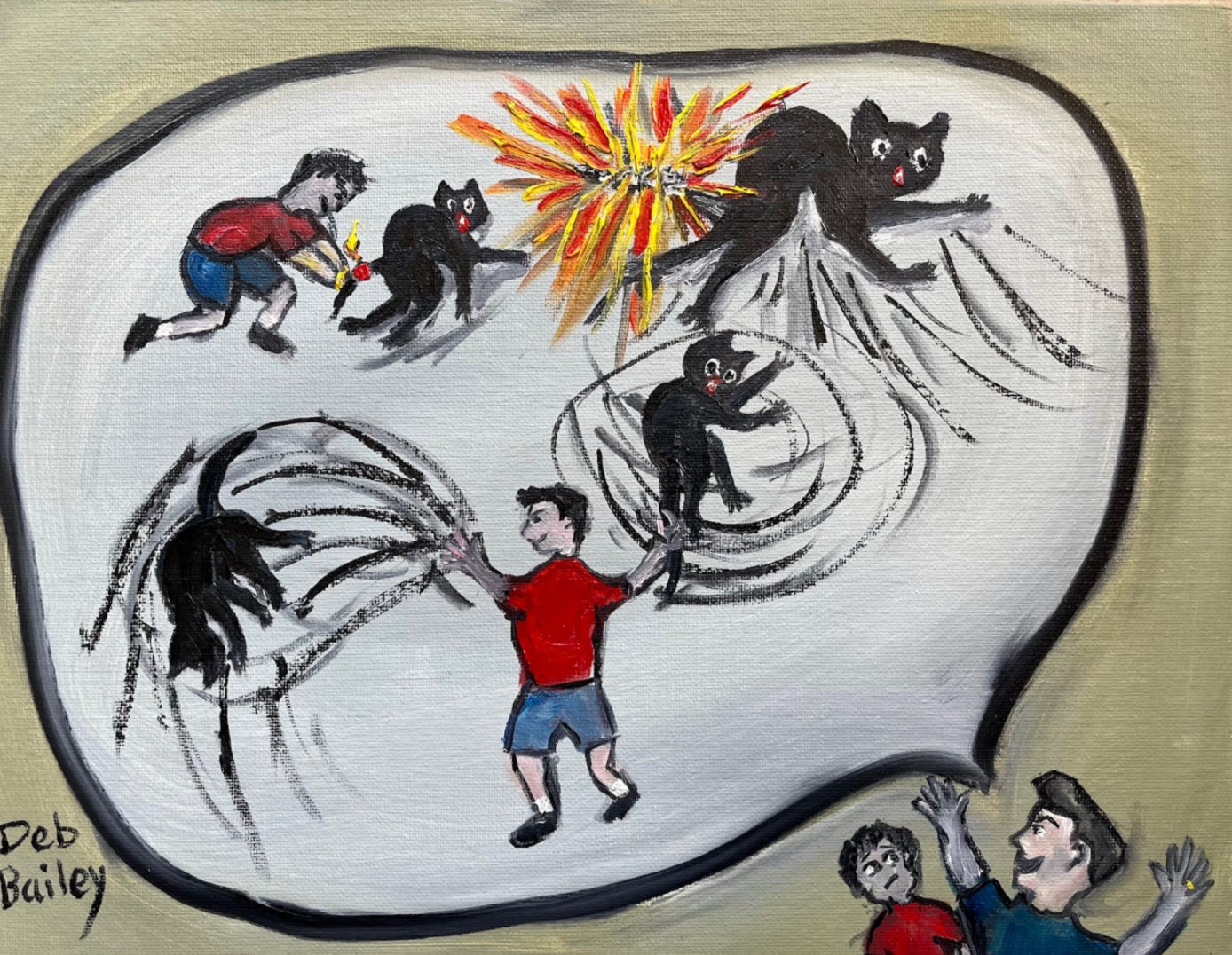
“Yeah, I always hated cats. I’d catch them by the tail and spin them around, then throw them. Sometimes, I’d tie a cherry bomb to its tail, light it, and boy did they run when it went off!”
I couldn’t react as I listened to my father recount this story like it was just a harmless prank. To react badly wasn’t possible, or I’d be in trouble. But I was also a kid, and he was telling this like it was no big deal. He laughed. We laughed.
But inside, I was trying to wrap my head around that story. First, what was so bad about cats that he thought they deserved that? Didn’t it hurt them, especially when the cherry bomb went off?
WHY would you do that to an animal?
His confidant and co-conspirator
Right from that toddler car ride when he molested me, car rides with Dad in later years were no better. In fact, as the years went on, they became a special form of hell.
I was born in November 1955 at 11:40 pm… which maybe explains why I always like the quiet solitude of late nights and even enjoyed working second shift in the hospital lab for years. But to be honest, I was actually reborn in September 1969, at 8:10 in the morning, on a day in my freshman year at Torrington High School, in College English IA, B-building, Room 204 with teacher “TD” (as it was listed on my computer class assignment card). Never have two letters so understated the full amazingness of an individual or what she would come to mean to me, and to so many others.
TD — her students either loved her or hated her, but no one was *indifferent* to her. She had that effect.
Before I continue with the rest of the story, I take a moment to note where I’m at in it. The preceding entries showed all the various influences on me from birth. And the rules I lived by that I took as normal life.
At this point, I was 14 years into that abuse. And I had no idea I was only halfway to an escape.
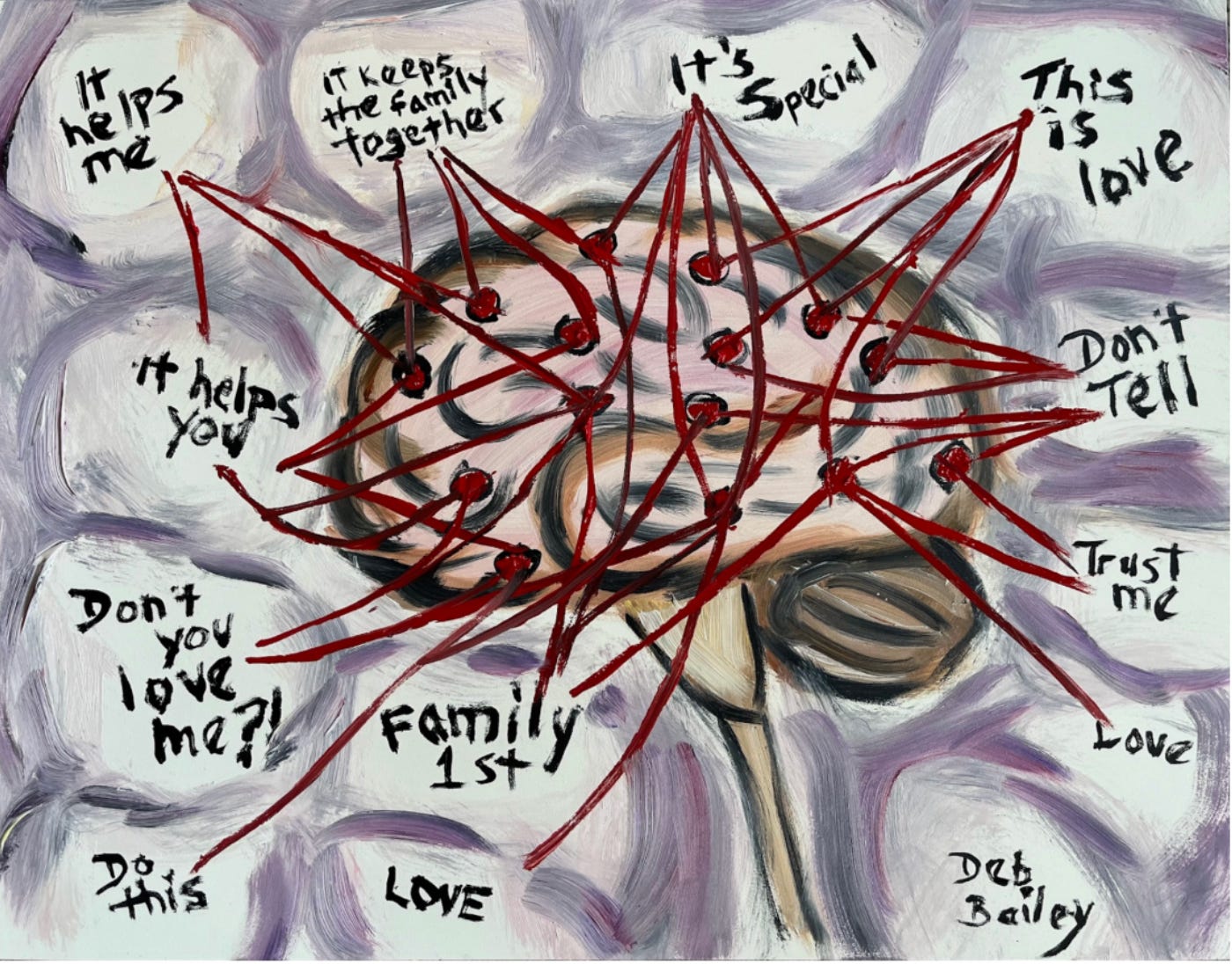
For all intents and purposes, I was controlled and didn’t realize it. I was manipulated and unaware. I was aware of my stress level whenever I crossed Dad. Aware of my relief and gratitude when he was kind and loving. And I was most aware that if he got upset, I blamed me.
I took it all in as any child would, and believed him. Why wouldn’t I? I had no idea that this was wrong. I had no role modeling that this was, in fact, truly aberrant behavior for a family. True, it felt wrong at times, but I assumed that was my mistaken judgment.
Painting by author
The trapped fly
If you’ve ever watched a spider wrapping a fly caught in its web, you might think of the spider as a vicious killer. But the spider isn’t breaking any laws. Nothing is calculated or premeditated. It’s just following the biology of its life cycle. Like all of us, the spider has to eat. And it responds to the thrashing of a fly trapped in its web out of instinct only. At least so far, science research hasn’t shown that the spider is finding pleasure in its actions.
In fact, given the process it uses, a spider could even be considered “humane.” It reacts quickly and efficiently. And with one exception, most spider species administer a venom into the trapped fly that not only immediately paralyzes it, but leaves it unaware of what is being done to it. It will then either digest the fly and eat it right then, or set it aside for a later meal. But the fly is mercifully unaware of anything. It doesn’t experience pain at that point, nor does it feel any apprehension of what might be in store for it.
The spider is just living by its life rules, and so is the fly. And to that end, there is no guile or treachery.
3. operating or proceeding in an inconspicuous or seemingly harmless way but actually with grave effect.
Insidious. Just the sound of the word makes my skin crawl. When I say it and feel the tactile sensations of the syllables as my mouth muscles form them and they roll off my tongue, I feel afraid. Listening to the word as I slowly enunciate each letter, it conjures sensations of evil. And that’s because it is.
It is something deliberate. Calculated. And executed before you even know what is being done to you. It is done so subtly and slowly that by the time you realize it, you’re in too deep. It’s too late. And all you can do is wonder if you were to blame because you didn’t see something coming, and feel stupid.
If ever there was a word that captured how he wove his web of control over me, “insidious” is it. He started on me from infancy. I will talk later about how I know that. But I was groomed, manipulated, and played like a puppet for years using the strings of his power, intermittent reinforcement of love, abuse, and brainwashing.
Like the fly, I was rendered helpless, and it all happened before I even knew what was being done to me. But unlike the fly, which was put out of its misery quickly and whose misery was just part of a natural cycle, I was NOT unaware of the sensations of apprehension, fear, and pain. It was definitely NOT part of a NATURAL cycle. And unlike the spider who was just following the rules of its species in a straightforward way, my father was most definitely choosing to break his in a calculating and stealthy manner. Nature…the spider… is actually merciful. My father was not.
I am one of those people who, when I get in the shower, relax and let everything slip from my mind. Which is precisely what my subconscious is waiting for!
The minute the mind goes blank and focuses on the snuggly warmth of hot water cascading over my skin, the subconscious starts talking. Some mornings just a word or two, and other mornings…a mile a minute. Everything from items for the grocery list, to what I need to write, connections for things I have been trying to figure out, or flashes of insight out of nowhere about a long forgotten question.
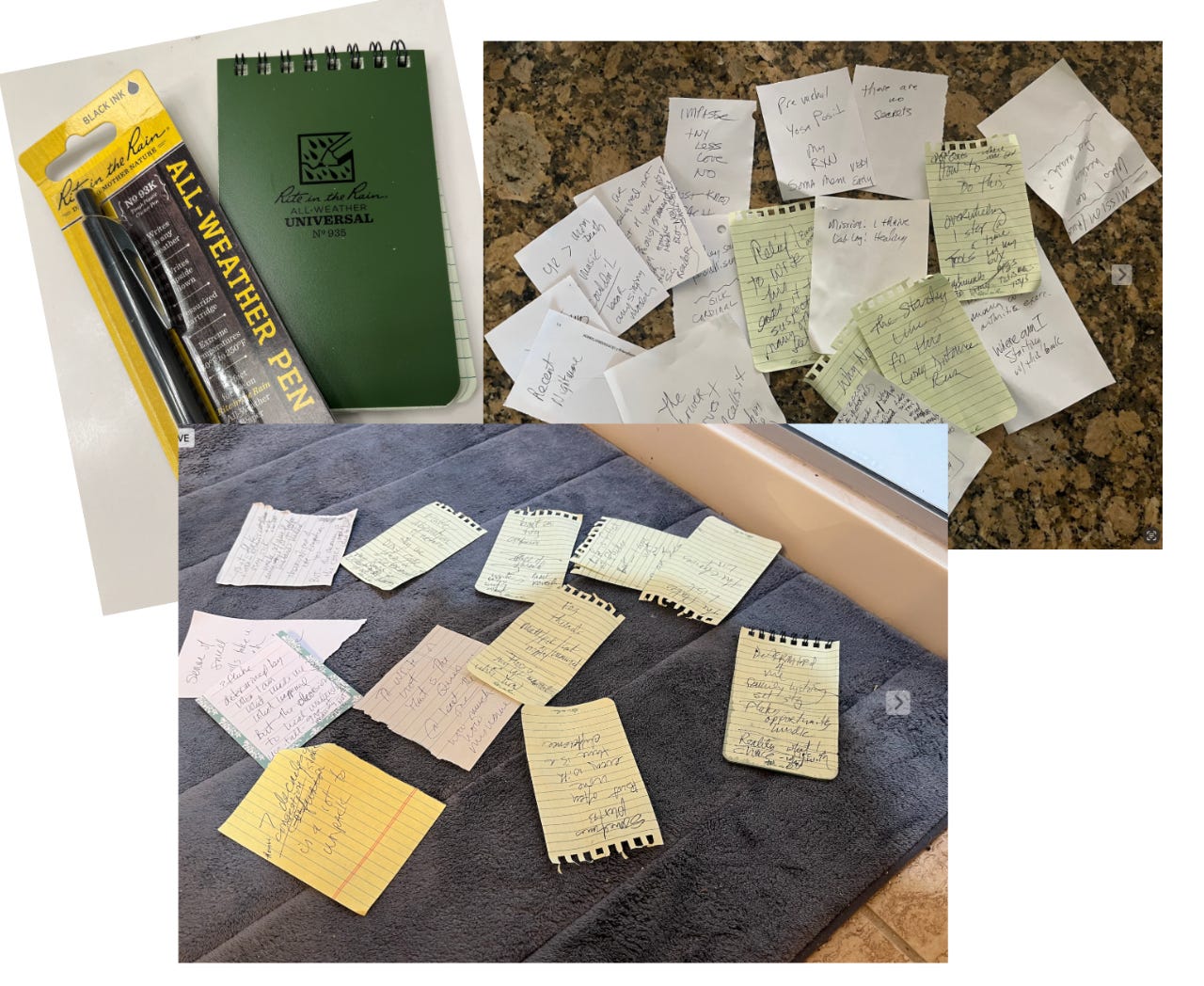
Aware that I can’t trust my memory to remember any of these things in my head until after my shower, I needed a way to capture them. Then I remembered that the nature researchers at the museum I taught at use waterproof field notebooks and pens to capture observations. So, I bought myself a package of “write in the rain” memo pads and a waterproof pen. And voila! I no longer have to worry about remembering.
Now, when a flash of insight pops in my head, I grab the notepad and pen which I keep on the shelf in the shower stall, jot it down, and fling it out of the shower and onto the floor. Afterward, I just collect them all and take action! And should the “thought flood” continue after I am out of the shower, I have another stack of recycled papers that I use to scribble more notes.
Today’s message – change the viewpoint
So the same thing happened this morning, related to my blog post yesterday, about why I write, draw, and paint my memories of abuse. In that post, I talked about looking back at the past in an intense “post-mortem” examination, like an autopsy…dig deep and see what it REALLY looks like, not just what I remembered it looking like.
Photo by author
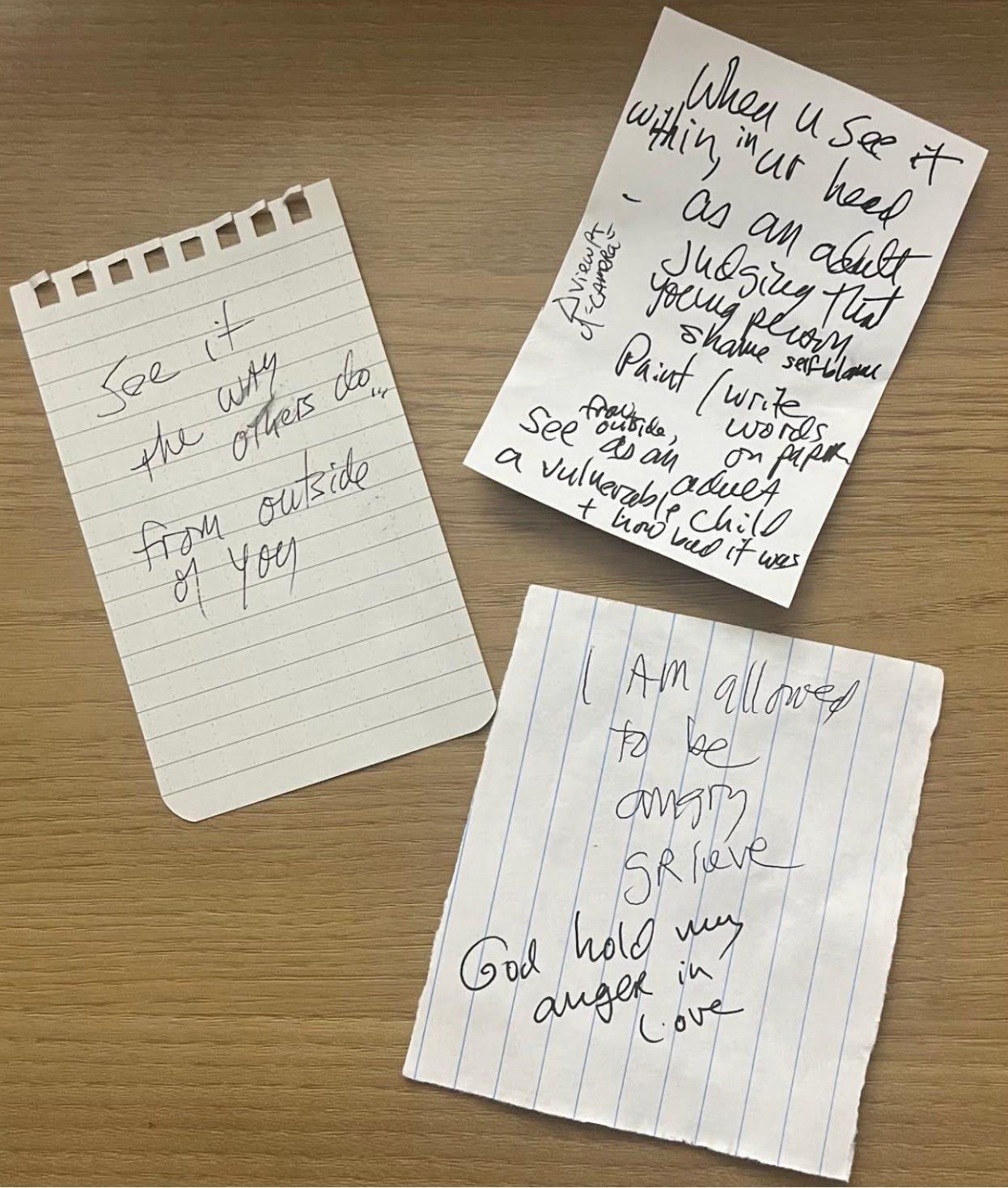
In the middle of today’s shower, these ideas flowed out about why I needed to get those images out onto paper, in paint, and words. The note about “anger and grief,” I will come back to another time. But the others were key thoughts for today:
I had to change the viewpoint. I needed to, instead, see my young self the way others would have seen me if they were standing there at that moment. The insight said, “Put yourself outside of you,” as if you were an observer seeing an adult doing to another child, the things done to you. In that moment, how would you react to that scene?
When I remember something done to me in the past, I may know it was done in my childhood or my teens, or my young adulthood. But my current-day, “adult” brain isn’t seeing me for the true age I was at the time…isn’t seeing what I was capable of knowing, understanding, or doing.
Instead, I’ve been inserting the “adult me” into that memory. So I am thinking of the me in those moments, as I currently am, and judging the me in that abuse scene, as if I were my current age.
Looking at the memory from within, I am seeing me with the eyes of judgment, shame, and intense self-blame. Statements like, “How could I have been so stupid? Why didn’t I fight back in that moment? Why didn’t I know better???!!!!” I judge the me of “then,” with the knowledge base of “present-day” me.
It has taken me a lifetime to understand how awful I am treating me, and how grossly unfair those judgments and questions are.
The shocking discovery
Four years ago, I realized I needed to write this book. But I couldn’t find words. They, and tons of mixed emotions, were choking me and rendering me unable to say a word. So, I started drawing and painting. And I made a shocking discovery.
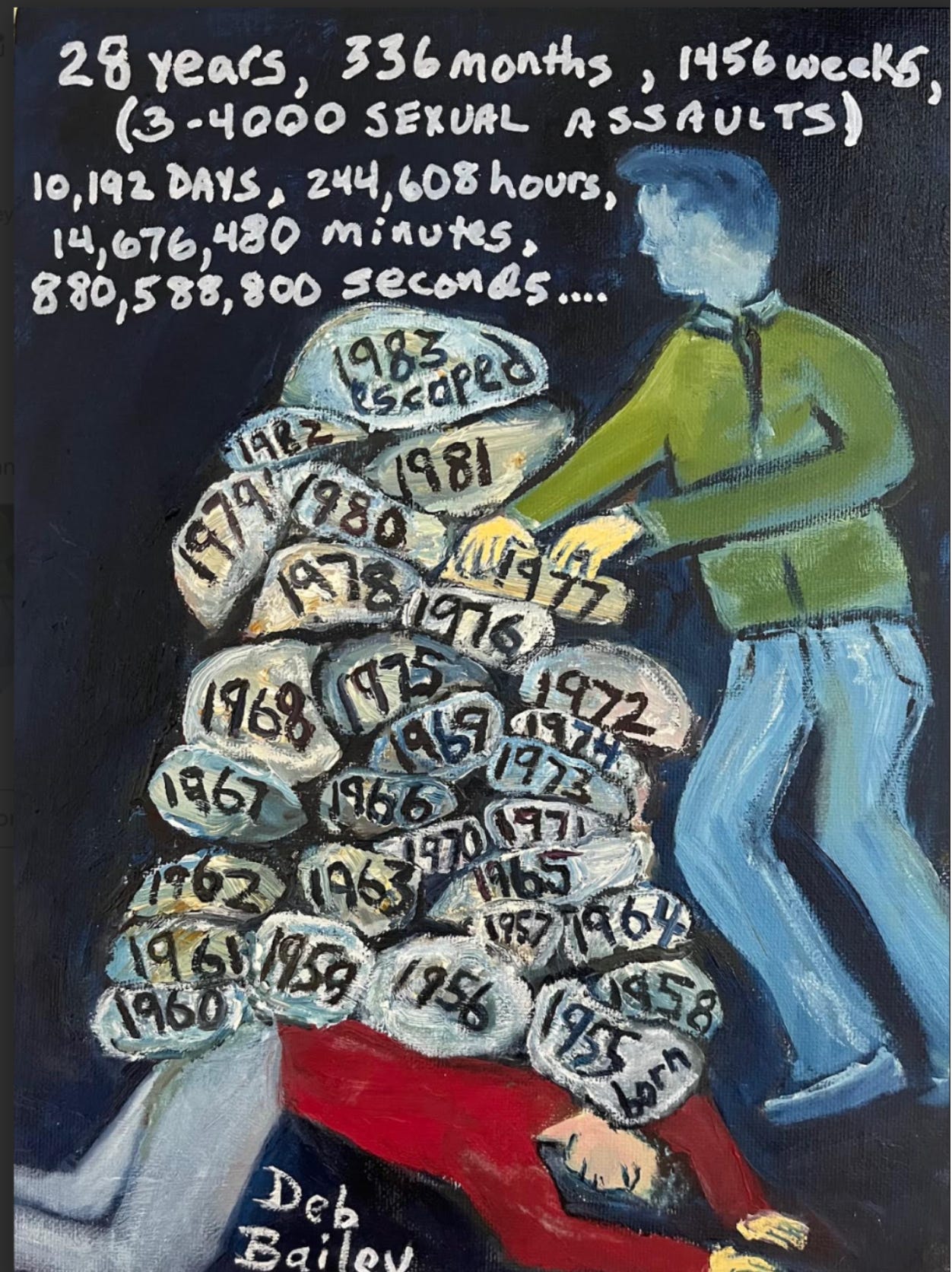
When I painted myself as that young child, pinned to the wall after supper, held there by my father’s fist….When I painted that small, scared child sitting by the stove and saying “I don’t want Daddy to come home,” …or, when I painted the Saturday afternoon image of my father pushing my young child’s head into his lap, I was shocked…horrified…then enraged.
The female elder in me now, the old adult, the woman who has been a mother for over 30 years, didn’t see an adult me in those paintings. I saw a helpless child. A child trying desperately to endure and sustain through absolutely abysmal situations. Situations she NEVER should have been put in.
Instead of judging me and hating me for not fighting back, I saw the total impossibility of that. How in God’s name could my little person have been able to stop him when my mother could barely pull him off of me? How could that young child have even understood what he was doing to me on that couch, much less that she was not to blame?
When I paint the scene I have carried in my head, I no longer hate myself. I am, instead, filled with horror FOR me, and compassion. Anger at him. And intense respect and admiration that my young self was able to keep going DESPITE being confronted with those things.
For years, I especially hated my teen and young adult self. But in doing these paintings, I then did the math for how many thousands of times over the years, from infancy to 28, that I was assaulted — physically, mentally, verbally, and sexually, I am now more upset that I judged me so terribly. That child, and teen, and young adult were doing the absolute best they could in that moment.
How could I have expected that young adult to have had the maturity she should’ve had for her age, after years of thousands of assaults? Those assaults and stress affected my cognitive and neurological development. My nervous system development. And assaults that robbed me of having any semblance of a decent childhood development process?
Now, looking at those pictures and writing those scenes, I am, instead, flat-out blown away that I fought back or held onto myself as much and as well as I did. And I NEVER could have made those realizations without doing those drawings and paintings, and writing out in black-and-white words on paper – just what was done.
My husband told me one day that he always heard and believed what I told him about my abuse. But he said that the paintings were so powerful that they made things so intensely real for him in a way that just saying it couldn’t. Powerful, yes.
Changing the picture
So, yes, I am revisiting the memories for a “second look” to see what I missed. But I am also revisiting them WITH DIFFERENT EYES. I have shifted my “viewpoint camera” from within me, to “OUTSIDE of me” and that has made all the difference.
Viewed in that way, THIS is how the picture changes:
Painting by author
I now feel so much compassion and love for my younger self. I feel remorse over judging her so harshly, and, instead, have such total respect for her….
Now, back to the next pieces on my “Wider Circle” – grandparents, school, and God.
Before I continue, it is time for a periodic update for the sake of new readers as well as current ones.
I want to take a moment to “recap” why I am writing this blog, and why I would like to publish it in some form as a memoir. I have been writing to discover what I didn’t see before, and to build that “crummy first draft.” Then I will revise, and revise, and revise, because my goal is to find an agent and seek publication. So for right now, I am writing, discovering, and sharing.
So often…every morning when I sit down to write…I feel weary. And I feel the heaviness of the pain from the past. Why, then, someone might wonder, am I doing this…re-living past abuse to put it on paper? And what will it give the reader?
Trigger alert – The descriptions here may upset some readers. Please proceed gently.
Who WAS Dick Phillip?
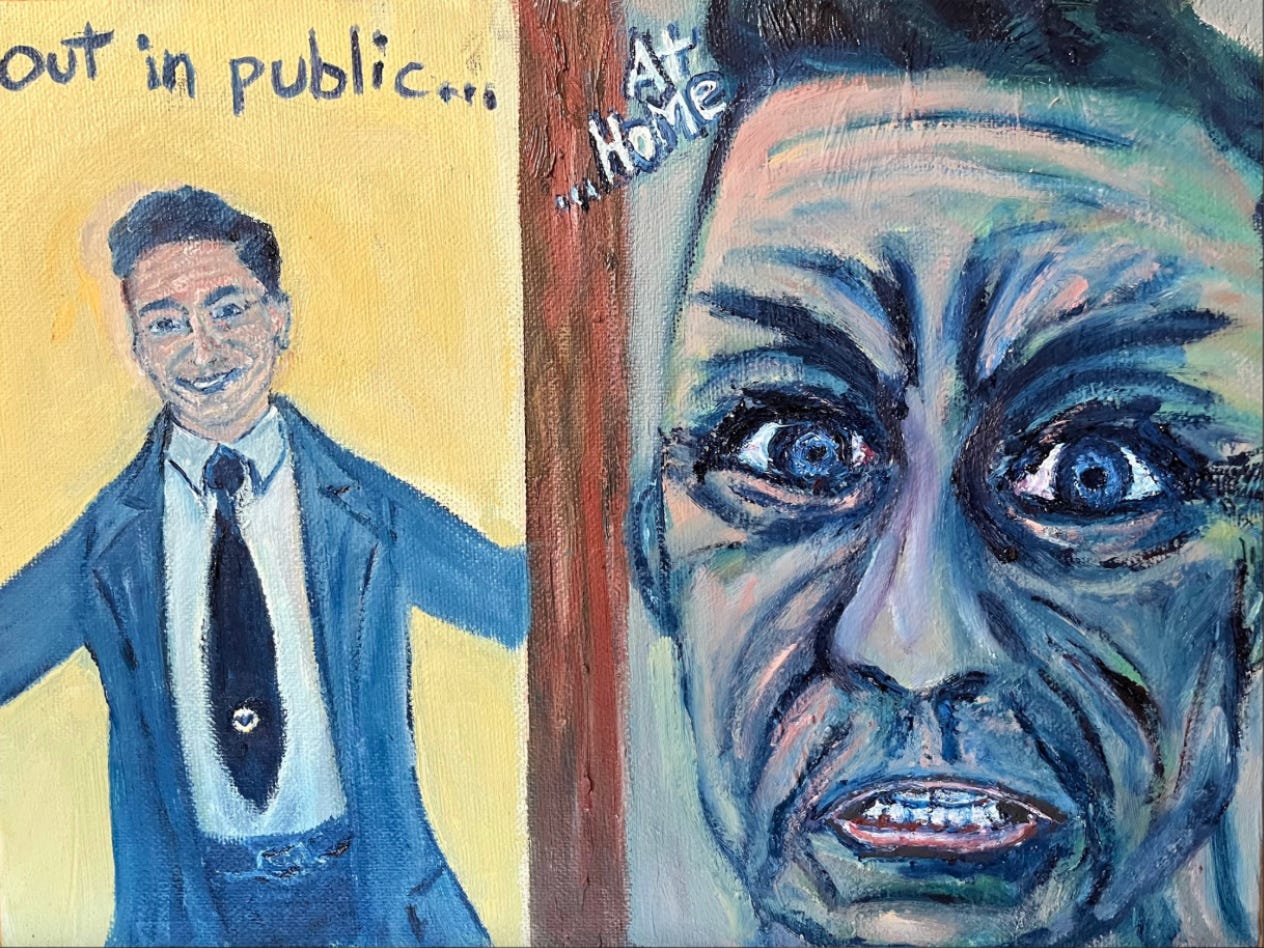
When Robert Louis Stevenson wrote his novella, *The Strange Case of Dr Jekyll and Mr Hyde*, he had no idea that 45 years later, his character would enter reality as my father.
Dick Phillip. Richard Phillip. Richard M. Phillip, Richard Marshall Phillip…Richie.
Who WAS Dick Phillip…and as an aside, as a kid…and an adult, I always wondered why he preferred “Dick” for a nickname. Except that in his case, it seemed to fit in more ways than one.
To me, who he was varied with his mood and his needs. Sometimes he was so warm and fun, and other times it was like I didn’t exist, or worse. Intermittent reinforcement. Alternate love with rage, with love, with cold isolation, and back to love again. Mix it up until I was so confused and convinced that somehow it was my fault, and if only I could figure out the right things to do, then it would be okay.
As for how he treated others, it just depended on what you were to him, where you stood in relation to what he wanted and needed, and who had the upper hand in the power dynamic between you.
When I started high school and was worried about succeeding in a public school after years with the nuns, his advice was:
“If you want people to like you, find out what they need or want, and give it to them. Then they’ll like you and you’ll look good.”
Even then, I thought that seemed like a cold way to treat people, and being a young teen, I ignored him. But it was his modus operandi in life because he wasn’t looking for friends. He was always about getting something out of an interaction.
If you were outside of the family and had nothing he needed, you were off his radar…except to make sure you weren’t a threat. If you were a family member, at the very least, he would put on enough charm to keep the peace and preserve any future usefulness you might have to him. If you had something he wanted or you could advance his goals, now you had his attention.
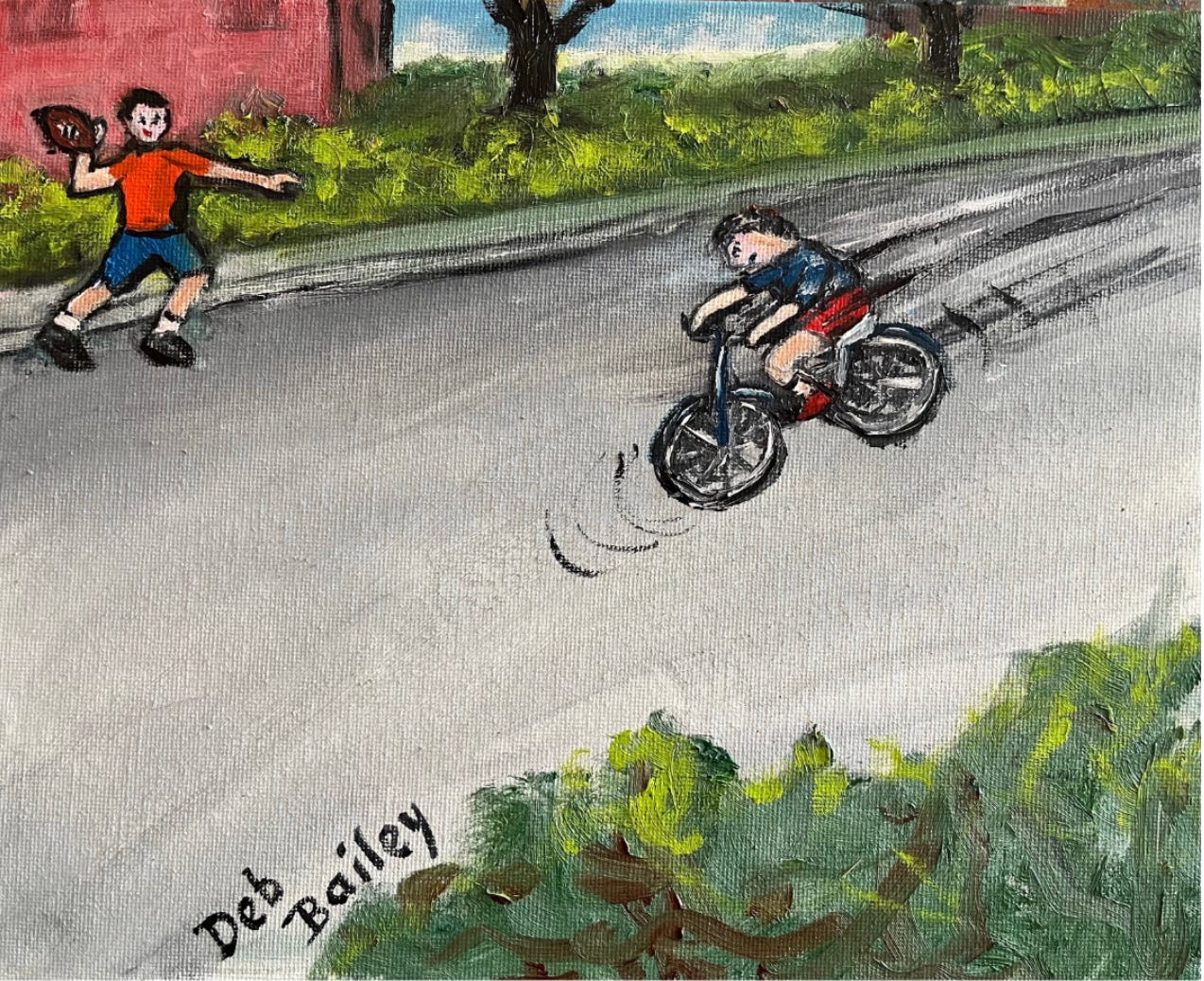
I was racing my bike around the block, happily flying down the hill on the last leg, before bombing down the sharp decline into my yard. My friend was on the sidewalk tossing his football up in the air. A mischievous smile crept across his face.
“I bet I can nail this football right in front of your bike tire!” His eyes danced with glee at the prospect of the challenge.
Mine did too, and I could feel the spark of excitement rush through me. It would never occur to me to show fear or back away from a challenge, especially one from a boy. In fact, this was all about showing him up and proving, yet again, that I was as good as any boy.
Taunting him back, I threw down the gauntlet with, “I DARE you!”
Then I shot past him down into my yard and started my next circle of the block. This was too good to pass up.
Rounding the corner of his street, I pedaled to the top of the hill and stopped. I could see him waiting for me, tossing the ball in the air, then taking his position to throw, a big grin on his face.
I grinned back at him, lowered myself flatter against the bike, and pushed off. Pedaling with all my might, I flew down the hill. Out of the corner of my eye, I could see his arm go up. I pedaled faster. He took aim. I leaned flat against the bike. He spiked the ball.
From the moment I came “galloping into the kitchen” on my stick horse at 5, I was bound to be an adventurer. I grew up with TV shows like Zorro, the Lone Ranger and Tonto, Cochise on Broken Arrow, and Roy Rogers and his horse, Trigger. So I was always swinging a sword, galloping my horse, or sliding across the floor.
Of course, that particular day I fell, slid headfirst into the cast-iron radiator, and learned what it meant to get stitches in my forehead at the local hospital ER. I wasn’t scared at first, more intrigued by all the medical tools and equipment. At least, that is, until the girl across the hall started screaming. Not sure what was coming, I panicked and started screaming, too.
I did survive it and even got homemade chocolate chip cookies from Mom when I got home. So, I was an old hand at stitches when I ended up back in the ER again the next year, when I fell off a bench and cut open my jaw. The bottom line is that in spite of my reticence to ever let go of the side of that YMCA pool, I not only learned to swim, I became the adventurer.
Nothing was more exciting at the beginning of every summer than the Saturday night family shopping trip to a discount store in Unionville called Myrtle Mills. It had everything, but most especially, sneakers! The new summer sneakers’ trip. To this day, I still remember the smell of rubber as we approached the basement area in the back, where all the new sneakers were on sale.
In trying to answer the question of how I survived that household, I need to explore who that young girl was — me — in the times when Dad was not around, in the times I could just be “me.” In a lot of respects, so much of who I became, and still am, how I navigated life both then and now, came out of her spirit.
Even in my seventh decade, I am a 9 or 10-year-old at heart. I am still all of the qualities listed below that she had. Those things got pummeled and almost beaten out of me. But somehow, the spark stayed alive within, and slowly, ever so slowly over my lifetime, I’ve fanned those flames back alive. And I would say it is now, in my seventh decade, that I have fully returned to the spirit of that kid. And no, it’s not “second childhood.”
About the only problem, though, is that while I have reclaimed my inner 10-year-old and she continues to drive all of these things in my heart, my body begs to differ with me on some days. So I am learning now to “moderate” that 10-year-old to match the 70-year-old body!
But to come back to that question of how I survived, if I had to give a short answer, aside from key people along the way, and God, it would be: “Her spirit.”
Who was she? Here is a list of those qualities she embodied, and I’ll expand on them over the next few pieces.
In many stories, the place and the time period are considered characters in their own right. Certainly, I would agree given the unique flavor of where I grew up, and when.
Torrington, Connecticut:
Nestled in the valley between the foothills of a section of the Appalachian Mountains known as the Berkshire Hills, Torrington is built around the Naugatuck River, which flows south through that valley, right through the center of town. When the town was originally founded, it was located on the hillsides east and west of the river valley, where the climate was healthier and less swampy and mosquito-infested in the summer.
A lot of the surrounding county area was, and remains, rural, with dairy farms, state forests, and nature trails. It is hilly countryside, and as such, the geography itself gives a sense of “constriction” between those hills, and isolation from nearby areas because of them. There are a lot of hardwood forests, including things like oak and sugar maples, and in spite of steel-gray cold skies in November, Fall, with its amazing color display, is my favorite time of year there.
The town and surrounding areas are steeped in history. Whether it is of ancient Mohawk tribes living in longhouses, or the story of Connecticut as the Charter Oak State, the state is living history.
The latter story is based on the fact that the state was given a royal charter in 1662, allowing for self-governance. During the Revolution, the charter was hidden in an oak tree to prevent it from being confiscated by the British.
Many locations around Torrington and throughout the state have markers noting various sites of importance from the 1700s and during the Revolution. The culture of the area was heavily influenced by the strict ethics of the Puritans, who had moved there from England to have religious freedom. And throughout the area, there is still a strong sense of individual ruggedness. That ruggedness is further fostered by the climate, which can suffer extremely cold winters with blizzards, and summers and falls with hurricanes, tornadoes, and Nor’easters.
Torrington was and is a small former factory town in that Northwest corner of Connecticut. It was an industrial powerhouse in the 19th and part of the 20th century, providing employment, a decent standard of living, and a strong economic base for the towns there. Industry included things like brass production, arms manufacturing, skilled tool and die companies, and small factories providing parts for the automotive and aerospace industries. Most of those places shut down and moved south during the 1960s-1980s, and later those things moved overseas. So the employment and economy of the area have taken a hit. But during my childhood, especially with the ’60s space race, things related to aircraft and aerospace industries were still thriving.
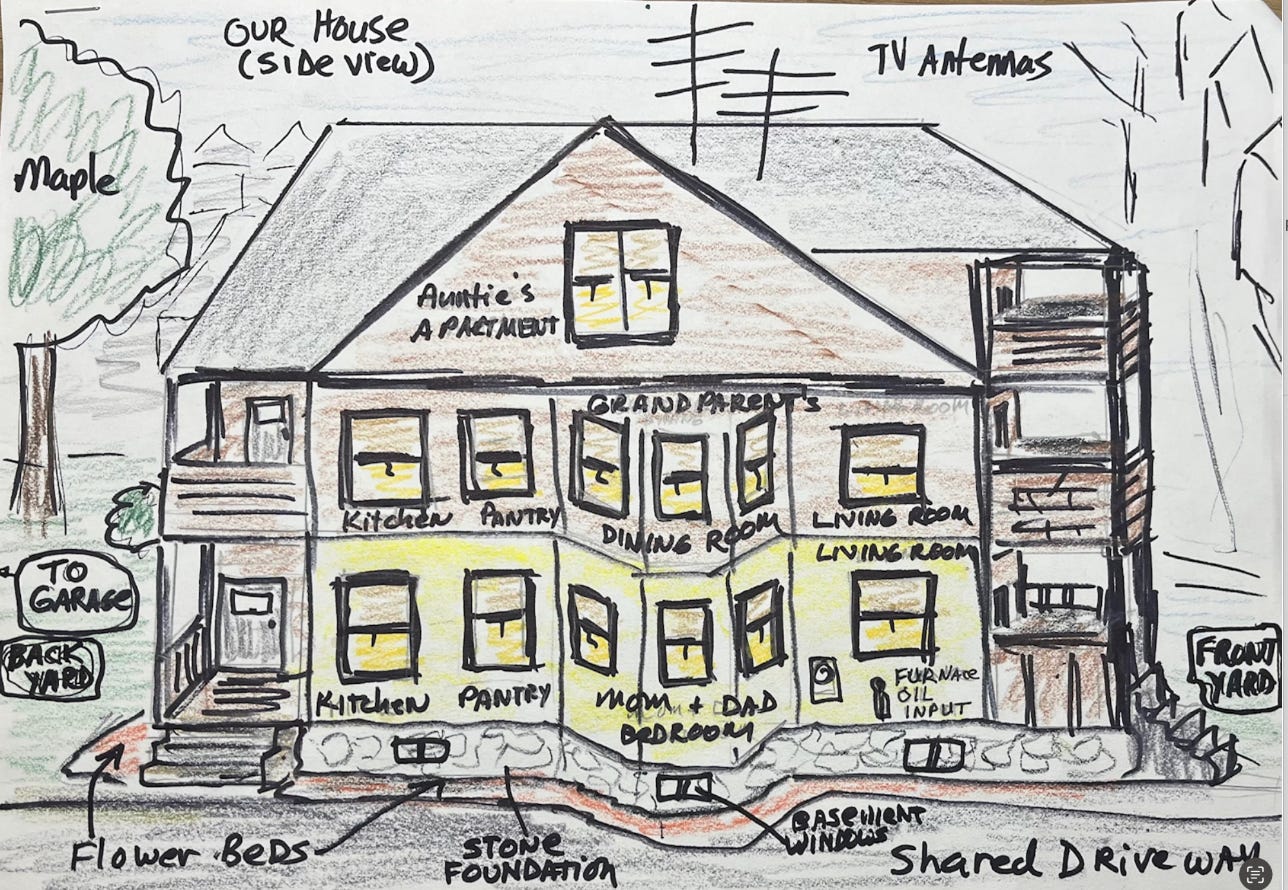
Most people during the early and middle of the 20th century lived in the main town because they worked in the local factories. This allowed them to walk to work, shops, churches, and doctors. My grandparents did not have a car, nor did most of the older Slovaks. In fact, our house was just down the street from the church and school we attended, so easily within walking distance.
The homes in town, including the one we lived in, were multi-family 2- and 3-story homes, in keeping with the blue-collar, industrial flavor of the area. There were some single-family homes scattered around in town, but more of those were on the outskirts, in more residential or agricultural areas.
 Soul Mosaic