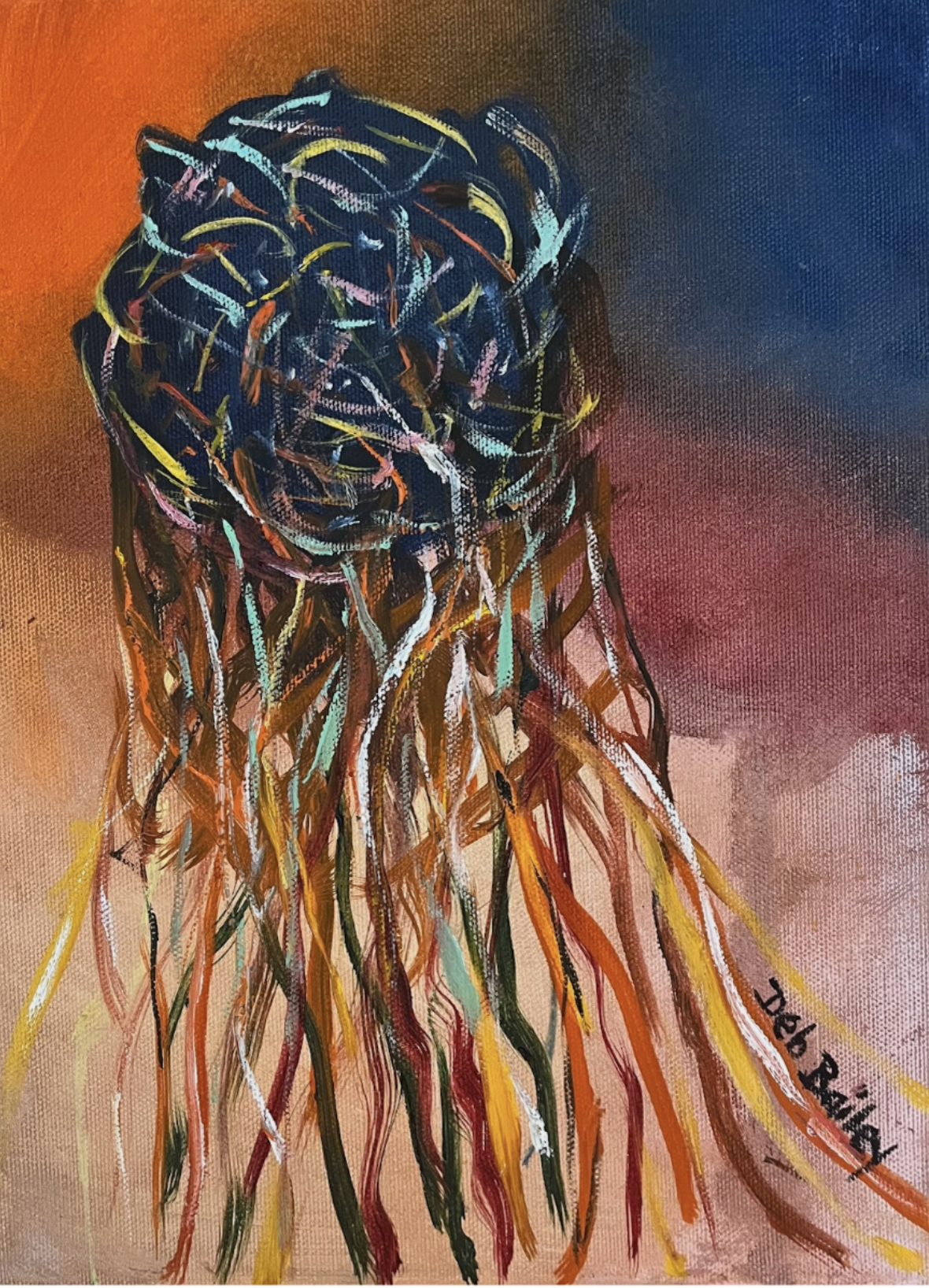
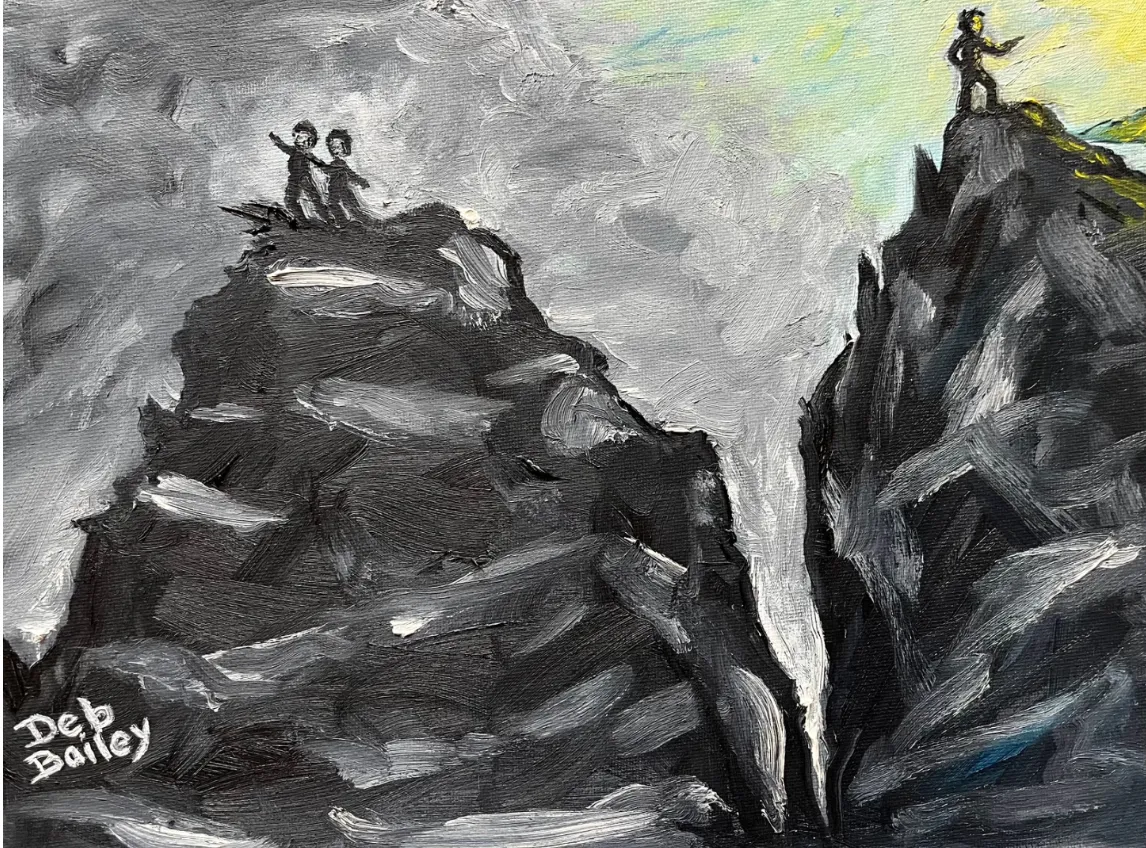
Eventually, those fog banks in my psyche concentrated themselves into a dense wall of black, looming ominously on the horizon. And all those aching, unidentified emotions were tightened into such a Gordian knot that only bold action stood a chance to untangle it. But…which thread to pull first?
And as a side note — I was also trying to hold all this at bay while I continued to work and manage the tasks of life. But there was no longer any stuffing them back behind any dam. They were out and letting me know there was more coming. So in my private moments, I painted, and tried to make sense of what was happening. And I learned that the longer you wait to begin, the tighter the knot binds itself together.
So, my choice was simple.
Do I spend the rest of my life avoiding “whatever it was,” forcing a smile, using “mind over matter” to pretend all was fine, and ignoring any evidence to the contrary?
I guess I expected that, like after Dad’s death, I would feel relief…or maybe more correctly, peace and serenity, given how it all ended.
While his aftermath was the relief of a threat finally extinguished, hers was the completion of caregiving done honorably. Though we parted with many unresolved things, I felt such peace at her transformation at the end…a kind of redemption from the rest of her life.
So I expected something more like: “It is done.” With both parents gone, and it being the end of that whole era, I should be able to “get over it,” “move on,” and “leave the past behind.” All those things people say, as if just the fact it is finally done means it is “over.” But nothing was further from the truth.
Instead, there was an intense explosion of a whole mess of emotions, ranging from love and grief, compassion and confusion, to anger, disappointment, abandonment, and back again to grief.
I’ve spent a bit of time in my posts talking about who I am, why I’m writing, how to do this book, why now, and what kind of tools I need.
Why have I “wasted” so much time on those things?
Maybe this post can answer that question. It will be the first entry in the book and sets the stage for the first chapter — Packing for the Journey, which will include the information I mentioned above.
“Why write…now?” Three simple words, but a vital question that demands an answer to the motive for my change of heart.
Dr. Edith Eva Eger, in her 2017 book, The Choice, about her experiences both as a Holocaust survivor and a psychotherapist, talks about the question, “Why now?” Whenever she was confronted with a new patient, her approach was always the same–questions. I loved her description:
“Why now?…This was my secret weapon. The question I always ask my patients on a first visit. I need to know why they are motivated to change. Why today, of all days…Why is today different from yesterday, or last week, or last year? Why is today different from tomorrow?”
But before I can even answer why I would write now, I need to answer the question that came before it: “Why write?” I had actually tried three times before to write something about sexual abuse, wanting to help someone else in the same situation. I tried articles for adults, a picture book for small children, a chapter book for older kids. No matter what I did, it didn’t come out right. The message was wrong…missing…useless. What could I tell a child that might help their situation? “Go tell an adult, and they can help you.” First, I am not a therapist. And second, if I said that, would I be opening them up to a world of more hurt with a simplistic answer?
Even when professionals try to intervene, there are no guarantees that it will be better. Sometimes if a child tells, they risk breaking up their family, retribution for speaking, possibly being removed from the home and put in foster care, or maybe ending up in a worse situation. If authorities remove the offending parent, the entire family’s financial stability might be at risk. I so wanted to make a useful contribution. But what message could I give to anyone?
The alarm hasn’t yet gone off, but I am awake. I’ve been so since about 5:30, like many mornings. The oblivion of sleep, its escape from reality, at least on the nights I have no nightmares, is over. While my regular blanket keeps me groggy and warm, the weight of the other blanket starts pressing me into the mattress. It is the heavy sensation of feeling scared, hopeless, and like I have done something wrong and will soon be in trouble. I neither want to stay in bed nor get up. I wish I could just sleep in oblivion all day. Getting up means facing another day of writing, struggling to live with the pain it releases, and holding the chaos I feel inside.
I get up anyway, because by now, in my 7th decade, I know that this is part of my life, my existence, at least for the time being. Even as I felt great last night, felt ready to take on the world, yet again, this morning, the black cloud was there to greet me when my eyes opened and consciousness returned. But life has taught me that, like the weather, everything eventually changes. You just have to wait long enough. So for now, I just focus on my “routine.”
The routine. It is something I had to create after I retired from teaching at Raleigh’s North Carolina Museum of Natural Sciences. When I was working, I didn’t have time to feel all of this. I had to get up, get moving, battle traffic, and then revel in the last job of my life — which was my total joy.
“The point in a conversation that is an impasse – both love each other very much. Both want desperately to make each other happy. One doesn’t want to hurt the other with his opinion but feels compelled to say it. The other wants desperately to agree, to be able to agree so all can be happy again, but can’t.
Both search to say something that would make it better…want to find those magic words. And “I love you,” may be true, but isn’t enough – it doesn’t dispel the present problem. The love is there, but so is the problem – each looks to the other to back down – to say the one thing they long to hear just to make the problem go away – but can’t, and each knows the other can’t but just hoped they would…and at this point no one knows what to say – all you can do is just walk away – confused – emotionally drained – completely mystified as to a solution.”
The missing link
How do you go from being a submissive, beaten-down child in an abusive family system to a healthy adult who stands up for herself? When does that miraculously happen? It’s not like you leave that house, flip a switch, and suddenly you’re an independent, healthy, assertive human being. In there somewhere is a missing link in the maturation process — years of trial-and-error efforts to heal and learn how to become that adult.
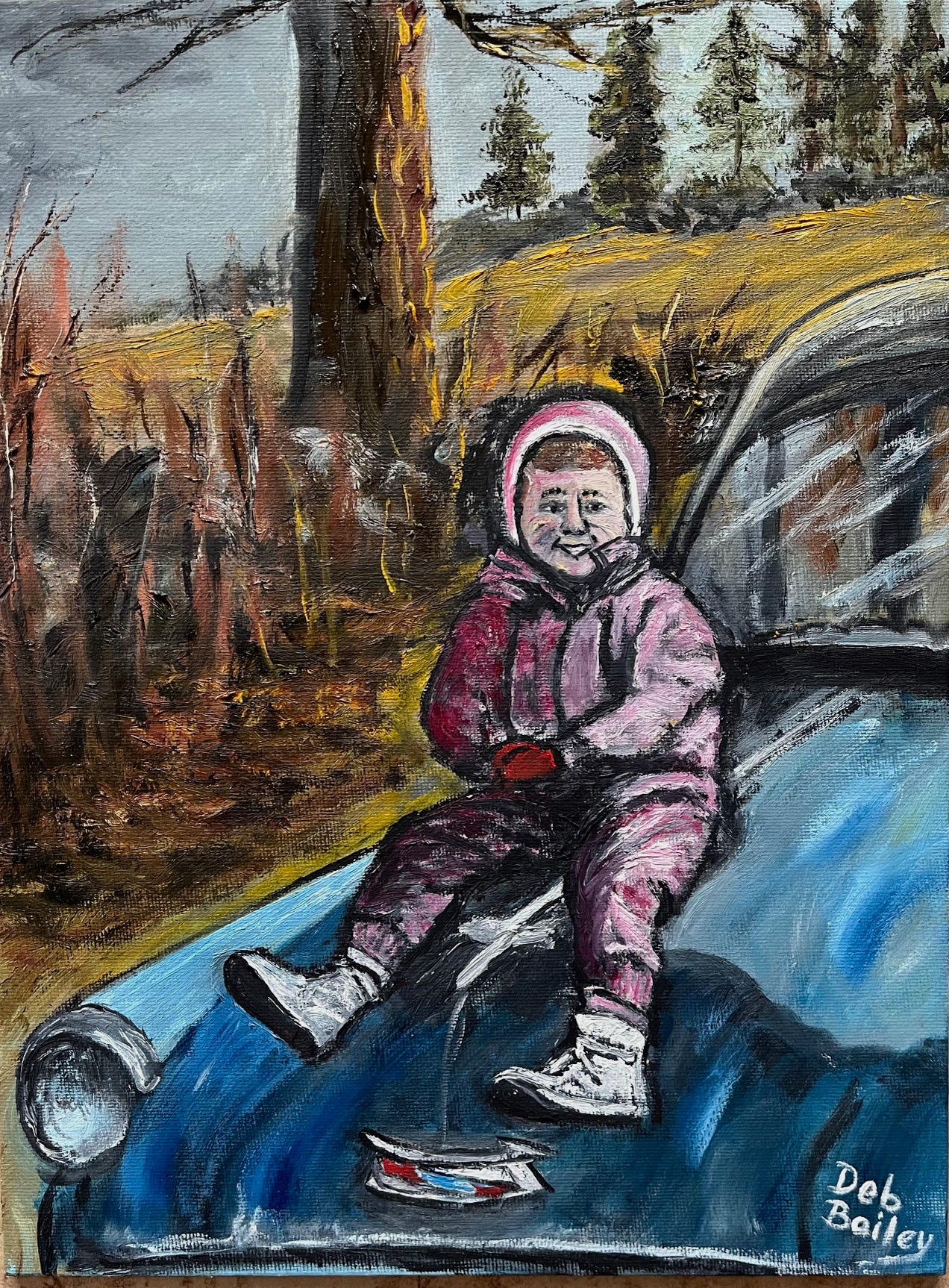
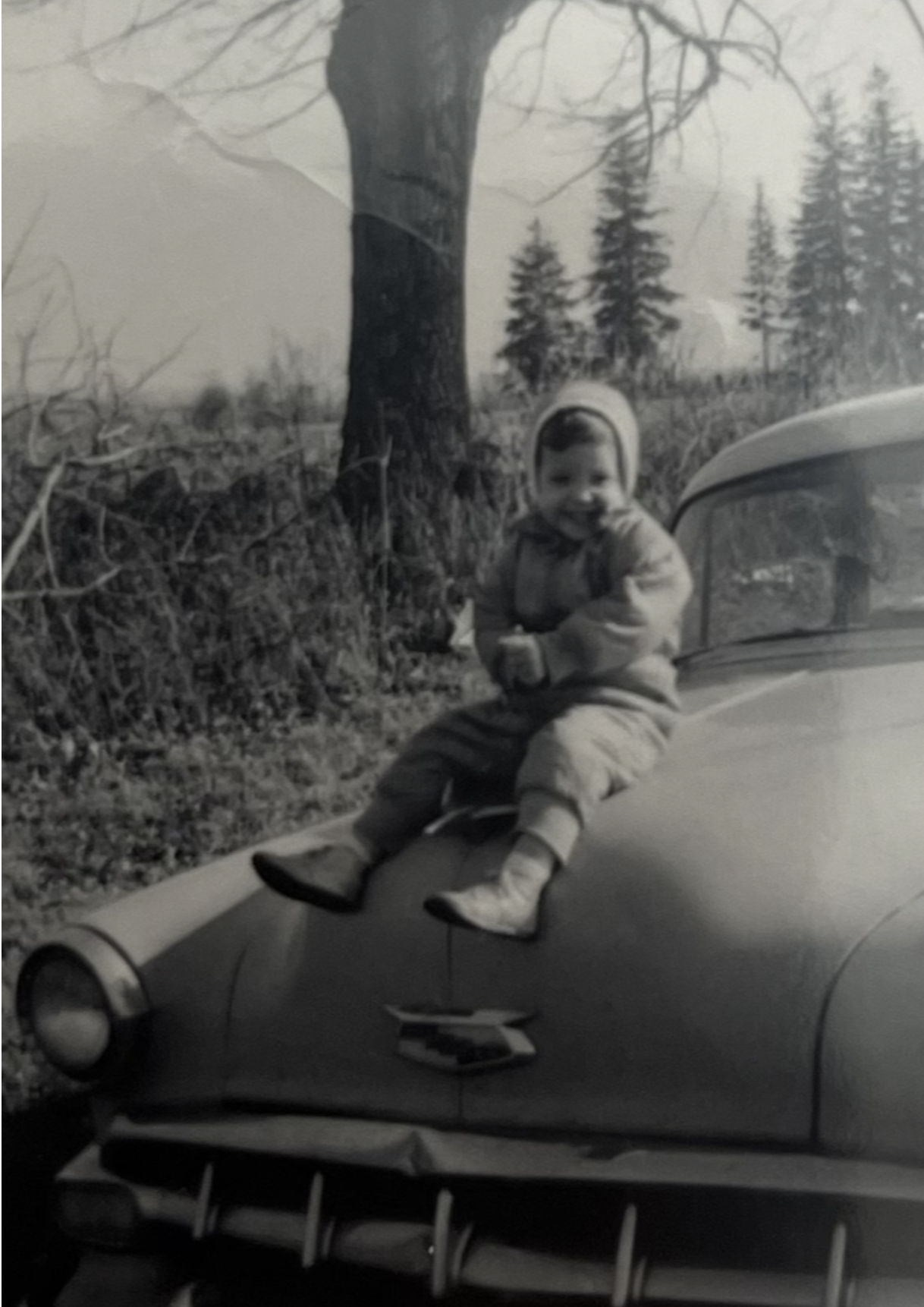
Painting by author – Author as an infant on hood of her father’s car
Driven to paint
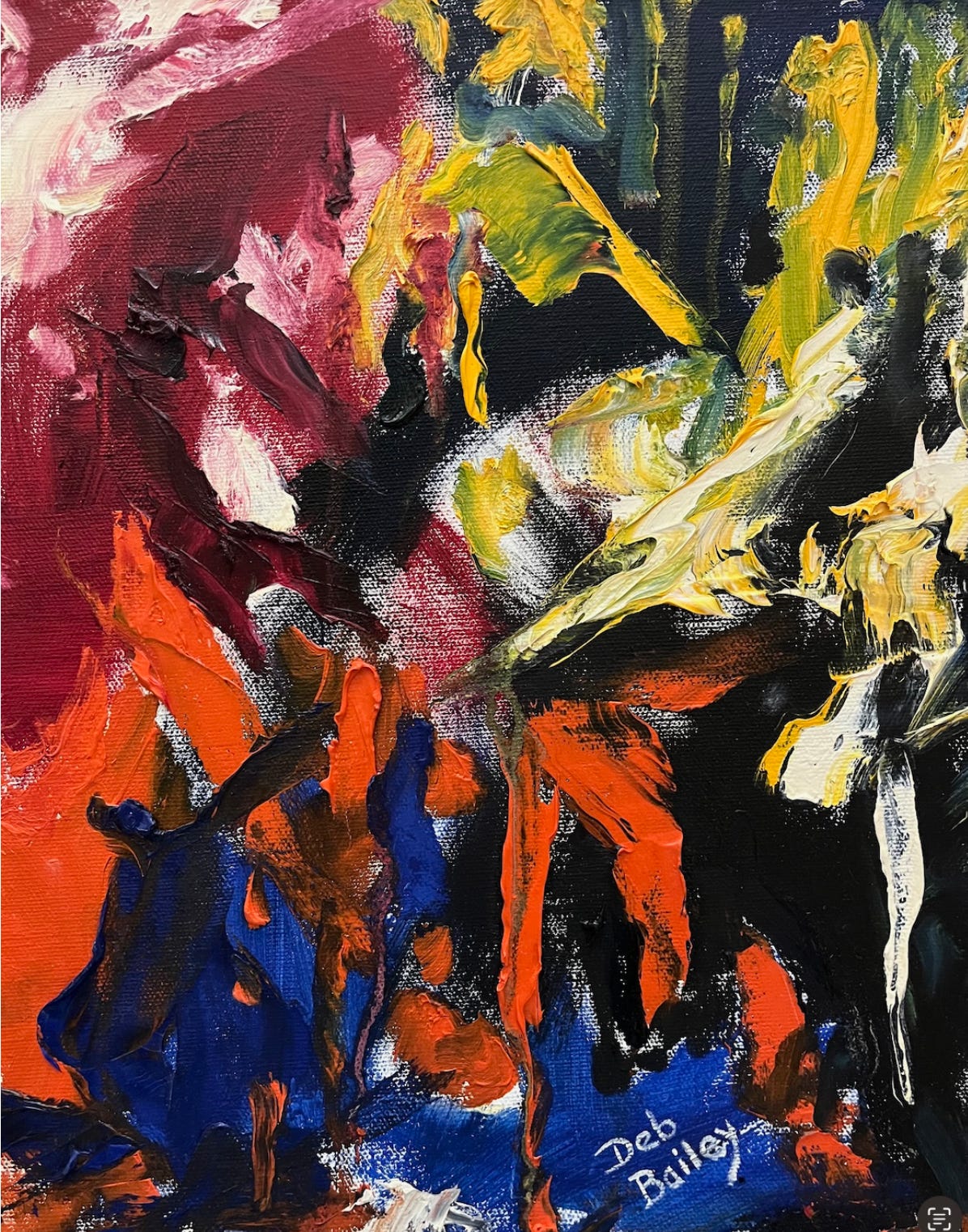
Before I share below a sampling of the visual elements I am using in my book, I thought I would share the “WHY” I not only used them, but HAD to use them.
Rebuilding my life
The book incorporates the story not only of the abuse I endured, but also of my journey from my parents’ house—the depression and despair—to my rebuilding, and my creating of a meaningful life.
Even after the initial crises of my escape and recovery with the help of good therapists and friends, I would return for rounds of therapy off and on throughout adulthood. Given all of the life lessons I had missed out on during my early phases of life, I looked at it as “preventive maintenance.” Why “wing something” when I wasn’t sure how to handle it and risk messing it up, then have to fix it? Better to learn as I went along.
The traumas of life
This approach worked well, and I thought I had finally put the past to rest…until midlife. Menopause hit. My husband almost died. The dog did die. My son left for college. All at once. But even worse, those new traumas blasted open a well of trapped emotions I never realized were even there. Like opening Pandora’s box, it unleashed a flood of unresolved depression, anxiety, flashbacks, nightmares…severe PTSD. At the time, I had no idea what was going on. Desperate and having major anxiety, I began working with a skilled trauma specialist who was and remains a godsend in my life.
This was fortunate because, in addition to everything that I was dealing with, I also began navigating the last chapters of my parents’ lives and their deaths. It was then that I realized just how much work I still had to do.
The past comes calling to claim its due
Those first decades of adulthood had been about building a life. Now, it was about returning to the past to address the well of unfinished business and unresolved pain that had come forward to claim its due. It had patiently waited a lifetime…my son came first all those years. But now, it was time for me…and that long-suffering child.
However, I had no tools to reach the pain, to know how much was there, or to express it. I only knew its presence through the agony of body memories and nightmares. That was when I made the discovery that art heals.
Finding the main threads and recurring elements that lead to a strong book
Photo by author
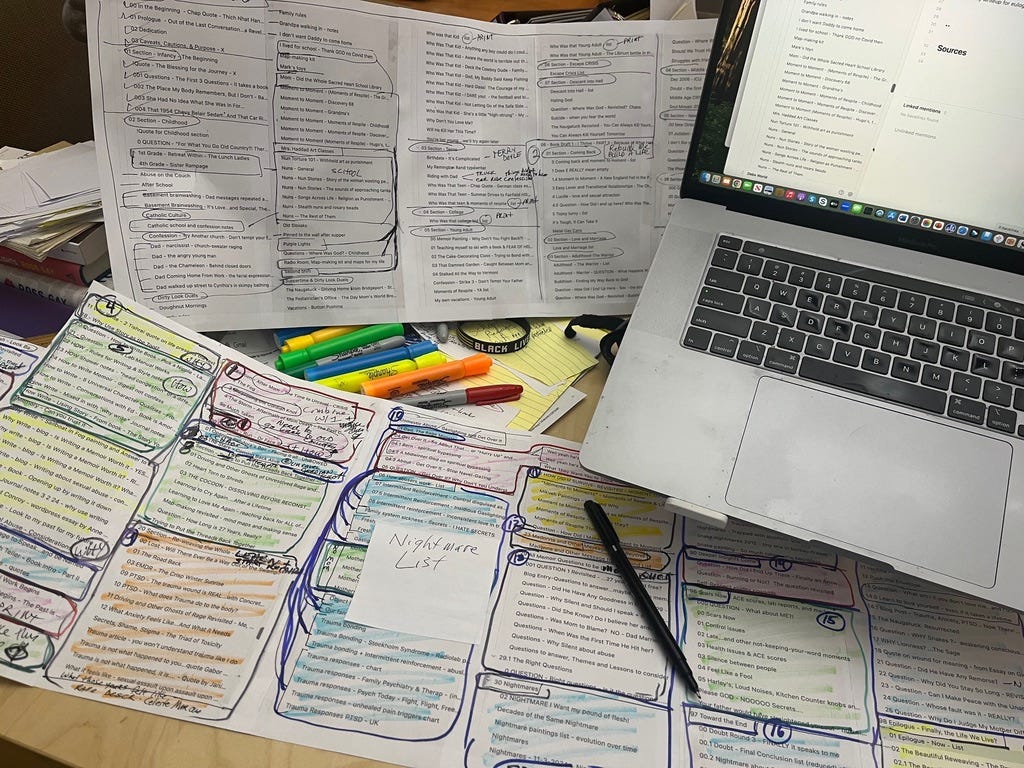
Today is a “heads-down” day, one of those unavoidable times in writing a book where you have no choice but to stop any forward progress and “assess.” I have spent years journaling for the book. There are a lot of reflections, insights, scattered accounts of events, and lists of things “to remember to put in the book.”
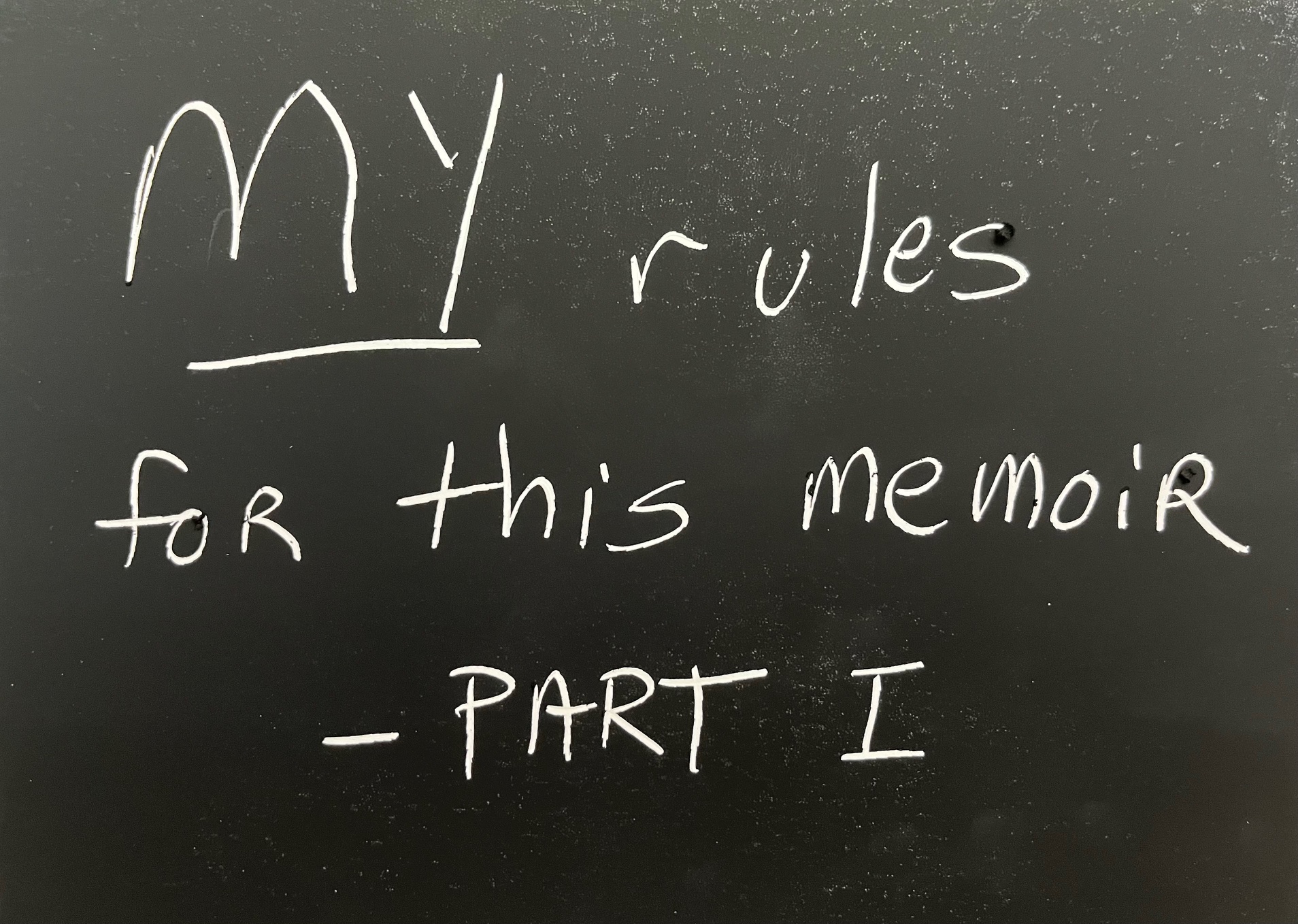
A moment before continuing the story, to state the “rules of the road” for this book
Before continuing with posts about my life, I want to share what I think is a vital part of any memoir – stating the rules, goals, and cautions for the book. So this is the first of a 2-part set of posts that will form the introduction to my memoir. That introduction will give all readers clear information about the how and why of my approach.
The “hows and whys” of my writing
Since there are so many good books on how to write a memoir, mine does not and will not be a textbook on all the nuances, methods, and rules.
But the following things jumped out at me as I studied all the different books on the subject. So I wrote myself some clear guidelines:
The “ancient history look” of 1950s black-and-white photos
It’s one of those typical 1950s black-and-white photos found in family albums — those of the era of the late Baby Boomers but before the 1960s when you could more easily obtain color film. It has that dated look and these days, it could simply be viewed as “back then, ancient history.” Only the car gives a clue as to the time period. The bottom line is that this picture comes across more as something found in a history book than a real moment out of a real life. So, while I’ll use some photos in this book, for a large part I am going to use paintings.
The details of a photo…
Why? First, check out the difference when viewing that same moment in full color:
 Soul Mosaic