This blog shares excerpts of my draft memoir — working title: “I Thrive.” While not graphic, it will discuss aspects of the sexual, physical, and emotional abuse I endured and my journey back to healing…and thriving.These entries start in June, 2025 and continue into the present. Prior entries cover other topics
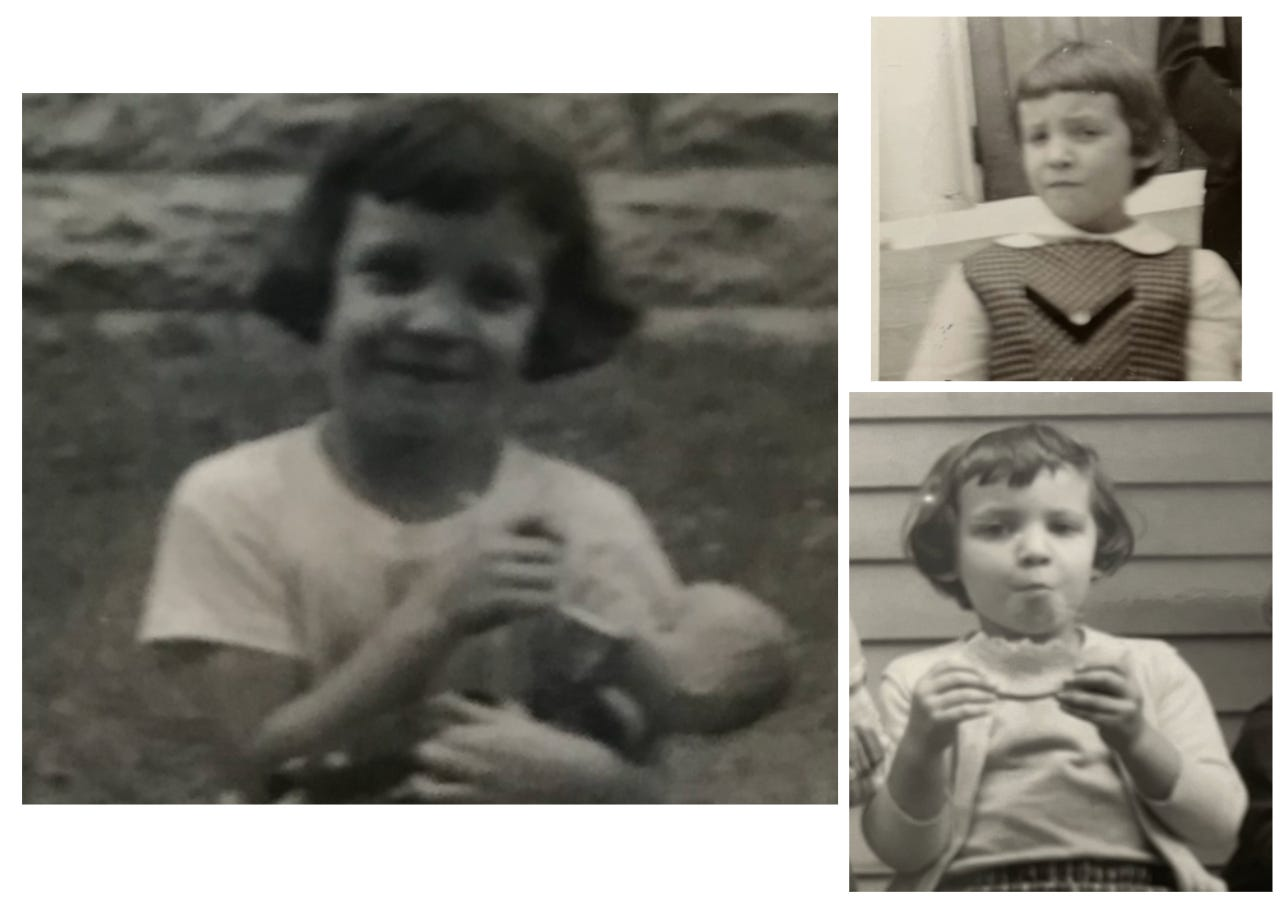
Photo by author, circa 1959-1960
To be the illustration
Memoir expert and author Marion Roach Smith described the genre of memoir this way:
“Memoir is not about you. It’s about something and you are its illustration.”
Another author, Trish Lockard, added that this genre is not just a recounting of things that happened to you because, after all — “Stuff happens to everybody.” Instead, memoir captures one’s reflections about an event when enough time has passed for a change, a transformation, to take place. Those insights gained over time through effort are the gift to the reader—the takeaway.
To only write a list of everything done to you in life without the reflections is like dumping a pile of ingredients on the counter and calling it a cake. It is only a cake when that pile of ingredients has gone through the crucible of a hot oven and been transformed into the real takeaway — dessert. Only then does it have “purpose and meaning.”
I loved how one author, whose name I cannot find, summed it up:
“Don’t just confess. Digest.”
Digestion is change and makes something useful…nutritious. It gives back. And digestion is the unfinished business of my life.
After seven decades of silence, it is time for me to look back, digest the raw material of my life, and obtain the nutrition— the insights that give it meaning. It is not: “Look at what was done to me” so much as the answers to the questions: “Because of what was done, what am I doing with it? What does it mean?” So, my life will be the illustration of that “something” that might have meaning and nutrition for all.
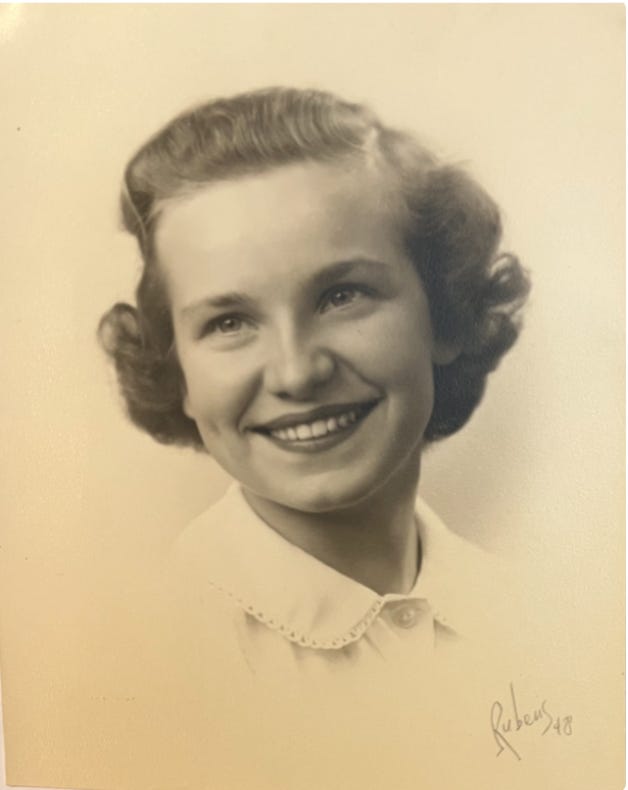
28 years of abuse…and building a “beautiful mosaic”
The next step I need to make sense of my life is to look for things that “repeat” — objects, metaphors, themes, events. It’s one of the reasons I mind map and journal so much.
When I spread out items on a large sheet of paper and stand back, that’s when I start to notice that certain elements come up again and again. And I spot connections between them.
With regards to my journals, I write in Word docs so I can read my writing better. I keep them in binders by date, and for each entry, I put a sticky note at the top of the page that has a few key words as to the topic.
The other plus to storing my notes in Word is that I can then do a global search of the words on that list to see how many documents they show up in. That lets me see if there are changes in that issue over time, whether it’s progress, a relapse, or some new way they come out in my life.
Photo by author
Periodically, I will flip through my journals, scanning those sticky notes with the topics, and, without fail, I’ll start to see repeating topics and phrases. Then I’ll also go through any folders of scribbled notes I haven’t journaled about yet.
From all of these, I’ll just make a word list of the repeating topics I’ve observed. Those are the precious clues to a truth I haven’t yet figured out. They are pointers to places I need to dig deeper and think about more. The fact that they come up again and again tells me they are “unfinished.”
Photo by author
The “treasure” map
Finally, I make a large mind map of all the recurring things on the sheet. I try to group the words in related categories and look for cross-connections between the categories.
Photo by author
While it may look chaotic, at least for my visually-driven brain, I need it. It is the map that leads me to the treasure I am after that I can only see when I have the big picture before me:
Patterns
Patterns are the home of beliefs, habits, and the unconscious forces that drive our thinking and behaviors. I find it vital for my growth to look for the patterns. Without them, I am missing a crucial chance to make sense of my life…and to change what no longer serves me.
By having that large map with everything on it, I can zoom in on a topic without losing the “big picture” connections. I can also jump from topic to topic, pose questions to myself, or journal about what I see, and wait. Inevitably, new insights come.
Photo by author
The final gift of maps
There is one other gift for going through all this work — I also get to discover “what’s missing.”
Sometimes, what’s missing is even more important than what is already there, because that is often the lesson or insight I needed but was either unaware of it or couldn’t quite put into words.
Something about this approach helps my brain to process the wide-ranging pieces of the puzzle and zero in on the very wisdom I needed. Sometimes it is a big insight that makes many things fall together. Other times it’s a more subtle but necessary step forward.
Either way, I get a better understanding of what my life has been about. And that, for me, is the ultimate gift — “integration” – that putting back together a few more lost or broken pieces of my life. My mosaics.
Note:
I am seeking financial support to complete my memoir, work with an editor, and make a visit to my home state for fact-checking. Your help would mean the world to me as I take this step toward healing and giving voice to my journey.
Please like, comment, and share this post to help spread the word. The link for my fundraiser is on GoFundMe. Thank you for your support.
“Life presents you with a text, but it is your meditation upon that text which gives it meaning and relevance.” 2 Tishrei – Meaningful Meditation – 350 Healing Light Meditations book
The previous post was all about asking questions. Especially the ones that will help me understand, learn, and heal. If I am going to pose questions, there is a rule that has to go with that effort: Honest self-reflection.
Reflections in regular life
Now, before I get into self-reflection as it relates to abuse, let me speak of how I use it in the ordinary places of life. These are the places I look back to see what happened and what insights I can glean.
Reviewing past interactions, I ask myself things like: What was my part in things? What choices have I made in that situation, or repeatedly over the years? Even if my intentions were good, did my actions result in harm? What could I do differently or better the next time?
And as I look over the choices I’ve made or the decisions I tended to repeat even if they weren’t healthy, I look for: Emotions I never felt or allowed before Behavior patterns through life My stress style when triggered My thinking style and attitudes How all of these have affected me…and others
I look hard now into my soul and try to observe everything now. Because there were so many small details about me that I refused to look at or accept. And when you deny a part of yourself, you deny that ultimate place of healing: INTEGRATION – the reuniting of all the broken pieces you lost along the way. How can you be whole if you wall off part of yourself? That is the ultimate self-hating act, and I’ve been guilty of it.
Now, this is not about self-flagellation or declaring me a horrible person. It’s also not about denial or refusing to look myself in the eye in the mirror when asking myself some direct questions. None of us is perfect in life, even when we set out to do the right thing.
“The scientist is not a person who gives the right answers; he’s one who asks the right questions.” Claude Levi-Strauss
Photo by author
Questions, questions, questions….
When people hear of my background, the first and most common questions they ask are: How did I survive it? Why did I stay so long? How did I finally get out?
For that matter, those are three of the big questions I’ve asked myself for years. And that second one in particular, I’ve used as a weapon.
I’ve bludgeoned myself with it, adding in judgment statements to go along with it like: How could I have been so stupid to believe that all his brainwashing was the truth? Or that our house was a loving, generally good one? Or, worst of all, “How could I have been so passive as to stay so long?”
These would then be garnished with another round of “How could I have been so stupid?” So, I doused myself in shame.
I know now that all of that bludgeoning was undeserved self-hate. But it took quite a while to realize that, and to start asking questions that took a hard look at all those years and the facts of how abusive households work.
Questions are key to healing. But it is not just about asking any old questions…but the RIGHT ones. And I’ve learned that the questions are even more important than the actual answers. They are the engines that push you to slog through the mud and fog to find understanding. The questions are the “meat of the work,” what you chew on to digest and get to the nutrition of answers. Before you extract insight, you have to wrestle.
Occasionally, there have been times I already knew the answer but had been either running from it or had just been blind to it. But then, pinned down by a finely focused question that wouldn’t let me off the hook, or one that swiped away the fog, I would finally come face to face with a truth I could no longer avoid.
For all of my life, aside from the above three questions, there has been one other unrelenting one. And no, it’s not: “Why me?” Frankly, that one has never haunted me. The real question dogging me all my life has been:
One of the answers to “How did I survive?” was: Moment-to-moment. One second, by one minute, by one hour, by one day. Some days, it was all I could do to just make it to bedtime and have a break from the violence. Never, never, never did I look too far down the road. THAT would have crushed me.
The other crucial item I used during those trauma times was a mental force field that I call “Moments of Respite.” Moments of Respite were for the many times when my world was being torn apart. They were the pain-relieving medicine that made enduring his torment possible. And they let me shield my nervous system by giving it a momentary distraction.
Moments of Respite were ALWAYS found in the details, whether sensory or physical. Details give the world its special beauty, and beauty is the perfect antidote to horror. Details are life’s adornments that bring order, calm, awe, mystery, and tranquility.
If you question whether overlooked tiny things have such power, consider this. You can draw a circle with a line sticking out of it and call it an apple with a stem. Or you can underpaint the circle with burnt umber, then add successive layers of cadmium red, cinnabar green, some titanium white, and Naples yellow. Suddenly, the depth, intensity, and richness explode on the page, and that image of the apple is like holding an entire world in the palm of your hand. I’ll expand on the apple example at the bottom of this post.
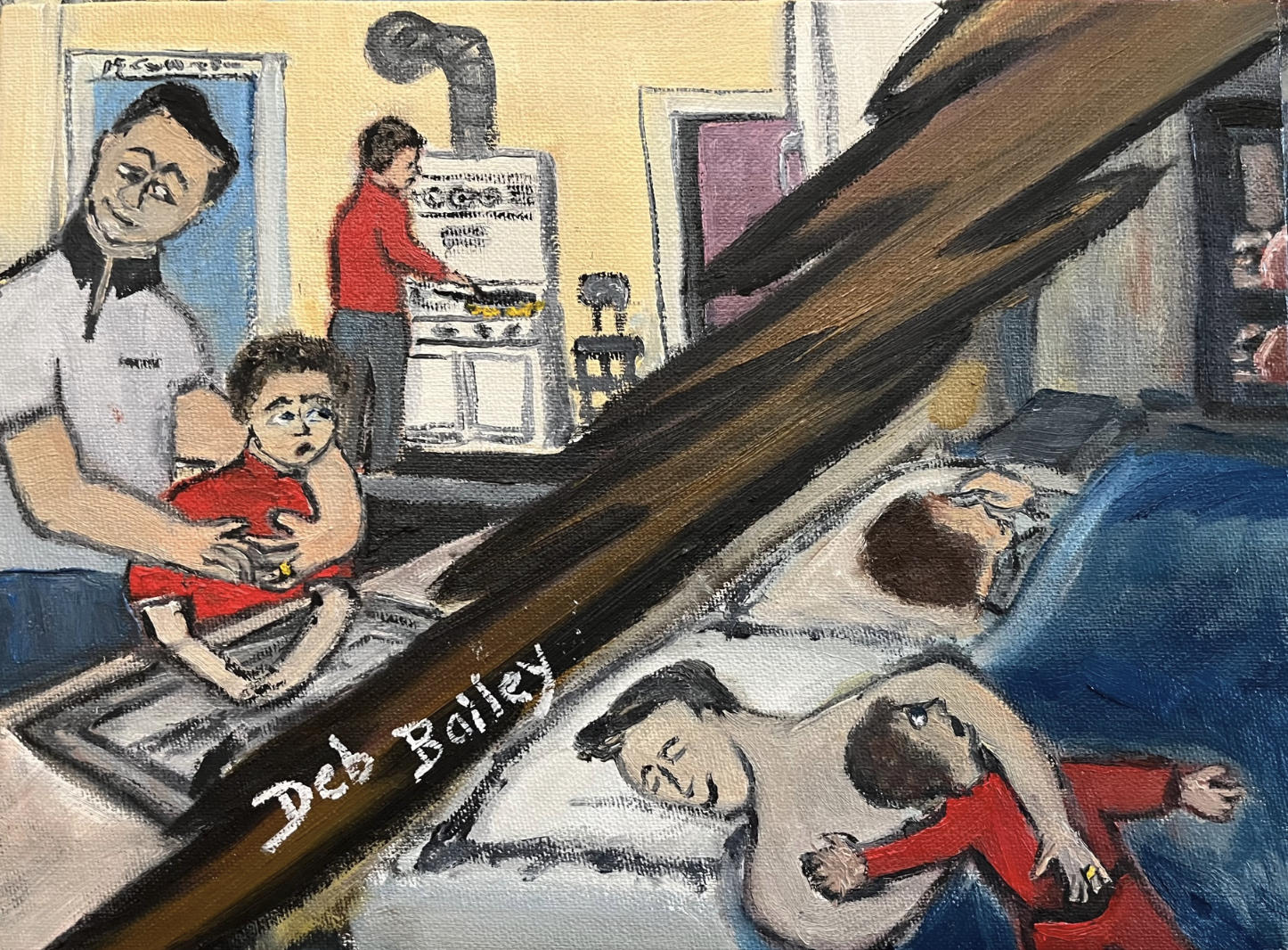
Painting by author
Suffice it to say that in the depths of my abandonment, all of those tiny aspects of life would call out to me. They were like friends racing up in a getaway car and yelling for me to jump in. They taught me to look for the beauty in the smallest of things and to see it no matter how bad the bigger picture was.
Even when I could count on no one or nothing else, the details in those Moments of Respite offered that intricate deeper dimension, right at my fingertips, always available…unlike the people in my life.
Moments of respite were my reminder that, even in the midst of chaos and horror, life possessed infinite little worlds of richness and beauty. They were my steadfast companions, offering sensory retreats — a “breath in between moments” — where my overwrought, throbbing, nervous system could escape and rest. If I focused on them, I could tune him out, even momentarily. And by doing that, I could withstand the next moment’s onslaught.
So, always, Moments of Respite, dosed moment-to-moment. And NEVER think further ahead than that.
It was a FULL-SIZED, Louisville Hillerich & Bradsby, Little League-approved baseball bat…1965…brand new…and BEST of all – inscribed with Mickey Mantle’s name at the end. Anyone who followed New York baseball in 1965 knew that Mickey Mantle was the ultimate batter. So, of course, that bat was my absolute pride and joy.
I suspect I was a rarity, as I was probably one of the rare girls at Yankee Stadium that day. It was the very first “Bat Day!” and anyone who had a child and a ticket to the game got a free, official Little League bat. Since all I remember seeing around us were boys and their dads, AND given it was 1965, the idea of a GIRL coming to bat day would have been unusual.
My two friends (both boys) from our neighborhood were going to this event with their dads, friends of our family. They must have invited my dad to join them, and since he only had daughters, and since, in a lot of ways, as the oldest, I was the replacement son, I got to go.
I remember bits of it. An exciting drive to New York City. Walking in and being handed THAT bat. Clutching it to my chest as we pushed our way through packed stairwells to get to our seats, and gripping it tightly the whole day. Stopping at a hot-dog stand for dinner on the ride home.
The entire day was heaven, with even my dad being in a good mood. And…that bat. I was going to treasure it forever. But sometimes forever isn’t very long.
This tool does not require a lot of words. Yet do not consider the brevity of this post an indication that it is not that important. Other than attitude, it is the most important one of all. To show no awareness of what it means is to throw away a most precious gift:
Time.
I’ve read a number of books by a YouTube podcaster, Ryan Holiday. He writes and speaks about a 2000-year-old philosophy called Stoicism. And that ancient philosophy couldn’t be more relevant for extracting meaning in every moment, today.
People often hear the word “stoic” and mistake it for taking on the world with no emotions and a hard, outer shell. It is the opposite. In some ways, it mirrors many teachings of Buddhism, Taoism, and many other ancient paths to wisdom. It is about living as fully as possible in the present moment; about knowing what is in your power to do or control and doing it without procrastination. And it is also about knowing what you can’t control, and letting that go.
But most of all, its most valuable message can be summed up in two Latin words, two words that say it all:
So. About tools. There are several I am going to share. And I need to start with maybe the most important one, at least for me. If I had this one, I could hang in long enough to use all the other tools that would come.
Attitude
“The girl in the navy sweatshirt…softly asked, ‘How did you not give up?’” “By realizing that giving up would mean giving in to the narrative that was written for me by my circumstances, by other people’s choices and mistakes.” Daria Burke, Of My Own Making
If I were forced to pick just one quality in me that helped save me in that house, and continues to fuel my healing now, I think I would choose “Attitude.”
The true and full answer for how I survived is a whole lot more complex. In reality, it was a swirling mix of so many individual happenings over my life that came together in just the right way, at just the right moment. And without that, I wouldn’t be here. I consider it just as miraculous as how the dense, hot, swirling chaos of dust and rock from the Big Bang gave us a nurturing, life-sustaining Earth. A long shot.
But that one quality, “attitude,” is the closest word I can think of, because in the end, that is what often gets someone through — how they view something, what drives them, what gives them a lifeline to hang on to.
The word salad of survival
For sure, my attitude is built from so many more words, each one contributing to my long-shot survival and eventual thriving.
There were people – from my husband, therapists, my wonderful high school teacher, family friends, and even strangers who, in a momentary crossing of paths, gave me the sustenance I needed to keep going.
There was God, even during the times I hated Him or Her. All during those daily Masses, that young me was deeply listening to the Gospel stories of how God takes care of everyone, even the lilies of the field and birds of the sky. I absorbed those words and held on for dear life.
There was even just plain blind ignorance. And I don’t mean that as a put-down. It’s just the reality of childhood.
When you’re a kid, you don’t know what you don’t know. You have no clue that your life isn’t the norm. You assume what you are living in is how everyone lives — some nice things, some not so nice things that you just have to survive. So you don’t even think to question it. Daria Burke said as much in her book about her own life:
“…we are hardwired to seek out and trust the familiar, even when the familiar isn’t safe or good for us…When you grow up surrounded by poverty, abuse, and violence…it’s not uncommon to accept your circumstances as commonplace, even expected…stressful forces that become so ordinary, they fail to register as traumatic events.”
In one way, then, blind ignorance was a blessing, at least at the time for me. By not knowing the reality of how abusive it was, I could retain an attitude that anything was possible if you worked hard enough and waited long enough, even in the midst of chaos.
I had hope and optimism that one magical day, I would be an adult and things would all “just work out.”
Hope and tenacity – your name is “resilience”
Actor Jane Fonda, in a Fresh Air interview, spoke of her life, her own sorrows at losing her mother to suicide at a young age. Of her wound of growing up without that love. And of the deep sorrow of learning years later that her mother’s suicide was rooted in being sexually abused and raised in an abusive household.
When asked why she kept striving in life despite her personal pain, Fonda talked about resilience, which to me incorporates the attitudes of hope and tenacity:
“Resilience is such an interesting thing…I think people are born with it…resilience is when a young child who is not getting love at home, kind of — there’s a radar that’s scanning the horizon. If there’s a warm body that maybe could love her or teach her something, you go there. You find love where you can. You find support where you can. That’s a resilient child. That was me.”
And that was me, too. I might not have always chosen wisely, but I really tried to find and take in love as best as I could in any moment.
One of my therapists along the way pointed out how amazing it was that, despite what I lived through, I stayed open to the hope of love. And that I did take it in whenever I could find it, from whoever offered it along the way. Yes, I made mistakes, but still, I kept the hope of love.
Now, for sure, I was hugely naive as to both my reality at home and what that life would cost me. And of course, that way of thinking would eventually implode when I realized the truth. But maybe it was best, then, that I could assume my life was “normal,” even if it was the opposite.
The other thing that ignorance gave me in childhood was what Viktor Frankl talked about in his book, Man’s Search for Meaning. He spoke of people surviving concentration camps because they found a “why” to keep going.
My “why” might have been totally wrong, warped by my father’s brainwashing, but still, I thought I had a why to go on. He drilled in that I was helping him and keeping the family together. And he kept demanding I not grow up to “be a stupid woman.”
So when you are told those things a million times from early childhood on, in your young mind, you think you have both a reason for your existence that gives you worth, and a goal for your future. And so you have hope. Of all the qualities I possessed that made up my attitude, I would say hope was the largest element. I will write more later about “hope” through life.
Of course, there’s the reality that those rules slowly poison you and prevent you from becoming your own person. And there is also devastation that comes when you get older and feel that you were played for a fool, so you hate yourself.
The mixed bag that was me
Aside from all of the above things, there was that mix of who I was at my core. I was a dreamer. So in any given moment, I was Nancy Drew, Ivanhoe, Robin Hood, a World War II Australian coastwatcher spying for the Allies in the South Pacific, and so many other personas all wrapped up in one. From those stories and biographies, I learned that true heroes were brave, unrelenting, and determined to stand up for what was right, no matter the risk.
I loved to learn and was creative enough to use that for Moments of Respite to feed my soul, especially during the bad times. I trusted the people I loved, was loyal to a fault, and had a good heart. And I was a highly competitive kid who never wanted to let anyone, especially the boys, beat me out at anything. If a boy could do it, so could I…and better!
That might have been foolish at times, like when I dared to out-race my neighborhood friend on my bike while he tried to nail the football in front of my bike tire. I was just a split-second too slow, flipped up in the air, and tore up my shoulder as I skidded across the pavement while just missing the curb with my head. This was, of course, the era before bike helmets. Yes, foolish. But NO ONE could say I didn’t try.
Painting by author
Also, there were the influences and examples of the old Slovaks in my life. They lived through poverty, loss, war, and the Depression. Their rules were to work hard, get an education, stick by family, tough your way through anything life throws at you, and don’t whine, be weak, or give up.
So I was the mixed bag of tough, loving, loyal, determined, stubborn, gentle, trusting…and hopeful. I thought I was living in a house that, while not perfect, was truly loving, and would someday, somehow, be better. I had hope. I will write more about the nature of this quality in my life later.
When I escaped that house, I did finally realize the extent of all the lies I had been living with. And that destabilized me for some time. But once I started to pick myself up, I was angry. And anger fueled a level of rebellious determination that, for a while, bordered on spiteful. I was going to survive and come back and fully reclaim my life, fast, just to spite him.
While that works for the short-term to get one started from despair, eventually, I would come to realize it wasn’t going to be fast, or ever completely healed. And I would eventually release the spite and instead, tap into self-determination — reclaiming what I deserved for my own good, for the love of my family, and for the goal of breaking that intergenerational cycle of abuse handed down by my family of origin.
So, now? Throw the damned football
So now, decades later, who am I?
No matter what, I am still that dreamer. That person who uses Moments of Respite to feed me. I still hold all those values I read about or saw in others.
I am also that determined, feisty person who refuses to give up or be held back by anyone. Tell me I can’t do something, and I will do my best to prove you wrong. I may be more judicious in picking my battles now, but still, I yield my power to no one.
So, somehow, despite all my father’s bludgeoning, I managed to keep that spark alive. I got just enough nurturance along the way that he could never completely snuff out my spirit.
For sure, I almost didn’t make it…several times. For sure, I have almost given up many times. And so often, I have crashed in despair.
Even now as I write these entries, I feel weary, sad, and angry. But somehow, I still have inside me that kid on the bike daring life to throw the football.
She has an attitude that screams – “I WILL take back as much of my life as I can…and I REFUSE to let him rob me of my future! He took my past. He will NOT get my future!”
Child-like
I have learned that it’s good to keep my “young inner child” alive and close by. I don’t mean to be childish, but “child-like.” That is the part that always had hope. And while no longer naive, I am still “hopeful.” I BELIEVE I can make my life a gift to me and to others.
And again, I can follow the example in Fonda, who is older than me, but who also refuses to give up on healing her life:
“…you’re never too old. You know, I’ve gone back into therapy now at 87 because I want to figure out why I’m not a better person and why I wasn’t a better parent. And I’m figuring it out…At 60, I thought a lot about, ‘OK, this is my last act.’ This is it…My last 30 years…What do I wanna get out of it? I wanna end with no regrets, or at least as few regrets as possible.”
No regrets. So, my first tool for sustaining in this work: Attitude.
And maybe the biggest ingredient in attitude for me is hope.
Note:
I am seeking financial support to complete my memoir, work with an editor, and return home for fact-checking. Your help would mean the world to me as I take this step toward healing and giving voice to my journey.
Please like, comment, and share this post to help spread the word. The link for my fundraiser is on GoFundMe. Thank you for your support.
The short answer is that no one can answer that ahead of time. It will take what it will take. It depends on the nature of each person and what they have lived through.
For me, given the long duration of my abuse, the deeply ingrained messages, and the amount of trauma stored in my body tissues, it’s not surprising that it was going to take a long time. And still does at times. So the amount of EMDR and Cognitive Behavioral Therapy work from 2018 to the present has been the most intense and continuous of my life.
I went back through my journals and calendars for those years and discovered that the number of EMDR sessions alone numbered twenty-four to date. The heaviest load fell into the first two years – thirteen sessions by the end of 2019.
Photo by author
Particularly during those two years, I needed the constant repetition to slowly and carefully crack open some of those huge and painful topics. Many of those sessions were recurring themes: rage, grief, loss, terror, shame, mothering, women’s friendships, family systems, and such.
“Whatever it was that he saw in me that made him choose me – I was determined that part of me would NOT survive!” My journal, July 22, 2018
If ever there was a statement that captured the self-hatred, blaming, and disgust that I felt toward me all through life, this was it.
I assumed it was me. I was wrong, somehow to blame, somehow responsible, contaminated with some trait that he couldn’t resist. I must have brought something to the table that caused this…and thus…it was my fault.
Or, even if I cut me some “slack” because, at least in the beginning, I was an infant, still, I was disgusted with myself. He had chosen me for this hell. So whatever it was that I possessed that drew him to me, I was going to PURGE it as soon as I could identify it.
Looking back, it’s a ridiculous idea…it wasn’t me at all. But given that he abused me right from infancy, it is a logical one. When bad things happen to young children, they assume they caused it and are to blame. They are still at that stage of thinking that everything is about them. So good or bad, it’s their fault. And on some deep and early emotional level within me, I carried that same message.
It was only now, in my late sixties, that a germ of a realization was dawning upon me and creeping into my consciousness…an idea I could finally FEEL, not just tell myself and try to believe it: Was it possible…that I was NEVER to blame? For any of it? That maybe it was about whatever he carried WITHIN HIM all along…
It takes more courage to remove one’s armour, than to assemble it.”
J. Střelou
The racehorse in the gate
The digital clock to my right read 4:01.
I settled onto the couch, a pillow on my side in case I needed to pull it to my chest. My therapist moved quietly about the room, pulling the window shutters closed and turning off lamps.
She settled into her desk chair, a clipboard and pen handy so she could take notes. The only light in the room now was from her small desk lamp.
I appreciated the darkness of the room. It walled out the world and helped me reinforce that we were about to journey to another place and time.
Before me at eye level was a tripod about 4 feet high holding a 3-4 foot long horizontal LED light bar. It was narrow, about two inches high, with a black background.
My therapist clicked the remote for the light bar to ensure it was working properly. Immediately, a small green light zipped across the bar. She adjusted the light beam’s speed and reminded me that she could adjust it to whatever my comfort level needed.
Despite trying to relax into the sofa cushion, every muscle in my body was a taut rope. I wondered how I would react this time…what thoughts might come up…and would this do anything. I felt like a cliff diver perched high atop a rocky peak, arms stretched out before me, and leg muscles tensed as I leaned out over the expanse to drop into the surf below. Would I clear the rocks or land on them?
My therapist’s voice brought me back to the room. “How are you doing?”
“I feel like exploding…I can’t wait to get on with this.”
“Where in your body are you feeling tension?”
“My muscles are all tight…but especially my throat..like I am being choked. And a heavy pressure on my upper chest.”
“Do you still want to continue?”
She barely asked the question before I cut her off.
“Oh my God, YES! I can’t stand this any longer.”
She confirmed that my husband drove me to the appointment and was in the waiting room so that I didn’t have to drive myself home. Then she began the process.
“You are in control and can stop this at any time. Follow the light beam back and forth with your eyes as you think about the image we have settled on. We’ll stop periodically to give you a rest and see what comes up for you as we do this.“
I shifted on the couch and stared hard at the dark light bar. I was a racehorse in the gate, ready for the sound of the gun.
“On a scale of one to ten, with one being no discomfort and ten being the highest level of discomfort, where are you now?”
Again, she barely finished her question, and I blurted out, “Nine…almost ten.”
“On a scale of one to ten, with one being not true at all and ten being totally true, how true is the statement ‘I feel powerful.’”
“One.”
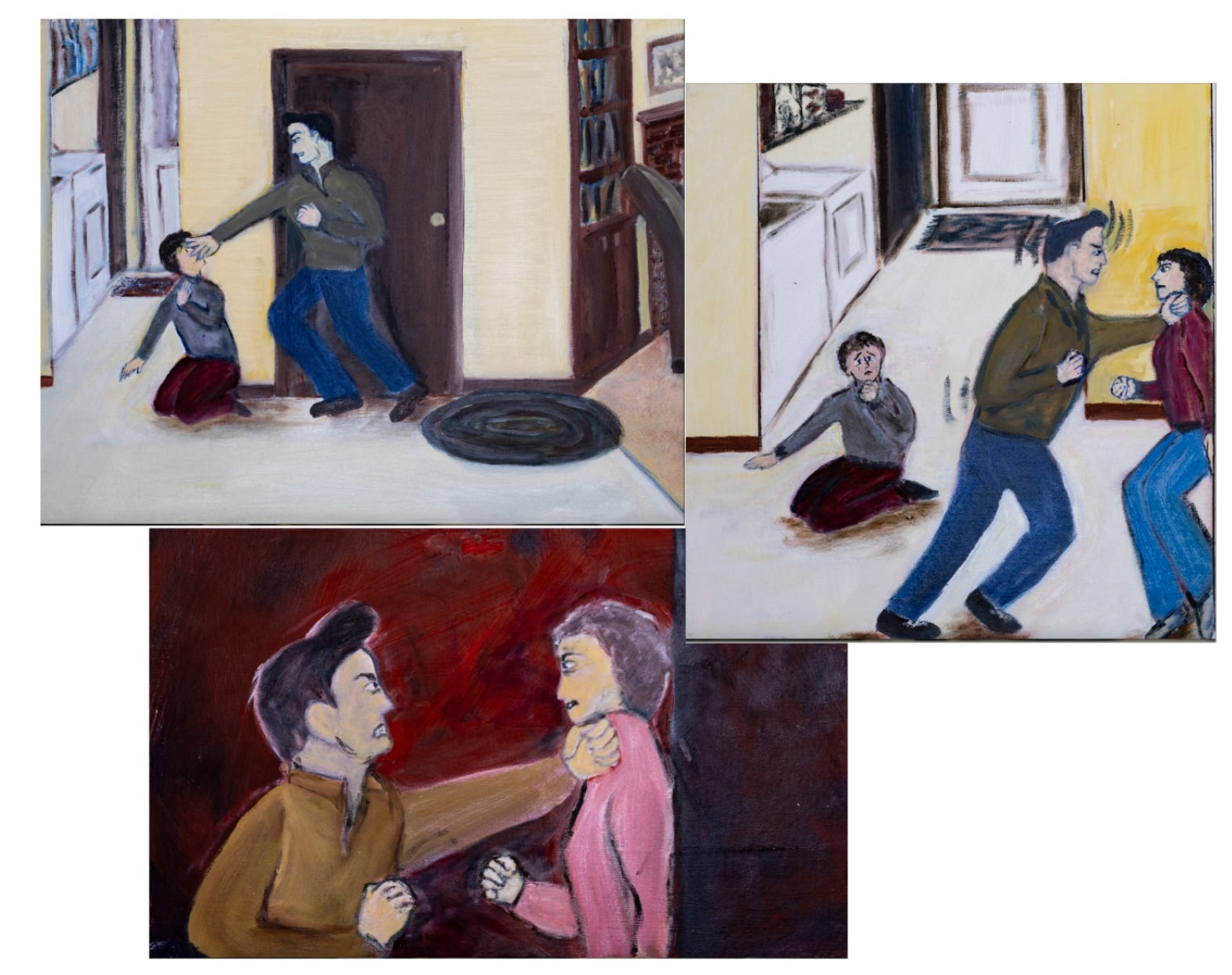
“Okay. Let’s start. Just focus on being there in your house on Sunday afternoons with your father coming down the hall and yelling at you.”