Posts Tagged ‘family’

The Post – Scarlett O’Hara and her molted ghost

January 31, 2008

fiddler-crabs-242.jpgfiddler-crabs-252.jpgfiddler-crabs-254.jpgfiddler-crabs-287.jpg

Well, I’ve been promising pictures of the fiddler family members so let’s start with Scarlett O’Hara and her recent molt.

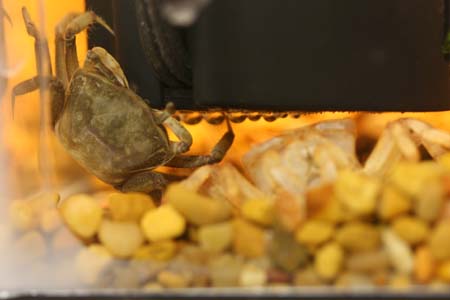
The first picture shows her just after she molted, climbing down the side of the water filter. I love how they can have their eyestalks going in two directions as they move about. If you look closely, the right eyestalk is vertical, while the left one is scanning in a horizontal direction. Off to the right in the picture, her whitish “ghost” sits, discarded. With the water currents waving the legs and claws back and forth, the discarded shell looked eerily alive.

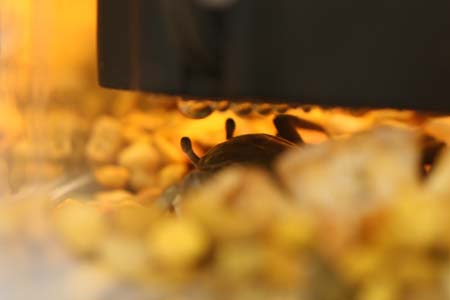
The second one shows her nestled safely under the water filter and behind her old self (fuzzy part in front), where she rested for some time. It is not unusual for newly molted crabs to hide. Their new shells are soft at this point and they feel vulnerable. So they hide to give themselves protection as their new shell hardens.

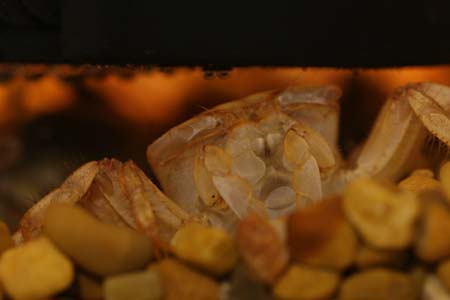
The third picture though a bit dark, gives you a close-up view of the ghost version. You can see the empty leg, claw and eyestalk casings. I will add that the “ghost of Scarlett O’Hara” no longer exists. Admiral Byrd ate it. Perhaps he is getting ready to molt. Crabs often eat discarded shells to reclaim the calcium the shells contain.

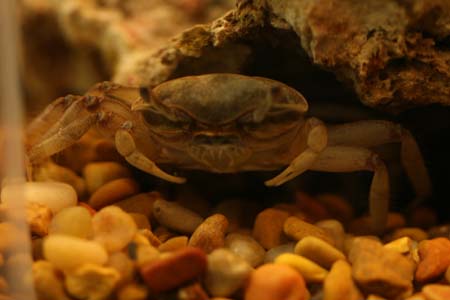
Last picture shows Scarlett O’Hara when she finally emerged from under the water filter. Still a bit tentative, she sought shelter under an overhang on the Live Rock.

These were all from Saturday, the 26th. Today she was back to her old self, running around the tank and eating. Maybe I can get a lighter picture of her now that she’s out and about. I need to work on “lighting” issues for these, but still, not bad considering no flash and long exposure times.

Soon to come, Admiral Byrd and Melanie Hamilton!!!

The Post – Caring, is catchy

January 30, 2008

Probably the most interesting thing in the fiddler crab experiment is my family’s reaction to them. My son came home from college at Christmas and initially looked at me like I was crazy because I talked so much about the crabs. In fact, my independent college student complained I was paying more attention to the fiddler crabs. He kept laughing at me as I talked to the crustaceans in that high-pitched mommy voice previously reserved for my toddler son and pet poodles. My husband just kept teasing me about the total amount we were up to on fiddler crab expenditures.

Within of day of being home, my son started watching them, and within a few days he was keeping track of who was doing what and telling me to check on Melanie Hamilton or Rhett Butler. In fact, I think he was the one who first noticed that Rhett Butler was dead.

My husband was the one who spotted Scarlett O’Hara molting and eagerly called me over to see her when I came in from grocery shopping. Last night, he came in from work and before he even said hello to me he stopped, peered in the tank and said with great concern, “There’s something wrong with Admiral Byrd! I think he’s dead!” As it turned out (after I poked Admiral Byrd with my latest acquisition, a 25 cc plastic pipette and bulb from Science Safari that I use to siphon out excess food), I think Admiral Byrd was just sleeping – they kind of hang there, their claws floating above their heads, and don’t react to much. But my husband walked away and said very seriously, “I think you’d better keep an eye on him.”

What I realized is that caring, like a cold, is an occupational hazard of sharing space. When you share space, even with a creature who has a brain the size of a pinpoint, it starts to get personal. When it’s personal, you start to care, even when you didn’t mean to.

I think the same thing happens with people. So often you hear people say, “I don’t like this group or that.” Then they meet someone from that group and find out they really are okay . . . maybe even . . . nice. It’s hard to share space – sit across the table from someone, hear their humanness, see it in their eyes – and not care. That’s the real risk factor I suspect . . . contact . . . sharing space. The minute you share the space, you start to see the real person. Once that happens, it’s personal. And once it’s personal, you’re done for because caring is catchy.