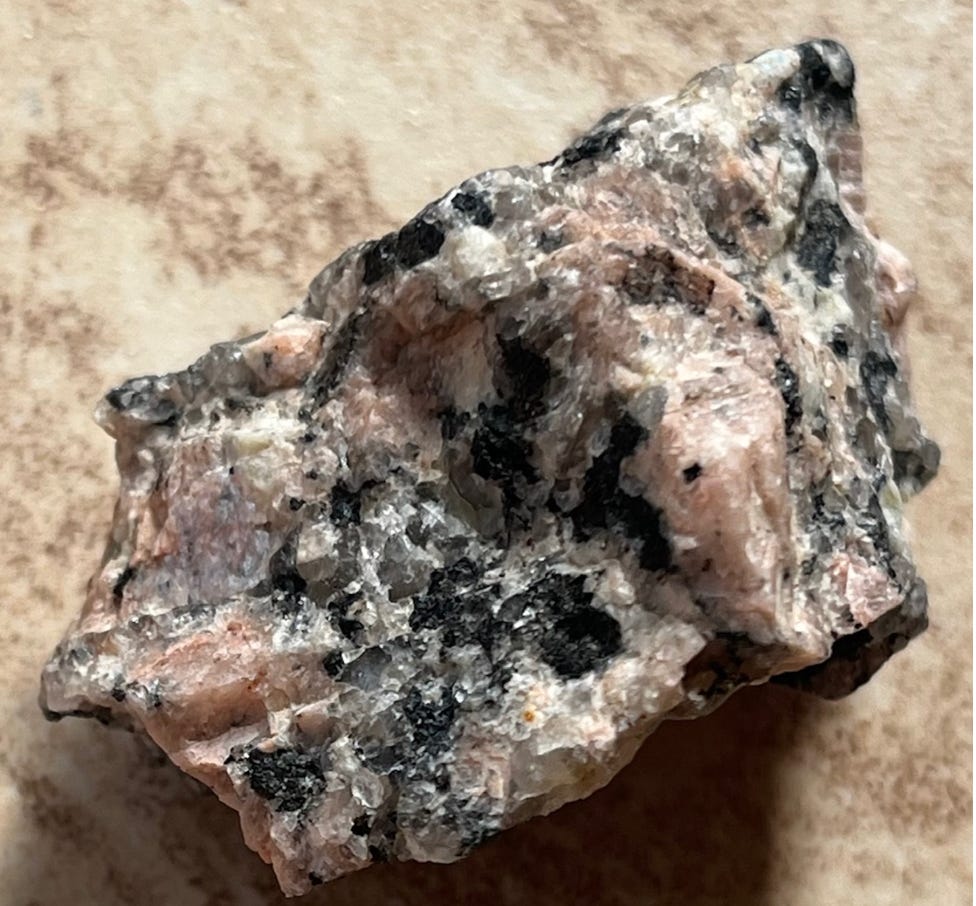
Pegmatite
I am a rock person. Growing up in boulder-strewn “New England,” that’s probably not a surprise. But I am always fascinated by the wide range of textures, mineral compositions, and appearances in all of them. But pegmatite is a particular favorite.
For one, it was born from intense fire and pressure. I know how it feels.
Volcanic magma was forced under high pressure into granite fissures underground. There it cooled slowly, taking eons to become its final “self.”
Again, I know that feeling. It’s taken me a lifetime to distill into my current form.
Second, it is complex. Because it cooled slowly, it is composed of concentrated amounts of a wide range of minerals and chemicals. While other rocks shot out of the volcano and cooled quickly, the liquid that formed pegmatite was the soup of all kinds of leftover minerals that just sank to the bottom of the magma. To look at a piece of pegmatite is to see that it has many facets — dull whites, sparkling flecks, glassy surfaces, and deep mysterious blacks.
And it is precisely this complexity that makes it valuable industrially. It contains such a wide range of chemicals and minerals that its uses range from gemstones and ceramics to microchips and aerospace components.
Maybe the same is true of all of us, especially those of us who were born of fire and pressure and had to wait a long time in life to become “us”?