“David Foster Wallace’s ‘This Is Water’ speech uses the metaphor of fish and water to highlight how the most fundamental aspects of our existence often go unnoticed. In the story, two young fish swim past an older fish who greets them with, ‘Morning, boys. How’s the water?’ After a while, one of the young fish turns to the other and asks, ‘What the heck is water?’ This illustrates how the most pervasive elements of our lives can become so familiar that they become invisible to us.
Many things go into forming a person, especially if the programming starts right from birth. As I tried to find the “entry point” to tell my story, I was overwhelmed by all the things I needed to weave into the narrative.
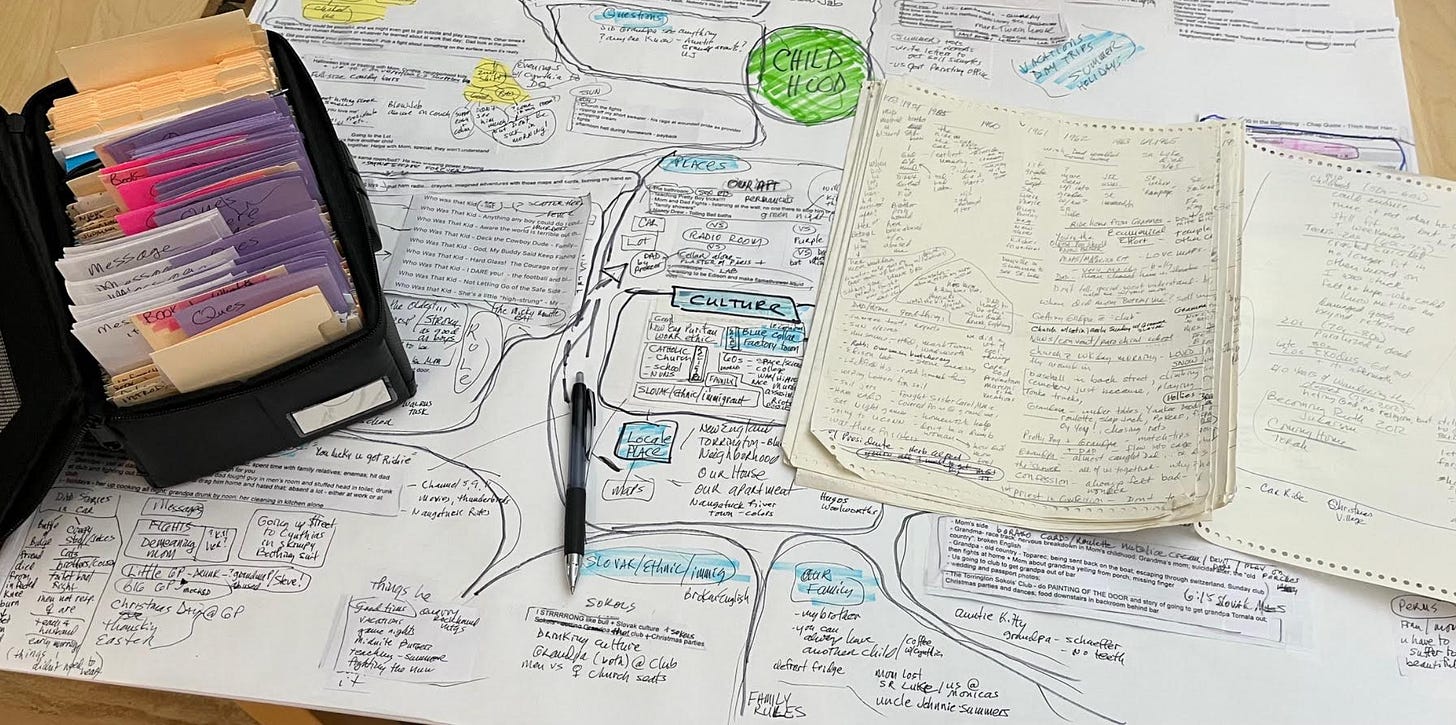
So, I resorted to what I always do when confronted with too much information: I throw everything I can think of onto a large sheet of paper to see it all at once. That way, I can then notice if there are key pieces that stand out — relationships, patterns, repeating elements.
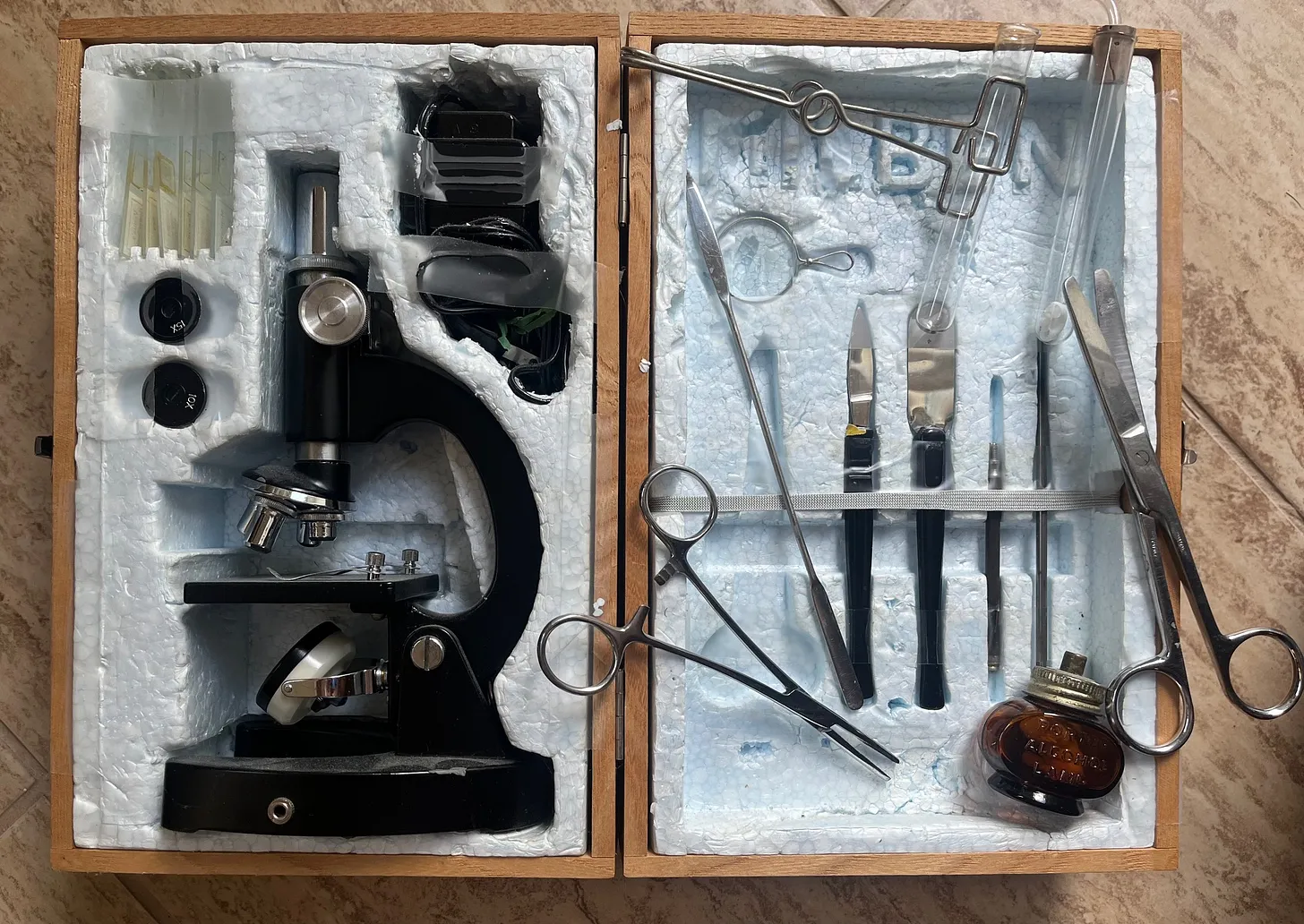
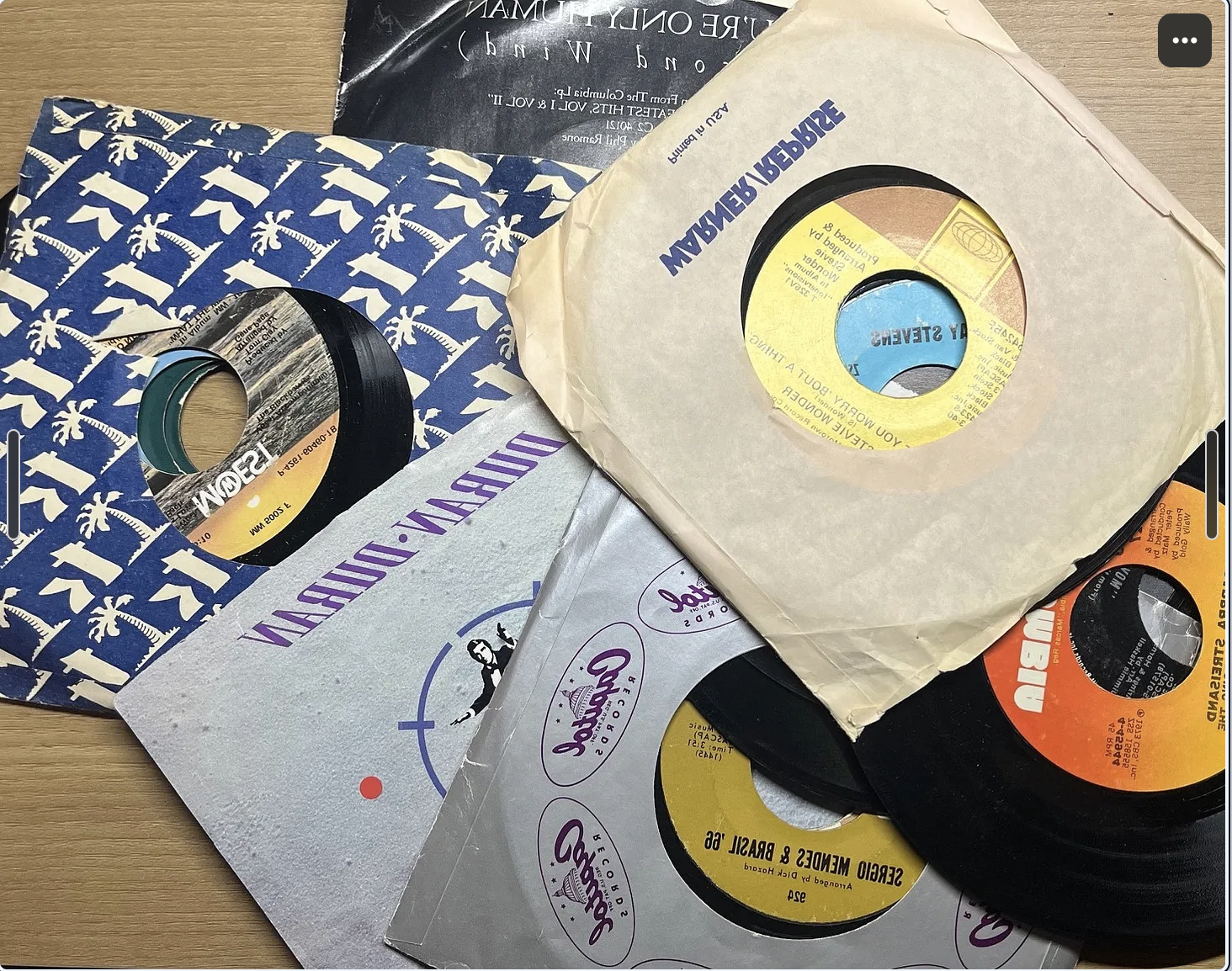
In my true scientist way, I made a list of all the different influences over my young life:
Along with all the released pain, the ache in my heart, the emptied out mess of my life before me, there was also an ironic twist in facing this work.
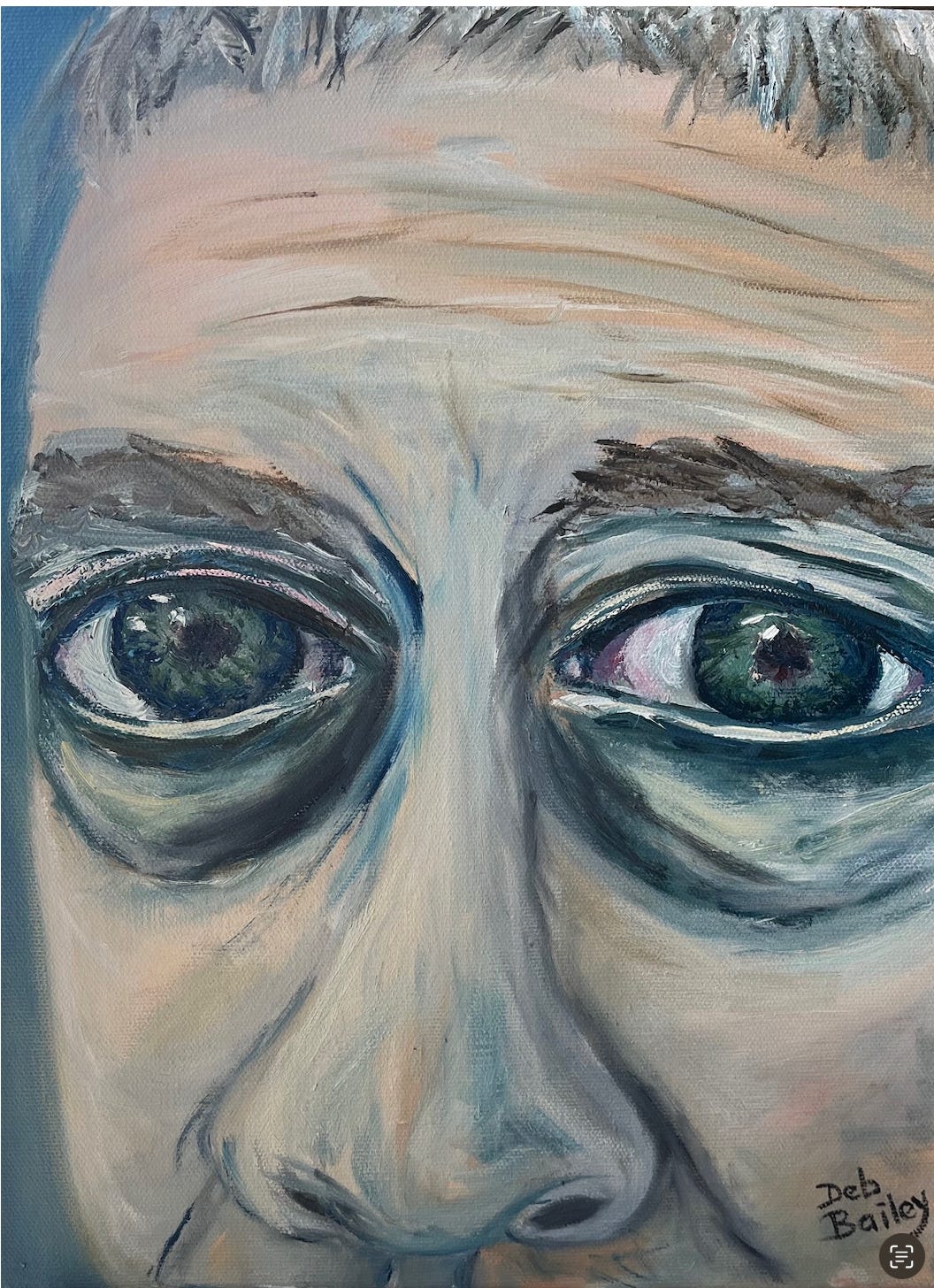
When I painted this particular self-portrait, it was after a hard session of EMDR work. I was looking for a way to capture how much fear, sorrow, pain, and despair I was experiencing at that moment.
On a whim, I took a selfie and realized all of the emotions were right there in my eyes. So, I decided to paint that picture. In fact, all of those feelings were so strong and so near the surface that I did the painting in about an hour.
Unbeknownst to me, Ed, who was exercising in the living room, kept looking over, as he described it, “watching the image emerge.” As the eyes formed and came into focus, he felt horror. Later, he acknowledged I had nailed “that look,” but he also hesitated before saying the rest.
He didn’t have to. I finished the sentence for him.
After all the see-sawing of emotions I had been totally unaware of, the final surprise was what came next — the silence. In that immensity and intensity of whatever this was about, it silenced me, and I had no words.
So I painted. And painted. And painted. And gradually, a few words seeped out.
I’ve spent a bit of time in my posts talking about who I am, why I’m writing, how to do this book, why now, and what kind of tools I need.
Why have I “wasted” so much time on those things?
Maybe this post can answer that question. It will be the first entry in the book and sets the stage for the first chapter — Packing for the Journey, which will include the information I mentioned above.
“Why write…now?” Three simple words, but a vital question that demands an answer to the motive for my change of heart.
Dr. Edith Eva Eger, in her 2017 book, The Choice, about her experiences both as a Holocaust survivor and a psychotherapist, talks about the question, “Why now?” Whenever she was confronted with a new patient, her approach was always the same–questions. I loved her description:
“Why now?…This was my secret weapon. The question I always ask my patients on a first visit. I need to know why they are motivated to change. Why today, of all days…Why is today different from yesterday, or last week, or last year? Why is today different from tomorrow?”
So it’s a fair question.
But before I can even answer why I would write now, I need to answer the question that came before it: “Why write?”
The alarm hasn’t yet gone off, but I am awake. I’ve been so since about 5:30, like many mornings. The oblivion of sleep, its escape from reality, at least on the nights I have no nightmares, is over. While my regular blanket keeps me groggy and warm, the weight of the other blanket starts pressing me into the mattress. It is the heavy sensation of feeling scared, hopeless, and like I have done something wrong and will soon be in trouble. I neither want to stay in bed nor get up. I wish I could just sleep in oblivion all day. Getting up means facing another day of writing, struggling to live with the pain it releases, and holding the chaos I feel inside.
I get up anyway, because by now, in my 7th decade, I know that this is part of my life, my existence, at least for the time being. Even as I felt great last night, felt ready to take on the world, yet again, this morning, the black cloud was there to greet me when my eyes opened and consciousness returned. But life has taught me that, like the weather, everything eventually changes. You just have to wait long enough. So for now, I just focus on my “routine.”
The routine. It is something I had to create after I retired from teaching at Raleigh’s North Carolina Museum of Natural Sciences. When I was working, I didn’t have time to feel all of this. I had to get up, get moving, battle traffic, and then revel in the last job of my life — which was my total joy.
Cathartic maybe. Healing, insightful, yes. But easy? Never – And sometimes it takes you down unexpected roads…
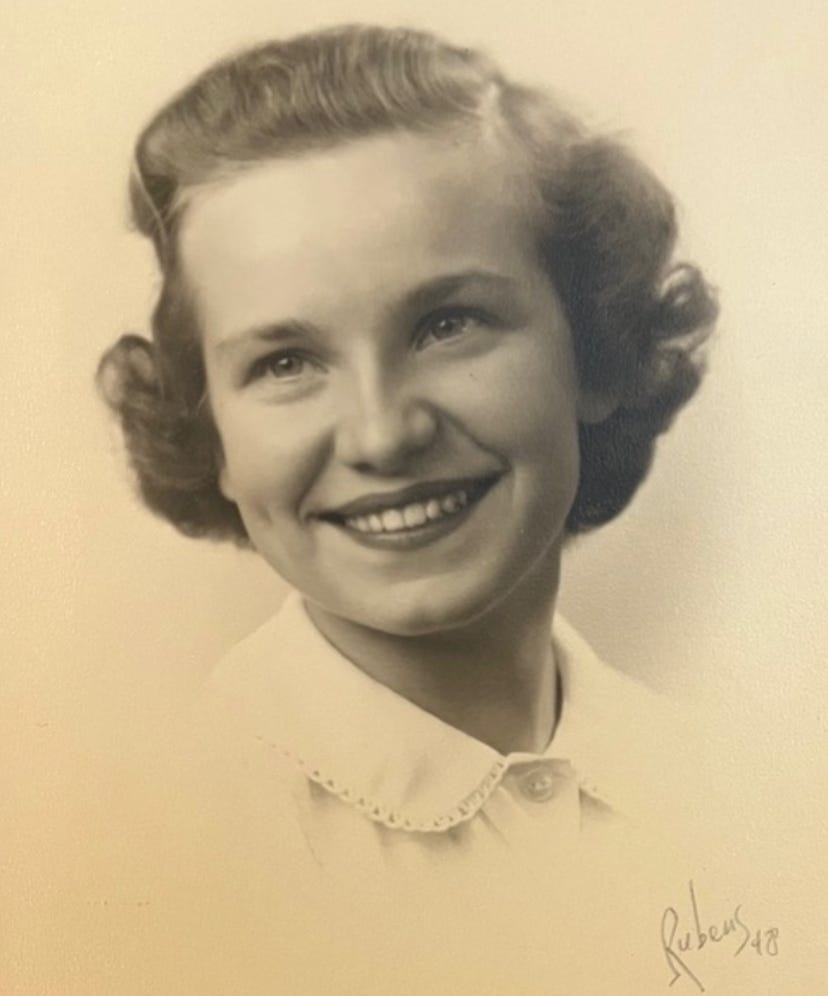
Author photo of her mother – 1948Author photo of her mother – circa 2017
It has been a difficult time. I have been writing …well, I WAS writing the next pieces about my childhood, working to move the book forward. But I got sidetracked by Mom.
The festering splinter
I had done a side piece about Mom..her death, her life…her, as part of the prologue. A matching bookend to the prologue entry about my father’s death. Yet every time I tried to edit it I ended up rewriting it instead. First from one angle, then another, struggling to capture that “something” inside me that needed to speak. That “something” that was driving me to write about her, and it was unrelenting. While I felt like I got closer to “it” with each round of writing, still, I was missing the essence.
Whatever it was I was trying to excavate, it was buried deep in my soul. The effort felt like when you have to plunge into your flesh with a needle to remove a deeply embedded festering splinter only to have it keep slipping out of your grasp and sink deeper. I felt like I was failing because that “Mom piece” was taking too long, and I needed to get back on track and return to that piece from my childhood. I was determined to stick to the outline.
This continued until late yesterday afternoon when, in a flash of insight…then despair, I realized I WASN’T off-track at all…and that there was actually something much bigger emerging in all of this. In fact, I suddenly understood that the “Mom” piece wasn’t the “sidetrack” but THE track. I kept getting pulled back to her…her death…her life because there were so many questions that needed answers. Questions like why did it matter so much to me that we took care of her to the end…why was I so proud of how she navigated her death process? Why did I care so much after she had abandoned me for a lifetime?
Aside from making order out of chaos by deciding which of life’s millions of details to include or leave out, there is the issue of how to order the book and tell the story. I am still working on that. But at least for the first draft stage, I have a rough outline to follow as I write.
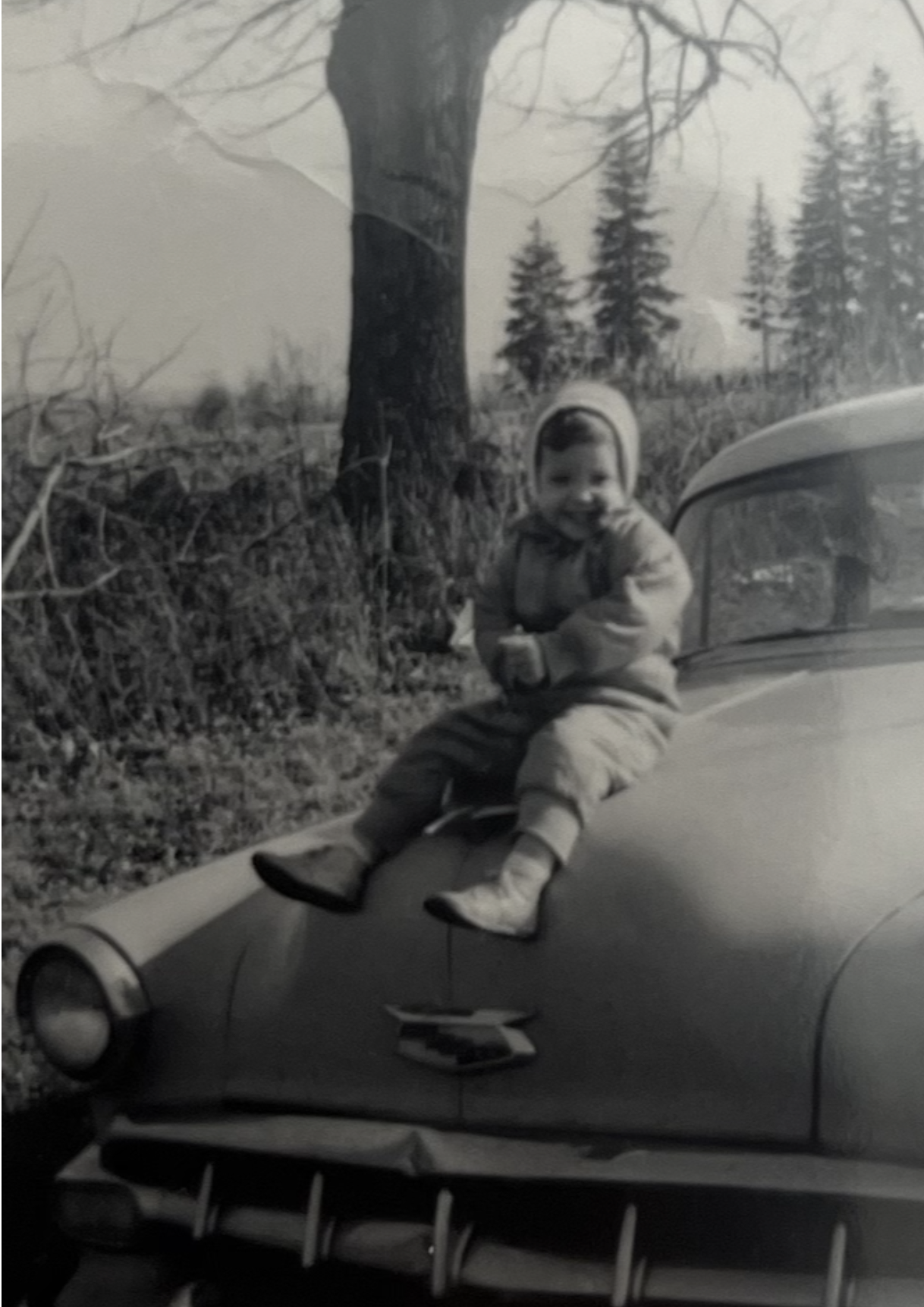
The “ancient history look” of 1950s black-and-white photos
It’s one of those typical 1950s black-and-white photos found in family albums — those of the era of the late Baby Boomers but before the 1960s when you could more easily obtain color film. It has that dated look and these days, it could simply be viewed as “back then, ancient history.” Only the car gives a clue as to the time period. The bottom line is that this picture comes across more as something found in a history book than a real moment out of a real life. So, while I’ll use some photos in this book, for a large part I am going to use paintings.
The details of a photo…
Why? First, check out the difference when viewing that same moment in full color:
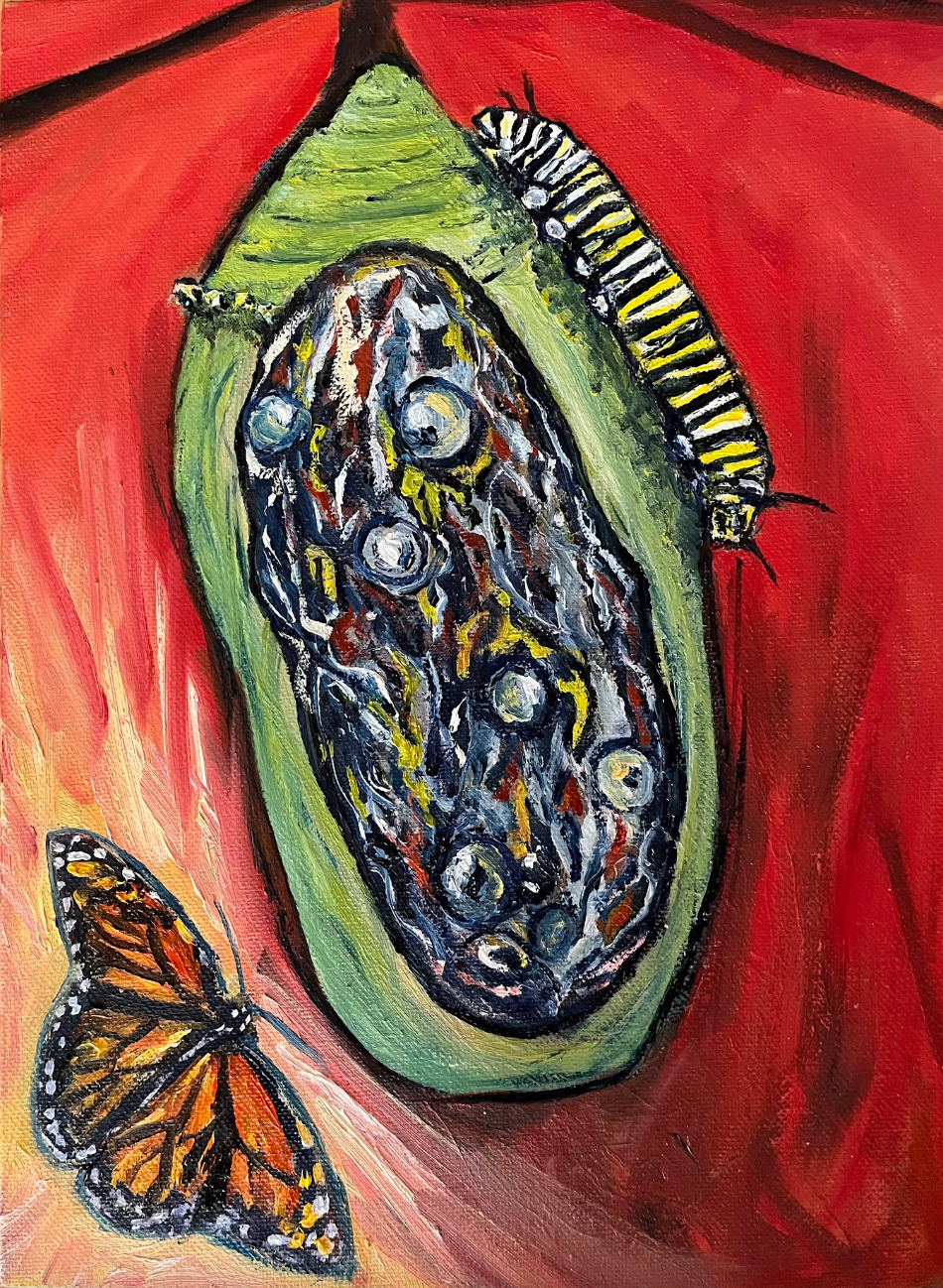
I recently wondered how a caterpillar — this slug-like crawling thing, emerges from a cocoon as a multi-colored, fragile-winged, flying beauty.
Being a retired science geek I of course hunted the answer down. While I sensed it was a sort of “magical” process, the specific details surprised me. Attached is a Scientific American article for those of you who would like to know the nitty-gritty process.
The short version is that all of the tissues of that caterpillar are literally digested and become mush! All its various structures are gone…with one exception: Imaginal discs.
Imaginal disc magic
When caterpillars are forming in their original eggs, they contain not only the structures needed to be a caterpillar but also an imaginal disc — an organized group of very specific cells — for each of the adult body parts they will have.
Once in the cocoon with the caterpillar reduced to mush, the imaginal discs take over and start reconstructing that soup into the adult butterfly. When the transformation is complete, the butterfly will emerge, mate, lay new eggs that will form new caterpillars carrying imaginal cells, and so on.
So…what do imaginal discs have to do with choosing not to write a memoir?
The very personal cocoon of transformation
Writing a memoir is a very personal decision and requires a careful assessment of risks to you and benefits to you. It is also a matter of personal timing in life as well as so many other factors. There is no right or wrong decision. It’s taken me seven decades to get to this point, even as I tried several times at different ages. It’s just that I was still mush in a cocoon and wasn’t ready.
Now, I choose to write. But after a lifetime of healing and transformation, I could have chosen the opposite instead. And I wouldn’t have been wrong. It’s not about the decision to write a memoir or not. It’s about growing, healing, and finding peace.
The Middle Path
The Buddhists say there is a Middle Path — not one or the other, but some road in between that fits you and lets you do what YOU need to do to heal. It doesn’t only have to be “write a memoir” or “don’t write.” Another way to heal could be to work with a therapist, paint, write only for yourself, or pursue some spiritual exercises that give you peace. The real point is to grow, heal, transform, and find peace.
“Spiritual” imaginal discs
To that end, I guess I relate to the caterpillar and butterfly story because I think we all have our own special “spiritual imaginal discs” — an inner part of us that came with us at birth and which holds the seeds of who we are meant to be in life. At the end of the day, it isn’t about a particular path to realizing our potential and our life mission. It is about finding out the mission itself. So find your own imaginal discs within you and follow your best path.
Take the time to consider things
Now, if you feel drawn to writing but aren’t sure , check out my previous two posts on “Is Writing a Memoir Worth it?” — the first on Risks of writing,
These two provide a number of points to consider before you decide. Maybe consider the lists, honestly answer the questions, and make your own decision. No one should ever tell you what to do, or that you are wrong.