Why show abuse and trauma in art? Why show it to another? Why SEE it?
The very direct version? For the world…and for me and anyone else who was abused.
Let me start with “for the world.”
For the world – the moments NOT in the family photo album
There is a raw reality that exists behind words like abused or molested. Those words are relatively “clean.” Cerebral. They tell another that “this” happened, but they do not convey the real horror of what “this” was.
They do not describe what I had to live through in each of those moments, for thousands of moments. They do not show the true images of what happened behind closed doors. Images that weren’t memorialized in the family photo albums. Those words don’t tell the “other side” of the story.
So, seeing those moments of horror in living color on a canvas gives that story a level of reality that words just can’t match.
My husband, who has watched me paint for every one of these pieces and saw the episodes of abuse emerge in paint, said as much. “I always knew about these things from what you told me, and I believed you. But seeing those moments makes them real in a whole different way. If he were standing here before me right now, I don’t know that I could actually restrain myself from going at him.”
The paintings show things that maybe society has never thought about in relation to “abuse,” things it doesn’t understand, or things it doesn’t want to look at.
And I want society to understand, because that is the only way this can change, and those harmed can be fully loved.
I want society to see what “childhood sexual abuse” really means. For me. For that young child that I was. For anyone out there who has been through it and isn’t understood by anyone around them. And to answer all of those who demand to know, “When are you going to get over this and leave it behind? Why can’t you just forget it already and move on?”
Intention
People may question the motives of artists and writers who are candid and open in sharing these experiences.
I will state totally emphatically that the intention for the art in this book is NOT to shock, traumatize, or titillate.
It is actually a heartfelt attempt to reach for that deepest human need – connection – by communicating what that reality was.
I’ve been reading a book by Jim Collins called What to Make of a Life. Over ten years, he and his team researched hundreds of people to see how they managed the challenges and moments of truth in life by harnessing what he calls “their encodings.” Those are people’s special innate talents held within and waiting for us to discover them. When used in the right moments and circumstances, those encodings propel us to fulfill our destinies and lead rich, satisfying lives.
He writes the book using the stories of matched pairs of individuals from all walks of life. For each particular life path, he showed how each member of the pair got started, found their way professionally and personally, then confronted a “cliff” — a moment of big change. Using their unique encodings, he showed how even very similar people can navigate transitions in very different ways.
It’s a great book and one I find very uplifting. It is heartening to read how even the likes of John Glenn, Carlos Santana, Admiral Grace Hopper, or Led Zeppelin’s Robert Plant can struggle, be enmeshed in a fog of “what next,” even choose poorly, then dig deep within to find their way.
I just finished reading the chapter about writers Toni Morrison and Barbara Tuchman. Morrison, winner of a Pulitzer Prize for fiction and the Nobel Prize in literature, wrote stories about the young black girls that did not seem to exist in any books she had read. So she wrote for herself, to create the stories she wanted to read. Barbara Tuchman was passionate about history and making non-fiction as rich a read as any good novel. Very different women, very different writing. But they were similar in one way.
Both were absolutely passionate about writing. They could not “NOT write. “As Morrison put it, “If all the publishers had disappeared in one night, I would have written anyway.”
And both used the word “compulsion” to describe what drove them to write. It wasn’t self-discipline enforced from outside themselves, but an inner compulsion to keep going for the sheer love and desire to see how their next sentence, paragraph, and story would turn out.
I resonated with these two women because that is exactly the word I would use to describe my attitude toward writing this book — compulsion. I MUST write it. I WANT to write it. I NEED to write it, to follow the story’s lead, to learn what wisdom it will reveal along the way. And I NEED to share it with whoever is supposed to find my story.
So I get up, write, research, and plan every day. And every day I channel a driven energy from somewhere within me. And that energy is always there.
This is a big topic, a KEY topic for me in my healing journey, bigger, even, than “why write.” In fact, without art, I would never have made the progress I have, and these posts would not exist.
So I am going to spend a couple of posts on art in healing, because there are several important parts to this.
In the fall of 2025, NPR’s Tonya Mosley interviewed Jane Fonda on her Fresh Air segment. In the course of their conversation about healing, the power of the arts came up:
“Jane, there’s a part of that speech, that SAG speech about the arts. And you say specifically that the arts have the power to create empathy, to understand a human so profoundly that you can touch another person’s soul.”
Tonya Mosley, NPR’s Fresh Air, September 2, 2025 – “‘We have to speak, we have to shout’: Jane Fonda is still an activist at 87.”
Touch another person’s soul…Oh my God, yes. I can honestly say that it is through the creations of various artists and actors — Madonna, Barbra Streisand, Meryl Streep, Viola Davis, and others — that I found comfort and wisdom, and received examples of powerful mothering and the “divine feminine” that I never received at home.
Of course, they don’t know this. But it was their masterful performances in their respective arts, delivered with all their hearts to the best of their abilities, that fed my soul when I needed it, and healed wounds like water on a drying, dying plant.
Madonna spoke in an interview of not being “the owner of her talent” but its master. It was given to her to allow it to move through and beyond her to those who need it. And she referred to her creative work in life as “medicine.”
Even scientists mirror these sentiments about the power of art to connect us all, and thus heal our lives:
“Here, around the fire, creative human expressions developed as an important layer of meaning-making and belonging… the activities we now call “the arts” began to take shape as an evolutionary priority to keep us alive. Art-making laid the basic foundation for culture and community among our earliest ancestors…these early gatherings helped to seed the social value of community. Researchers now know that participating in and fostering social connections in this way is akin to exercise for the brain: It improves cognitive function, lowers stress, and diminishes depression. …it allowed our species to build empathy and understanding with others.” Susan Magsamen and Ivy Ross, Your Brain on Art: How the Arts Transform Us (203)
I could go on with examples, but frankly, I will speak to it myself.
The next step I need to make sense of my life is to look for things that “repeat” — objects, metaphors, themes, events. It’s one of the reasons I mind map and journal so much.
When I spread out items on a large sheet of paper and stand back, that’s when I start to notice that certain elements come up again and again. And I spot connections between them.
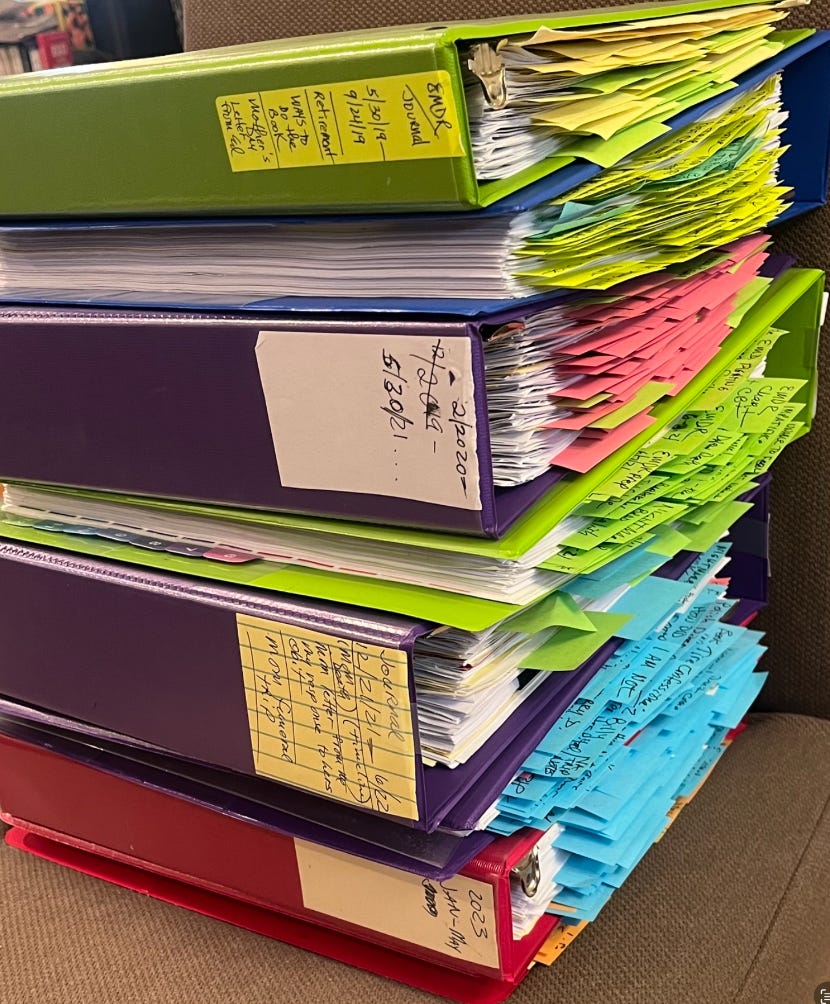
With regards to my journals, I write in Word docs so I can read my writing better. I keep them in binders by date, and for each entry, I put a sticky note at the top of the page that has a few key words as to the topic.
The other plus to storing my notes in Word is that I can then do a global search of the words on that list to see how many documents they show up in. That lets me see if there are changes in that issue over time, whether it’s progress, a relapse, or some new way they come out in my life.
Photo by author
Periodically, I will flip through my journals, scanning those sticky notes with the topics, and, without fail, I’ll start to see repeating topics and phrases. Then I’ll also go through any folders of scribbled notes I haven’t journaled about yet.
From all of these, I’ll just make a word list of the repeating topics I’ve observed. Those are the precious clues to a truth I haven’t yet figured out. They are pointers to places I need to dig deeper and think about more. The fact that they come up again and again tells me they are “unfinished.”
“Life presents you with a text, but it is your meditation upon that text which gives it meaning and relevance.” 2 Tishrei – Meaningful Meditation – 350 Healing Light Meditations book
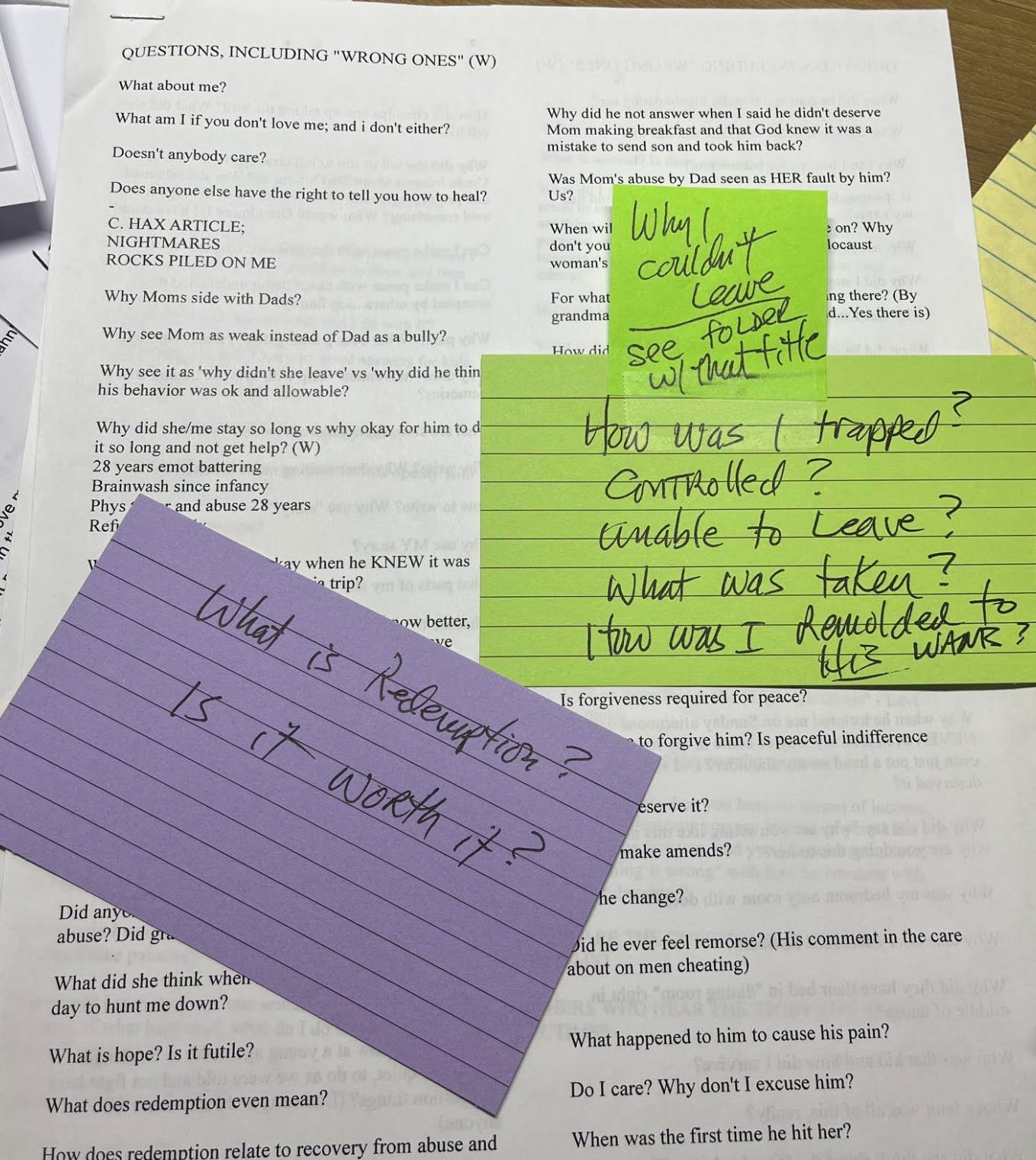
The previous post was all about asking questions. Especially the ones that will help me understand, learn, and heal. If I am going to pose questions, there is a rule that has to go with that effort: Honest self-reflection.
Reflections in regular life
Now, before I get into self-reflection as it relates to abuse, let me speak of how I use it in the ordinary places of life. These are the places I look back to see what happened and what insights I can glean.
Reviewing past interactions, I ask myself things like: What was my part in things? What choices have I made in that situation, or repeatedly over the years? Even if my intentions were good, did my actions result in harm? What could I do differently or better the next time?
And as I look over the choices I’ve made or the decisions I tended to repeat even if they weren’t healthy, I look for: Emotions I never felt or allowed before Behavior patterns through life My stress style when triggered My thinking style and attitudes How all of these have affected me…and others
I look hard now into my soul and try to observe everything now. Because there were so many small details about me that I refused to look at or accept. And when you deny a part of yourself, you deny that ultimate place of healing: INTEGRATION – the reuniting of all the broken pieces you lost along the way. How can you be whole if you wall off part of yourself? That is the ultimate self-hating act, and I’ve been guilty of it.
Now, this is not about self-flagellation or declaring me a horrible person. It’s also not about denial or refusing to look myself in the eye in the mirror when asking myself some direct questions. None of us is perfect in life, even when we set out to do the right thing.
“The scientist is not a person who gives the right answers; he’s one who asks the right questions.” Claude Levi-Strauss
Photo by author
Questions, questions, questions….
When people hear of my background, the first and most common questions they ask are: How did I survive it? Why did I stay so long? How did I finally get out?
For that matter, those are three of the big questions I’ve asked myself for years. And that second one in particular, I’ve used as a weapon.
I’ve bludgeoned myself with it, adding in judgment statements to go along with it like: How could I have been so stupid to believe that all his brainwashing was the truth? Or that our house was a loving, generally good one? Or, worst of all, “How could I have been so passive as to stay so long?”
These would then be garnished with another round of “How could I have been so stupid?” So, I doused myself in shame.
I know now that all of that bludgeoning was undeserved self-hate. But it took quite a while to realize that, and to start asking questions that took a hard look at all those years and the facts of how abusive households work.
Questions are key to healing. But it is not just about asking any old questions…but the RIGHT ones. And I’ve learned that the questions are even more important than the actual answers. They are the engines that push you to slog through the mud and fog to find understanding. The questions are the “meat of the work,” what you chew on to digest and get to the nutrition of answers. Before you extract insight, you have to wrestle.
Occasionally, there have been times I already knew the answer but had been either running from it or had just been blind to it. But then, pinned down by a finely focused question that wouldn’t let me off the hook, or one that swiped away the fog, I would finally come face to face with a truth I could no longer avoid.
For all of my life, aside from the above three questions, there has been one other unrelenting one. And no, it’s not: “Why me?” Frankly, that one has never haunted me. The real question dogging me all my life has been:
One of the answers to “How did I survive?” was: Moment-to-moment. One second, by one minute, by one hour, by one day. Some days, it was all I could do to just make it to bedtime and have a break from the violence. Never, never, never did I look too far down the road. THAT would have crushed me.
The other crucial item I used during those trauma times was a mental force field that I call “Moments of Respite.” Moments of Respite were for the many times when my world was being torn apart. They were the pain-relieving medicine that made enduring his torment possible. And they let me shield my nervous system by giving it a momentary distraction.
Moments of Respite were ALWAYS found in the details, whether sensory or physical. Details give the world its special beauty, and beauty is the perfect antidote to horror. Details are life’s adornments that bring order, calm, awe, mystery, and tranquility.
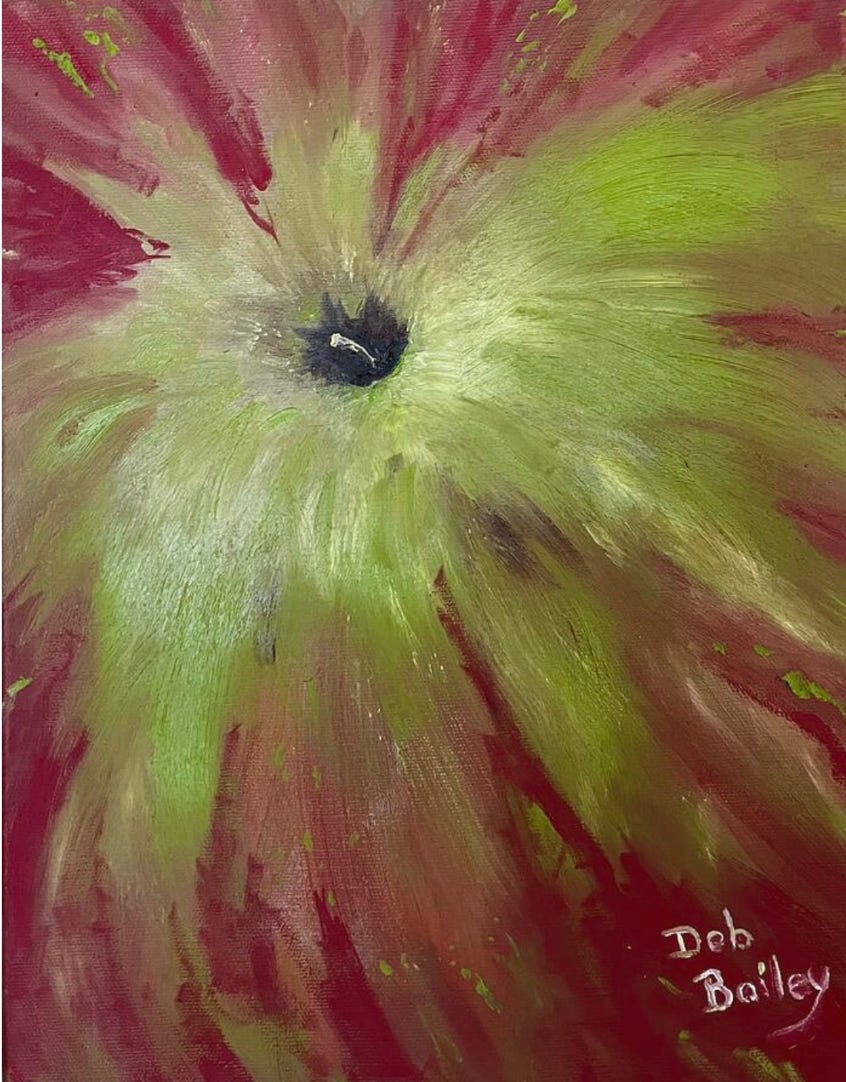
If you question whether overlooked tiny things have such power, consider this. You can draw a circle with a line sticking out of it and call it an apple with a stem. Or you can underpaint the circle with burnt umber, then add successive layers of cadmium red, cinnabar green, some titanium white, and Naples yellow. Suddenly, the depth, intensity, and richness explode on the page, and that image of the apple is like holding an entire world in the palm of your hand. I’ll expand on the apple example at the bottom of this post.
Painting by author
Suffice it to say that in the depths of my abandonment, all of those tiny aspects of life would call out to me. They were like friends racing up in a getaway car and yelling for me to jump in. They taught me to look for the beauty in the smallest of things and to see it no matter how bad the bigger picture was.
Even when I could count on no one or nothing else, the details in those Moments of Respite offered that intricate deeper dimension, right at my fingertips, always available…unlike the people in my life.
Moments of respite were my reminder that, even in the midst of chaos and horror, life possessed infinite little worlds of richness and beauty. They were my steadfast companions, offering sensory retreats — a “breath in between moments” — where my overwrought, throbbing, nervous system could escape and rest. If I focused on them, I could tune him out, even momentarily. And by doing that, I could withstand the next moment’s onslaught.
So, always, Moments of Respite, dosed moment-to-moment. And NEVER think further ahead than that.
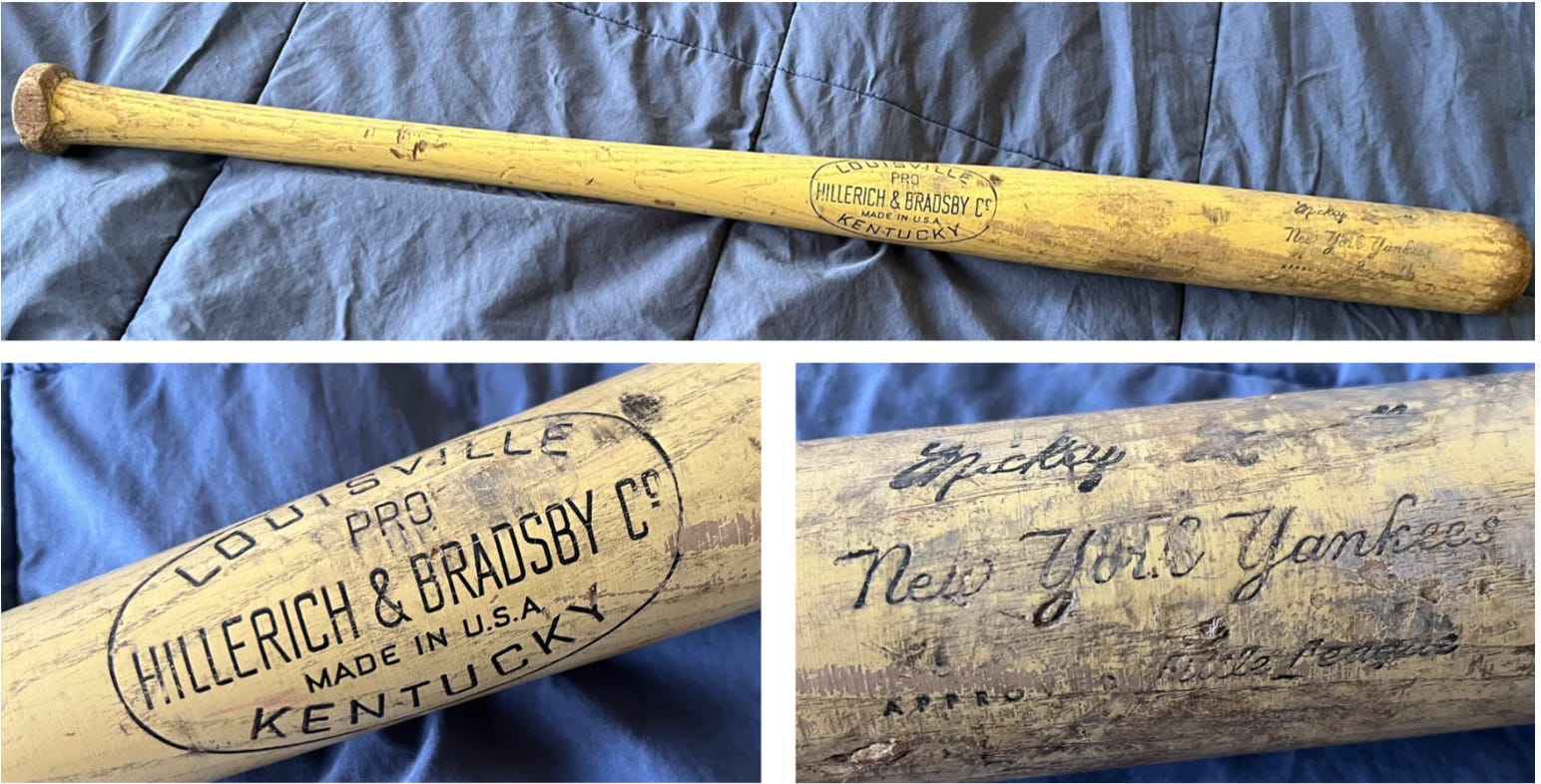
It was a FULL-SIZED, Louisville Hillerich & Bradsby, Little League-approved baseball bat…1965…brand new…and BEST of all – inscribed with Mickey Mantle’s name at the end. Anyone who followed New York baseball in 1965 knew that Mickey Mantle was the ultimate batter. So, of course, that bat was my absolute pride and joy.
I suspect I was a rarity, as I was probably one of the rare girls at Yankee Stadium that day. It was the very first “Bat Day!” and anyone who had a child and a ticket to the game got a free, official Little League bat. Since all I remember seeing around us were boys and their dads, AND given it was 1965, the idea of a GIRL coming to bat day would have been unusual.
My two friends (both boys) from our neighborhood were going to this event with their dads, friends of our family. They must have invited my dad to join them, and since he only had daughters, and since, in a lot of ways, as the oldest, I was the replacement son, I got to go.
I remember bits of it. An exciting drive to New York City. Walking in and being handed THAT bat. Clutching it to my chest as we pushed our way through packed stairwells to get to our seats, and gripping it tightly the whole day. Stopping at a hot-dog stand for dinner on the ride home.
The entire day was heaven, with even my dad being in a good mood. And…that bat. I was going to treasure it forever. But sometimes forever isn’t very long.
This tool does not require a lot of words. Yet do not consider the brevity of this post an indication that it is not that important. Other than attitude, it is the most important one of all. To show no awareness of what it means is to throw away a most precious gift:
Time.
I’ve read a number of books by a YouTube podcaster, Ryan Holiday. He writes and speaks about a 2000-year-old philosophy called Stoicism. And that ancient philosophy couldn’t be more relevant for extracting meaning in every moment, today.
People often hear the word “stoic” and mistake it for taking on the world with no emotions and a hard, outer shell. It is the opposite. In some ways, it mirrors many teachings of Buddhism, Taoism, and many other ancient paths to wisdom. It is about living as fully as possible in the present moment; about knowing what is in your power to do or control and doing it without procrastination. And it is also about knowing what you can’t control, and letting that go.
But most of all, its most valuable message can be summed up in two Latin words, two words that say it all:
So. About tools. There are several I am going to share. And I need to start with maybe the most important one, at least for me. If I had this one, I could hang in long enough to use all the other tools that would come.
Attitude
“The girl in the navy sweatshirt…softly asked, ‘How did you not give up?’” “By realizing that giving up would mean giving in to the narrative that was written for me by my circumstances, by other people’s choices and mistakes.” Daria Burke, Of My Own Making
If I were forced to pick just one quality in me that helped save me in that house, and continues to fuel my healing now, I think I would choose “Attitude.”
The true and full answer for how I survived is a whole lot more complex. In reality, it was a swirling mix of so many individual happenings over my life that came together in just the right way, at just the right moment. And without that, I wouldn’t be here. I consider it just as miraculous as how the dense, hot, swirling chaos of dust and rock from the Big Bang gave us a nurturing, life-sustaining Earth. A long shot.
But that one quality, “attitude,” is the closest word I can think of, because in the end, that is what often gets someone through — how they view something, what drives them, what gives them a lifeline to hang on to.
The word salad of survival
For sure, my attitude is built from so many more words, each one contributing to my long-shot survival and eventual thriving.
There were people – from my husband, therapists, my wonderful high school teacher, family friends, and even strangers who, in a momentary crossing of paths, gave me the sustenance I needed to keep going.
There was God, even during the times I hated Him or Her. All during those daily Masses, that young me was deeply listening to the Gospel stories of how God takes care of everyone, even the lilies of the field and birds of the sky. I absorbed those words and held on for dear life.
There was even just plain blind ignorance. And I don’t mean that as a put-down. It’s just the reality of childhood.
When you’re a kid, you don’t know what you don’t know. You have no clue that your life isn’t the norm. You assume what you are living in is how everyone lives — some nice things, some not so nice things that you just have to survive. So you don’t even think to question it. Daria Burke said as much in her book about her own life:
“…we are hardwired to seek out and trust the familiar, even when the familiar isn’t safe or good for us…When you grow up surrounded by poverty, abuse, and violence…it’s not uncommon to accept your circumstances as commonplace, even expected…stressful forces that become so ordinary, they fail to register as traumatic events.”
In one way, then, blind ignorance was a blessing, at least at the time for me. By not knowing the reality of how abusive it was, I could retain an attitude that anything was possible if you worked hard enough and waited long enough, even in the midst of chaos.
I had hope and optimism that one magical day, I would be an adult and things would all “just work out.”
Hope and tenacity – your name is “resilience”
Actor Jane Fonda, in a Fresh Air interview, spoke of her life, her own sorrows at losing her mother to suicide at a young age. Of her wound of growing up without that love. And of the deep sorrow of learning years later that her mother’s suicide was rooted in being sexually abused and raised in an abusive household.
When asked why she kept striving in life despite her personal pain, Fonda talked about resilience, which to me incorporates the attitudes of hope and tenacity:
“Resilience is such an interesting thing…I think people are born with it…resilience is when a young child who is not getting love at home, kind of — there’s a radar that’s scanning the horizon. If there’s a warm body that maybe could love her or teach her something, you go there. You find love where you can. You find support where you can. That’s a resilient child. That was me.”
And that was me, too. I might not have always chosen wisely, but I really tried to find and take in love as best as I could in any moment.
One of my therapists along the way pointed out how amazing it was that, despite what I lived through, I stayed open to the hope of love. And that I did take it in whenever I could find it, from whoever offered it along the way. Yes, I made mistakes, but still, I kept the hope of love.
Now, for sure, I was hugely naive as to both my reality at home and what that life would cost me. And of course, that way of thinking would eventually implode when I realized the truth. But maybe it was best, then, that I could assume my life was “normal,” even if it was the opposite.
The other thing that ignorance gave me in childhood was what Viktor Frankl talked about in his book, Man’s Search for Meaning. He spoke of people surviving concentration camps because they found a “why” to keep going.
My “why” might have been totally wrong, warped by my father’s brainwashing, but still, I thought I had a why to go on. He drilled in that I was helping him and keeping the family together. And he kept demanding I not grow up to “be a stupid woman.”
So when you are told those things a million times from early childhood on, in your young mind, you think you have both a reason for your existence that gives you worth, and a goal for your future. And so you have hope. Of all the qualities I possessed that made up my attitude, I would say hope was the largest element. I will write more later about “hope” through life.
Of course, there’s the reality that those rules slowly poison you and prevent you from becoming your own person. And there is also devastation that comes when you get older and feel that you were played for a fool, so you hate yourself.
The mixed bag that was me
Aside from all of the above things, there was that mix of who I was at my core. I was a dreamer. So in any given moment, I was Nancy Drew, Ivanhoe, Robin Hood, a World War II Australian coastwatcher spying for the Allies in the South Pacific, and so many other personas all wrapped up in one. From those stories and biographies, I learned that true heroes were brave, unrelenting, and determined to stand up for what was right, no matter the risk.
I loved to learn and was creative enough to use that for Moments of Respite to feed my soul, especially during the bad times. I trusted the people I loved, was loyal to a fault, and had a good heart. And I was a highly competitive kid who never wanted to let anyone, especially the boys, beat me out at anything. If a boy could do it, so could I…and better!
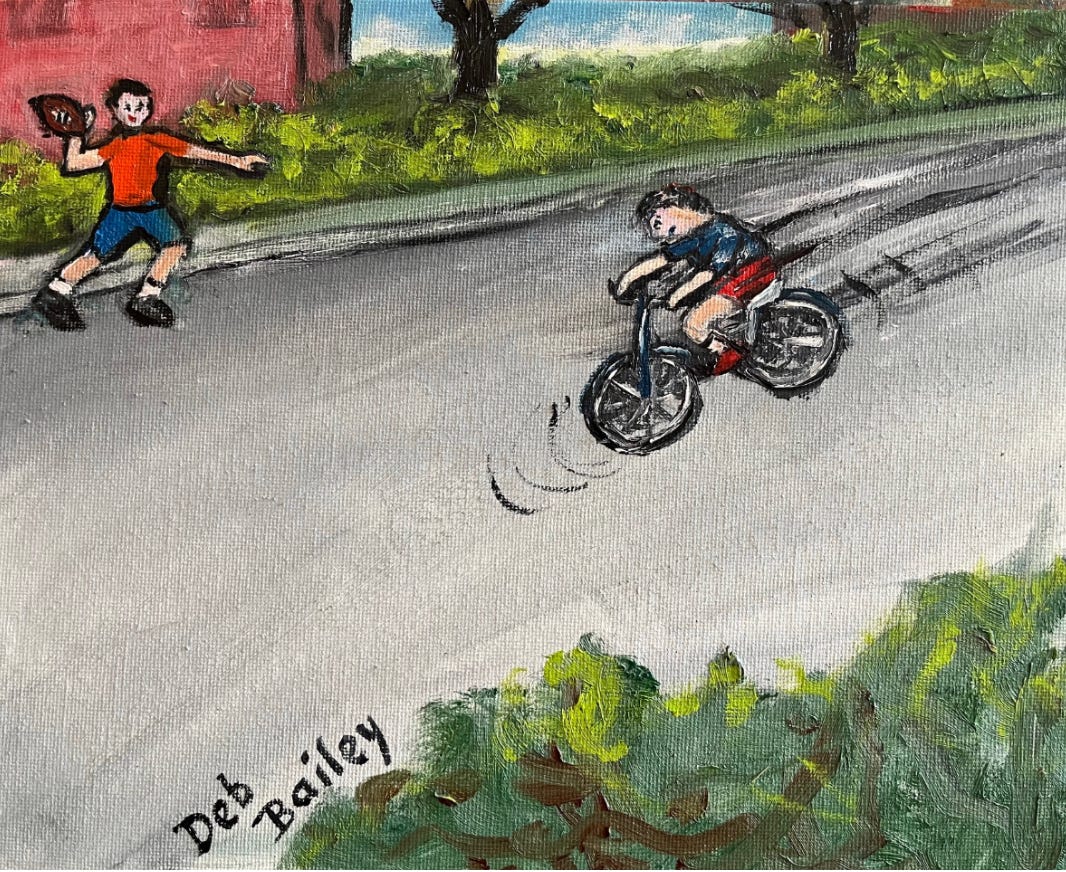
That might have been foolish at times, like when I dared to out-race my neighborhood friend on my bike while he tried to nail the football in front of my bike tire. I was just a split-second too slow, flipped up in the air, and tore up my shoulder as I skidded across the pavement while just missing the curb with my head. This was, of course, the era before bike helmets. Yes, foolish. But NO ONE could say I didn’t try.
Painting by author
Also, there were the influences and examples of the old Slovaks in my life. They lived through poverty, loss, war, and the Depression. Their rules were to work hard, get an education, stick by family, tough your way through anything life throws at you, and don’t whine, be weak, or give up.
So I was the mixed bag of tough, loving, loyal, determined, stubborn, gentle, trusting…and hopeful. I thought I was living in a house that, while not perfect, was truly loving, and would someday, somehow, be better. I had hope. I will write more about the nature of this quality in my life later.
When I escaped that house, I did finally realize the extent of all the lies I had been living with. And that destabilized me for some time. But once I started to pick myself up, I was angry. And anger fueled a level of rebellious determination that, for a while, bordered on spiteful. I was going to survive and come back and fully reclaim my life, fast, just to spite him.
While that works for the short-term to get one started from despair, eventually, I would come to realize it wasn’t going to be fast, or ever completely healed. And I would eventually release the spite and instead, tap into self-determination — reclaiming what I deserved for my own good, for the love of my family, and for the goal of breaking that intergenerational cycle of abuse handed down by my family of origin.
So, now? Throw the damned football
So now, decades later, who am I?
No matter what, I am still that dreamer. That person who uses Moments of Respite to feed me. I still hold all those values I read about or saw in others.
I am also that determined, feisty person who refuses to give up or be held back by anyone. Tell me I can’t do something, and I will do my best to prove you wrong. I may be more judicious in picking my battles now, but still, I yield my power to no one.
So, somehow, despite all my father’s bludgeoning, I managed to keep that spark alive. I got just enough nurturance along the way that he could never completely snuff out my spirit.
For sure, I almost didn’t make it…several times. For sure, I have almost given up many times. And so often, I have crashed in despair.
Even now as I write these entries, I feel weary, sad, and angry. But somehow, I still have inside me that kid on the bike daring life to throw the football.
She has an attitude that screams – “I WILL take back as much of my life as I can…and I REFUSE to let him rob me of my future! He took my past. He will NOT get my future!”
Child-like
I have learned that it’s good to keep my “young inner child” alive and close by. I don’t mean to be childish, but “child-like.” That is the part that always had hope. And while no longer naive, I am still “hopeful.” I BELIEVE I can make my life a gift to me and to others.
And again, I can follow the example in Fonda, who is older than me, but who also refuses to give up on healing her life:
“…you’re never too old. You know, I’ve gone back into therapy now at 87 because I want to figure out why I’m not a better person and why I wasn’t a better parent. And I’m figuring it out…At 60, I thought a lot about, ‘OK, this is my last act.’ This is it…My last 30 years…What do I wanna get out of it? I wanna end with no regrets, or at least as few regrets as possible.”
No regrets. So, my first tool for sustaining in this work: Attitude.
And maybe the biggest ingredient in attitude for me is hope.
Note:
I am seeking financial support to complete my memoir, work with an editor, and return home for fact-checking. Your help would mean the world to me as I take this step toward healing and giving voice to my journey.
Please like, comment, and share this post to help spread the word. The link for my fundraiser is on GoFundMe. Thank you for your support.