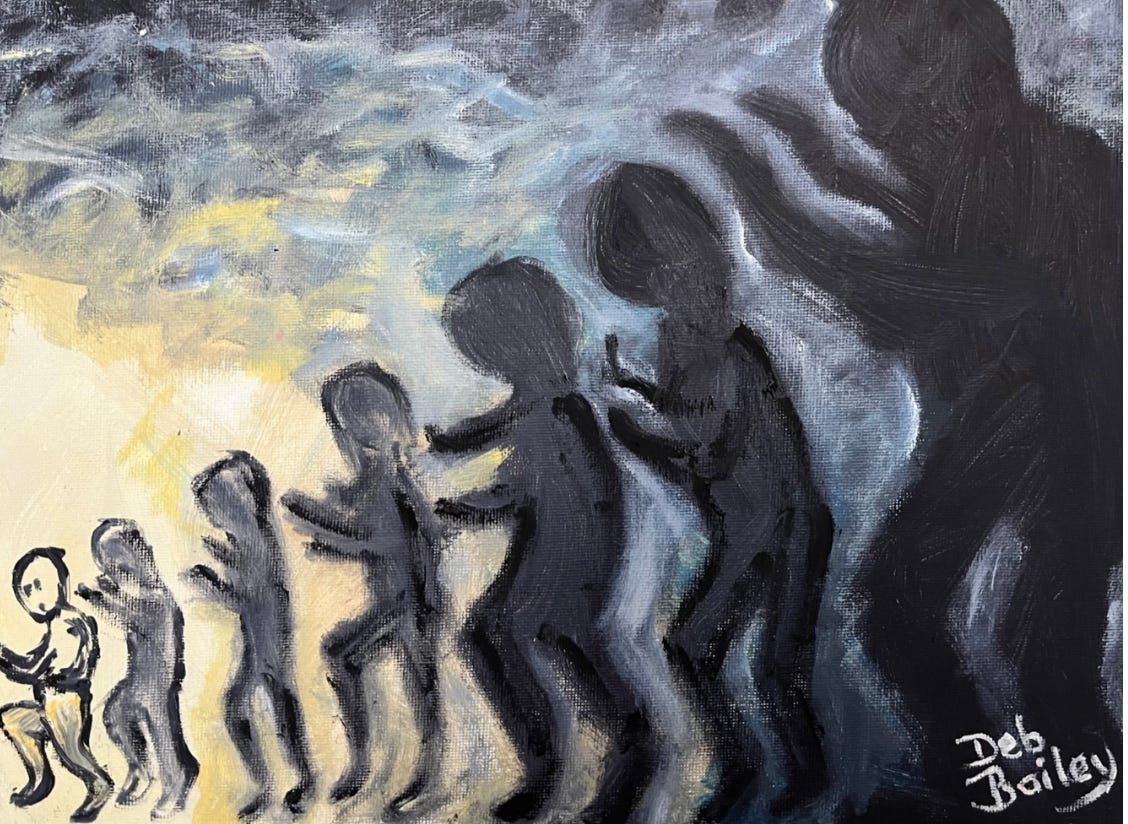
Dreams are a weird mix of things from the past and present, wrapped up as metaphors that are weapons against ugliness and that give truth…then…healing…if you can endure them.
The nocturnal performances
One thing I have learned is that many of my dreams are about my psyche trying to process something I either can’t remember or can’t handle consciously. I have learned that very early abuse experiences are often not remembered as a “movie narrative” but as uncomfortable body feelings and flashes of an image or metaphor.
I think there are those dreams that are not coincidental. I’ve had a lifetime of those. Instead, they put on a nocturnal drama that’s a riff on something from my life. The plots and characters are formed around unresolved issues, trapped emotions, and terrors from things done but not consciously remembered. And some of those “performances” have been stuck on replay for literally years, either trying to tell me something, release something…or process it.
There are many familiar ones that have been regular occurrences going back decades — to at least to my twenties. Maybe earlier. I can’t remember when they started, but do I remember what’s in them? Oh, my, yes. My journals are filled with their details. And many circle the same disturbing themes.
Most of the time when I’m having nightmares, I don’t think I wake my husband. But he has told me that there are nights he hears me tossing and turning, or muttering in my sleep. And occasionally I have yelled out. So, it is a fair thing to say that, for me, sleep is often not a respite from my traumas. Just a different theater for their performances.
As I return to writing about the deep work I was going through as I struggled to understand my past, it’s easy to question if anything is getting any better. If I had any doubt of progress, though, a recent incident in a doctor’s office showed that I am growing in self-caring and empowerment.
That most “inappropriate” appointment
The medications I take can have an adverse effect on my metabolism. That can work against me for healthy blood sugar levels and weight management. I have been following a diet and exercise regimen that is helping, but I wanted to see a specialist in this area to see if he felt my progress was on track.
At the office, we waited a long time, but eventually, we were called in and taken to a small examination room, where the nurse took my vitals and the usual other things they do before the doctor arrives. She was pleasant, finished up her work, and said that the doctor would be with us shortly. We waited a fair bit longer, but finally, there was a knock on the door, and the doctor strode in. He was followed by a young woman.
Right from the start, the energy seemed off. He quickly introduced himself and started to brush past me. Trying to observe the usual “niceties” when meeting a new caregiver, I reached out my hand to shake his, and introduced myself. He seemed distracted, almost put off by this. I handed him the clipboard of forms his nurse asked me to fill out, but he tossed it on the counter without even so much as a glance.
He started to begin the appointment, then caught himself. Waving his hand at the woman with him, he rattled off her name and said she was an “observer,” but gave no explanation as to why she was there. He just asked if it was okay with me.
I found it odd. In seventy years of doctor appointments, and over thirty-five of those as a medical professional, I’d never had a doctor behave like he was.
For one thing, I knew it was customary for him to provide some amount of explanation for the person, such as she’s a medical student, or a college student, or whatever. But he gave nothing. I didn’t care, but was put off by his attitude, which seemed to imply my consent would of course be given, and he was doing me a favor asking.
He stared at me, then at my husband who was with me, and with a surly attitude, asked, “Who’s this guy? And is it okay for him to be here?” It was not a polite or professional request, but almost an irritated one.
I was irritated at how he referred to my husband, and was a bit confounded by his attitude. But tried to give him the benefit of the doubt. I introduced my husband and noted that, of course, it was fine and I wanted him there. At this point, I felt somewhat on the defensive, but assumed I was reading it all wrong.
For me, if I need to get up to speed on anything, my first stop is books. I am a book person. It’s how I learn best. I even taught myself to downhill ski using a book. Successfully even. I had no money for lessons, and it was a book that saved me (and anyone around me) on the steep ski slopes. Give me a book, and I can learn almost anything…except calculus. That one is a lost cause.
My writing process has been no different. I have two bookshelves full of tomes just on how to write essays and memoirs. More shelves OF memoirs. And none of those include the MANY shelves on character, plot, pacing, premise, mythology, hero journeys, and the power of story. Yes, just a few.
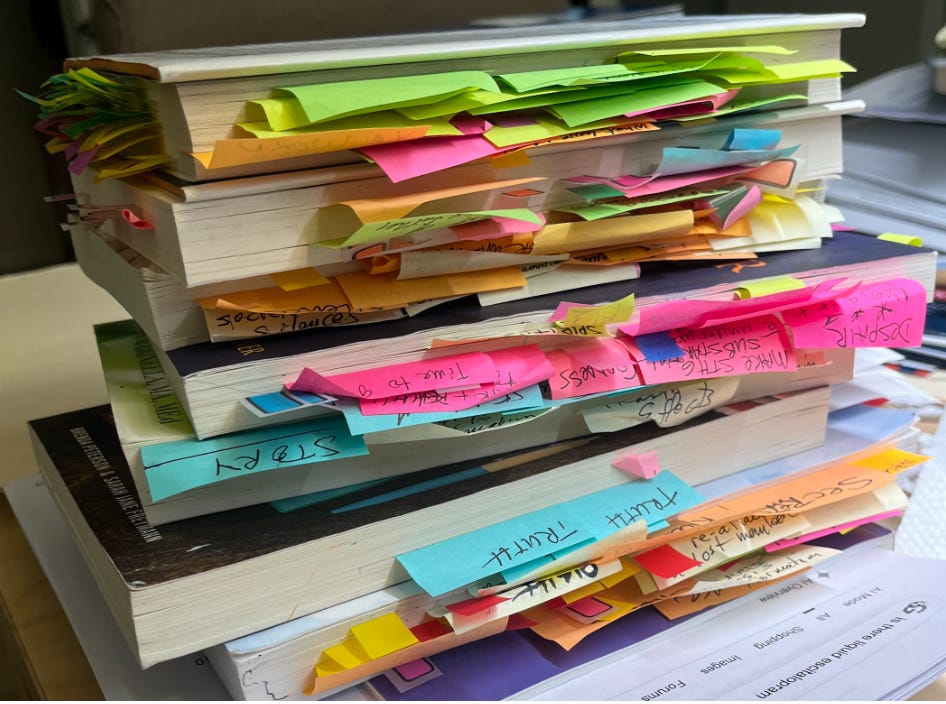
But there are a select few that have been truly amazing…my constant companions on this journey, for various reasons. Because of them, I risked believing I could write this story, and found my way to delve into it. So I will share those here in case anyone else would find them a good resource.
Photo by author
My top “ten or so” books that are always by my side
For starters, there were four books that not only got me started, but I loved because they offered writing prompts and questions to reflect on at the ends of their chapters:
Your Life is a Book: How to Craft & Publish Your Memoir, by Brenda Peterson & Sarah Jane Freymann. Aside from the reflective questions posed, the book was a wealth of information on how to approach this intimidating process. It also included chapters on the various types of memoirs as well as the challenges to navigate for publishing.
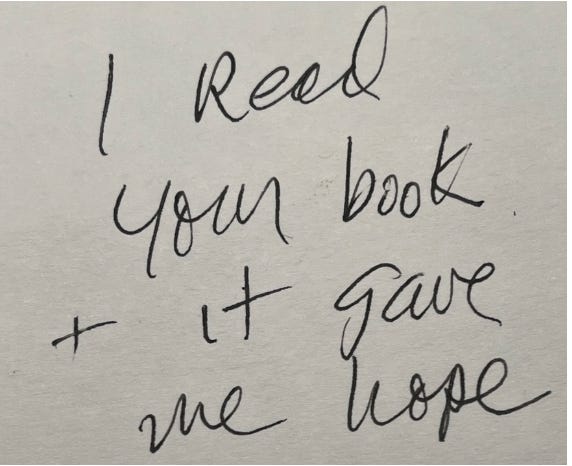
This book also gave me the biggest first gift when I began this process, and I even jotted a note down at the time and stuck it in the book:
Photo by author
HOPE…This book truly made me hopeful that I could do this somehow.
The other three books, with both great information and writing prompts, were:
The Story You Need to Tell: Writing to Heal From Trauma, Illness, or Loss, by Sandra Marinella, MA, MEd.
Writing Ourselves Whole: Using the Power of Your Own Creativity to Recover and Heal From Sexual Trauma, by Jen Cross
A Midwinter God: Encountering the Divine in Seasons of Darkness, by Christine Valters Paintner. This one could also fit into the next category – food for the soul.
These two, along with the above, Midwinter God, fed my soul because they spoke to my love of mythical approaches and my soul’s spiritual journey at this stage of life:
The Heroine’s Journey: Woman’s Quest for Wholeness, 30th Anniversary Edition, by Maureen Murdock
Deep Memoir: An Archetypal Approach to Deepen Your Story and Broaden Its Appeal, by Jennifer Leigh Selig, PhD
There were two that I related to on a very personal level because the experiences of both authors mirrored many things in my life:
The first is a repeat mention – Jen Cross’ Writing Ourselves Whole. Like Midwinter God, this book wins in two categories also.
Of My Own Making, A Memoir, by Daria Burke – Just an incredibly well-written book with not only great factual information, but such a heartfelt telling of what she lived through.
And for helping me find my way in how to deal with truth in memoir writing:
Dear Writer: Pep Talks & Practical Advice for the Creative Life, by Maggie Smith
On Writing: A Memoir of the Craft, by Stephen King
A “primed” mind doesn’t stop
Once I turn on the “spigot of my mind,” it can be impossible to stop its flow. Not a bad thing, just overwhelming at times. Primed by all the books and questions and writing prompts, my brain just kept on going long after I finished reading something. Idea after idea after idea would just come pouring out, and each idea would trigger two or three or more related ones.
This happens to me especially first thing in the morning when I’m in the shower. I’m sleepy, not focused on any particular thing other than how good the warm water feels, and that’s like the trigger for my subconscious to start speaking. My subconscious, unlike me, is a “morning person.”
I could ignore everything, but I have found that my best ideas come up then. So I can’t afford to lose them. AND at this stage of life, I CANNOT and have learned that I SHOULD NOT trust my memory.
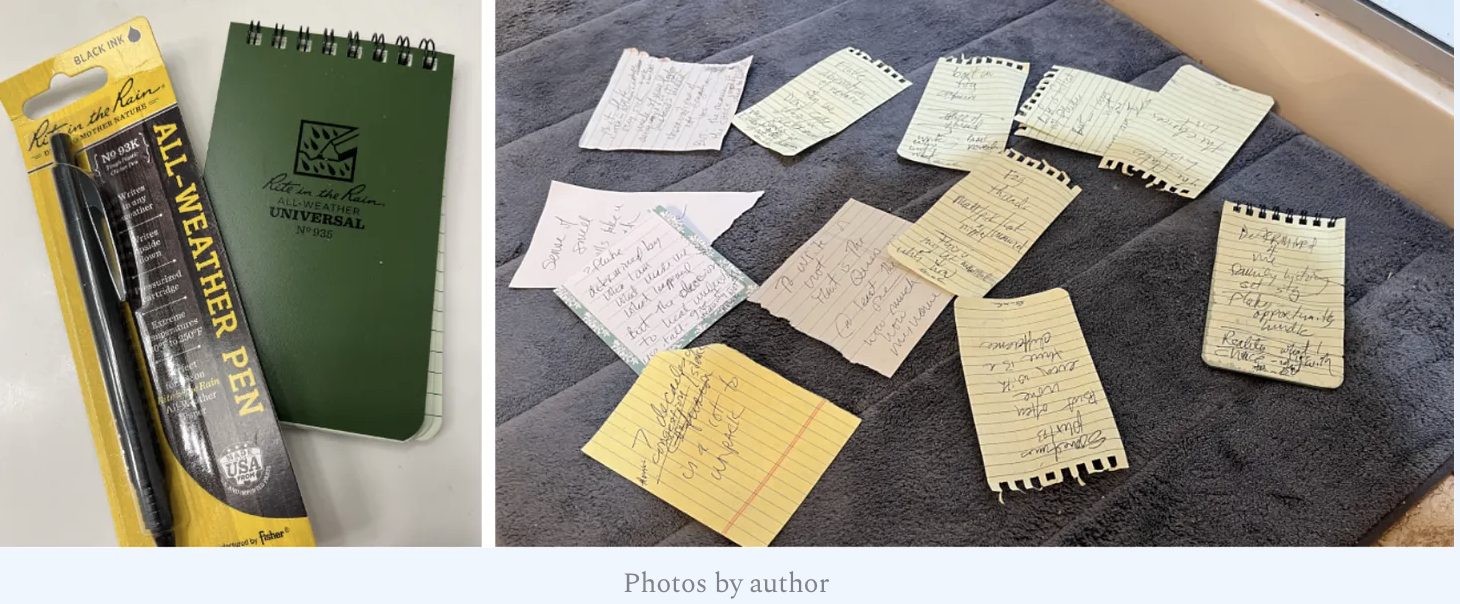
So write them down, right? Absolutely. But in the shower? Well, that’s where my nature museum teaching experience came in handy – use waterproof field notepads and the waterproof pen.
Every time something pops up in my head, I write it down, rip it out of the pad, and toss it out on the bathroom floor next to the shower. When I’m done, I collect them all and start my writing day with them. My husband, noting a particularly fruitful day with many notes on the floor, asked if this is considered a “congestion of thoughts?”
I liked that – a congestion of thoughts. Because when my head is flooding with ideas to remember, it literally does feel congested. And seven decades of silence have yielded MANY days of “thought congestion.”
But no matter. The important thing is to simply not lose them. Later I can write them all down on a large sheet of paper and make a mind map. Then I can start to see how all the stray thoughts connect to many others.
Don’t get blocked seeking perfection
Once I have a topic, or a plan for a series of topics, then it’s just a matter of getting on the keyboard. I try not to let my brain trip me up with things like “Well, which idea should I write about first?” That’s a prescription for paralysis. I have found that the best thing I can do for me is just “pick one.” Pick something, any one of them. And just start. I can always rearrange them later. But don’t get blocked in writing trying to pick the perfect topic first.
Just a few last reminders for me
I have just a few short notes I jotted down for me one day that help me not to worry about perfection. I’ll share those for anyone who would like them:
Style is the servant of content and soul. It will vary to suit the telling.
Write staccato…in bullet points if necessary, but just throw it up on the page, get it out quick and unvarnished, like ripping off a bandaid. Let the soul lead the way.
LOCK UP THE LEFT BRAIN until later drafts.
The memories and thoughts that should be here will present themselves. If it’s important, the right things will show up.
What appears in the process is meant to be there, even if it gets cut later. Often it’s not what I planned, but just write what shows up and leave the rest to a Higher Power…and a later editor.
And last and most importantly:
Humble myself in the telling. Be willing to look the fool for love of other victims. Show the shame. The ineptness. The ignorance and mistakes as I struggled to learn and catch up with life.
Up next
This is all I have to say at this point about the tools I’ve needed to navigate my soul searching, writing, and healing processes. If I think of anything else important, it will come at the end of the book.
Now, back to “The Nigredo” – Part II, the rest of my “Dark Night of the Soul,” and nightmares, rage, and the journey through EMDR.
Note:
I am seeking financial support to complete my memoir, work with an editor, and make a visit to my home state for fact-checking. Your help would mean the world to me as I take this step toward healing and giving voice to my journey.
Please like, comment, and share this post to help spread the word. The link for my fundraiser is on GoFundMe. Thank you for your support.
So, after all these posts on the “Tools” I use to heal, tools which drove my decision to write, the final question to answer was: “What “form” of writing to use?
For me, it was a simple choice – STORY.
It is a method as old as humans themselves, the method used around the campfires of ancient hunters and warriors, the tool heard from caves, to feudal halls, to family hearths. Story.
Story, in all its ugliness, joy, failure, and success. Story, not as “happily ever after,” Story, not as journalistic objective news reporting because that is never possible. Story, not as seen by others, but Story, as what happened to me.
And when you write your own story you need to put it ALL out there on the table, see all the bits and scraps, pain and mess, mistakes and breakthroughs, spread out before you. Only then can you start the long hard work of examining each piece, and then putting the pieces all back together. Only then can you see the whole picture, and what it can teach you.
What is “story?”
Because my academic background is science, not literature, I went looking to people steeped in both writing and psychology for the answer to this question. These were my favorite and most helpful answers:
“Tibetan Buddhists believe that eloquence is the telling of a truth in such a way that it eases suffering.” Melanie Brooks Interview with Kate Bornstein in Writing Hard Stories
Photos by author
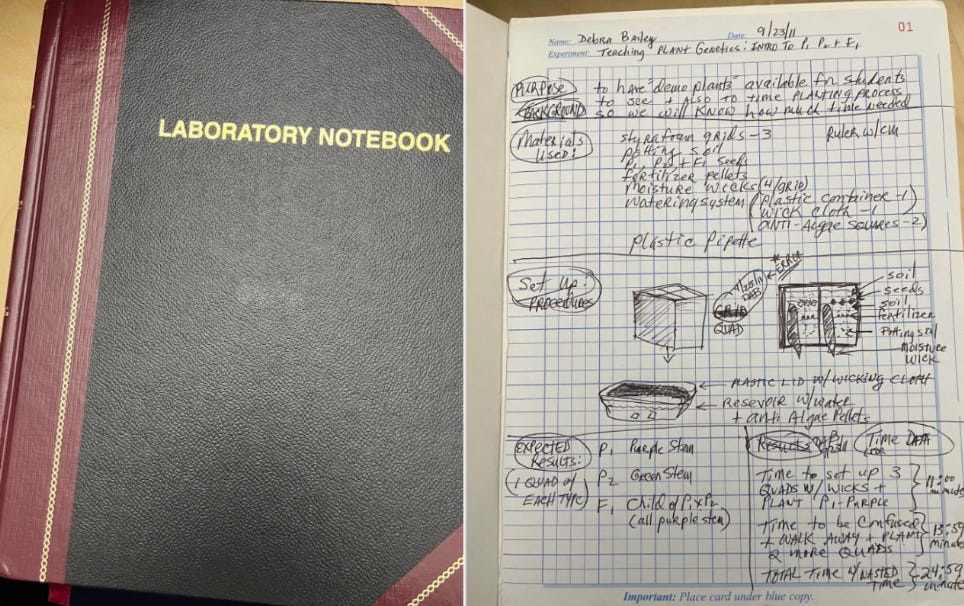
Given my background as a laboratory technologist, science researcher, and then science teacher, I know you can’t do an experiment well without a plan.
So, like that good science-tech-turned-writer, I have researched my ideas, made my lists of risks and benefits for writing, and explored the natures of truth, memory, and courage.
And, like for any good experiment, I have written up “the protocol” — the list of rules for how this particular “experiment” will be done.
Or plain and simple, these are my “line-in-the-sand” rules for what I will and won’t do in this book.
came in a shift of knowing when even her fondest sureties faded away. it was the summer she understood that she had not understood and was not mistress even of her own off eye, then the man escaped throwing away his tie and the children grew legs and started walking and she could see the peril of an unexamined life. she closed her eyes, afraid to look for her authenticity but the light insists on itself in the world; a voice from the nondead past started talking, she closed her ears and it spelled out in her hand “you might as well answer the door, my child, the truth is furiously knocking.” Lucille Clifton
About the nature of fear
Painting by author
Carl Jung said that “…what you resist not only persists, but will grow in size.” I would add a P.S. to that…truth will hunt you down until there is no escape.
And even if you try, it will never really let you go. It will just come out in other forms. Like the truth in Lucille Clifton’s poem that is “furiously knocking,” mine, too, is relentless and so I “might as well answer the door.”
What is courage?
There are all different circumstances we can encounter that require…or at least invite us to show courage. But what exactly is it?
“You too are driven by the desire to understand, know…beneath your desire for knowledge writhes the hunger to understand and love yourself.” Gloria E. Anzaldúa’s essay: “now let us shift…the path of conocimiento…inner work, public acts,” in This Bridge We Call Home
Time Passages…
It all started with Al Stewart’s song, “Time Passages,” on the radio. It’s a mellow song that I have heard thousands of times and always enjoy.
On this particular day, the melody and lyrics drifted through the background of my consciousness as I drove along. As usual, I hummed along with some of the familiar words about memories and escapes into the past. But this time, one particular line smacked me with a recognition I’d never had before – the line about things left behind.
Like a lone dancer on a dark stage suddenly framed in a brilliant white-hot spotlight, those words flashed in my brain. Things left behind. THAT’S what this has been about.
“Becoming the author of your story is about claiming the power to define what something means and to take charge of the ways your life events impact you and influence how you move forward…the power is in you to shape how you will live…The power is in the stories you tell to encourage you to take the next risk, to make the next move, to keep saying yes to life.” Sandra Marinella, MA, MEd, The Story You Need To Tell: Writing to Heal From Trauma, Illness, or Loss
Why write?
The world asks, “Why write?”
And the writers answer:
“Avoiding a secret subject can be its own kind of bondage.” Melissa Febos, in Body Work: The Radical Power of Personal Narrative
There is no greater agony than bearing an untold story inside you.” Maya Angelou, I Know Why the Caged Bird Sings
“A story untold could be the one that kills you.” Pat Conroy
But then the world asks, again, “Why write?” as if you never answered.
Which makes me ask, “Didn’t you hear the writers’ answers?”
However, after seeing this go on for years, my mind finally understands: They did. They just didn’t like the answer. So they keep asking. And, besides, “Why write?” was not really a question anyway.
sometimes they ask me to remember but they want me to remember their memories and i keep on remembering mine
Lucille Clifton, from her book, The Collected Poems of Lucille Clifton 1965-2010, 1987, pg 262
So what DO we put in a memoir?
It takes a lot more thought than just penning a bunch of trauma memories.
Of course, I use my memories, the ones that I have. But do I remember everything correctly? Completely? There have been moments when I think my memory is great. Then I find a journal entry that had even more details than I remembered, and it makes me question how good my memory actually is, even as I’ve carried that image my whole life.
Then, there is truth. We tell something, and we are sure we are accurate. Our intention is honorable, Yet, how often have we heard, “That’s not the way I remember it!” In that moment, anyone listening is wondering, Who is telling the truth? How can they know for sure? For that matter, are we really clear on our intentions?
And then, there is “humanity” in writing. Do we answer the siren call of being true to the art even if it means causing harm to another? Or betrays someone’s privacy?
When I don’t know what to do, I do what I do best – research the hell out of it. I look around for the widest range of answers from experts before I decide what my own path will be.
So I spent the better part of a year reading over twenty books on how to write a memoir, seeking the “Holy Grail” of answers to these questions.
In this post, I’ll share several things I discovered from the many thoughts and opinions I found, things I then had to “chew on” to decide if the advice rang true for me. In an upcoming post, I will share “My Conclusions” for my own approach to what and how to write a memoir.
The nature of memory
“Rubens discovered a peculiar thing: Memory does not make films, it makes photographs.” Milan Kundera, Immortality
One thing I learned about memory is that it is often pretty good around the moments of intense trauma. I REMEMBER being held against a wall by my throat. I REMEMBER how taut my nerves were when he would come at me verbally and physically. But could I tell you what happened immediately before the incident? Or right after? Or later that afternoon? No. But that moment? Absolutely. So, memory is often snapshots of a spot in time.
And what about those moments when our memory differs from that of another about a shared incident? What do you do? Whose memory do you trust?
I love words. Discovering new ones. Sounding them out. Finding out where they originally came from. How their meaning evolved over time.
As a kid, I used to spend summer afternoons reading both the dictionary and Roget’s Thesaurus. Yes, truly. I read them…of my own choice. Another one of my Moments of Respite.
It was just fascinating to find so many meanings for one word, and so many words for one meaning. Then there were all the different ways you could alter words — nouns, adjectives, verbs. And best of all, deciphering the code of odd characters for accents, hyphenations, and pronunciations.
As an unexpected twist of fate, that activity served me well later on, as, at one point in my writing career, I was a freelance lexicographer: I helped write and edit a dictionary and a thesaurus. I made sure every possible nuance of meaning, cultural reference, and usage was there for each word, and that every detail of origin and pronunciation was correct. I couldn’t believe I was being paid to “meet words and learn their life stories!”
So it is no surprise that for this memoir, I have a list of “power words.” They are words that prompt deep reflection on my life, Words that evoke strong emotions. Words that best describe the images in my head, and the depths of my spirituality. And they provide abundant “prompts” for my journaling and this book.
And that is just in English.
Behold!
I also have books now on Hebrew words. Their pronunciations and how to write them in both Hebrew and English fonts. Their root origins, the multiple ways they can be interpreted, and… most importantly… how they connect with my soul’s power in using them. When I write them and form the curves and lines with the pen, I FEEL their power. Especially this one: